
 14 hours ago
2
14 hours ago
2

Published Mar 17, 2026, 12:00 PM EDT
Chris Perkins reflects on D&D's most famous vampire for Curse of Strahd's 10th anniversary
 Image: Wizards of the Coast
“The story of villains is much more entertaining than the story of heroes, because monsters are not born, they are made,” an apocryphal quote attributed to Frankenstein author Mary Shelley says. While heroes are often born to a great destiny, the best villain stories are usually about a fall from grace. We can all relate to tragedy in some way, and this is what makes these characters so compelling.
If you are a Dungeon Master about to run Dungeons & Dragons’ best-selling adventure, Curse of Strahd, you want to pull all the tricks to make sure that your players do not sympathize with the charismatic villain at the center of it all: Strahd von Zarovich. According to the adventure’s principal designer, Chris Perkins, Strahd is an ultimately irredeemable villain, and he should remain so. After all, Strahd murdered his brother and his wife out of jealousy, turned a literal angel into Doctor Moreau, and exterminated his own worshipers out of boredom. And the list goes on.
When Curse of Strahd was released 10 years ago, Perkins and Tracy Hickman, who authored the original Ravenloft module published in 1983, made it clear in interviews that the big, bad vampire is unmistakably evil. This stance may surprise modern fans living in a post-Twilight era, but in a video interview with Polygon, talking about Curse of Strahd’s enduring legacy, Perkins confirmed he stands by the choice. “In the original Ravenloft, Strahd is irredeemably evil, and you don't feel bad about killing him, nor should you, because that's the whole point of the adventure,” Perkins said. For D&D’s former chief creative, the most important thing was to reinforce the original portrayal of the villain as “an irredeemable predator monster.”
 Image: Wizards of the Coast/Clyde Caldwell
Having clearly defined boundaries between good and evil is surely one of the charms of classic D&D. The real world is too often painted in shades of gray, but once you step into this fantasy realm, things become refreshingly simpler: monsters are evil, and you’re supposed to slay them. However, things have changed over time, and understandably so. Modern sensibilities require nuance, and the concepts of good and evil have become more flexible, even in D&D. If Curse of Strahd were to be written today, would Perkins change the portrayal of the villain? His answer is as clear as it can be. “No,” Perkins said. “I feel pretty strongly that you have to be faithful to the original. Otherwise, create something new. If you want to create a sympathetic villain, create a new sympathetic villain. Doing something that fundamentally different means Strahd is no longer Strahd.”
It’s hard to argue with this. Accusations of being a monolithic character fall flat against Strahd’s enduring claim as one of D&D’s most famous characters. “You can't tell me that he is not interesting, because he is by far D&D’s number one villain,” Perkins said. “And I think the clarity of villain equals evil is easy for a lot of people to grok. It may not be realistic, but then vampires aren't realistic, so he doesn't have to kowtow to human sensibilities.” Still, while Strahd might look like a classic monster, he was pretty revolutionary for his time.
Strahd is at once both familiar and unpredictable. He’s magically bound to a Domain of Dread called Barovia, but the players don’t know exactly when or where he’ll show up (except for his location provided by the Tarot-like reading with a Tarokka deck). Hickman created Strahd to be the opposite of the classic D&D monster who sits in a dungeon room, waiting for the party to show up. He has goals, agency, and a checkered past for players to discover.
 In a preview of D&D's roadmap for 2026, Wizards of the Coast shared this look inside the upcoming Ravenloft: The Horrors Within.Image: Wizards of the Coast
However, while Strahd’s history is important, it doesn’t open a window for players to empathize with him. He is not Coppola’s Dracula, who turns to the dark powers after finding out his beloved wife has been tricked into committing suicide. Strahd kills the woman he loves (or rather, obsesses over), Tatyana, and his brother due to jealousy. He turns to the Dark Powers of the Shadowfell because he’s afraid of growing old and losing his power and prestige. Over the centuries, Strahd keeps falling for countless women who remind him of Tatyana, but it’s a selfish pursuit rather than a tragic love story. He remains a monster until the end, unlike Dracula, who is often painted as a tragic romantic character by giving him a chance for redemption, even if dim.
That doesn’t mean, however, that players will be immune to the vampire’s charm. When I ran Curse of Strahd, one of my players toyed with the idea of becoming Strahd’s next wife. In the end, she chose her companions over becoming Strahd’s next discarded toy (you meet a number of Strahd's undead wives while exploring his castle), but that dynamic added a lot of tension and fun to the campaign. The adventure also gives you a chance to gain a better understanding of the vampire and what led to his downfall.
The Amber Temple is one of the many areas added to Curse of Strahd that were not in the original Ravenloft. It’s a real meatgrinder dungeon that can wipe out even an experienced party, but its most interesting feature is the amber sarcophagi containing the vestiges of malevolent entities that can grant dark powers to whoever touches them. However, this usually comes at a great price. Perkins said this was Tracy Hickman’s idea, based on a visit to the fabled Russian Amber Room. The amber sarcophagi in the temple let players experience the same temptation that turned Strahd into a vampire and trapped Barovia in the mists.
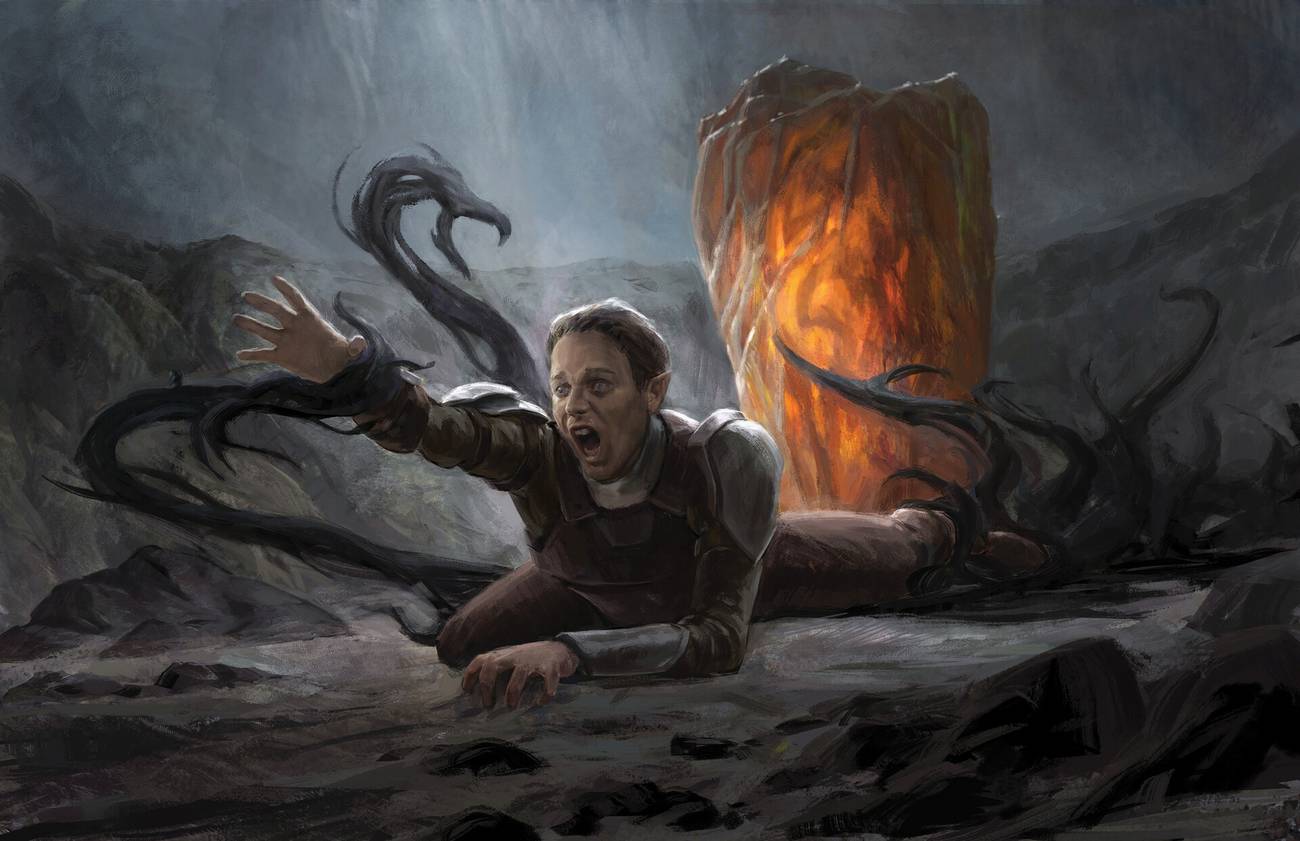 Image: Wizards of the Coast/Sam Keiser
Accepting the “dark gift” from a sarcophagus bestows a sinister physical trait or personality flaw on the character and may cause their alignment to change to evil. This being D&D, you can’t really expect players not to touch these things. My group went into the Amber Temple looking like a perfectly normal party — but then came out as a motley crew of weird monsters with severe personality issues. “It addresses the gothic theme of temptation,” Perkins said. “The goal was letting the players taste that for themselves. It might not give them sympathy for Strahd, but at least now they understand what temptation can do to him as well as them.”
Strahd’s enduring popularity is in part tied to Ravenloft and Curse of Strahd being exceptional adventures that defined eras of D&D. However, Strahd himself stands out as a villain you can feel justified — and satisfied — in hating. It reminds players of simpler times when good was good and evil had visible fangs and drank young women’s blood. Despite this, Strahd’s story is still relatable because it’s built around power, greed, and jealousy, which are all deeply human themes. “I don't see Strahd as mine,” Perkins said. “I don't see Ravenloft as mine, but I feel like Barovia is a place that I was welcome to play in. I had fun while I was there. And as we said, Strahd is D&D's number one villain. So I would fully expect at some point to see a revision of Curse of Strahd.”
With D&D 5.5’s Season of Horrors and a new Ravenloft sourcebook coming in 2026, I wonder whether Strahd will stand the test of time or be forced to adapt.





 English (US) ·