
United Artists
We may receive a commission on purchases made from links.
In 1976, John Wayne made his final movie. "The Shootist" was, fittingly, a Western in which its star — a titan of the genre — perished in the final minutes, having dissuaded a young Ron Howard from embracing a life of violence. This was a major change from the book on which the film was based, resulting in Wayne's character dying in a way more befitting his image as an honorable, essentially moral figure. For Clint Eastwood, however, the whole thing was just "cruel."
It's well known that Clint Eastwood and John Wayne had a long-running feud. What many fans might not be aware of, however, are the more conciliatory moments in the Eastwood/Wayne story. In Scott Eyman's "John Wayne: The Life and Legend," the author notes how, while hurling invective at director Sam Peckinpah for his violent films (Wayne hated Peckinpah's controversial "The Wild Bunch" for its violence), Wayne allowed himself a moment of vague positivity when speaking about his younger rival. "I think Eastwood has a chance," said the Duke of the "Dirty Harry" star's acting abilities.
Aside from Wayne telling Eastwood that they should make a movie together upon their first meeting, that was about as warm and friendly as things got between the two icons of cinema. Otherwise, things often got outright hostile — appropriate considering the unmade movie that would have starred the pair was set to be called "The Hostiles." Even after the Duke passed away in June 1979, Eastwood continued to express his dislike for aspects of the late actor's career. It was during one such time that "The Shootist" came under fire.
Clint Eastwood didn't understand the villains of The Shootist
Paramount Pictures
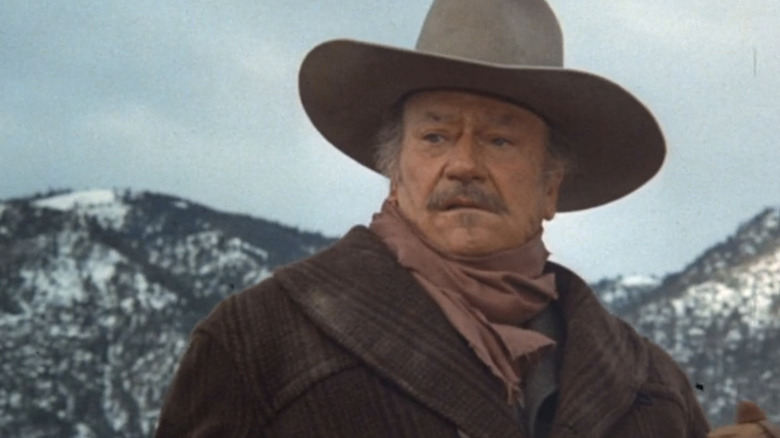
"The Shootist" sees John Wayne play aging gunfighter J. B. Books, who's diagnosed with terminal cancer. After settling into a boarding house, Books meets the owner's young son, Gillom Rogers (Ron Howard), who quickly takes a liking to his new guest. Books later arranges for three men to meet him at the Metropole saloon on a specific date. Outlaw Mike Sweeney (Richard Boone), card dealer Jack Pulford (Hugh O'Brian), and Gillom's boss Jay Cobb (Bill McKinney) all have violent pasts, which is apparently all Books needs to set them up. When they all congregate at the Metropole, Wayne's gunslinger takes them all down, before he's shot in the back by the bartender. Gillom arrives and kills the bartender, before immediately tossing the gun aside in a moment designed to symbolize his rejection of violence, putting a smile on Books' face before he passes.
Wayne fought a constant battle behind the scenes of "The Shootist," primarily to implement changes that aligned the film with his legacy. In the book, for example, Gillom kills Books and revels in the violence. Wayne wasn't having it. But according to Eastwood, such changes were futile when the film was already cruel.
In "Conversations with Clint: Paul Nelson's Lost Interviews with Clint Eastwood, 1979-1983," neither the actor nor the journalist seemed to like "The Shootist." In Eastwood's case, it came down to the fact that Wayne's character had essentially set up three men to die for no reason. "I didn't read the book, so I don't know whether it's in there anyway," he said. "But I didn't understand why they invented a scene about these villains who are never set up to have really done anything wrong, and he kills them."
Clint Eastwood thought The Shootist was needlessly cruel
Paramount Pictures
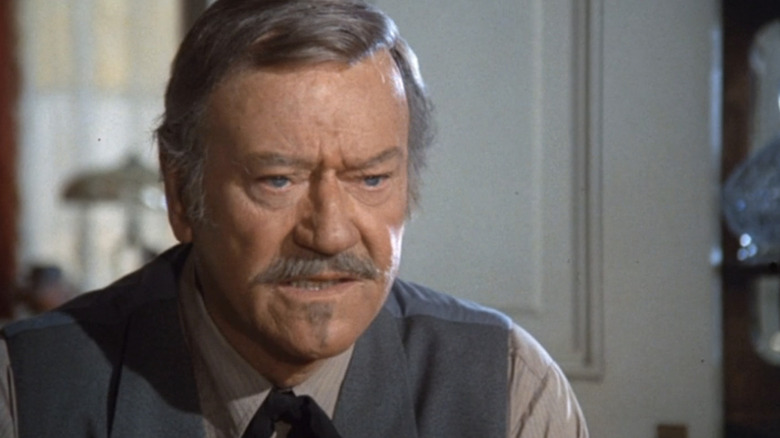
"The Shootist" showed Ron Howard how much of an artist John Wayne could be. Apparently, it also proved to Eastwood that Wayne's moviemaking impulses weren't always to be trusted. The Duke had essentially made it so that Gillom Rogers rejects violence, but only after three men had, in Eastwood's view, already been unjustifiably killed. As Paul Nelson put it, "[Wayne] sets those guys up to be his executioners so he can die with a gun in his hand, I guess," to which Eastwood replied, "That is kind of cruel. I mean, what happens if everybody who is sick just went out and killed somebody else on the freeway?"
Interestingly enough, "The Shootist" was one of the few times Eastwood and Wayne came face-to-face, with the former visiting the set where he was photographed next to a smiling Duke Morrison. The film was also directed by Don Siegel, a frequent Eastwood collaborator who oversaw his seminal but controversial 1971 crime thriller "Dirty Harry." The director and Eastwood didn't always see eye to eye, but generally maintained a productive relationship. Wayne and Siegel, however, clashed from the outset, with the screen legend pushing back against his director's vision on multiple occasions, most famously over shooting someone in the back — an act the great John Wayne found repulsive.
Perhaps, then, Wayne and Siegel's friction played into Eastwood's negative view of "The Shootist." Or, perhaps it was the more than a decade of friction between the two actors. Or maybe Eastwood genuinely didn't like the movie's plot. That said, the "Fistful of Dollars" star often seemed to downplay what was, at times, a fairly heated feud between the two, one that likely wouldn't allow Eastwood to ever be fully positive about his formidable forebear.
 English (US) ·