
 3 hours ago
8
3 hours ago
8
For a man whose campaign slogan was once “Keep it real”, Ali G has his work cut out in the reality of 2026. The big dog of Da West Staines Massiv was the character with whom Sacha Baron Cohen carved out his own niche of gonzo-gotcha comedy in the late 1990s – and now he’s back with new film, Ali G: Who Iz I? But it’s unclear if his great creation has gone sufficiently fallow in the collective consciousness to still operate well in real-life situations, the kind of lethal idiot who once pitched Donald Trump anti-drip ice-cream gloves. And more critically, is the Ali G satirical project – which poked at 90s multicultural mores – still relevant and funny in far more rancorous times?
It’s not just Baron Cohen’s career as an undercover operative that’s on the line. It’s the future of character-led comedy as a going concern, now that he seems to be the last man standing in this once-noble tradition – in cinemas, at least. To be clear, character comedy isn’t merely comedy with characters; it’s comedy filtered through a central persona that overlaps with the comedian playing it and whose subversive sensibility colours the entire work.
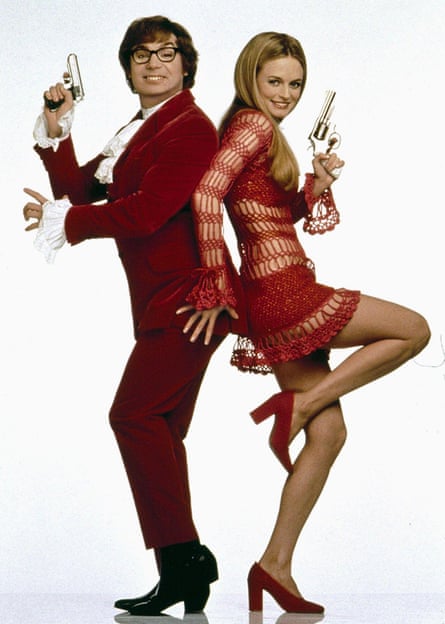
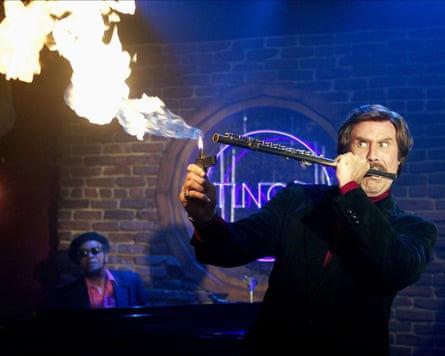
Mike Myers’ swinging London exile Austin Powers was the most commercially successful example – but the actor hasn’t made a film in that first-person style since his self-help spoof The Love Guru tanked in 2008. Will Ferrell, ruling the roost as fashion’s Dr Evil, Mugatu (in Zoolander), Buddy the Elf and Ron Burgundy, seemed the best successor. Mystifyingly, though, Ferrell has barely been able to get a film bankrolled in the last decade – and certainly not one putting him out front to that extent. Character comedy subsists on TV, from where it came, with the likes of Alan Partridge and Philomena Cunk. But unless the new Ali G can blaze a fresh hit of chronic satire into the genre’s bloodstream, it’s hard to see a future for it on the big screen.
Ali G was already controversial back in the day: the regular accusation was that while he was satirising the white appropriation of black culture, he in fact enabled straight lampooning of the latter. Now those criticisms are sharpened by the notion that, in 2026, he is past his sell-by date: both out of step with a more culturally mixed Britain and, overflowing with bifter gags and mad patois, dangerously adjacent to racist caricature that won’t pass these days. British standup comedian Dane Baptiste recently told Deadline: “After Black Lives Matter and the brief humanisation of black people and black creatives, it seems very dubious that we are now regressing back, not just five years, but 25 years, to bring back a character that was able to flourish because there were no accurate portrayals of black Britishness on screen.”
But it would be a shock if Baron Cohen wasn’t wise to the current sensitivities. In 2020’s Borat Subsequent Moviefilm, he mostly successfully updated the Kazakhstan reporter for the post-truth, Covid-era end times of Trump’s US. His choice of target interviewees in Who Iz I? remains to be seen, but it would be surprising if he didn’t pick a few where he can opportunistically needle both woke and anti-woke camps.
These debates are tricky ones, on cultural shifting sands, and Baron Cohen undeniably skirts close to reactionary goading at times (the fact that dumb Americans might actually believe Kazakhstan is that backward doesn’t escape the fact he’s propagating the idea it’s a potassium-, incest- and antisemitism-crazed shithole). But if the new Ali G film does fall foul of the post-Black Lives Matter climate, it’ll be hard not to also conclude that our splintered, fractious era lacks the unity – or at least consensus – that makes character comedy possible at all. To a large extent, audiences have to agree on the social phenomena these big satirical beasts feed off. In the late 90s, black street culture was sufficiently new and prominent a force in the UK mainstream to make this crip-sign-throwing buffoon a direct hit.
There’s no reason why character comedy can’t thrive off societal shifts, though – if the character is positioned carefully enough. In fact, this is how it originally manufactured tension, with the likes of Charlie Chaplin’s Tramp getting fed through the mangler of industrialised capitalism in Modern Times. Or Peter Sellers playing both old establishment nabob Sir John Kennaway and the trade union firebrand Fred Kite in 1959’s labour-relations satire I’m All Right Jack. With postwar Britain evolving rapidly, Tony Hancock picked up the baton in 1961’s The Rebel, both surfing and sending up boho nonconformism in his role as an accidentally successful avant garde artist. Alan Partridge’s long slide into local radio-bound insignificance has only attained glorious new parallels in the post-Brexit era.
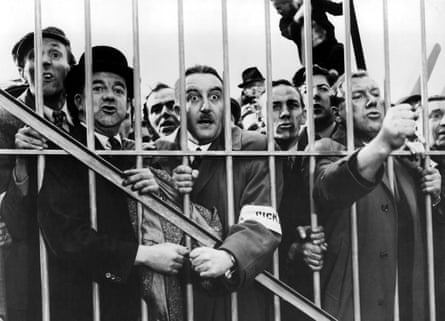
Another reason why character comedy may have fallen from favour is its vaudevillian strut, a very human theatricality that seems old-fashioned in an age of frictionless CGI blockbusters. It revels in transformation and disguise (Baron Cohen now, of course, being so famous he has to layer on disguises on top of his original disguises – hence the new Rasta Ali G). The genre often compounds this ludic chaos by having its stars play multiple roles, as Sellers, Eddie Murphy and Mike Myers love to do.
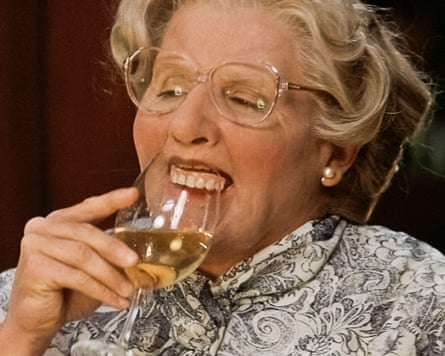
Somehow this protean fun allows the presiding comic genius’s essential quality to pierce through all the more clearly: in Sellers’ case, a kind of unnerving mildness that could transmute into mania, or Myers’ cheeky puerility. Mrs Doubtfire, from 1993, is one of the most revelatory uses of this ventriloquist effect. Another persona that the film’s divorced voiceover artist adopts in order to see his children more often, the Scottish nanny is really a conduit for the sentimental streak that underpinned much of Robin Williams’s work. And like the theatre, you can see the tactile human continuity between character comedy’s practitioners: Myers has often talked about his admiration for Sellers’ chameleonic powers. Dr Evil’s “one million dollars” faux pas is a lift of a similar gag near the end of Sellers’ 1959 geopolitics satire The Mouse That Roared.
By 2002, when Myers was doing silhouette gags about giving birth to Mini-Me in Austin Powers: Goldmember, this vaudevillian style was looking passe. With The Lord of the Rings and Harry Potter in full pomp, blockbuster film was firmly in the CGI era; comedy had moved on, too, to the edgier Frat Pack films and the realism of Judd Apatow.
But perhaps character comedy had also lost strong moorings by this point, with social comment largely absent from the genre since the 1980s. Instead, Austin Powers was an extended riff on 60s and 90s pop-cultural overlaps and discrepancies (Jean Dujardin did something similar in his later OSS-117 series), while Eddie Murphy’s multi-character outings The Nutty Professor and Norbit seemed largely there to prop up the fat-suit industry. Only Will Ferrell – via his blowhard news anchor Burgundy, but also in his general screen persona in ensemble work such as Wedding Crashers, Step Brothers and Talladega Nights – embodied a type that spoke clearly for the times: the arrested manchild.
That all changed the moment Borat and his wobbling producer Azamat Bagatov landed in New York in 2006. By injecting Borat with a raw hit of the reality format incubated on The 11 O’Clock Show and Da Ali G Show, Baron Cohen completely revitalised big-screen character comedy. Suddenly, it became thrillingly politicised as his sublimely ignorant aliases, Borat and in 2009 Brüno, flushed out American and Middle Eastern absurdities and prejudices. Not to mention the high-wire aspect of his escapades: Baron Cohen was somehow impervious to whatever peril he stirred up, whether that was desecrating the Star-Spangled Banner at a rodeo in Borat, or an interpretation of mano-a-mano quite different to what cage fighting audiences were expecting in Brüno. His gleeful brazenness was the signature quality that shone through.
But Ali G has been dormant a long time. His last big-screen outing, 2002’s hit-and-miss Ali G Indahouse, was a very different, fully scripted endeavour. Beyond a gag about mistaking a pregnancy test for a vape, the trailer for Ali G: Who Iz I? doesn’t give much away about how sharply the character’s been updated; judging by the small-penis outro, some things are undying.
Staines’s favourite son will need to pull more out of his XXXXXL puffa. Only the current culture wars – police violence, colonialism, cultural appropriation – can supply him with appropriately charged material that he can “booyakasha” his way through. Anything less, and the character’s age will show, and the once-cutting posturing and patois will seem less than ironic. Which would be a bad thing for character comedy – then the mask really will have slipped.






 English (US) ·