
 3 weeks ago
25
3 weeks ago
25

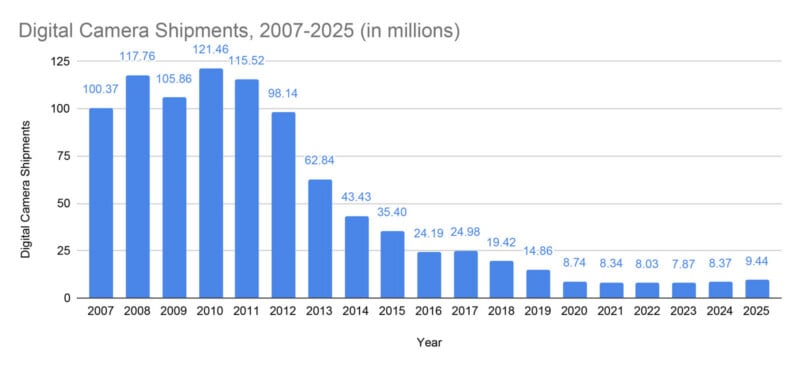
The Camera & Imaging Products Association (CIPA) has released its detailed stats for global digital camera and interchangeable lens production and shipments in 2025, and both digital camera and lens shipments were higher in 2025 than in 2024, which was the first year since 2017 that digital camera shipments increased.
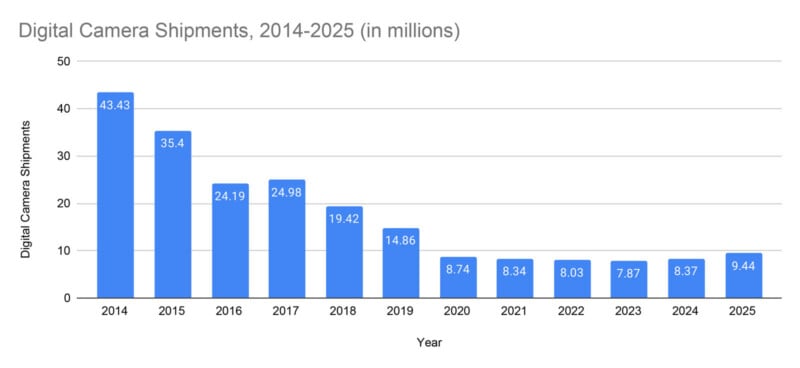
Before 2024, total worldwide digital camera shipments had steadily decreased every year since 2017, dropping from 24.98 million in 2017 to 7.87 million in 2023, a low watermark for the digital camera industry. In 2024, digital camera shipments increased to 8.37 million. Last year, digital camera shipments hit 9.44 million units, the highest total since the COVID-19 pandemic. Further, although comparable data goes back only to 2007, this was, coincidentally, the last time that digital camera shipments increased in consecutive years.

CIPA data breaks down digital camera production and shipments by camera type, including interchangeable lens cameras (SLR and mirrorless) and cameras with built-in lenses. Compact cameras, or cameras with built-in lenses, were a significant driver of the increased camera shipments in 2025.
In 2024, Japanese camera manufacturers, which include all the major players except Leica and Hasselblad, produced 1.88 million cameras with built-in lenses, shipping nearly all of them to retailers worldwide. Last year, that number surged to 2.32 million units produced and 2.44 million shipped, meaning that manufacturers had to dip into their inventory to meet demand, and even that wasn’t enough, as many of the most popular models are routinely sold out. That’s a roughly 30% year-over-year increase in compact camera shipments, which is huge in an industry where numbers have generally been declining over the past decade.
As for interchangeable lens cameras, unsurprisingly, DSLR camera production and shipments continue to fall. There were 690,911 DSLRs shipped in 2025, down from 997,608 in 2024. The death spiral of the DSLR continues.


Mirrorless interchangeable lens camera production increased from nearly 5.5 million units in 2024 to 6.1 million in 2025, while shipments increased from 5.6 to 6.3 million. While not as stark an increase as the one in compact camera shipments, this is still very healthy growth in the mirrorless space that, fortunately, outpaces the dip in DSLR shipments by a decent margin.
It is always fascinating to look at the sensor sizes of the cameras being shipped around the world. In 2025, both full-frame production and shipments decreased from 2024, reaching 98.4% of 2024’s total. This slight dip was more than offset by crop-frame camera shipments, including APS-C and Micro Four Thirds models. These cameras hit 109.3% of 2024’s metrics last year, a healthy bump.
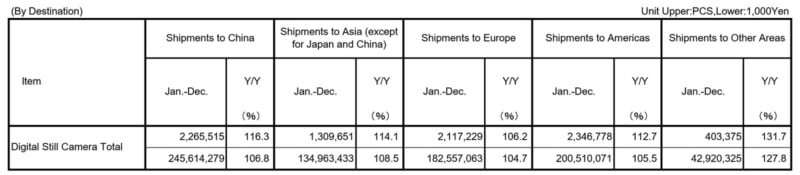
Total digital camera shipments to all regions increased last year, with the largest year-over-year increase occurring in China. This tracks with mid-year data PetaPixel reported in August, which showed China being the world’s largest photography market thus far in 2025. While China ultimately ceded that position to the Americas by the end of the year, it remained the world’s fastest-growing photography market, a trend PetaPixel expects to continue.
It is worth noting that all these positive signs of growth in the digital camera industry arose in a year marred by geopolitical conflict, economic uncertainty, and polarizing and potentially illegal U.S. tariff policy, which made photography, an already expensive and relatively inaccessible hobby, even pricier to Americans, a hugely important market for every camera manufacturer. This is now two straight years of increased digital camera shipments after many years of decreases. Will this resurgent pattern continue in 2026?
Image credits: Header photo created using an asset licensed via Depositphotos. Data by CIPA.





![20 Years Later, One of the Best Sitcoms of the 21st Century Returns With Hilarious First Look [Exclusive]](https://static0.colliderimages.com/wordpress/wp-content/uploads/2026/02/malcolm-in-the-middle-life-s-still-unfair-feature.jpg?w=1600&h=900&fit=crop)

 English (US) ·