
 4 hours ago
5
4 hours ago
5
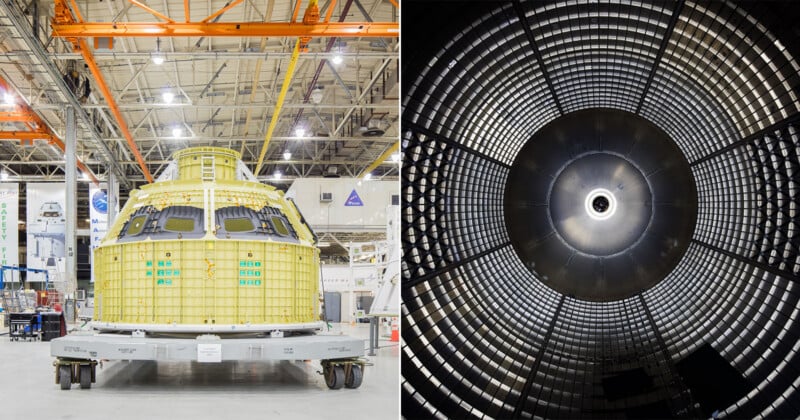
Professional architectural photographer Mike Kelley has achieved extensive commercial success but has remained dedicated to personal artistic projects as well. These personal projects have often been the ones to lead to Kelley’s “craziest opportunities,” including one that took him to NASA’s Michoud Assembly Facility to photograph the Orion crew capsule and SLS rocket that just last week carried four brave Artemis II astronauts into space to orbit the Moon.
Kelley says he originally shot these photographs way back in 2018, illustrating just how long major space exploration missions take from start to finish. The Artemis program traces its lineage back to the Constellation project canceled over 20 years ago.
“NASA selected a handful of photographers to come put their spin on the in-progress assembly of the spacecraft, and I was luckily one of the chosen photographers,” Kelley tells PetaPixel about his trip to the Michoud Assembly Facility in New Orleans, Louisiana, in 2018.
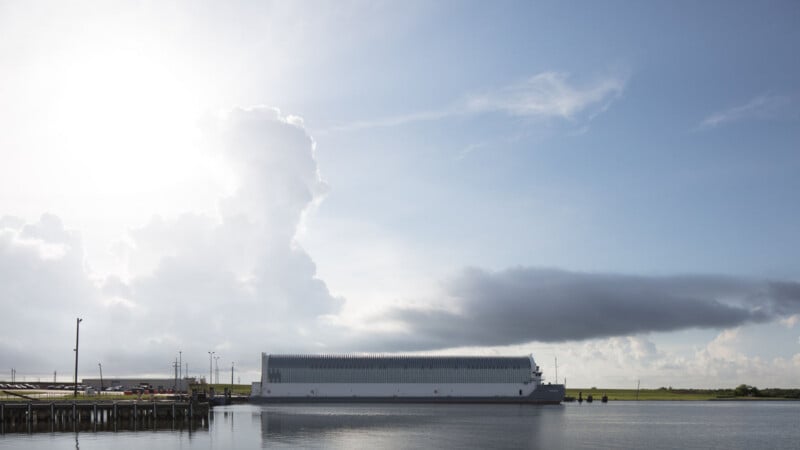
“This came right on the heels of my Airportraits project so my name had been in the press a bit at the time thanks to the virality of that one. It seems most of my career’s craziest opportunities have come from someone saying ‘Hh, yeah, you did that viral project about (fill in the blank) — wanna come shoot our (object/building/project)?’ Since then, a lot has changed in the media landscape as you know! Virality is totally different now.”
Kelley is an extremely accomplished and experienced architectural photographer, so he approached NASA’s spacecraft fabrication facility as he would any other building, even though it is fundamentally a very different type of place than a luxury home overlooking Los Angeles or a new, modern museum.
“I tried to just do what I do (photograph architecture!) here and not try to reinvent the wheel or my process — not succumbing to pressure to shoot a different way just because the subject is different than what’s normally in front of my lens,” Kelley explains.
That said, there was a more documentary angle to the project. There’s a story behind the structure and what the people there were building, which Kelley worked hard to incorporate into his photos.
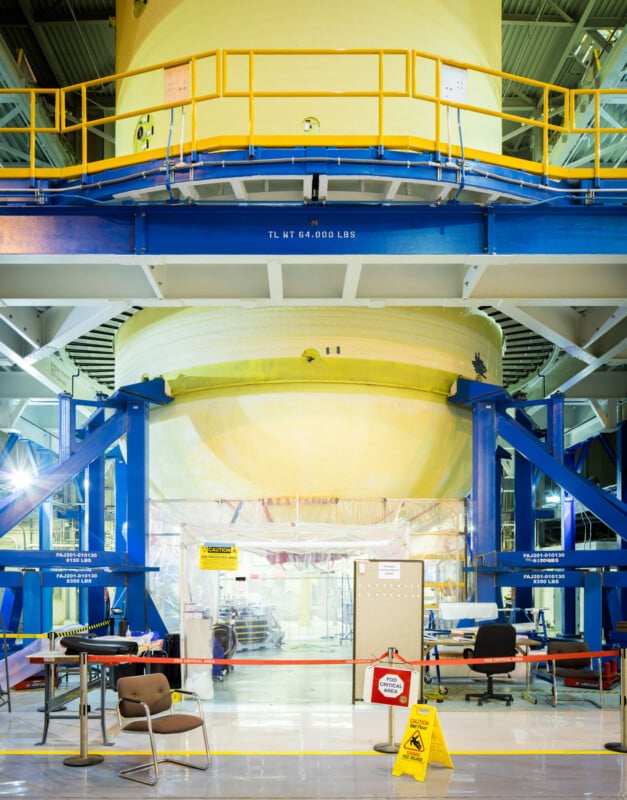
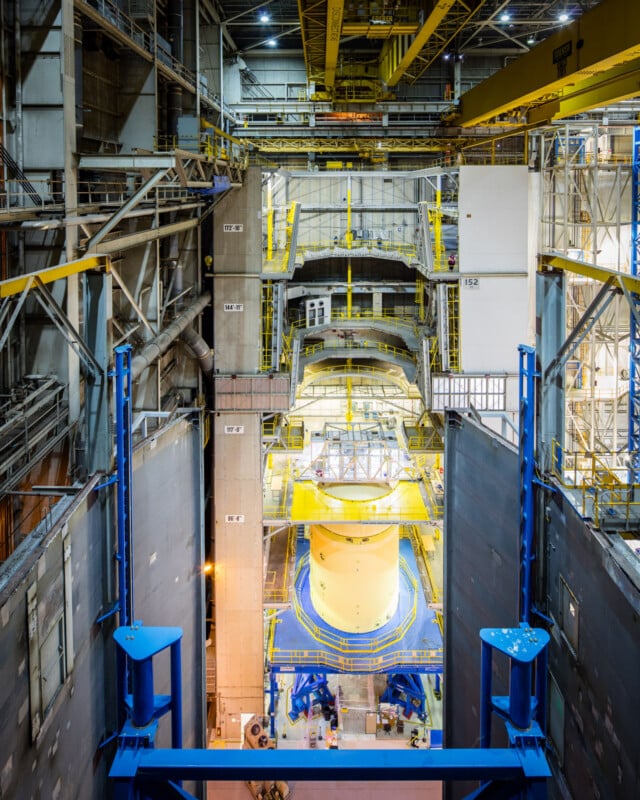
“It’s actually fairly rare for things like this to be approached from a more rigorous architectural documentation standpoint — I was very cognizant to try to show correct scale, line, form, etc, instead of just pointing the camera at something cool. I wanted to show how the Artemis project was actually being built in some of these buildings — which are absolutely huge — and pulling back and showing a bit of context is integral to that,” the photographer says.
For Kelley, it was also an exciting opportunity from an emotional perspective. Given his very successful “Airportraits” project, it is of little surprise that the photographer has a soft spot for all things aviation, even if he admits he’s more into planes than space ships.
“As a child of the 90s, I grew up with the Space Shuttle front and center — as did many other kids. I can’t say that I’m obsessed with it like I am with architecture or commercial aviation, but I think that would change if there was more of it in our lives,” Kelley says.
“NASA was such an inspirational force while the shuttle was in operation, I’m hoping that with our return to the Moon and beyond that it becomes something we are all rooting for again. I’ve always had a background interest in this kind of stuff — playing some Kerbal Space Program and watching SpaceX launches and that kind of thing — but I’m really excited to see if NASA can suck us all back in like we were back when we were growing up with it! No pressure!”
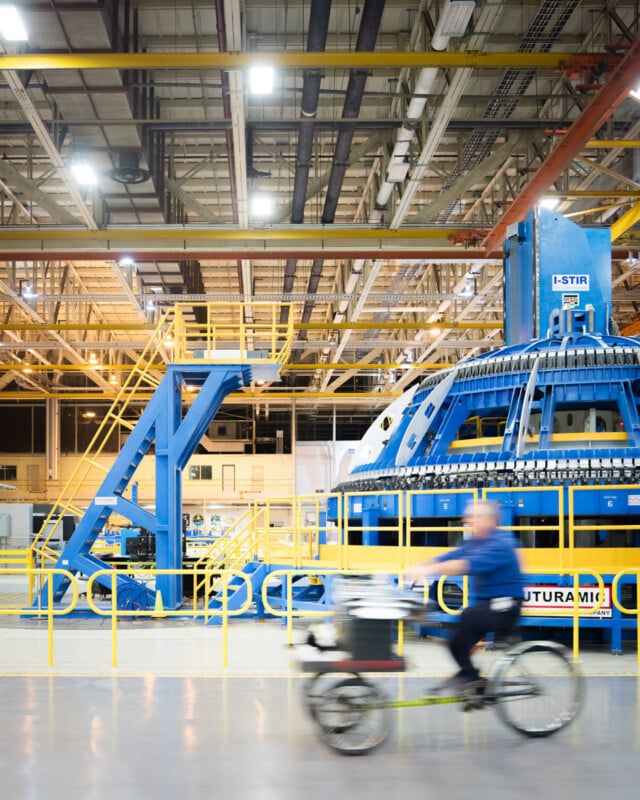

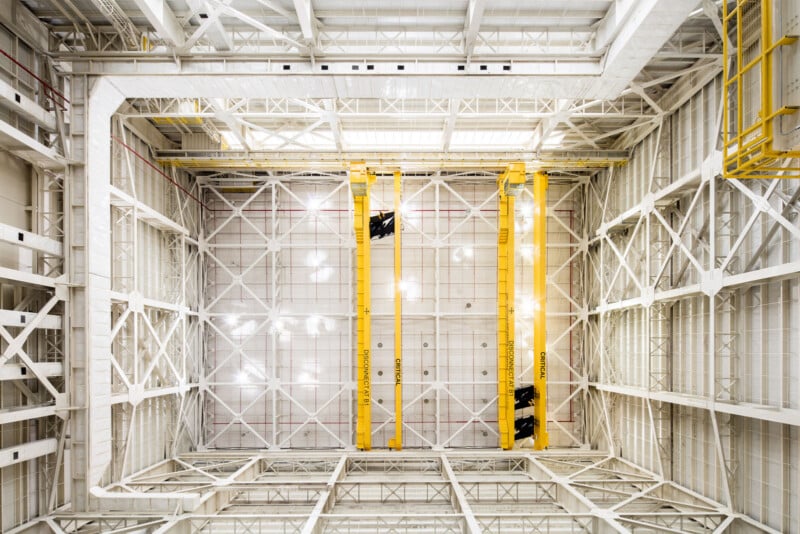
As Kelley said on social media over the weekend, it was also very exciting for him to see the parts he photographed many years ago as they were being built launch people into space last week. As evidenced by how much Kelley remembers of his 2018 visit to the Michoud Assembly Facility, his experience there has stuck with him.
“So cool to see these pieces absolutely soar off the launch pad with four crew perched inside the capsule on top of those massive rocket motors,” Kelley wrote on Instagram.
He tells PetaPixel that he had to pull over on the side of the 101 freeway on his way to a shoot last Wednesday, April 1, to watch the Artemis II launch on his phone.
“Probably not the safest move but better than watching while driving,” Kelley says. “It was also quite an adrenaline rush knowing that this was all fairly new tech, with actual people inside — what a relief to see them get through Max-Q and into orbit without much drama (toilet notwithstanding!)”
Back in 2018, Kelley says he took all his photos at the NASA Michoud Assembly Facility using Canon tilt-shift lenses on his Canon EOS 5DSR DSLR, which remains, to this day, Canon’s highest-resolution camera. Kelley calls it “the best camera ever made for photographing architecture.”
“These are all done on either a 17mm or 24mm Canon tilt-shift lens. Crazily enough a lot were actually handheld because I was up in the catwalk or literally inside a fuel tank and you can’t put a tripod down there, which is really difficult with a tilt shift. A bit of a pat your head, rub your stomach situation,” Kelley recalls.
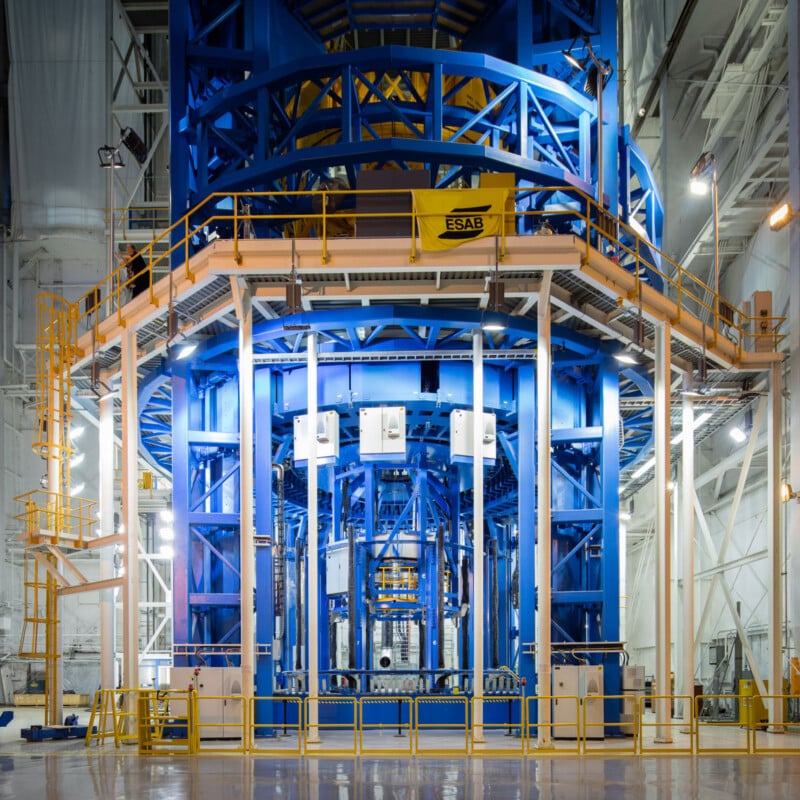
Canon’s legendary TS-E lenses remain popular among photographers today, in part because they’re essentially perfect for architectural photography, and also because Canon has not made new versions for mirrorless cameras.
Canon makes four TS-E lenses: the TS-E 17mm f/4L, TS-E 24mm f/3.5L II, TS-E 50mm f/2.8L Macro, and the TS-E 90mm f/2.8L Macro. These lenses are essential tools for architectural photographers like Kelley because they offer tilt and shift control, allowing him to keep all vertical lines straight in his photos. Rather than pointing his camera up at a tall object, like a rocket being built, he can shift the focal plane, keeping the optical path parallel to the image sensor. Avoiding perspective distortion is vital for Kelley.
It’s often hard for photographers to select their favorite photo from a project, but not so for Kelley.
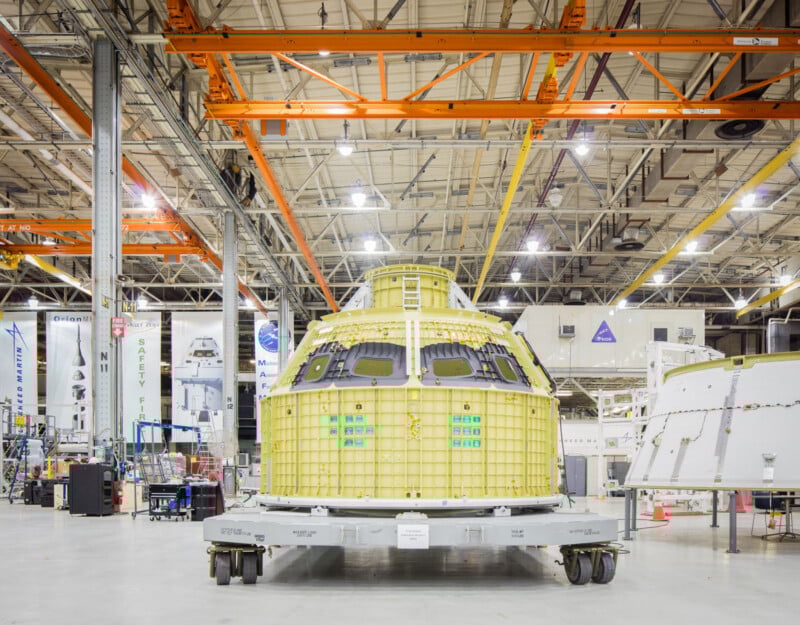
“My favorite is definitely the wide photo of the incomplete crew capsule,” he says. “It’s just so freaking cool, and the way the colors jump of the page is also quite arresting.”
That said, he also likes how many non-space NASA vehicles were at the Michoud Assembly Facility.
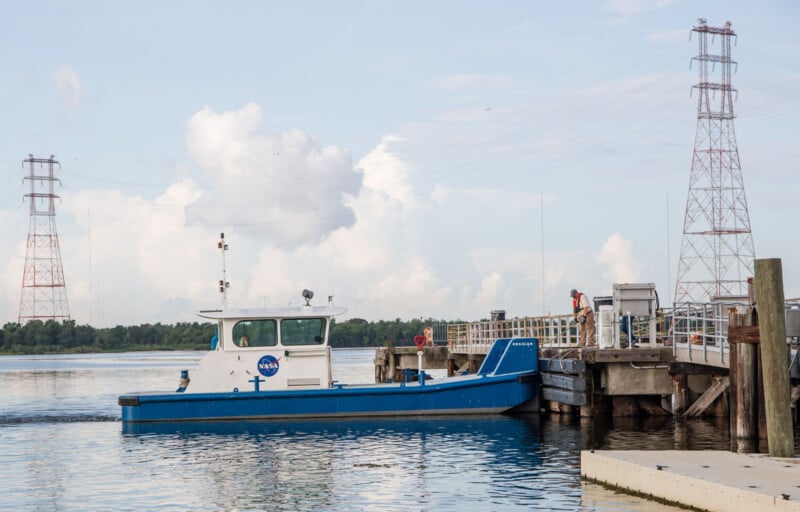
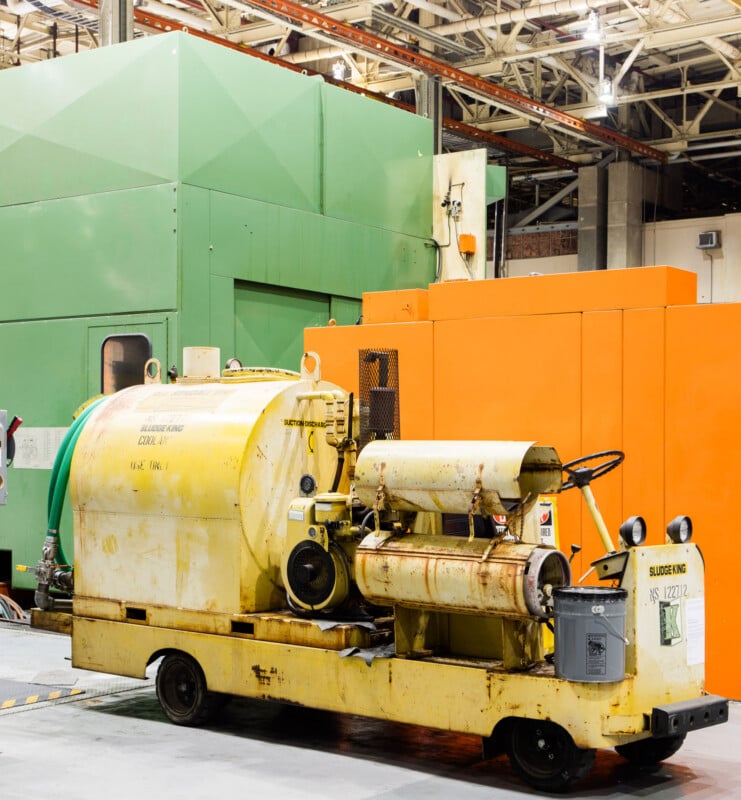
“I also love some of the non-space NASA vehicles — the boats, the tugs, etc, which feel far more fun and pedestrian than the typical ‘spacey’ objects that are all high tech. It’s cool to know NASA is still using good ‘ol dependable workhorse machinery to build incredible things. If it ain’t broke, don’t fix it!”
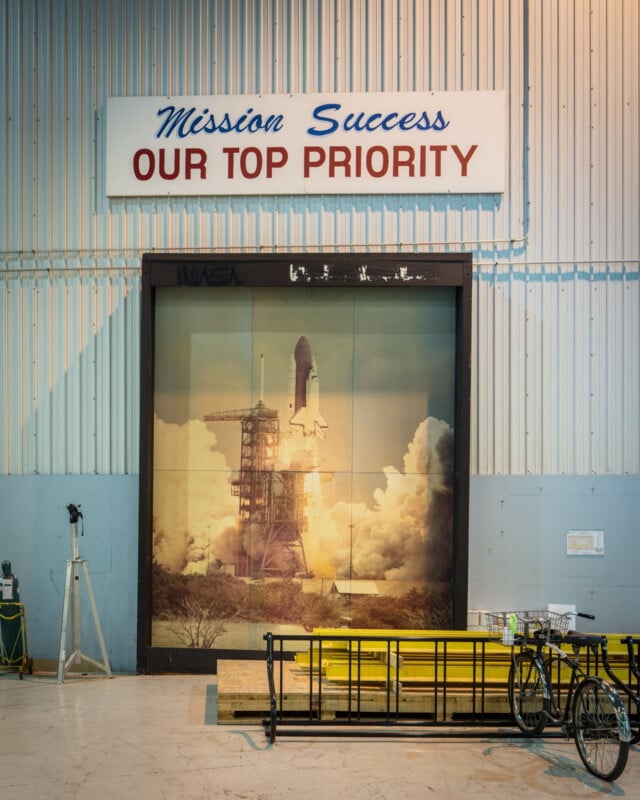
It takes so many people and machines to send people to space. The public often only sees the polished, final results and the big, dramatic moments. Kelley’s photos, which have taken on fresh meaning with the Artemis II crew’s successful launch into space and record-breaking trip around the Moon, capture a very rarely-seen but critically important side of the massive NASA space exploration machine.
Image credits: Photographs by Mike Kelley (Instagram)







 English (US) ·