
Amnezia VPN review - quick menu
Amnezia VPN is an open-source VPN launched in 2020 that originated at Demhack, a hackathon run by Russian digital rights organization Roskomsvoboda.
Today, Amnezia offers products for different types of users. Amnezia Premium provides a subscription VPN with servers operated by the company, while Amnezia Free offers limited free connectivity for users in restricted internet environments. The platform also supports self-hosted deployments on personal cloud servers, plus Amnezia VPN Business for teams and Amnezia VPN Hosting, which simplifies server setup.
For the scope of this review, I’ll be focusing solely on Amnezia Free and Amnezia Premium.
Amnezia VPN Free: features and performance
Amnezia Free works differently from most free VPN services — and indeed from its own Premium version — by only routing specific apps and websites through the VPN rather than all your internet traffic.
This lets you reliably access commonly restricted platforms like WhatsApp, Telegram, Signal, Instagram, TikTok, and selected news sites, while everything else connects normally without VPN overhead.
Unlike many free VPNs out there, you don’t need to sign up for an account to use Amnezia Free, and you won’t have to put up with annoying or irrelevant in-app ads either.
A couple of caveats of the free version of Amnezia VPN, however, are that speeds are capped at 500 Kbps and that it doesn’t let you choose your location. Instead, you’ll be assigned to the region you’re in. If this is all too limiting, then you may want to consider its Premium version, which doesn’t have the same restrictions.
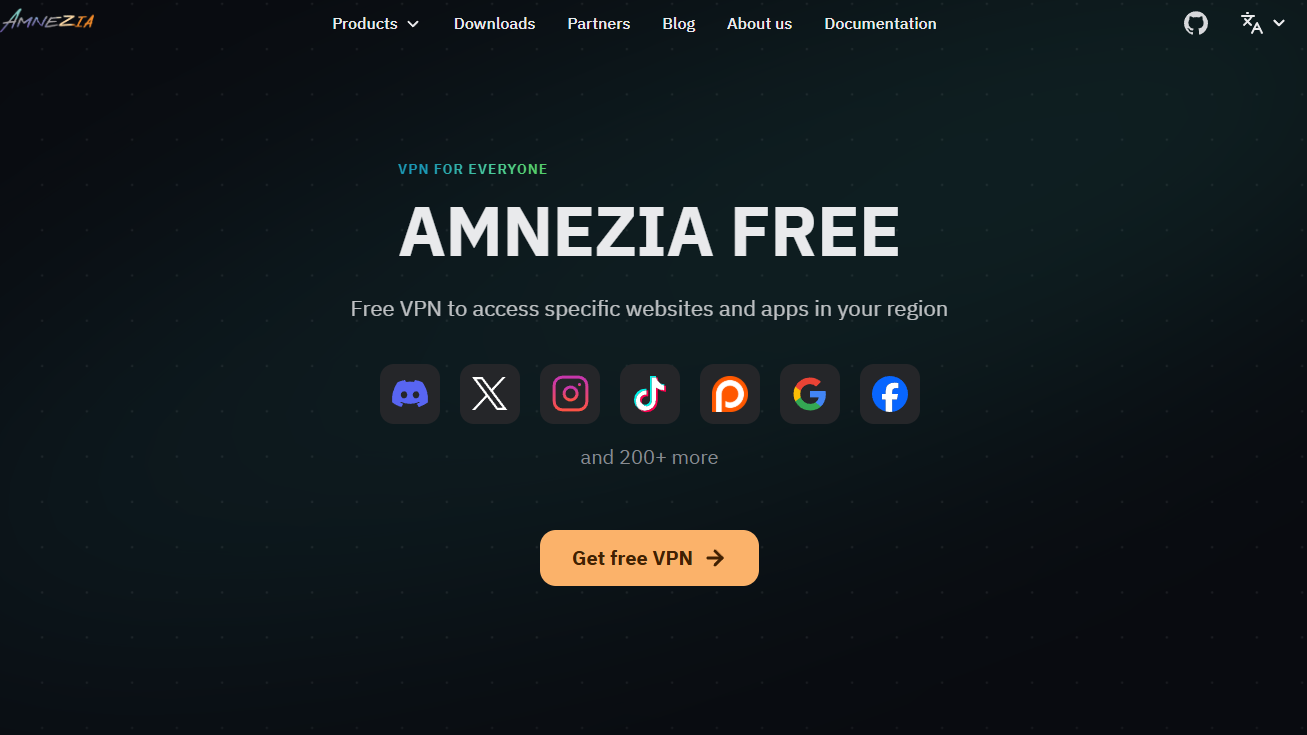
An Amnezia spokesperson told TechRadar that Amnezia Free is primarily created and operates in countries with a high level of internet censorship and restrictions. These include Russia, Myanmar, and Iran, as well as Turkey, Vietnam, India, Pakistan, Nepal, Brazil, and Cuba.
The UK has also been added as an experimental market due to a high demand. The goal, however, is to make Amnezia Free available to all users worldwide.
Under the hood, Amnezia runs on its own modified WireGuard-based protocol, AmneziaWG, designed to make VPN traffic harder to detect or block.
On the security side, it includes essentials like ChaCha20 encryption and a kill switch. The latter of which serves to cut your internet traffic in the event that the VPN connection drops, preventing the accidental exposure of your data.
Just keep in mind that these protections apply primarily to the traffic routed through the VPN and not your entire device.
Amnezia VPN Premium: features and performance
Amnezia describes its Premium offering as "a classic VPN" for when you want to secure all of your internet traffic all the time. It offers apps compatible with all major operating systems (Windows, macOS, iOS, Android, and Linux) and comes with an allowance of seven devices.
Apps and servers
With Amnezia Premium, you’ll have access to servers in 20 countries, which include the US, UK, Canada, Switzerland, Australia, and Japan. This is nowhere near the size of market-leading VPNs like NordVPN, Surfshark, and Proton VPN, which can prove limiting as far as unblocking or simply finding a local server for when you need the fastest possible speeds.
One curious quirk of Amnezia’s desktop and mobile apps is that it isn’t possible to switch servers while connected. Instead, you need to disconnect before reconnecting to your new desired location, making for a slightly clunky experience.
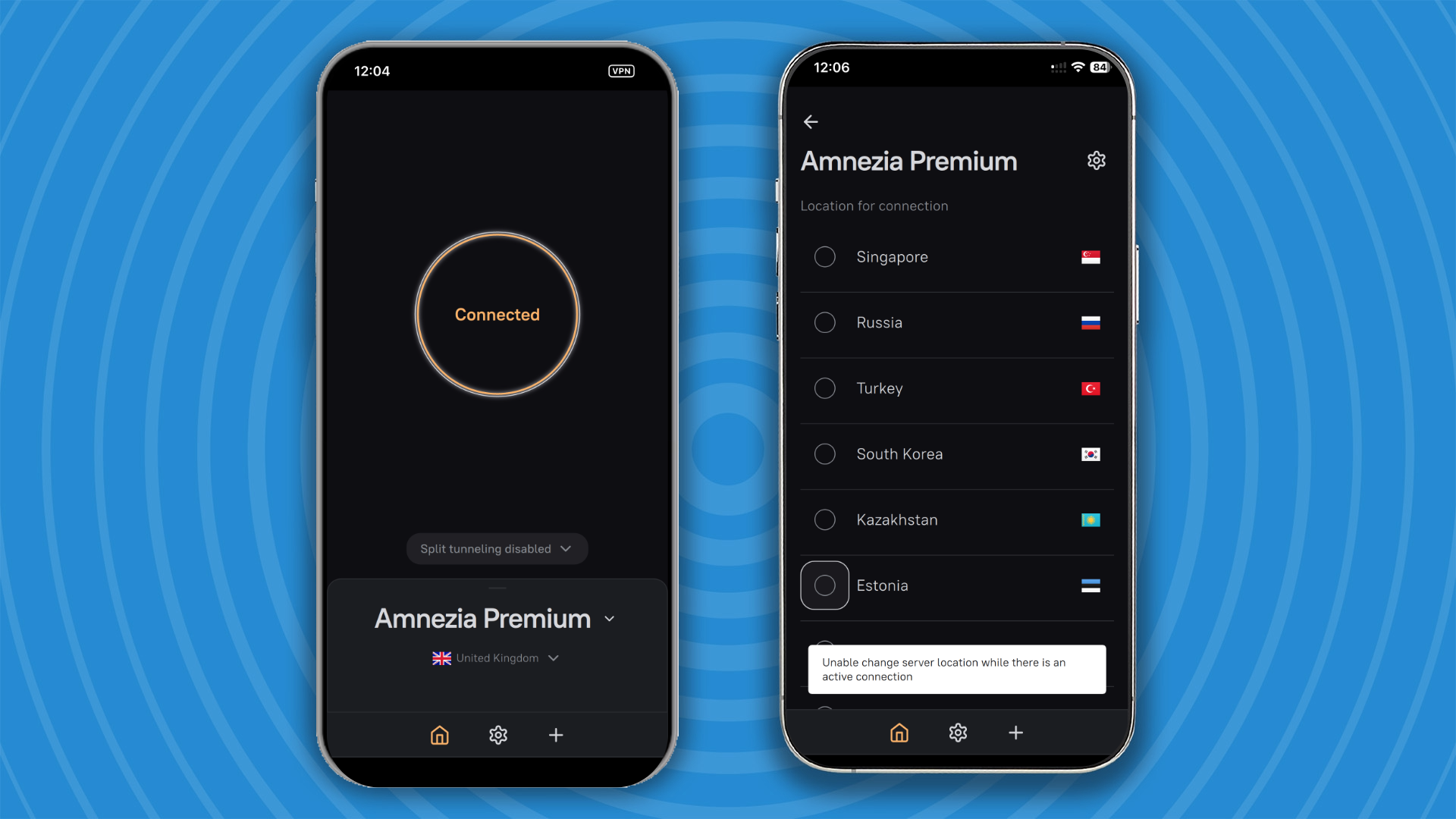
Having said that, Amnezia is aware of this limitation, which it ensures TechRadar the team plans to fix in a future update. Still, it doesn’t take long to connect to or disconnect from servers, and the app has a lightweight, responsive feel as well as a simple, uncluttered layout that should appeal to first-time VPN users.
Amnezia VPN’s desktop and mobile apps have the same straightforward design, which features a large quick-connect button and a footer menu that takes you to the home page, settings, and connection setup.
Selecting the server location at the foot of the home screen brings up the full list of server locations. These seem to be listed at random with no option to filter them by alphabetical order, latency, or to favorite specific locations for faster future access.
Streaming unblocking and speeds
Many people use VPNs to access their usual streaming services while traveling abroad, and the good news is that Amnezia VPN successfully accessed everything I tested it against, including US Netflix, BBC iPlayer, and 9Now. Better still, it worked at the first time of asking in each case.
As for speed, Amnezia claims to offer speeds of up to 200 Mbps, and I found this to be accurate. I recorded speeds of 220 Mbps while connected to the server most local to me (France) and even had speeds of 120 Mbps when connecting to a server further afield in the US.
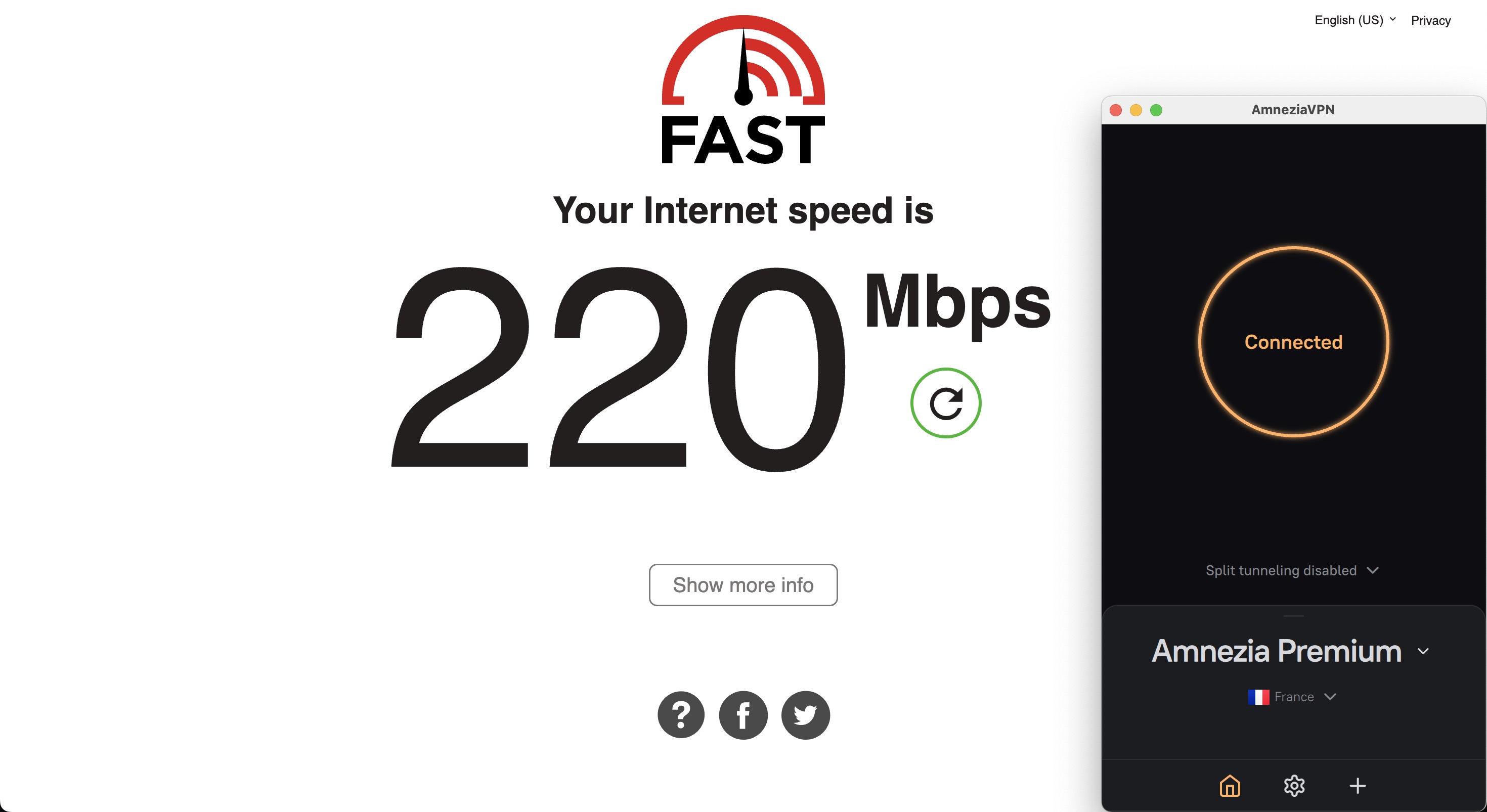
These speeds are more than fast enough for streaming, and I had no issues with playback while connected.
Security features
Amnezia connects you by default to its proprietary WireGuard-based protocol, AmneziaWG, designed to make VPN traffic harder to detect or block. With the release of AmneziaWG 2.0, the team strengthened its obfuscation power, promising to outsmart even more sophisticated censorship tactics.
Amnezia Premium also offers the XRay VLESS protocol, which the team says users should choose as an alternative in the event that AmneziaWG struggles in more challenging network environments. You can switch to VLESS by heading to the server's settings.
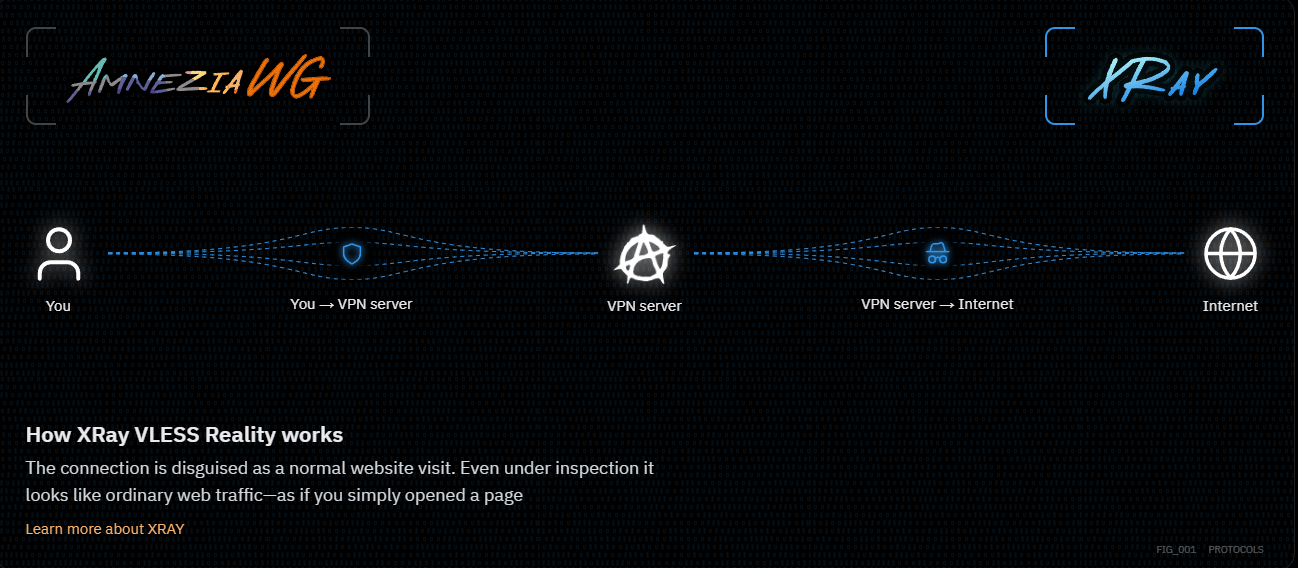
Over time, Amnezia VPN has phased out protocols including OpenVPN Over Cloak and ShadowSocks, because they were increasingly detectable by Deep Packet Inspection (DPI) blocking systems.
This isn’t exactly a feature-packed VPN and lacks much of what the best VPNs offer, such as ad blocking or Double VPN servers. Still, it ticks every security box with ChaCha20 encryption, DNS leak protection, and a kill switch.
Amnezia VPN also offers split tunneling, which lets you route only selected apps or IP addresses through the VPN while the rest use your normal connection, which is useful when you want to access local services or improve speed for everyday apps while still protecting specific traffic.
Does Amnezia VPN offer privacy?
Amnezia is headquartered in Romania and has a privacy approach that centers on minimal data collection and user control, as evidenced by its strict no-logs policy and use of RAM-only servers. The VPN’s privacy policy explicitly states they don’t collect or store users’ IP addresses or any other personally identifying information during normal operation.
The only exception is brief temporary logging when users violate terms or threaten infrastructure, with data deleted afterward. This minimal data stance is reinforced by independent security audits carried out by 7ASecurity in 2022 and 2024, as well as penetration testing by the Open Technology Fund.
For Premium subscribers, connections are routed through company-operated servers using the custom AmneziaWG protocol by default, which is designed to resist censorship without compromising the no-logs promise. It's also worth mentioning that Amnezia VPN's apps are open source, so anyone can freely inspect their code.
Regarding payment privacy, Amnezia accepts major credit cards as well as cryptocurrency options, including Bitcoin and Ethereum. Unlike Mullvad, it doesn’t offer a truly anonymous cash payment method.
Although payment processing for subscriptions involves third-party vendors that may collect transaction data, the core VPN service avoids tracking browsing activity, connection timestamps, or bandwidth usage.
Amnezia VPN review - final verdict
Amnezia VPN may not have the flashiest apps or the myriad of features of more established VPN services, but that’s not too surprising considering its major focus is developing tech to bypass ever-sophisticated censorship tactics.
If you’re looking for a simple VPN that gets the basics right, though, it certainly ticks that box. Between strong encryption and a kill switch, Amnezia VPN provides a high level of security for your data, all while protecting your privacy with a strict no-logs policy that should satisfy even the most privacy-conscious users.
Particularly impressive in testing was its ability to access streaming services like Netflix. That said, Amenzia VPN's small server network considerably limit its global reach.
The lack of some popular add-on like ad and malware blcoking are also downsizes that need to be considered — especially when many other VPNs are offering them as standard protection.
You should also keep in mind that, if you switch to Amnezia Premium, the company operates under a limited 7-day money-back guarantee, in an industry where the standard is typically 30 days.
Nonthless, Amnezia's fairly competitive subscription prices, which starts from the equivalent of $4 a month, will give you the opportunity to support the work that the team is carrying on in promoting a secure and uncensored internet, even in the most challenging environments.
We test and review VPN services in the context of legal recreational uses. For example: 1. Accessing a service from another country (subject to the terms and conditions of that service). 2. Protecting your online security and strengthening your online privacy when abroad. We do not support or condone the illegal or malicious use of VPN services. Consuming pirated content that is paid-for is neither endorsed nor approved by Future Publishing.



 English (US) ·