
 Image via Warner Bros. Pictures
Published Aug 22, 2026, 2:53 PM EDT
Jeremy has more than 2700 published articles on Collider to his name, and has been writing for the site since February 2022. He's an omnivore when it comes to his movie-watching diet, so will gladly watch and write about almost anything, from old Godzilla films to gangster flicks to samurai movies to classic musicals to the French New Wave to the MCU... well, maybe not the Disney+ shows.
His favorite directors include Martin Scorsese, Sergio Leone, Akira Kurosawa, Quentin Tarantino, Werner Herzog, John Woo, Bob Fosse, Fritz Lang, Guillermo del Toro, and Yoji Yamada. He's also very proud of the fact that he's seen every single Nicolas Cage movie released before 2022, even though doing so often felt like a tremendous waste of time. He's plagued by the question of whether or not The Room is genuinely terrible or some kind of accidental masterpiece, and has been for more than 12 years (and a similar number of viewings).
When he's not writing lists - and the occasional feature article - for Collider, he also likes to upload film reviews to his Letterboxd profile (username: Jeremy Urquhart) and Instagram account.
He has achieved his 2025 goal of reading all 13,467 novels written by Stephen King, and plans to spend the next year or two getting through the author's 82,756 short stories and 105,433 novellas.
Sign in to your Collider account
Certain books get multiple adaptations, and it’s something people just generally accept when those adaptations aren’t very good (you can never fully outweigh or delete the source material), but then also, it’s easy to celebrate when a second (or third) adaptation does things a little better than the first. With The Lord of the Rings, it’s probably not something that anyone will have to worry about, and the problem there would be the second adaptation (like, another film trilogy) doing things worse than the first time. But with Dune, there was one attempt at making a movie in 1984, and it didn’t go perfectly, so after a few decades had passed, that Frank Herbert book got another adaptation. Well, it technically got two movies, with that one adaptation being released in two parts, and those two movies are being counted separately below.
Dune: Part Three will be the fourth theatrically released Dune movie, and it’ll differ from the ones already made because it’s set to adapt a different book in the series: Dune Messiah, which was originally published four years on from the first book. For now, though, you’ve technically got three Dune movies generally, and you can also say that you’ve got three movies based on that first Dune novel. Either way, those three Dune movies are ranked below, starting with that one that didn’t quite work (but still proves interesting), and finishing with the two that are admittedly hard to separate, but they were released independently. So, until there’s a Kill Bill: The Whole Bloody Affair kind of situation where the first and second of the recent Dune movies get edited into one massive epic, you’re sort of forced to consider them as movies on their own, when it comes to ranking. That’s more than enough by way of preamble and explaining, hopefully.
3 'Dune' (1984)
 Image via Universal Pictures
In 1984, David Lynch hadn’t really developed the style that would become known as Lynchian, though Eraserhead (his first feature film) was definitely Lynchian in hindsight, and though The Elephant Man was more grounded, it also wasn’t without some dreamlike and eerie imagery. He probably seemed like a good fit for an adaptation of Dune, even if he hadn’t really done a movie on that large a scale, just because Dune is a fairly out-there novel at times, and there’s plenty it does with world-building and other details that feel surreal, or even a bit psychedelic. The core story is identifiably one about power, corruption, and war, sure, but all the extra stuff that makes Dune stand out as Dune… that’s the kind of stuff that definitely feels within David Lynch’s wheelhouse.
The opening of Dune (1984) feels a bit choppy, and then the final act really suffers, since it condenses the last half of the book into not much longer than half an hour.
So, it ended up being the case that 1984’s Dune was interesting. It is not an absolute disaster, by any means, even if some talk about it like it completely misunderstands the source material (as an adaptation) while also not really getting anything right as a film. Dune didn’t look amazing for its time, because there are limitations with some of the special effects here that don’t hold up to certain other large-scale sci-fi movies of the era, yet other parts are visually striking. David Lynch was a good director, to say the least, and stayed a good director, even if what he was directing might've been spiraling a bit out of control. There is a stretch of Dune where he feels like he was in control, or at least in control enough. The opening of Dune (1984) feels a bit choppy, and then the final act really suffers, since it condenses the last half of the book into not much longer than half an hour. The second half of the story feels like it’s playing out at 2x speed, or even a bit faster. So, the landing is not stuck, and the opening isn't great, but there are parts of Dune (1984) in between that are pretty good. The music’s memorable, some of the casting is very inspired, and it “gets” the weirdness of the book. Had it been successful, Lynch might well have been even better-suited to adapting some of Dune’s sequels, since a few of them see Frank Herbert doubling down on some of the weird stuff he began developing in the first book.
2 'Dune' (2021)
The first half or so of Dune (1965) was given a bit more room to breathe with Dune (2021), even if it’s not the part of the story that is the most interesting and intense. As set-up, though, it’s very well-executed, and there are things here that are easier to appreciate once you’ve seen the follow-up. It’s worth noting how much of a risk it was, helming the whole adaptation the way they did. Dune was filmed without official confirmation of a second movie, and so it wasn’t like The Lord of the Rings or Kill Bill, where they had one huge production and then edited what was shot into multiple parts/releases. The sequel was greenlit only after the first proved successful enough (not a huge hit financially, but it was during COVID, and the movie did well enough when taking into account the box office and how much it was watched on HBO Max). At least things turned out well, and the story was finished, but at the time, Dune (2021) did end in a pretty odd way.
It’s not even really a cliffhanger ending, and you don’t get a mild sense of finality that you get at the end of both The Fellowship of the Ring (the Fellowship parting) and The Two Towers (thanks to Sam’s speech that ties a bow on certain things). It was odd for it to end the way it did without a follow-up being a guarantee. The ending is the biggest flaw here, even with the knowledge that a second half exists. And then the second-biggest flaw is probably how much Dune (2021) feels like an extended prologue, and with that feeling comes a lot of exposition. Still, it’s interesting exposition, and there is a world where Dune (2021) was released with a longer-than-necessary runtime and even more by way of characters explaining (well, over-explaining) things. Beyond the structure and pacing, the other difference here compared to the 1984 movie is that Dune (2021) feels a little less weird and more grounded, which could be detrimental for some, but could also be a change of a more welcome variety for others.
1 'Dune: Part Two' (2024)
 Image via Warner Bros. Pictures
Rome wasn’t built in a day, as they say, and neither was Dune read in a day. No, well, you could probably read it in the space of a day if you really wanted to, and didn’t have anything else going on that day, but it would be difficult, owing to it being a relatively hefty book. It’s an epic, basically, even if you don’t take the sequels into account, and so it was the right move to give that first book two movie adaptations. Dune: Part Two, you shouldn’t be surprised to know, is the second part of that adaptation. Denis Villeneuve returned as the director, as did most of the cast members whose characters were still alive and kicking, and then a few people joined the cast, too (the characters played by the likes of Austin Butler, Florence Pugh, and Christopher Walken did appear, in one way or another, in the source material’s first half). The cast might be even more impressive here, truth be told, and it plays a role in Dune: Part Two feeling like even more of an epic than Dune (2021).
It’s got a bit more by way of action and battle sequences, too, even if they're never focused on so much that the movie becomes an action film. All the spectacle on that front is icing on the cake, because what makes Dune: Part Two really compelling is what it does for the main character, Paul Atreides. He’s more passive in the first movie, but then realizes more things about his destiny (or apparent destiny) in Dune: Part Two, slowly becoming more intense, and progressing from a potential hero of sorts to an antihero, and then to someone who feels more like a villain than anything else. Dune: Part Two gets dark, and in ways that help make Dune: Part Three well and truly one of the most anticipated movies of 2026. With this second film in what will soon become a trilogy, much of the potential of the first movie is realized, and then you put the two together and they end up feeling like one of the greatest epic films released in recent memory. Oh, great music, too. The music of Dune (1984) was mentioned before, with its memorable score by Toto and Brian Eno, but Hans Zimmer also knocked it out of the park when it came to composing the scores to both Dune (2021) and Dune: Part Two.
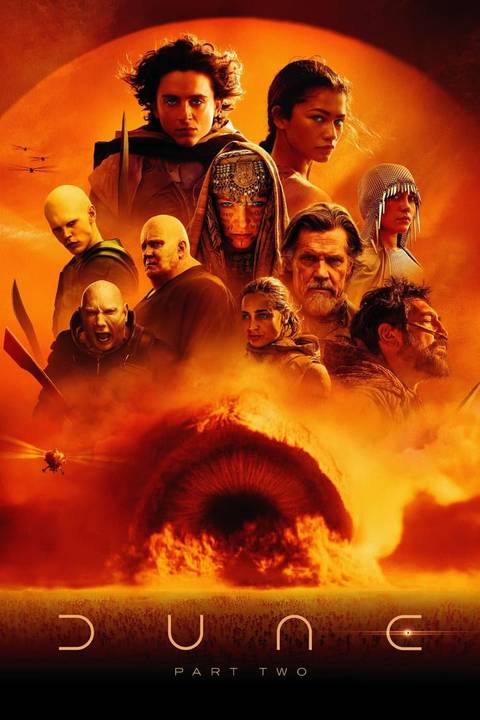
Dune: Part Two
Release Date February 27, 2024
Runtime 167 minutes
Director Denis Villeneuve
Writers Denis Villeneuve, Jon Spaihts, Frank Herbert




 English (US) ·