
 2 weeks ago
35
2 weeks ago
35
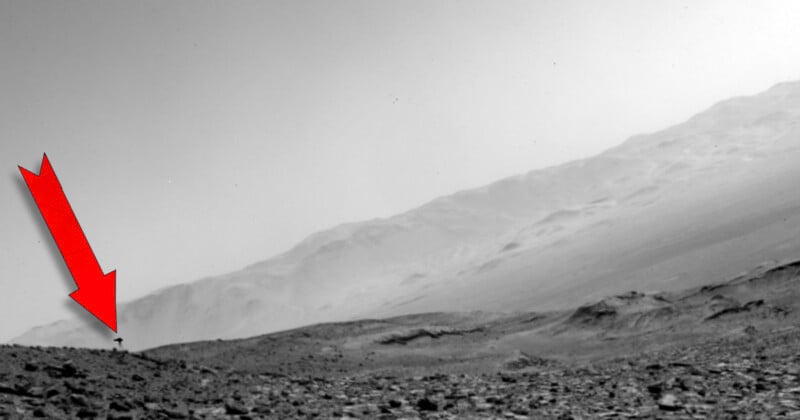
A photo taken by the Mars Curiosity Rover a few years ago has resurfaced online, and that’s because it shows something strange on the horizon.
Taken on Curiosity’s Right Navigation Camera on August 20, 2023, there is a figure hovering on the horizon. Through human eyes, which are admittedly prone to pareidolia, a domed head and tentacles appear to hover above the ground — kind of like the invaders in War of the Worlds.
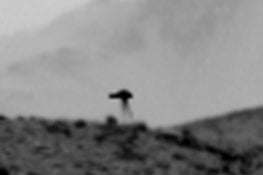 Cropped.
Cue recent headlines like “Mysterious ‘jellyfish’ spotted in NASA Mars photo sparks theories of life on the Red Planet,” by the Daily Mail. But whatever it is, it really is on the original photo, per NASA’s website.
There was a photo taken just 13 seconds earlier, which doesn’t show the “jellyfish.” That led to some people speculating that a giant invertebrate is scuttling around extremely quickly over the Martian surface.
 Similar vibes.
What Is It?
While it is impossible to totally rule out the giant alien jellyfish theory, a far more logical explanation is that it’s actually some kind of camera artifact.
Dr. Joseph Farah, an astrophysicist, believes it was caused by a cosmic ray striking the camera’s sensor, pointing out a perfect row of black pixels when zooming in on the figure.
“What I think happened is a cosmic ray struck the camera at the exact right moment and left this big old artifact in the image,” says Dr. Farah.
“It explains why the shape is so weird; just a perfect row of pixels with no anti-aliasing effect. And why it wasn’t present just 13 seconds earlier.”
Another hypothesis suggested by EarthSky is that it could be due to an electronic or transmission glitch.
“A pixel value can change at multiple points between the camera sensor and the final image file on Earth,” notes EarthSky. “Within the readout electronics, inside the flight computer’s storage, during onboard compression, throughout the downlink transmission or during ground processing.”
Whatever it is, for photographers on Earth, there’s a good lesson here: next time an unexpected object appears in your photo, blame it on a cosmic ray hitting your camera.
Earlier this year, Curiosity captured photos of rocks that look like dragon scales and a sea of polygons.
Image creditsCourtesy of NASA.
Affiliate Disclosure PetaPixel articles may include affiliate links; we may earn a commission if you buy through one.






 English (US) ·