
ACT! CRM, launched in 1987, is one of the oldest names in customer relationship management. It offers tools for small and medium businesses to manage customers, sales, and marketing. Interestingly, ACT! provides cloud and on-premises options, catering to both productivity- and security-focused businesses.
In my review, I found ACT! CRM to be a lot more than just a CRM platform. Like a few other small business platforms, it includes features for automating sales, marketing, and customer service. It also gives a complete view of customer interactions, helping businesses track data, manage sales, and run targeted campaigns.
Flexibility is a key advantage of ACT!. The platform allows rigorous customization to fit specific business needs. Its adaptability, along with its solid reputation, makes this a top choice for small and medium-sized businesses.
ACT! CRM core capabilities
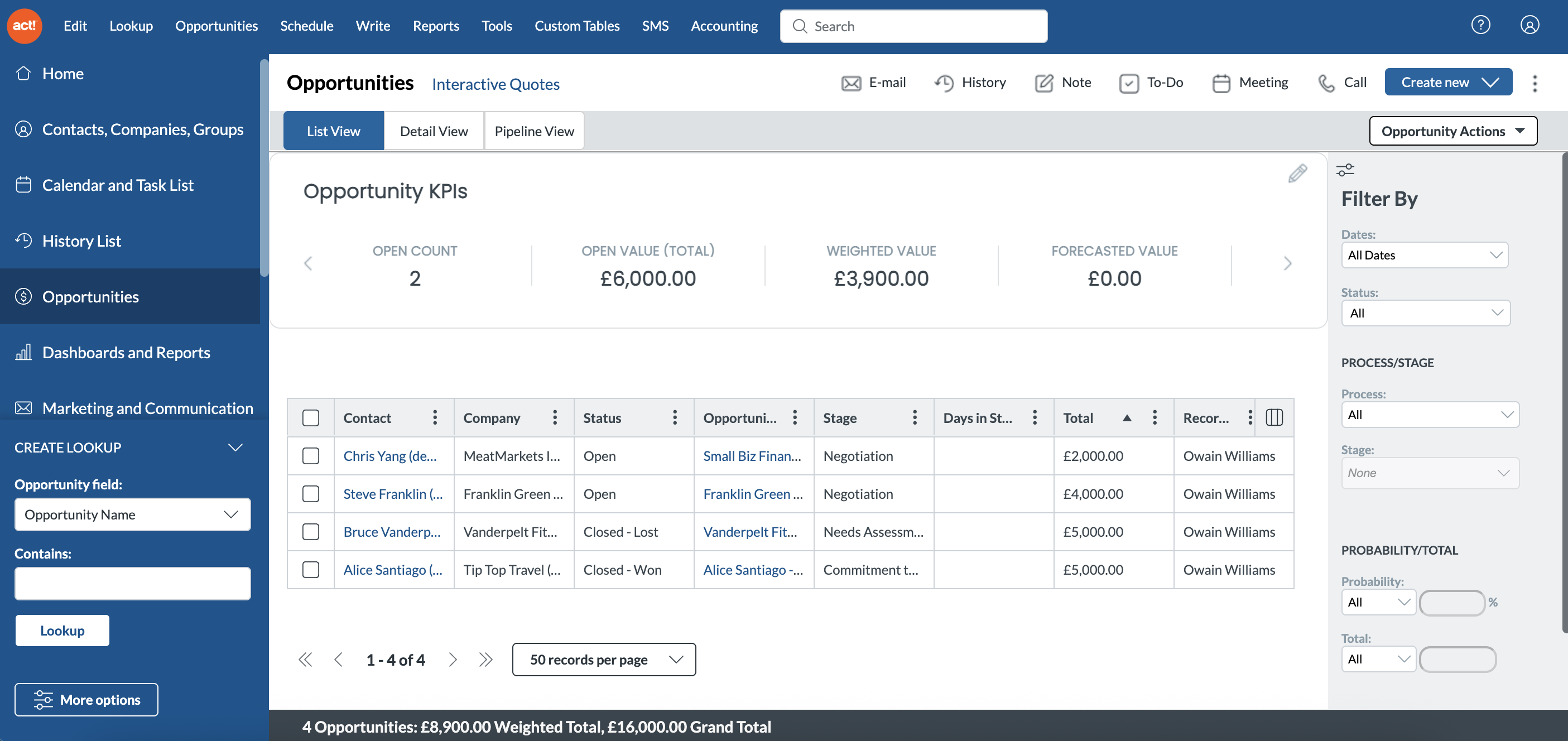
ACT! CRM has a long-standing reputation as a leading contact management tool. Its records are very detailed, allowing users to store information like notes, documents, and interaction history in one place.
Lead management is strong, helping users track potential sales from initial contact to closure. The customizable sales process allows businesses to align stages with their unique sales methods, benefiting companies with specific workflows. A visual sales pipeline view helps users project revenue, adjust strategies, and prioritize efforts. Contextually relevant metrics provide quick insights into pipeline health, aiding sales managers in making informed decisions.
For sales forecasting, ACT! has solid functionality, though it may lack the depth of some enterprise CRMs. Users can create forecasts based on opportunity data, closure probability, and historical performance. This suffices for most small to medium businesses, though more complex needs may find it limiting.
Reporting has improved significantly. ACT! Insight offers interactive dashboards for individual, team, and business performance metrics. The range of over 50 pre-configured reports covers sales, marketing, and business health KPIs. Users can also create custom reports, providing deeper data insights.
ACT! also offers a companion app for iOS and Android. The app provides access to key contact details, activities, and some dashboard metrics on the go. While it lacks full desktop functionality, it covers essential needs for field sales and remote work.
Beyond the usual CRM features, ACT! offers tools for creating and managing email marketing campaigns, including a template editor and response tracking. Useful for small businesses looking to streamline operations.
Custom tables also allow users to manage industry-specific data alongside standard CRM information. ACT! also syncs with popular platforms like Microsoft Outlook, Google products, and social media channels like LinkedIn and Facebook, creating a seamless workflow.
But while ACT! has a solid core, some users may find the interface less modern compared to newer CRM solutions. Its software has evolved from its contact management roots, but some legacy aspects remain. Still, it's a good platform with strong customization features that could serve niche and security-focused small businesses well.
How easy is ACT! CRM to use?
When it comes to ease of use, ACT! CRM offers a mixed experience. Its interface is functional but feels somewhat outdated compared to modern CRMs. When I first logged in, I had to slowly adjust to the information-dense layout, which can be overwhelming for new users.
A dashboard displays various widgets with crucial information like daily tasks, open opportunities, and sales pipelines. Navigation is handled through a left sidebar that lists all CRM features, providing quick access to different modules.
However, the top menu adds to the interface's overall complexity. It took me around 30-60 minutes to become comfortable with the layout and navigation, which aligns with feedback from other users about the software's learning curve.
ACT! offers robust customization options, allowing users to tailor the software to their specific business needs. Its flexibility is a significant advantage for businesses with unique workflows. However, making these customizations isn't always intuitive and requires technical know-how.
Accessibility features are present but not particularly advanced. ACT! offers basic screen reader compatibility and keyboard navigation but lacks sophisticated accessibility options found in newer CRMs.
On the positive side, ACT! provides comprehensive onboarding and training resources. It includes helpful tutorial videos, a knowledge base, and webinars to assist new users in getting up to speed. The "Welcome Links" on the dashboard, which provide quick access to uploading, importing, and learning about the CRM, and was a nice touch.
Available for both iOS and Android devices, the mobile app offers a more streamlined and user-friendly interface compared to the desktop version. I found adding new opportunities or contacts to be much more intuitive on the mobile app, even if it's more limited in functionality.
Overall, ACT! CRM’s ease of use is hampered by an outdated interface and a sometimes overwhelming amount of information. For businesses willing to invest the time in training and setup, however, it can be a powerful tool.
ACT! CRM integrations
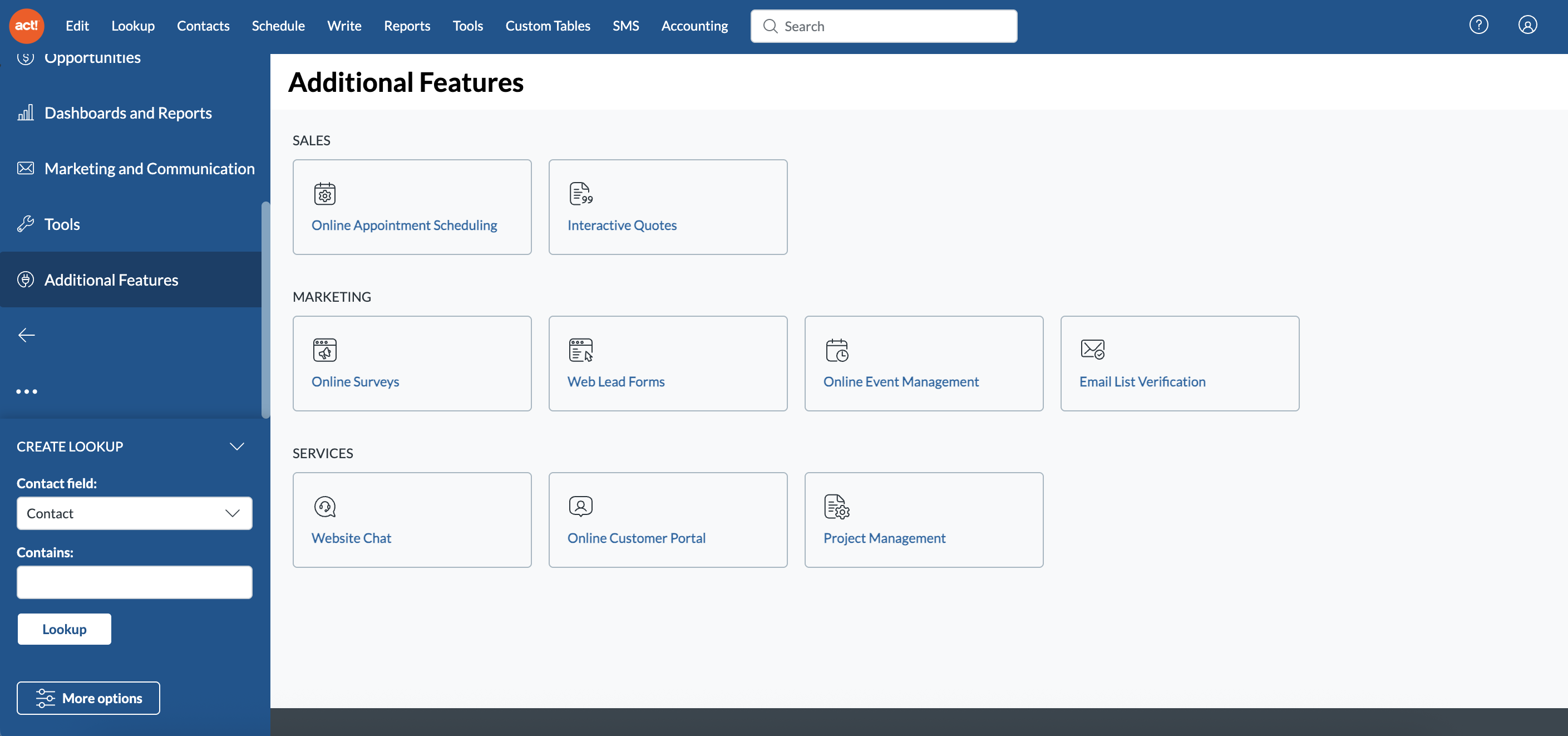
ACT! CRM offers a powerful set of integration capabilities, balancing between pre-built integrations and the flexibility to create custom ones.
The ACT! Marketplace serves as the central hub for the integrations, offering a wide array of pre-built connectors categorized by function, such as sales and marketing, business productivity, social media, ecommerce, back office, and customer service.
I particularly appreciated the seamless integration with Microsoft Office suite, including Outlook, which allows for effortless synchronization of emails, contacts, and calendar events. For users of Google Workspace, ACT! also offers solid integrations with Gmail, Google Calendar, and Google Contacts.
ACT! also supports Zapier, a no-code automation platform that lets you build custom integrations without technical knowledge. This opens up lots of possibilities for connecting ACT! with hundreds of other web applications. During my testing, I was able to create several Zaps (automated workflows) that connected ACT! with tools like Slack for notifications and Trello for project management.
For more advanced users and developers, ACT! provides a comprehensive API. API documentation is well-structured and easily accessible through the ACT! developer portal. It follows REST principles and uses JSON for data exchange, making it relatively easy for developers to create custom integrations or extend the functionality of ACT!.
ACT! also offers a feature called Web API, which allows for more direct integration with web-based applications. This can be particularly useful for businesses with custom web applications or those looking to embed ACT! functionality into their existing web platforms. While powerful, I found that leveraging the Web API requires more technical expertise compared to using pre-built integrations or Zapier.
In terms of data syncing performance, ACT! generally performs well. During my tests, most integrations maintained near real-time synchronization with minimal latency. However, I did notice occasional delays with some third-party integrations, particularly during peak usage times.
How good is ACT! CRM support?
ACT! CRM provides a multi-faceted approach to customer support, offering users various channels to seek assistance. During my evaluation, I found that the quality and accessibility of support resources were generally good, although there were some areas where improvements could be made.
Phone support is available during standard business hours. Response times are reasonable with an average wait time of about 5-10 minutes. Support representatives are knowledgeable about the product. However, it's worth noting that phone support is only available to customers on higher-tier plans, which may be a drawback for smaller businesses.
All users have access to email support. Simple queries are typically answered within 24 hours, while more complex issues sometimes took up to two days for a response. The quality of the email responses is generally good, with clear explanations and step-by-step instructions.
Something that ACT! falls short in is the lack of live chat support. Many users prefer the immediacy of chat for quick questions or troubleshooting, especially when most competitors offer robust chat support options.
ACT! makes up for this somewhat with its extensive self-service resources. Its knowledge base is comprehensive and well-organized, covering a wide range of topics from basic setup to advanced features. I found the search function to be particularly useful, quickly surfacing relevant articles based on keywords. It also includes a good selection of video tutorials.
ACT! CRM's community forum is another valuable resource for users. It's active and well-moderated, with both company staff and experienced users contributing to discussions. ACT! also offers regular webinars and training sessions, which serve as both educational resources and indirect support channels.
In terms of resolution times for support tickets, my experience and research suggests that the company performs adequately but not exceptionally. Simple issues are often resolved within 1-2 business days, but more complex problems can take longer, sometimes up to a week.
User testimonials regarding ACT!'s support quality are mixed. Many users praise the knowledge and helpfulness of the support staff, particularly for phone support. However, some users express frustration with longer wait times for email support and the occasional need to escalate issues to get them resolved.
ACT! CRM pricing and plans
Swipe to scroll horizontally
Plan | Advantage Standard | Premium Desktop | Advantage Professional | Advantage Ultimate |
Price | $30/user/month | $39/user/month | $45/user/month | $60th/user/mon |
Best For | Small businesses needing cloud-based CRM with basic marketing features | Businesses preferring on-premises CRM solution with advanced customization | Organizations requiring both cloud and desktop access with data synchronization | Growing small-to-medium businesses (SMBs) and power-users who want an all-in-one front-office ecosystem |
Features | Comprehensive contact management Basic marketing automation Cloud-based accessibility | Advanced customization options Robust offline capabilities On-premises data control | Cloud and desktop access Data synchronization Combined cloud-desktop benefits | Drops all caps on custom tables/enhanced support, unlocks full marketing automation, a customer portal, and 50,000 email sends/month. |
Limitations | Limited advanced marketing features without addons | Requires IT resources for maintenance and updates | Higher cost may not justify benefits for all users | Interface still suffers from legacy clutter. Lacks real-time human chat support |
Recently, Act! has modernized its software distribution by structuring its core offerings into the Act! Advantage suite. Rather than forcing a choice between basic cloud access or entirely self-hosted deployments, the vendor now scales its cloud features across three structured tiers, while maintaining a standalone desktop tier for legacy organizations.
The entry point remains the Advantage Standard plan (formerly known as Premium Cloud) and is priced at $30 per user, per month (when billed annually). This tier provides complete browser-based CRM functionality paired with foundational email marketing capped at 2,500 messages per month. It offers highly competitive value for small businesses that require structural contact mapping, mobile pipeline accessibility, and automated updates without the technical overhead of an on-premises deployment.
For teams looking for modern workflows, Act! can offer the Advantage Professional tier for $45 per user, per month. This tier injects native generative AI tools - including an AI Writing Assistant and automated AI history summaries - directly into the environment, while expanding email marketing thresholds to 25,000 monthly sends and adding native project management.
At the top of ACT!'s cloud offerings resides the Advantage Ultimate tier ($60/user/month), which functions as a comprehensive, no-compromise package. It drops external upcharges by natively including custom industry data tables, an interactive online customer portal, and advanced marketing automation limits of 50,000 email sends per month.
For organizations bound by strict data localization or internal compliance rules, Act! maintains its self-hosted Premium Desktop environment for $39 per user, per month. It is important to note that the convenient local-to-cloud data redundancy mentioned in legacy reviews is no longer bundled as a unique tier; instead, Desktop Sync functionality is treated as a flexible $10/month per-user add-on that can be attached to any standard cloud subscription.
A potential drawback I noticed is the lack of a free plan. Many competing CRM solutions offer a basic free tier, which can be beneficial for very small businesses or for those wanting to test the system extensively before committing. ACT! does provide a 14-day free trial, which is sufficient for a basic evaluation of the software, but it may not be enough time for a thorough assessment in a real business environment.
How we tested ACT! CRM
At TechRadar Pro, our CRM testing is based on extensive, hands-on evaluation. To accurately analyze Act! CRM's legacy desktop capabilities, modern cloud environments, and updated marketing automation tiers, our enterprise software analysts put the platform through a practical testing process designed to simulate real-world operations in small-to-midmarket sales teams.
Given the platform's focus on automated intelligence pipelines, we dedicated a specific evaluation block to Act!’s native AI Writing Assistant and automated history tools available on the higher-tier cloud plans. We evaluated the system's accuracy when analyzing long timelines of contact notes, checking how concisely the AI could summarize years of interaction histories into actionable context for a sales rep. We also tested the writing assistant's natural tone variability by auto-generating targeted prospecting emails directly inside the CRM workspace.
ACT! CRM review: Final verdict
ACT! is a feature-rich incumbent that has successfully adapted to the changing CRM landscape over its long history. Its comprehensive contact management, powerful sales tools, and integrated marketing features make it a compelling choice for small to medium-sized businesses looking for an all-in-one CRM.
Act! remains a reliable, feature-rich workhorse for small to medium-sized businesses that need a unified sales and marketing platform. Its defining strength is deployment flexibility—offering both modern cloud subscriptions and rare, on-premises desktop installations. This makes it an ideal fit for data-heavy teams or companies in highly regulated sectors with strict compliance and security needs.
The software's strength lies in its flexibility, offering both cloud-based and on-premises deployment options. This, combined with extensive customization capabilities, allows businesses to tailor the platform to their specific needs. However, the software is starting to show its age. The legacy interface and a steeper learning curve can feel restrictive compared to modern, instantly intuitive alternatives. Still, it's a great choice for businesses in regulated industries with complex data security needs.









 English (US) ·