
Last month, The Pokémon Company announced that it will finally be shutting down Pokémon Bank in 2027. This 3DS storage app has been the bridge between generations of Pokémon games going as far back as the Game Boy Advance releases. Though its use cases in 2026 are far more niche than they were when people were moving between those earlier games, it marks the end of an era and of a long-held, nostalgic tradition the community once took part in before everything became centralized in the current, platform-agnostic Pokémon Home storage app. However, one software developer is working on a technical solution that could make it possible for players to trade Pokémon between their Game Boy Advance and their Switch.
Andrew Henley, a software developer who has been working on a GBA-to-Switch adapter, has finally gotten a prototype working.
Trading Pokémon between an original GBA and a Switch 2 😎😲
My GBA-to-Switch trade adapter is working!
Still plenty of work ahead, but seeing a real GBA communicate and trade with the Switch is pretty incredible.#Pokemon #GBA #Switch2 pic.twitter.com/W09ELMBCM3
— Drewworks (@ahenley17) September 3, 2026
Henley tells Kotaku that the device started as a passion project, as he wanted to trade Pokémon between his original cartridge games and their Switch re-releases. The video he posted to his Twitter account shows a working trade between the GBA version of FireRed and LeafGreen and the Switch port Game Freak released earlier this year.
“I thought there was something compelling about being able to take a Pokémon that still exists on an original Game Boy Advance cartridge and let it interact with a modern system while still preserving that original hardware experience,” he said in an email. “From there, it grew into a technical challenge that I became really passionate about solving.”
While backwards compatibility is the standard for a lot of systems these days, the idea that a system as old as the Game Boy Advance could interface with a Switch seems hard to believe, and Henley says that figuring out how to make two seemingly incompatible devices work together seamlessly was a real challenge.
“Nintendo built very robust communication systems for both the Game Boy Advance and the Switch, and it has been interesting to learn how those systems behave and what each side expects,” he says. “The challenge is getting two systems that were never designed to talk to each other to stay synchronized and communicate reliably in real time. There has been a lot of testing, debugging, and trial and error involved.”
 © The Pokémon Company
Henley’s experience in software has spanned multiple industries far beyond video games, with the dev having worked in private sectors, government agencies, and now owning and developing a hospital compliance platform, with the goal of giving smaller and rural service providers more affordable systems. And he’s brought all that experience to bear in making two video game devices with decades between them talk to each other.
“At a high level, the adapter acts like a translator between two systems that were never designed to communicate with each other,” he explains. “The Game Boy Advance expects to talk to hardware from its own era, while the Switch uses a completely different communication system. My hardware and software sit between them and translate the communication in real time so that each side can interact normally without needing to understand how the other system works.”
For the moment, Henley is primarily focused on connecting different generations of Pokémon games, but says the project is “designed around interoperability,” so there could be other uses for it in the future beyond just trading Pokémon.
“An important part of that is that neither game is modified by the project,” he explains. “The games continue to operate normally, and the bridge sits between the two systems and helps their existing communication reach the other side in the form it expects. In fact, the bridge generally doesn’t need to understand what the games are actually saying to each other. Most of the game data can be treated as opaque information. My project only needs to understand enough about each system’s communication method to faithfully carry that message from one side to the other.”
The idea started out of a desire to trade his old ‘mons to new systems, but Henley says that he thinks finding some way for old tech to communicate with current tech is “very important.”
“There is a huge amount of history tied up in older hardware and software, and I think there is value in finding ways for those systems to continue interacting with newer technology without modifying the original games themselves.”
Welcome to Exp. Share, Kotaku’s Pokémon column in which we dive deep to explore notable characters, urban legends, communities, and just plain weird quirks from throughout the Pokémon franchise.
Henley hopes to create a production-level version of this adapter, but admits there’s still “a lot of work” to be done before he’s got something he’d be comfortable putting out into the world. He says he wants something that will be a “plug-and-play solution” for anyone looking to connect their GBA to a Switch console with “minimal friction.” He says Nintendo would “obviously be in a much better position” to manufacture and create something like this on its own, but he also says it’s not practical for Nintendo to make such a niche peripheral for a 20-year-old device it’s no longer manufacturing.
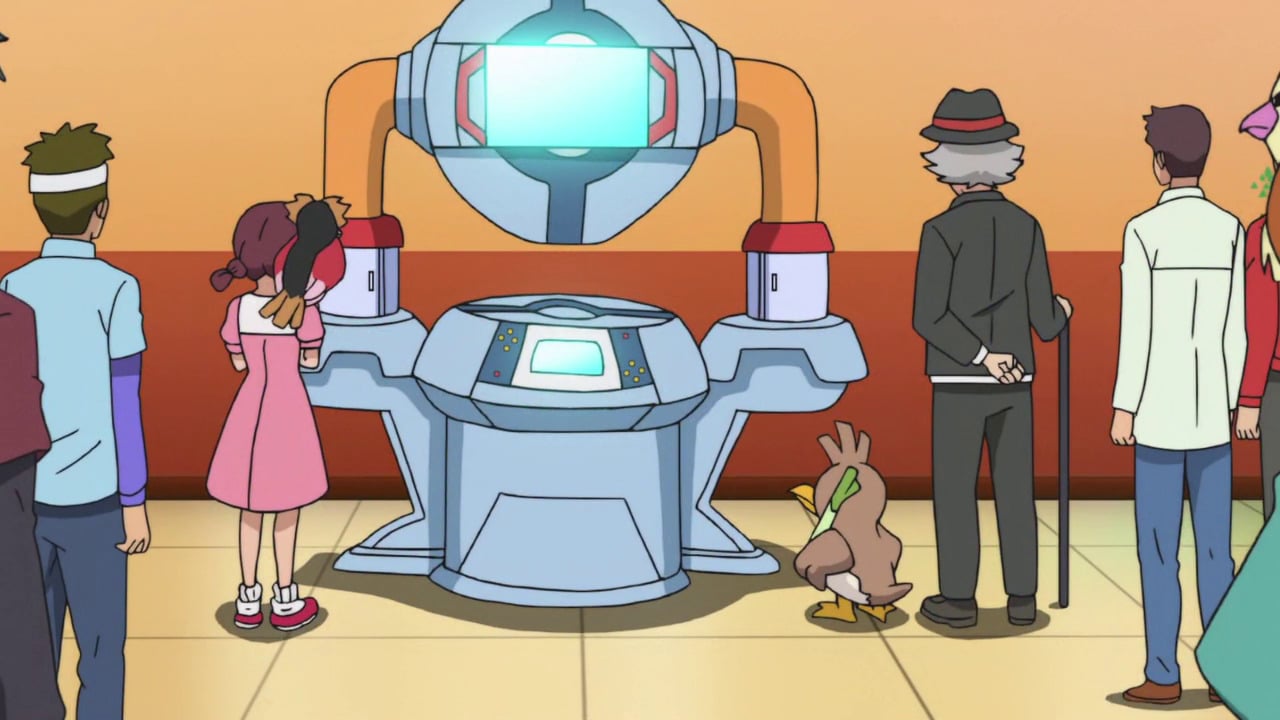 © The Pokémon Company / Bulbapedia
“I also think it’s important to be fair to Nintendo,” he says. “They have an enormous number of games, systems, and services to support, and something this specialized may simply be difficult to prioritize as an official feature for a single game…I can’t speak to their internal priorities or what they may be working on behind the scenes, though. You never know, so I’d never say never.”
For now, he’s handling this as an independent project, with some help from the open-source work and research of Pokémon homebrew and console communications specialists Yannik and Tornadus11 but no official affiliation or endorsement from Nintendo. He also says the uptick in interest, especially from those who are hoping to still trade Pokémon across many generations, has “encouraged” him to keep developing the adapter into something “more polished and accessible.” Anyone interested in following along can find Henley’s work on Twitter and Bluesky.
Pokémon Bank is set to officially shut down on February 25, 2027, so if you don’t want to wait on a GBA-to-Switch adapter to trade old ‘mons to new hardware, you’d better get started. The process is very, very complicated at this point, and you only have a few months left to get it done.





 English (US) ·