
 3 weeks ago
23
3 weeks ago
23
“I pretty much, at that point in time, gave up on being an astronaut.”
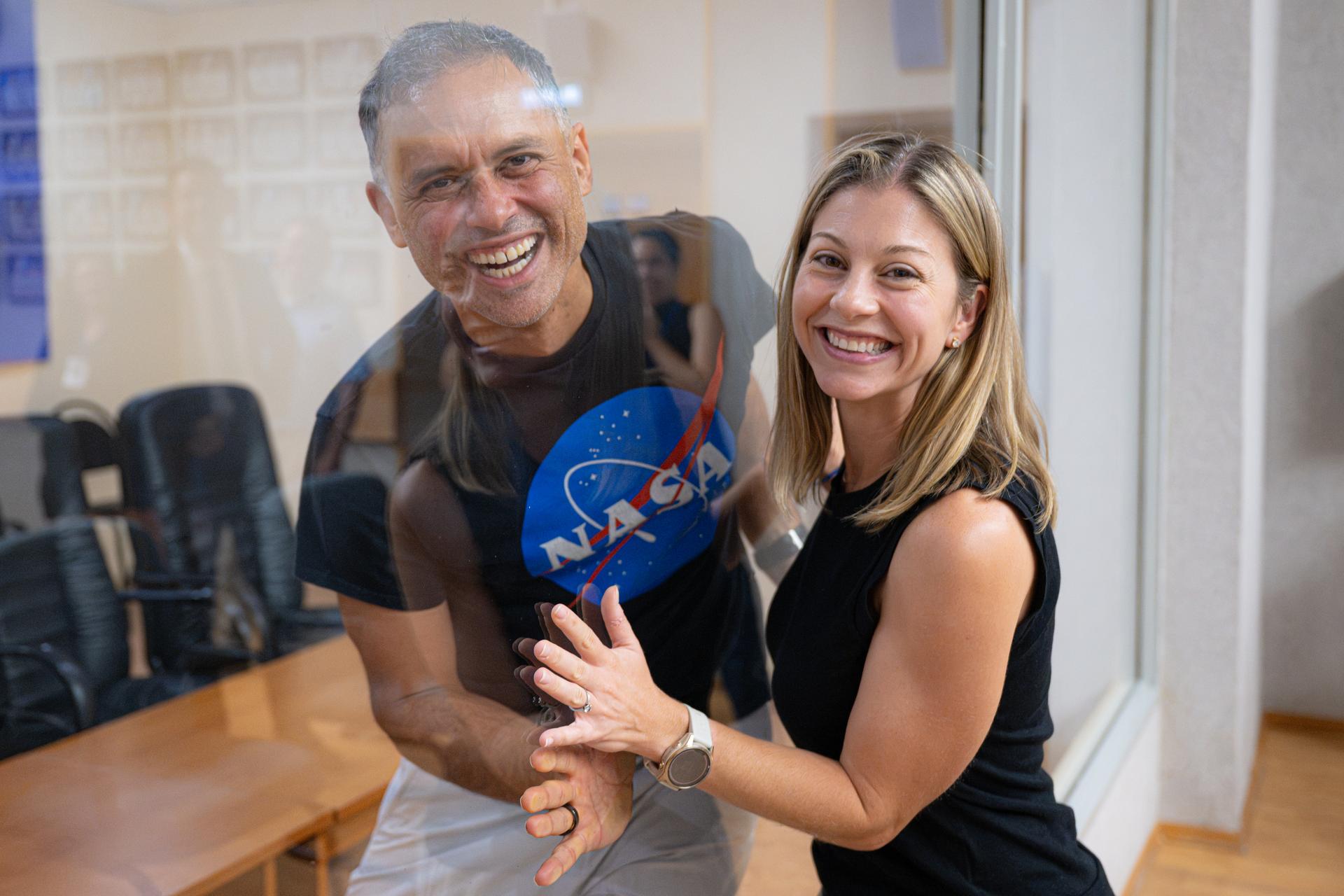
NASA astronaut and Expedition 75 crewmember Anil Menon, left, and his wife, NASA astronaut candidate Anna Menon, right, pose for a photograph between glass, Monday, July 13, 2026, at the Cosmonaut Hotel in Baikonur, Kazakhstan. Credit: John Kraus/NASA
NASA astronaut and Expedition 75 crewmember Anil Menon, left, and his wife, NASA astronaut candidate Anna Menon, right, pose for a photograph between glass, Monday, July 13, 2026, at the Cosmonaut Hotel in Baikonur, Kazakhstan. Credit: John Kraus/NASA
Anil Menon, a NASA flight surgeon, felt crushed nine years ago as his hopes and aspirations collapsed around him.
For the fourth time, he had diligently applied to become an astronaut at the US space agency, seeking to fulfill a lifelong dream. Although he made it to the final round, NASA had once again rejected his application at the end of the grueling process.
“I was so sad, and I admitted defeat,” Menon said. “I just did not see a pathway forward. So I pretty much, at that point in time, gave up on being an astronaut. I thought there was a zero percent chance.”
He was 39 years old. In 2017, Menon was already half a decade older than the average age of those selected to become astronaut candidates. He felt a door closing, and looking for a new one to open, devoted time to thinking deeply about what he wanted to do with the rest of his life.
His life was not without adventure up to that point—far from it. An emergency physician by training, Menon had practiced medicine on Mount Everest, provided relief in Port-au-Prince after a devastating earthquake in Haiti in 2010, and flown search-and-rescue missions with the US military in Afghanistan.
As he considered what should come next, Menon journaled daily about his passions, purpose, and principles. Eventually, he settled on space medicine. If he could not go to space, he would help others do so. And collectively, humanity would advance. “I needed that to be crystal clear in my mind,” Menon said.
It had to be, because Menon and his wife Anna were about to make some momentous decisions. Decisions that would ultimately culminate in not one of them, but both, going to space.
Facing a difficult decision
After spending his childhood years in the Midwest, Menon studied at Harvard University (neurobiology) before attending Stanford University to obtain a degree in mechanical engineering and, in 2006, a medical degree. He worked as an emergency physician in Los Angeles. He also joined the Air National Guard, became a pilot, and worked as a physician on search-and-rescue helicopters in Afghanistan.
In 2014, he became a flight surgeon at NASA, helping train and support the launch of six astronauts on long-duration missions to the space station. All of these flights launched from Baikonur, Kazakhstan, as the Russian Soyuz vehicle offered the US space agency its only means of accessing orbit. Along the way, as he built his impressive resume, Menon continued applying to become an astronaut to no avail.
After his fourth rejection and some extended soul-searching, Menon saw an opportunity at SpaceX. The company was preparing for the first human mission on the Crew Dragon spacecraft and needed a physician to help. He was intrigued by the new space company and saw an opportunity to help build the future of spaceflight.
Upon being offered the job, Menon faced a difficult decision. He had a great job at NASA and multiple appointments to Houston-area emergency rooms. He and Anna had started a family, putting down roots in Houston. She also had a promising career as a flight controller at Johnson Space Center, working for the space station program.
“Going to SpaceX was a big gamble for us, and for our family,” Anil Menon said.
Starting the new position in April 2018, Menon threw himself into the new job. His boss, Lee Rosen, said the company wasn’t sure what it needed from a flight surgeon, so he urged Menon to be “entrepreneurial.” He did just that, working with NASA astronauts Doug Hurley and Bob Behnken to ensure a safe ride in and recovery from the Dragon spacecraft during the Demo-2 mission.
Once in California, Anna soon landed a job helping to manage crew operations at SpaceX. They settled into their new lives and thrived.
“I think that’s one of my life takeaways—that sometimes it’s worth the risk to gamble on what you’re really passionate about, because it leads to some exciting opportunities,” Anil Menon said. “And so we did it. We both moved out there to California, and it was transformative.”
In early 2020, the workload for Demo-2 was approaching its most crucial phase as NASA sought final paperwork and other tests to ensure the readiness of Dragon to safely fly astronauts into space. It was at this critical moment that the COVID-19 pandemic struck.
A pandemic and Demo-2
Six years later, Menon still remembers the company-wide email sent by SpaceX President Gwynne Shotwell in the early days of the COVID-19 pandemic. The disease was happening, she said. SpaceX was going to be safe, but it was also going to execute its mission. She added that SpaceX had its own flight surgeon working on the third floor of the factory in Hawthorne, California. She gave his name, number, and email address if anyone had questions.
They did. “As you can imagine, in a company of 10,000 people, my email inbox exploded all of a sudden,” Menon said.
Menon’s job expanded. He now had to not only superintend the flight health aspects of Demo-2 but also help lead SpaceX’s internal response to the pandemic. Menon embarked on several activities, including antibody testing to track the spread of the disease. This led to a collaboration with Harvard and two publications in Nature journals. SpaceX also built 4,000 solenoids for Medtronic ventilators, and volunteers manufactured 55,000 masks for Los Angeles-area emergency departments.
Then, in May 2020, SpaceX and NASA launched the Demo-2 mission from Kennedy Space Center in Florida amid the height of the pandemic. Menon was there with the crew during their last minutes on Earth, and among the first to greet them after they splashed down in the Gulf of Mexico.
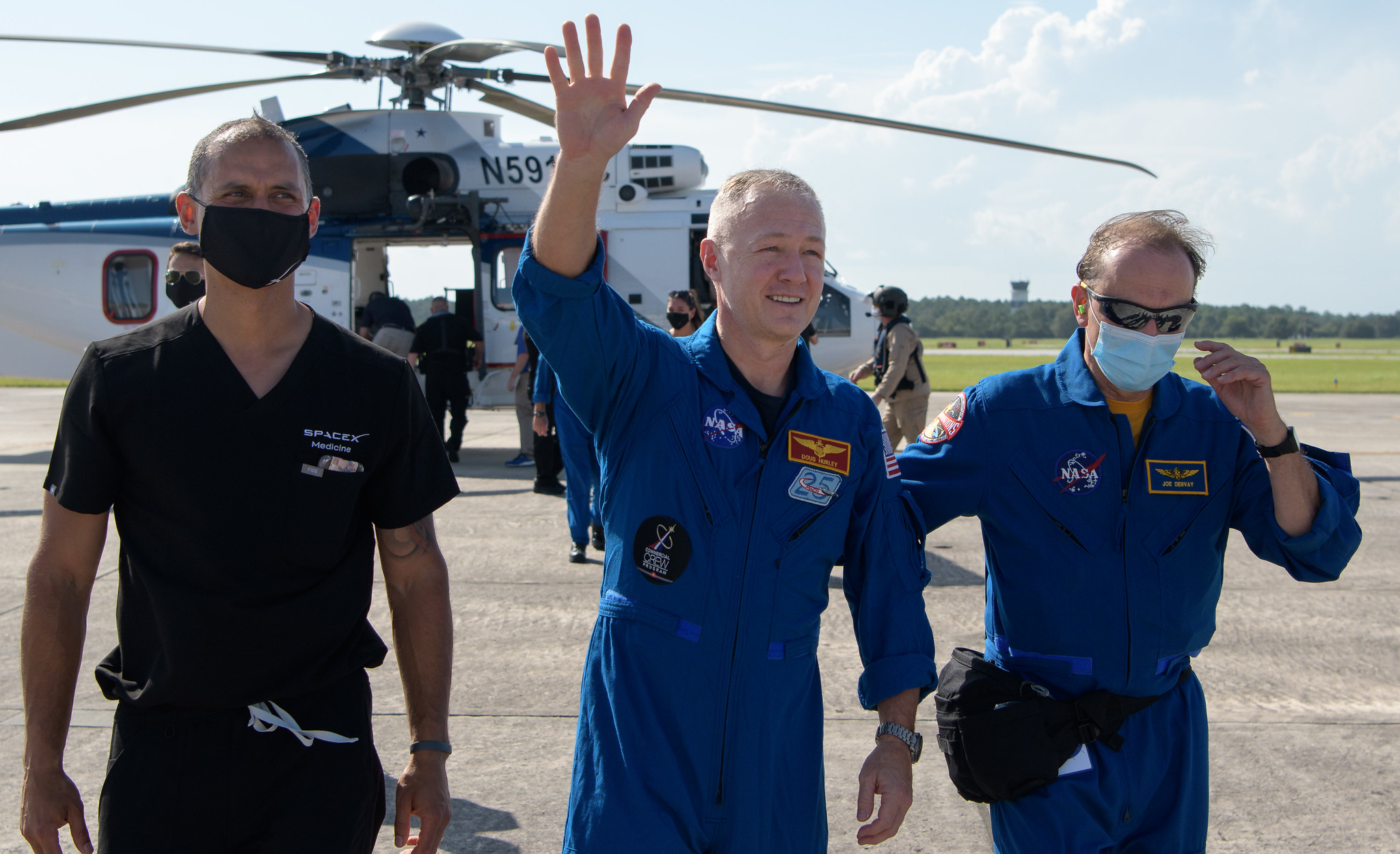
Menon, left, escorts NASA Astronaut Doug Hurley shortly after the Demo-2 mission landed in 2020.
Credit: NASA
Menon, left, escorts NASA Astronaut Doug Hurley shortly after the Demo-2 mission landed in 2020. Credit: NASA
“It was the busiest and most fun time I’ve ever had in my life,” Menon said. “Demo-2 was such a highlight, being part of that team to get this launch to happen. It was always right around the corner but also seemed like it was 10 years away.”
As all of this was happening in 2020, NASA opened yet another round of applications for what would become its 23rd astronaut group. So, with the pandemic raging and Menon swamped with emails from fellow SpaceXers about personal and professional questions while trying to clear Dragon for flight, he contemplated reopening a painful chapter in his life—the astronaut application process.
He was now in his early 40s, having moved his family across the country less than two years earlier. The question he could not get past was, “At the end of my life, would I regret not at least throwing my hat in?” And so he did. alongside more than 12,000 other people from the United States.
This time, he had a new attitude. He meditated to gain self-belief that he was good enough for the job. Menon also worked on his interviewing skills, which he felt had undone him before.
Not one, but two Menon astronauts
A year and a half later, he and Anna were taking a break from work with some of their SpaceX friends at Big Bear Lake, in Southern California. It was a Friday afternoon, and when a Houston area code popped up on his phone, Menon did not think much of it. The couple was in the midst of finally selling their Houston home, and he’d been getting a lot of spam calls related to the sale.
He decided to answer anyway, and the caller turned out to be Reid Wiseman, chief of the Astronaut Office at Johnson Space Center. Although Menon had not expected a decision on astronaut selection to come so soon—the process had been delayed by months due to the difficulty of in-person meetings during the pandemic—his hopes rose immediately.
But Wiseman wanted to talk about something else. “What’s going on with Dragon’s toilet?” he asked. Restroom facilities on Dragon, like with almost every other human spacecraft since the beginning of time, were proving troublesome.
“And I was like, this isn’t it,” Menon said. “He just wants to know about the toilet. I started explaining stuff to him, and he let me go on and on for like five minutes. And then Reid said, ‘I’m just kidding. I really want to know if you want to join NASA as an astronaut.’ And it caught me super off guard.”
Menon was at a loss for words. Anna walked into the room they were staying in at that moment and could read her husband’s face like an open book. She started crying, knowing what it meant to him. And he started crying. “It was a crazy, big, powerful moment,” he said.
Soon their lives would take another major twist. As part of her crew operations job at SpaceX, Anna had worked closely with private astronaut Jared Isaacman to help him and his civilian crew prepare for the Inspiration4 mission on Crew Dragon. It flew in September 2021. Isaacman, impressed by her work, asked Menon in December if she wanted to join his next mission.
It came as a total shock. Within a month, Anil had learned he would be an astronaut at NASA, and that Anna would fly on Polaris Dawn with Isaacman. She beat her husband to space by two years, flying a groundbreaking, five-day mission in 2024. A year later, she, too, was selected to become a NASA astronaut.
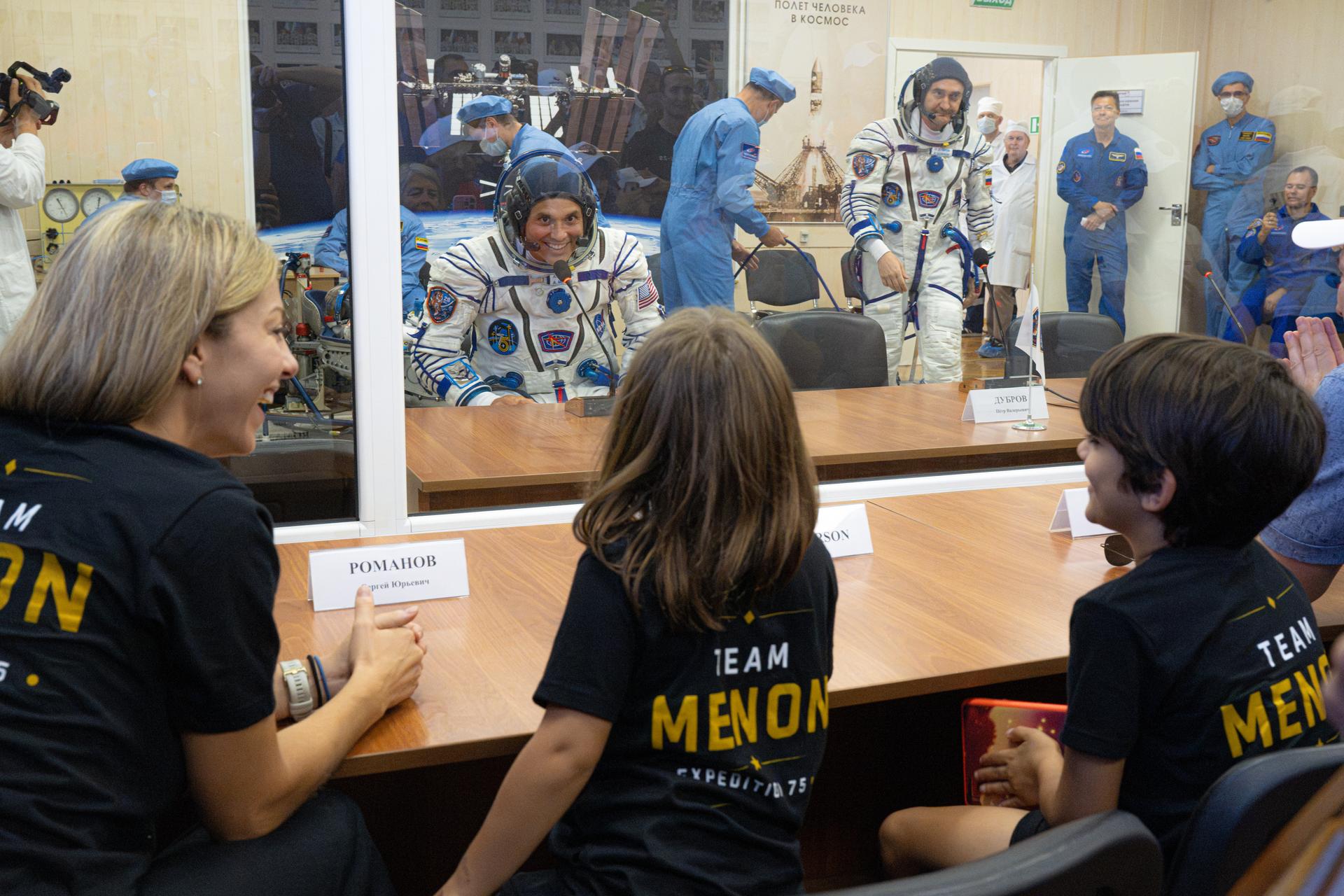
The Menon family says their final goodbyes before launch on Tuesday.
Credit: John Kraus/NASA
The Menon family says their final goodbyes before launch on Tuesday. Credit: John Kraus/NASA
A couple of years ago, Menon was selected for his first spaceflight. Briefly, he was assigned to Boeing’s Starliner vehicle before being moved to a Russian Soyuz vehicle. After working as a flight surgeon to help half a dozen NASA astronauts train in Russia and launch from Kazakhstan a decade earlier, it was his turn.
This weekend, Anna traveled to Baikonur along with the couple’s children, other family members, and friends to see her husband fly into space on Tuesday evening, local time. Among the traveling party was Isaacman, who, however improbably, went on to become NASA administrator last December.
On Monday, the day before launch, Menon and his two Russian crewmates held a final, ceremonial meeting with well-wishers at the Cosmonaut Hotel. Through the glass, Isaacman clearly became emotional.
“Few have ever worked harder in their life to chase their dream,” said Isaacman, speaking both as Menon’s friend and now his boss. “No one has earned this more.”
A day later, Anil Menon launched into space.
Eric Berger is the senior space editor at Ars Technica, covering everything from astronomy to private space to NASA policy, and author of two books: Liftoff, about the rise of SpaceX; and Reentry, on the development of the Falcon 9 rocket and Dragon. A certified meteorologist, Eric lives in Houston.







 English (US) ·