
 2 weeks ago
35
2 weeks ago
35
Let’s start at the very beginning – famously, a very good place to start.
Just two decades after the second world war, a Hollywood crew descended on Salzburg with stars, show tunes and a compelling, essentially true story of love and opposition to Adolf Hitler: The Sound of Music.
The Austrian city, still economically and morally devastated from the Nazi period, wasn’t quite ready to receive them.
Although director Robert Wise was free to make use of the glorious Alpine settings and the old town’s historical facades, scenes such as soldiers marching across the central Residenzplatz under swastika flags made municipal authorities deeply uneasy.
When the film premiered in 1965, it ran for a couple of weeks, closed for lack of ticket sales and largely disappeared from local memory. That is until the tour buses started coming.
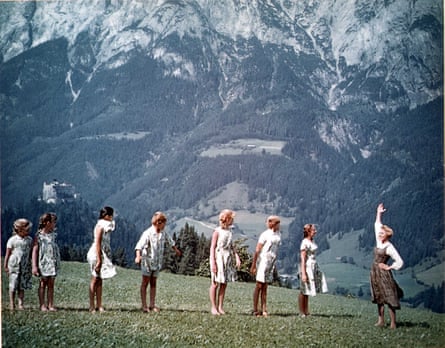
-
Kym Karath, Debbie Turner, Angela Cartwright, Duane Chase, Heather Menzies, Nicholas Hammond, Charmian Carr and Julie Andrews in The Sound Of Music.
Most Austrians – and Germans – still have never seen the five-time Oscar-winning film starring Julie Andrews and Christopher Plummer.
But a new museum in Salzburg dedicated to the movie and its real-life anti-Nazi family of singers now aims to reconcile the global cultural touchstone with its long ambivalent home town.
The road to Austria’s growing embrace traversed dramatic hills and valleys only the budding nun Maria and her cherubic band of charges could properly serenade.
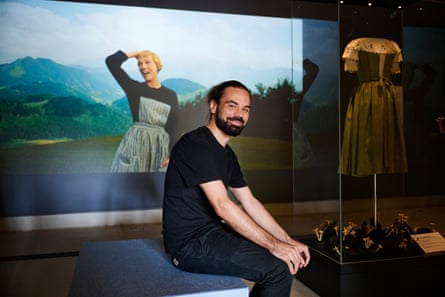
“Beneath all the kitsch, this is also a film about resistance,” co-curator Matthias Bergsmann said on a tour through the exhibition. “It was about saying no to national socialism. And about a family who said: if we stick together we will abide, and music will save us. For all its beautiful images and songs, the film has depth.”
-
Curator Matthias Bergsmann in the Sound of Music museum , Salzburg.
The nearly three-hour opus was rarely shown on Austrian television until a special screening last Christmas for the 60th anniversary. The dubbed film, known as Meine Lieder – meine Träume (My Songs – My Dreams), remains obscure in Germany as well.
The 1959 Broadway musical and subsequent film were based on a popular memoir by Maria von Trapp. In it she described how as a spirited young novice, she was hired by Georg von Trapp, a widowed father who had been a submarine commander in the Austro-Hungarian navy, to care for his seven children.
Trying circumstances and proximity soon gave way to love.
The Nazi annexation of Austria led the family, who had already started performing together in the 1930s, to flee their homeland. Moved by fierce opposition to Hitler as well as financial concerns, they left everything behind to begin new lives in the US as professional troubadours.
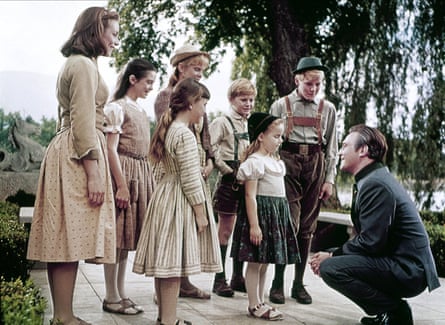
-
The von Trapp family in The Sound of Music, 1965.
Bergsmann said the reasons for the cold shoulder in Austria were not as simple as embarrassment over the Nazi period, particularly considering the glut of second world war films produced in German in the ensuing decades.
“At the time, it was perhaps simply too early to tackle this subject in this way seen as sentimental. Perhaps the wounds were still too deep, or the process of coming to terms with the past was only just beginning.”
He said Salzburgers also quibbled with Hollywood scrambling their landmarks and the von Trapps’ story for the sake of the script, such as having them flee Austria on foot to Switzerland when they actually left for South Tyrol by train.
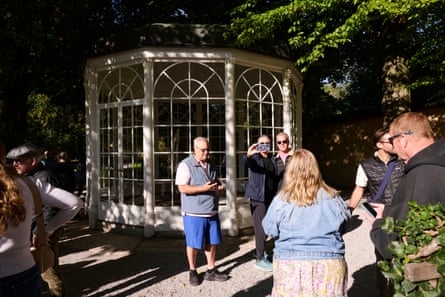
-
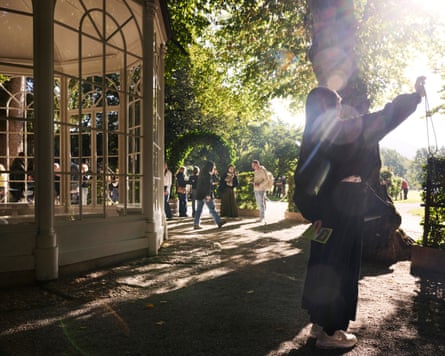
The glass gazebo that inspired the set of the Sixteen Going on Seventeen duet between Liesl and Rolf, as well as Maria and Georg’s first declaration of love.
Days after the opening, the museum was packed with international visitors and a few locals. “It was top of my bucket list, my dream location since I was a kid,” said Jemimah Daniel, 29, a youth librarian from Christchurch, New Zealand. Her partner Rhys Harris, 30, said many parents used to turn off the television during the movie “when the Nazis come”. “So I never knew about that part until when I was an adult and I thought, wow, OK, they actually touch on some real things.”
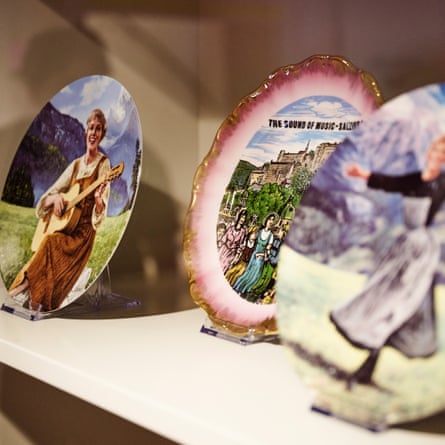
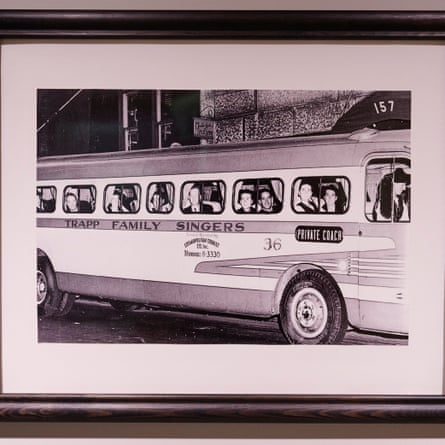
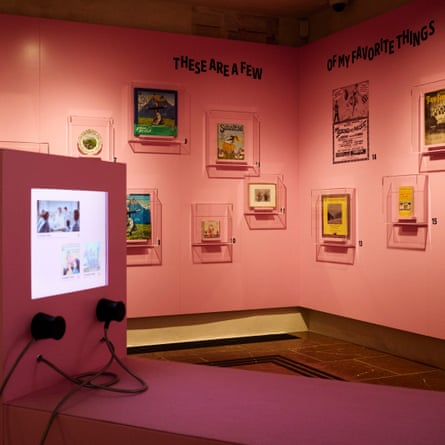
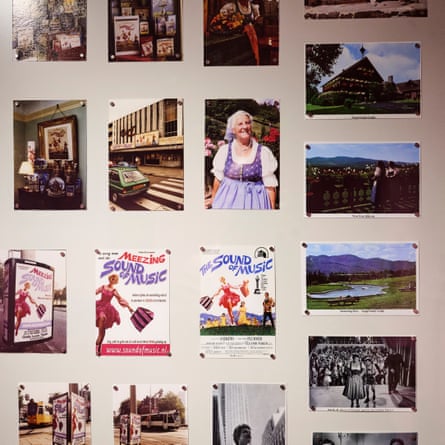
-
Clockwise from top left: vintage memorabilia, framed photo of Von Trapp family in the US, family photos on the wall and illustrations.
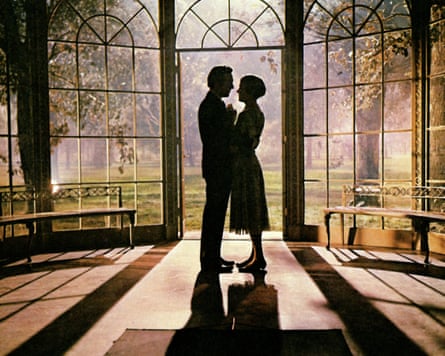
The exhibit is in the coach house and hunting lodge of the majestic 17th-century Hellbrunn Palace, whose grounds were used in the “I Have Confidence” scene in which a euphoric Maria leaves the abbey to become a governess. It also boasts the glass gazebo that inspired the set of the Sixteen Going on Seventeen duet between Liesl and Rolf, as well as Maria and Georg’s first declaration of love.
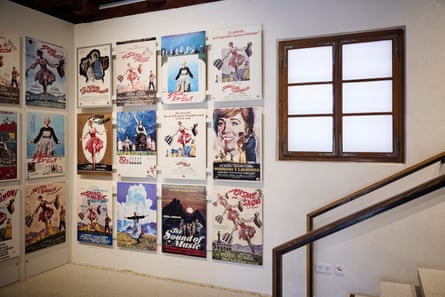
The building work cost €4.6m (£4m) in public funds, while another €1.8m went into the exhibition, including original costumes, film posters and private Super 8 films recorded on set.
-
Clockwise from top left: Sound of Music posters from around the world, a still of Christopher Plummer and Julie Andrews from the film and a visitor takes a selfie by the gazebo.
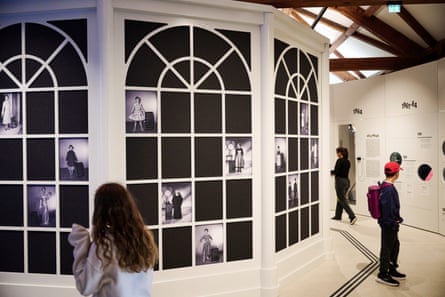
A reconstruction of the gazebo inside shows a restored copy of the playful “Do-Re-Mi” scenes shot at Mirabell Gardens on a loop, and visitors are invited to sing along. Access to the real pavilion outside had to be restricted after too many guests danced in it, causing damage.
-
A reconstruction of the real gazebo.
Upstairs are von Trapp family relics including a winter dirndl worn by the real Maria, Georg’s naval uniform complete with a sabre, and a journal from the von Trapps’ flight to the US.
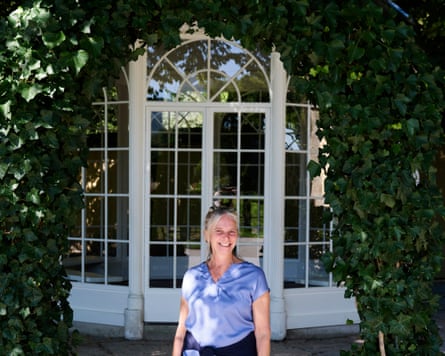
Caroline Dolley, 55, a companion for elderly people from Chester, England, called the museum “a joyful place”: “I only recently watched The Sound of Music in its entirety for the first time ever. It’s stood the test of time really well.”
-
It’s ‘a joyful place’, said Caroline Dolley.
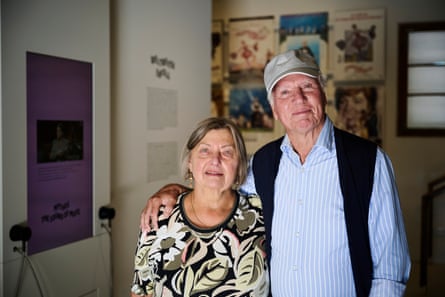
Helmut and Margarete Zoufall, native Salzburgers, wanted to learn more about the film after decades watching giddy tourists “hop around” on the city monuments. “I remember in the 1970s Americans coming into a record shop and asking for the Austrian national anthem – they thought it was ‘Edelweiss’!” Margarete, 73, said, laughing.
-
Margarete and Helmut Zoufall.
Helmut, 81, remembered seeing the movie crew at Nonnberg’s hilltop abbey as a young man. “It was always said that the film was made too soon after the war. People were starving and didn’t want to be reminded of that period,” he said. “But time has passed.”
Dutch child psychotherapist Weeke von der Kooi, 66, said she loved the movie for its “romance and hope” but never knew it was based on a true story. With rightwing extremism on the rise again, she said, “it’s like history repeating – it’s awful”.
-
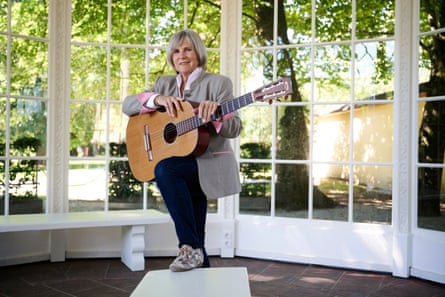
Elisabeth von Trapp.
Elisabeth von Trapp, a granddaughter of Georg and his previous wife Agathe, divides her time between Vermont and Salzburg, where she offers guided tours. Although the movie made her family world famous, she said it irked them that their story got warped by Hollywood. “When they saw the film, they were going, ‘that’s not how I experienced it’,” von Trapp, 72, said, citing for example the captain’s inaccurate portrayal as harsh and remote. “I’m so thrilled that they have a section in this exhibit that tells their true story.”
She is grateful Austrians are restoring the von Trapp legacy in their homeland. “I just hope this museum will help say, ‘look, this family was from your own back yard’,” she said, describing their story as a “wake-up call” in a fraught political age. “They returned in 1950 and sang three major concerts in Salzburg. They had a clarion call saying it’s time to rebuild and that whatever happened during those years shall not happen again.”
Social media has recently ignited interest in The Sound of Music among younger audiences, particularly in southeast Asia, Bergsmann said. The timeless Rodgers and Hammerstein songs fly on YouTube, and a scene in which Georg rips down the Nazi flag and tears it in half became a go-to gif for opponents of the far right.
Plans for the museum date back to the 1980s. Beyond finding the right spot, lining up government financing and resolving copyright concerns took decades. The museum will cater to the estimated 300,000 people who come to the city each year primarily for its associations with the film – roughly holding its own with native son Wolfgang Amadeus Mozart in terms of local attractions, Bergsmann said.


 English (US) ·