Dyah (pronounced Dee-yah) is a Senior Author at Collider, responsible for both writing and transcription duties. She joined the website in 2022 as a Resource Writer before stepping into her current role in April 2023. As a Senior Author, she writes Features and Lists covering TV, music, and movies, making her a true Jill of all trades. In addition to her writing, Dyah also serves as an interview transcriber, primarily for events such as San Diego Comic-Con, the Toronto International Film Festival, and the Sundance Film Festival.
Dyah graduated from Satya Wacana Christian University in October 2019 with a Bachelor's degree in English Literature, concentrating on Creative Writing. She is currently completing her Master's degree in English Literature Studies, with a thesis on intersectionality in postcolonial-feminist studies in Asian literary works, and is expected to graduate in 2026.
Born and raised between Indonesia and Singapore, Dyah is no stranger to different cultures. She now resides in the small town of Kendal with her husband and four cats, where she spends her free time cooking or cycling.
Some shows were simply meant for their time. HBOredefined what a drama series could be and how it transcends different genres. Whether it's a show about womanhood or a fictional sci-fi realm, there is always drama rooted in humanity. However, considering HBO's penchant for realism, many of its shows also reflect the values that were prevalent during the era of their premiere.
While their debuts helped revolutionize television thanks to their bold, unapologetic approach, some of these series don't hold up as well for today's audiences. In some cases, it's due to questionable creative decisions; in others, real-life controversies have changed how viewers see them. Without further ado, here are the HBO shows that have aged like milk.
Since then, the series has introduced several new storylines, but some of them ended up feeling unfinished. One of the many instances is when Cersei Lannister (Lena Headey) was pregnant again, most likely by her twin brother Jaime (Nikolaj Coster-Waldau). This confused many viewers because Maggy the Frog's (Jodhi May) prophecy said that Cersei would only have three children. Other stories also fizzled out, including Arya Stark's (Maisie Williams) rushed training with the Faceless Men and the abrupt defeat of the Night King.
'Westworld' (2016–2022)
Image via HBO
Season 1 of Westworldis a complete package, with a clear beginning, middle, and end. The show follows the grieving and disillusioned Ford (Anthony Hopkins), who searches for a new purpose in life. Along the way, the story explores themes such as oppression, consciousness, and what it means to be human. These ideas become the philosophical foundation of the show, but the series begins to struggle with them in later seasons.
Starting in Season 2, Westworld introduces more abstract ideas, but it rarely provides strong arguments to support them. The season explores a cynical view of humanity, yet it never fully justifies that perspective. By Season 3, the character writing also loses much of its emotional impact. For example, Bernard's (Jeffrey Wright) storyline lacks direction, and much of his role is reduced to chasing Dolores (Evan Rachel Wood) while traveling with Stubbs (Luke Hemsworth).
'Girls' (2012–2017)
Image via HBO
Often described as a modern version of Sex and the City, Girls follows four women in their 20s as they navigate their lives in New York City. The show is the embodiment of the 2010s millennial experience, taking place during the early days of social media, the rise of the gig economy, and the financial uncertainty that followed the recession. While these themes reflected real struggles for young adults, some parts of the show feel less relevant to today's more socially and politically aware audiences.
Critics often labeled the characters as "unlikable," but that is never the real issue. The bigger problem was how narrow their perspective was. The characters mostly represent a privileged, predominantly white group. For a series set in Brooklyn, a borough known for its diversity and large immigrant communities, the nearly all-white main cast felt underrepresented in New York City. When the show did diversity, such as Donald Glover's brief role as a love interest, it often came across as tokenism.
'Entourage' (2004–2011)
Image via HBO
Entourage tells the story about chasing Hollywood dreams and was loosely inspired by the experiences of Mark Wahlberg. Following rising actor Vincent "Vinnie" Chase (Adrian Grenier), he doesn't want to enjoy success alone. His solution is to bring his childhood friends with him to Los Angeles. Although their camaraderie is meant to represent loyalty and friendship, their little boys' club ends up being exclusionary and, at times, insulting.For a series that tries to poke fun at Hollywood's shallow culture, it often ends up reflecting the same problems it's mocking, especially its lack of gender balance.
Today, Entourage would probably face more criticism for its hyper-masculine culture, which often comes across as homophobic and misogynistic. Ari Gold (Jeremy Piven), despite being one of the show's guilty pleasures, frequently mocks his openly gay assistant by using slurs. Vincent and his friends also tend to judge success by how many women they sleep with. Female characters rarely have their own storylines and mostly exist to support the group's bachelor lifestyle.
'The Newsroom' (2012–2014)
Image via HBO
An Aaron Sorkinscreenplay is bound to be political, and The Newsroom does just that. Following cynical news anchor Will McAvoy (Jeff Daniels), the series shows him and his staff under the pressure of the journalism industry. In a way, The Newsroom presents Sorkin's idealism about how a newsroom should operate.In television terms, that often means taking the riskiest, boldest decisions — ones that could put journalists' careers in danger.
Not all audiences are drawn to this idealized portrayal of journalism. Real journalists have commended the show for highlighting a side of the profession that is often overshadowed: the realistic, sometimes boring yet enriching grunt work to form one cohesive story. While news reporting is indeed a line of work that demands accountability and the utmost seriousness, McAvoy's self-righteousness and his penchant for lecturing others about the proper way of doing things undermine the public's understanding of the profession.
'True Blood' (2008–2014)
Image via HBO
When True Blood entered HBO's roster in 2008, it immediately sank its teeth into audiences. Following telepathic waitress Sookie Stackhouse (Anna Paquin), the show begins when she becomes fascinated with vampires after meeting Bill Compton (Stephen Moyer). At the height of the late-2000s vampire craze, the world was hooked on its guilty pleasures of steamy romance, bloody violence, and supernatural politics, all of which felt new and exciting at the time.
Unfortunately, with True Blood being part of the public's wider obsession with vampire media — ranging from the Twilightfranchise to The Vampire Diaries — the show kept trying to raise the stakes. As a result, it gradually moved away from its small-town Louisiana setting and expanded its plots to such an extent that it lost its core story. In an attempt to keep things fresh among the competition, long-term characters were subjected to numerous inconsistent plot twists. The seductive appeal slowly disappeared, replaced instead by a more soap-opera-like, melodramatic tone.
'The Deuce' (2017–2019)
Image via HBO
An exploration of New York's porn industry in the 1970s, the premise of The Deucealone is already a risk. Unfortunately, for a show that requires sensitivity in the matter, the real-life controversy surrounding its star, James Franco, brought the series down. Ironically enough, Franco, who played morally ambiguous characters like the Martino brothers, faced several allegations of sexual misconduct.With The Deuce bringing up topics of sexual exploitation, Franco's inappropriate behavior immediately gave the show a notorious reputation.
Considering the two creators of The Deuce are men, the show is not always nuanced in its examination of the 1970s sex trade.Its focus on violence feels creepily indulgent, and many of these scenes involve women of color. Instead of presenting situations that encourage audiences to think critically, the exploitation sometimes comes across as voyeuristic. With characters profiting off sex work — something that The Deuce sympathizes with — it does not always present the subject in a way that is mindful of the risks involved.

 Image via HBO
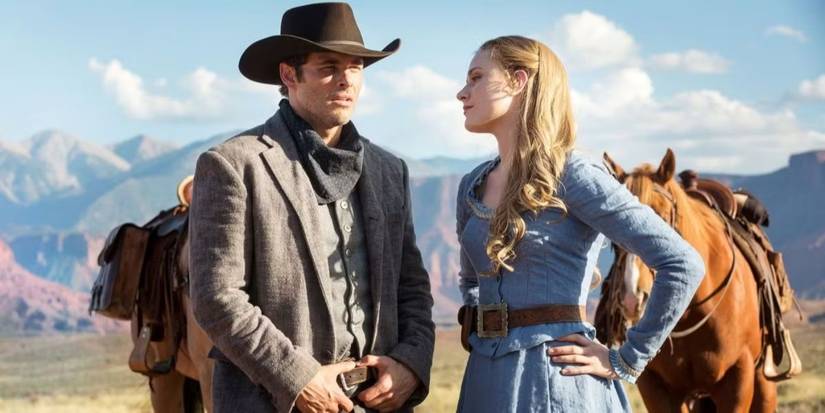 Image via HBO
 Image via HBO
 Image via HBO
 Image via HBO
 Image via HBO
 Image via HBO





 English (US) ·