
 Image via Columbia Pictures

Published Feb 19, 2026, 3:48 PM EST
Jeremy has more than 2300 published articles on Collider to his name, and has been writing for the site since February 2022. He's an omnivore when it comes to his movie-watching diet, so will gladly watch and write about almost anything, from old Godzilla films to gangster flicks to samurai movies to classic musicals to the French New Wave to the MCU... well, maybe not the Disney+ shows.
His favorite directors include Martin Scorsese, Sergio Leone, Akira Kurosawa, Quentin Tarantino, Werner Herzog, John Woo, Bob Fosse, Fritz Lang, Guillermo del Toro, and Yoji Yamada. He's also very proud of the fact that he's seen every single Nicolas Cage movie released before 2022, even though doing so often felt like a tremendous waste of time. He's plagued by the question of whether or not The Room is genuinely terrible or some kind of accidental masterpiece, and has been for more than 12 years (and a similar number of viewings).
When he's not writing lists - and the occasional feature article - for Collider, he also likes to upload film reviews to his Letterboxd profile (username: Jeremy Urquhart) and Instagram account.
He has achieved his 2025 goal of reading all 13,467 novels written by Stephen King, and plans to spend the next year or two getting through the author's 82,756 short stories and 105,433 novellas.
Sign in to your Collider account
You probably know the deal with Stephen King by this point, right? In case you don’t, somehow, he’s incredibly prolific, and he’s also incredibly popular, as an author, when it comes to movie adaptations. The sheer quantity of books he’s written over the past 50+ years has quite a bit to do with that, as there are almost 70 novels that have his name on the front, and then many more novellas and short stories. Some of these shorter stories of his are indeed large enough to translate to something feature-length, and then plenty of his longer books have, for better or worse, been condensed and/or split into multiple movies – see It and It Chapter Two, for example.
There are probably more Stephen King stories that work better on the page than on the big screen, and a fair few (more than some might be willing to admit) that are about equal in quality. Below, though, are the movies that go one step beyond, and potentially even improve on the source material. Now, there aren’t many that do that. To be transparent, five of these are very good (or even great) stories in their original form that are only a little better as movies. And even then, some of those picks are hot takes, but it should be stressed that for those five, it’s a case of still saying, “Yes, King’s original stories are great.” And then there’s one movie here that was a mess of a book, and maybe slightly less of a mess, as a movie. Still counts, even though that movie’s the odd one out as it is, to put it bluntly, still not technically good.
6 'Carrie' (1976)
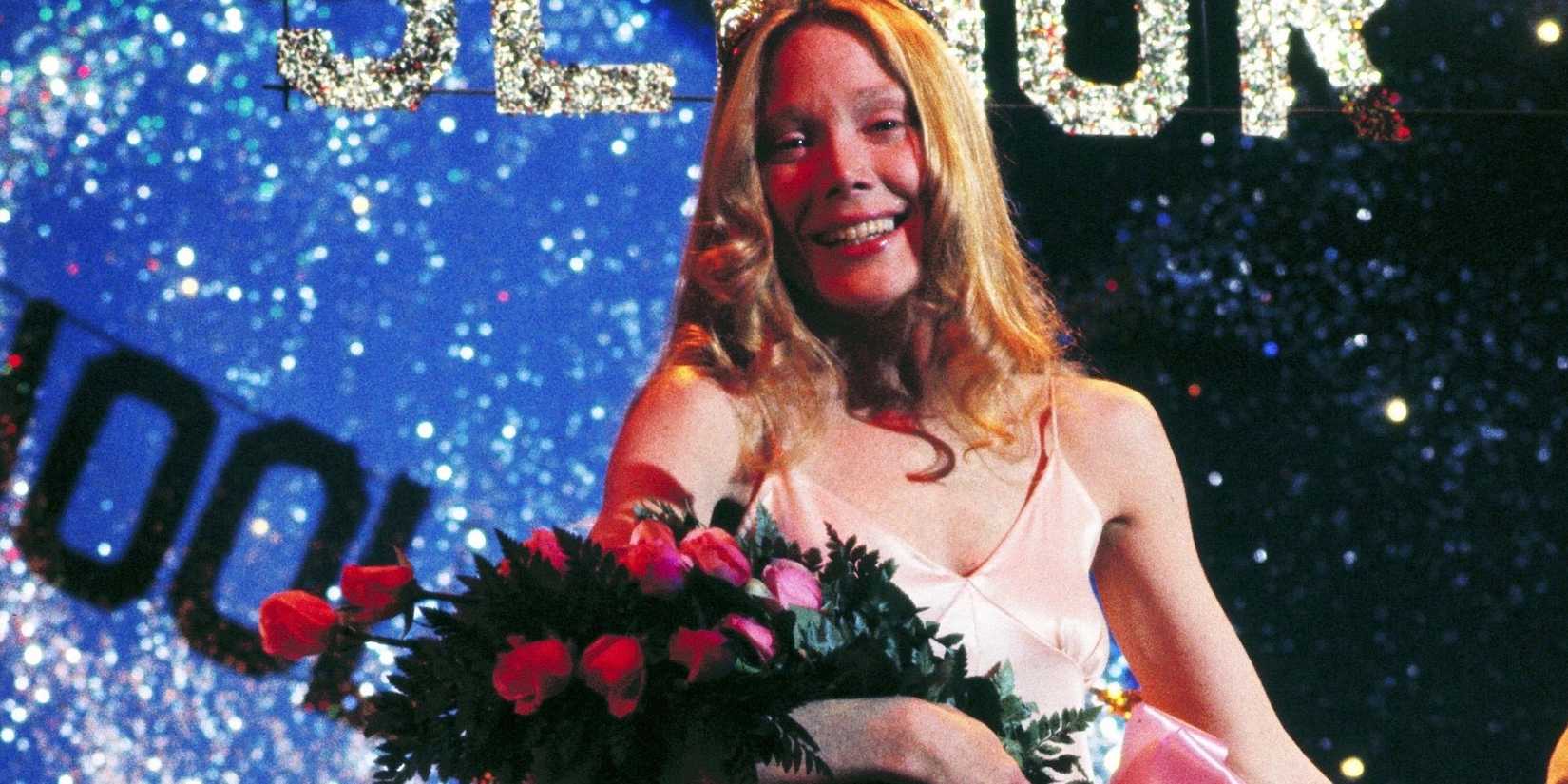 Image via United Artists
The one that started it all, being King’s first novel published, Carrie was also (maybe not too surprisingly) the first story of his to get a movie adaptation. It’s one of those previously alluded to “good book and good movie” situations, and it helps, maybe, that it’s a shorter novel and therefore proved easier to adapt. Even then, there were still things to streamline, and so the question of “which Carrie is better?” comes down to whether you like the more distinct way the story is told on the page, or whether you find the linear storytelling of the movie more effective. Regarding the movie, it’s definitely more surprising.
The most horrific stuff in Carrie comes right at the end, not too surprising for a work of horror, but in the book, you're told more or less what will happen, and the details are unknown. The movie hits harder when it comes to the eventual tragic and horrific stuff, even if there are some interesting stylistic choices that couldn’t really be showcased in a movie, versus in the form of a novel. That’s the only thing that makes the upcoming miniseries adaptation sound potentially interesting, but even then, they're probably going to have to add quite a lot, since the book’s a slim 200-ish pages. As for the other movie adaptations of Carrie, forget about them. The one from 1976 is all you need, really.
5 'Dreamcatcher' (2001)
 Image via Warner Bros. Pictures
This is the not very good one. It’s Dreamcatcher. Dreamcatcher is a mess of a book, truth be told, but it’s got some sort of redeeming parts if you're a particularly big Stephen King fan. It’s him tackling aliens again, a bit over a decade on from The Tommyknockers, and doing so with a similarly hazy and almost delirious approach. Things don’t entirely make sense, and they're also hard to summarize, yet maybe that’s the point? Still, it’s hard to have that be the point and have it also be satisfying, so what you get instead is a frustrating read.
They did the best they could with flawed source material, and they do that flawed original book justice, sort of.
So, why put the movie here? It’s a little less painful to get through. Part of that’s the length, since the book is much longer than it needs to be (King can do epics well, but not always), and then the movie is just a bit over two hours. That results in a ton of material getting cut, and it feels for the best. What’s retained is not exactly great, and maybe not even good, but they did the best they could with flawed source material, and they do that flawed original book justice, sort of. As much justice as was possible (again, not much, but the attempt can be recognized).
4 'The Green Mile' (1999)
 Image via Universal Pictures
The reasoning here is nice and simple. The Green Mile is a serialized novel, and so it was probably best experienced back in 1996, with one part (six all up) released every month or so throughout the year. It was a way for Stephen King to improvise more than usual, and you can kind of tell with small things that happen throughout. There are some minor inconsistencies and a sense of repetition (particularly near the start of every new installment) that can drag the quality down just a little.
If The Green Mile had been written with a little more planning, and maybe slightly tighter editing, it would've been even better. Still, the form it’s in remains pretty great, and certainly very moving either way… it’s just that the movie adaptation was a way to streamline and make things a bit more consistent. In that sense, it’s a slightly more satisfying watch, as a movie, than The Green Mile (1996) is, as a novel. Both are profound and impactful in similar ways; it’s just that the film adaptation is ever so slightly tidier and more efficient.
3 'Stand by Me' (1986)
 Image via Columbia Pictures
It’s hard to put this one here, because the novella Stand by Me is based on (called The Body) is also great, and indeed one of Stephen King’s favorite stories of all the ones he’s written. Still not his very favorite, but up there. And understandably so, given it’s an all-timer of a coming-of-age story, and one of King’s simpler novellas, too. There are four young boys who are close friends, and they set out into the woods on a journey to find a dead body they’ve heard about.
That’s a dark adventure sort of story, just not with the horror elements you might expect from most Stephen King stories. And Stand by Me might well have been the first great non-horror adaptation of a story by King, and it’s honestly hard to fault, as a coming-of-age movie. The original novella is already a compelling and fairly streamlined read, but the movie more so, since it clocks in at just under 90 minutes and really doesn’t waste any of them. Again, it’s a hard example to justify. You're talking a great book and a great movie, with the latter potentially being just a tiny bit greater.
2 'The Shawshank Redemption' (1994)
So, Frank Darabont tackled the previously mentioned The Green Mile, and he was also the director behind The Shawshank Redemption. Further, he did another film adaptation of a Stephen King story in 2007 that’s probably the instance of an adaptation that most improves upon the source material, but let’s not get too far ahead of ourselves. The Shawshank Redemption is sometimes considered one of the best movies of all time, or at least one of the most crowd-pleasing, and it deserves a mention for present purposes.
The original novella, Rita Hayworth and Shawshank Redemption, is also celebrated, so it’s more just the case that the movie is next-level in terms of how it’s appreciated and how it delivers, as a broad and effortlessly appealing drama. It’s got a slightly different ending in the novella, and an arguably more emotionally satisfying one in the adaptation. But maybe this is also a Carrie situation where it’s hard to judge one over the other. Maybe a coin was flipped and The Shawshank Redemption was included here, as a result, instead of being left off. You can’t really go wrong with either the novella or the movie, is perhaps the main thing to take away from all this.
1 'The Mist' (2007)
 Image via Weinstein Company
Though Stephen King’s The Mist (the novella) is pretty good, you're probably not going to find too many people calling it one of the most amazing things he’s ever written. It’s good. It does what it has to as a Lovecraftian sort of horror story, and it reliably puts a bunch of characters in a life-or-death situation, fighting for survival, all that stuff, just not quite as grand as something like Under the Dome. It’s pretty much all set in a supermarket, instead of a town. But in both cases, people are very much trapped and conflict between survivors gets intense.
It just gets a lot more intense, by the end, in 2007’s The Mist. There’s an eerie kind of note the novella ends on, but with enough ambiguity that you don’t necessarily have to read it as downbeat. The movie, on the other hand, is infamous for really packing a punch with how it chooses to end things. That decision is the most discussed part of the adaptation, and for good reason. If the movie ended the same way as the novella, it would probably be a pretty good movie adaptation of a pretty good novella. Yet the risk taken with the whole other approach elevates the film considerably, and makes it perhaps the most striking example of a Stephen King movie adaptation improving upon the source material.

The Mist
Release Date November 21, 2007
Runtime 126 minutes
Director Frank Darabont
Writers Frank Darabont




![20 Years Later, One of the Best Sitcoms of the 21st Century Returns With Hilarious First Look [Exclusive]](https://static0.colliderimages.com/wordpress/wp-content/uploads/2026/02/malcolm-in-the-middle-life-s-still-unfair-feature.jpg?w=1600&h=900&fit=crop)

 English (US) ·