
 3 weeks ago
33
3 weeks ago
33

Published Sep 5, 2026, 5:00 AM EDT
Some inspired hope. Others inspired fear. Together, these five ships transformed how Star Trek told its stories.
 StarTrek.com
Great science-fiction ships are never just transportation. Over time, they become characters in their own right.
The best ships develop personalities, accumulate history, and become inseparable from the people who command them. Long after we've forgotten their technical specifications, we remember the adventures they carried, the sacrifices made aboard them, and the moments that defined the heroes standing on their bridges.
Few franchises understand that better than Star Trek. Every era introduced a ship that expanded the franchise in a different way. Some redefined exploration. Others changed Starfleet forever. That's why the best ships in Star Trek aren't simply the fastest or the most heavily armed. They're the ones that left the biggest mark on the franchise itself.
With that in mind, here are the five greatest ships in Star Trek history.
5 Discovery
 Image: CBS
When Discovery premiered in 2017, audiences were introduced to the USS Discovery and the biggest technological leap the franchise had seen since the warp drive. Thanks to the experimental spore drive, the USS Discovery could instantly jump across the galaxy, fundamentally changing what a Star Trek ship could do.
Whether fans embraced the idea or questioned why such technology disappeared from Starfleet history, the spore drive forced the franchise to rethink the limits of exploration. Just as The Original Series imagined warp drive for a new generation, Discovery imagined a future where distance itself was no longer an obstacle.
4 Defiant
 StarTrek.com
For more than two centuries, Starfleet built ships to explore the galaxy, seek out new civilizations, and make first contact. The USS Defiant represented something entirely different. It was the Federation's first true warship, designed in the aftermath of the Battle of Wolf 359 when the Borg exposed just how vulnerable Starfleet had become. Commander Benjamin Sisko even helped design the prototype himself, creating a ship whose mission wasn't exploration — it was survival.
Everything about the Defiant reflected that purpose. Compact, heavily armed, and equipped with a rare Romulan cloaking device, it was, as Sisko put it, "an overpowered little warship."
Throughout Deep Space Nine, the Defiant became the spearhead of the Dominion War, proving that despite Starfleet's ideals, sometimes humanity needs a ship capable of defending them.
3 Borg Cube
 StarTrek.com
When the Borg Cube first appeared in The Next Generation, it looked exactly like its name: a giant cube drifting silently through space. That simplicity became its greatest strength. It didn't need to look intimidating. It simply was.
The Cube completely changed the stakes of Star Trek. After Q introduced the Borg in "Q Who," Starfleet learned there were threats it couldn't negotiate with or outsmart. That lesson became devastatingly real when a single Borg Cube assimilated Jean-Luc Picard, transformed him into Locutus, and nearly wiped out an entire Federation fleet at Wolf 359 before continuing its march toward Earth.
Unlike the Enterprise or the Defiant, the Borg Cube was never meant to inspire hope. It was designed to inspire dread. It represented an enemy that couldn't be reasoned with, intimidated, or defeated through diplomacy. The Cube forced Starfleet to rethink everything from ship design to military strategy, ultimately paving the way for vessels like the Defiant. Nearly 40 years after its debut, it's still one of the most terrifying starship designs in science fiction and one of the most influential in Star Trek history.
2 Enterprise-D
 CBS via Getty Images
The original Enterprise boldly went where none had gone before. The USS Enterprise-D showed what happened after everyone got there.
When Star Trek: The Next Generation premiered in 1987, Gene Roddenberry's vision of Starfleet had evolved. The Galaxy-class Enterprise wasn't simply a starship. It was a community. Families lived aboard alongside Starfleet officers. Children attended school, civilians worked on board, and Ten Forward became one of television's most memorable gathering places. For the first time, the Federation's flagship felt less like a naval vessel than a city traveling through space.
The Enterprise-D became memorable because it allowed audiences to imagine themselves living there. By the time the saucer section crashed in Star Trek: Generations, it felt less like watching a starship destroyed than saying goodbye to a place that had become home.
1 Enterprise (NCC-1701)
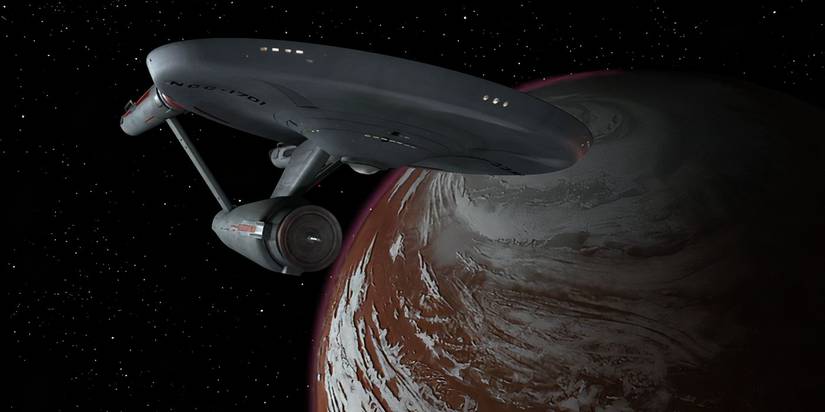 Enterprise at Delta Vega in Star Trek TOS
Every great Star Trek ship owes something to the original USS Enterprise.
When Captain James T. Kirk first took command of the Constitution-class starship in 1966, television had never seen anything quite like it. The Enterprise wasn't simply a setting where stories happened. It embodied Gene Roddenberry's optimistic vision of the future, carrying audiences to strange new worlds while proving science fiction could tell stories about diplomacy, morality, curiosity, and humanity just as effectively as space battles.
The original Enterprise didn't simply define Star Trek. It became the benchmark against which every memorable science-fiction starship would eventually be measured. Larger ships, faster ships, warships, and even vessels capable of instantly crossing the galaxy all entered a conversation the Enterprise began.
Decades later, it's still the image most people picture when they hear "Star Trek." The Enterprise didn't just launch a franchise. It gave science fiction one of its most enduring symbols.








 English (US) ·