
Static Media
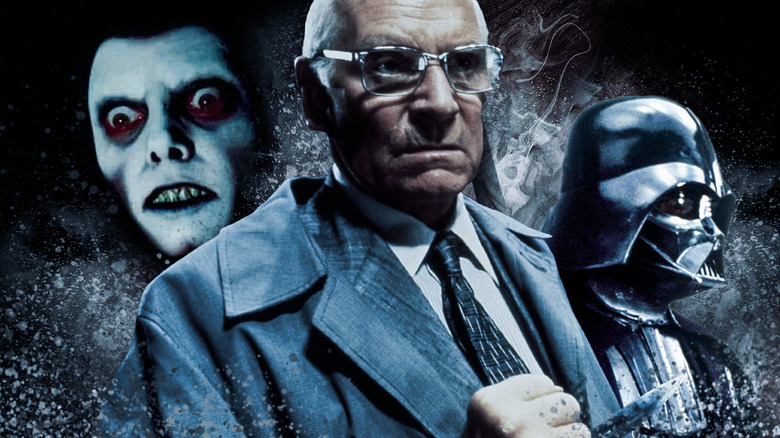
Many film lovers would point to the 1970s as the best decade for American movie-making — and what's a movie without a good villain?
1970s' cinema was the era of the New Hollywood, shepherded by directors raised on movies of the studio system who were ready to break old trends. The censorious Hays Code's hold on Hollywood had been broken, and so movies got darker. Thanks to political corruption like the Watergate scandal, the America of the 1970s was a less trusting, more disillusioned place than before and the movies shifted to reflect that. "Protagonist" rarely meant "hero" and there were no tacked-on happy endings to reassure the audience's faith in justice.
If the heroes of the New Hollywood were dark, the villains were even darker. Again, the end of the Hays Code meant that bad guys could be truly heinous and scary; crimes and violence once confined to subtext could be shown onscreen. The great films of the 1970s range from crime dramas to horror to science fiction, and the great villains of those movies are similarly eclectic. Here are five '70s movie villains who stand head and shoulders above the rest.
5. Christian Szell (Marathon Man)
Paramount
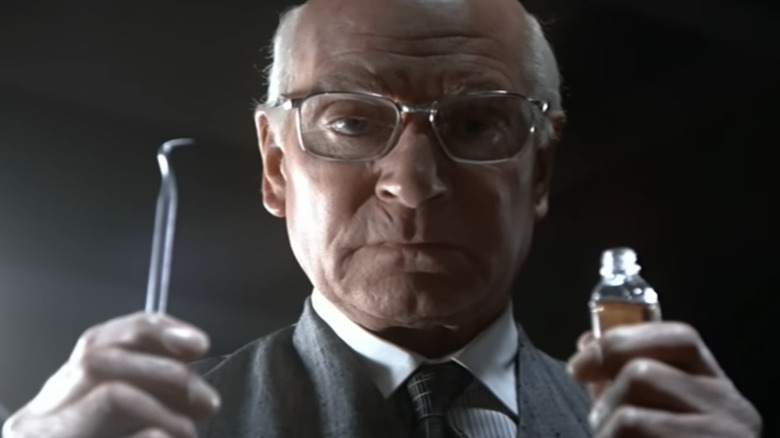
Nowadays, "Marathon Man" is most-remembered for an anecdote about Sir Laurence Olivier's wisecrack at Dustin Hoffman's method acting: "My dear boy, why don't you just try acting?" Olivier definitely did more than just "try" to act on the picture.
The thespian played the film's villain: Dr. Christian Szell, "der weiße Engel" (the white angel). A war criminal and former Nazi concentration camp officer, Szell fled Germany for South America after World War 2. Szell comes to New York City seeking a safety deposit box filled with diamonds, but he can't stop looking over his shoulder, fearing he might be identified. "Is it safe?" Szell always asks, because for him, the answer can never be yes.
Nazi officers escaping to South America is a story with true history behind it, one that many films have used, not just "Marathon Man." Remember, in 1975, World War 2 and the atrocities of the Third Reich were a living memory for many more people. ("Marathon Man" director John Schlesinger, writer William Goldman and Hoffman were all Jewish, as is Hoffman's character Babe Levy, meaning the choice to depict this living history must've carried extra weight for them.)
Szell represents a ghostly evil returned, in particular one especially brutal part of this history: the Nazis' policy of yanking out concentration camp prisoners' gold tooth fillings, to be converted into bullion. Szell, a dentist by trade, was one of the men who performed such operations and reaped the stolen wealth.
When he and his men capture Babe, Szell gives him a surprise check-up and carves into his teeth. A normal trip to the dentist can be nerve-wracking enough, but the thought of letting Szell's dental tools anywhere near your mouth will have you squirming in your seat just like Babe.
4. Pazuzu (The Exorcist)
Warner Bros.
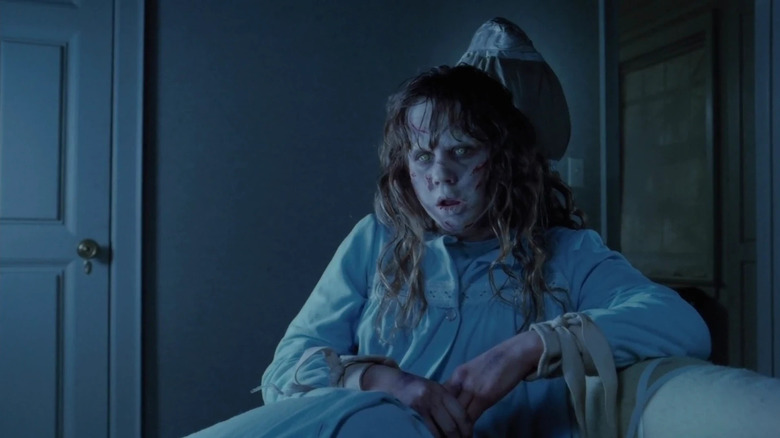
The 1970s had some great horror films, but William Friedkin's "The Exorcist" tends to take the crown as the best scary movie of that decade. Just as terrifying today as it was in 1973, "The Exorcist" is absolutely the peak of its era's religious horror trend, preceded by "Rosemary's Baby" and to be followed by "The Omen." Whereas those movies are about the Antichrist, the evil child of "The Exorcist" is not evil by nature; the demon Pazuzu has possessed young Regan MacNeil (Linda Blair), daughter of actress Chris MacNeil (Ellen Burstyn).
"The Exorcist" offers only the briefest flash of what Pazuzu's true demonic form might be, leaving Blair and voice actor Mercedes McCambridge to carry those horrors. With telekinetic powers and the ability to twist Regan's body in inhuman shapes, Pazuzu is quite comfortable where he is. He's got no intention of freeing Regan or easing the torment on those around her. Can even God's power save her?
The growl of an old crone coming out of this little girl feels so wrong. A child dropping F-bomb after F-bomb in a horrible voice could be comical, but here it's bone-chilling. Regan's physical deterioration, growing ever paler and scabbier skin with yellow eyes and grimy teeth, ties into the other fear Pazuzu embodies. "The Exorcist" is not purely a Catholic scare picture suggesting evil will steal our children away, it's a metaphor for illness. One of a parent's worst nightmares is for their child to fall seriously ill, as it leaves them utterly helpless to relieve their child's pain. That's exactly what happens to Chris. Regan's infliction just happens to come from the bowels of Hell.
3. Darth Vader (Star Wars)
Lucasfilm
It's not hyperbole to say Darth Vader is the biggest villain in all of popular culture. But, considering the confines of this list, let's judge him only by his appearance in the original 1977 "Star Wars." Forget the sequels and prequels to come, forget the truth of who Luke Skywalker's (Mark Hamill) father is, and consider, how does Vader stack up as a bad guy based on "Star Wars" alone? Pretty damn well.
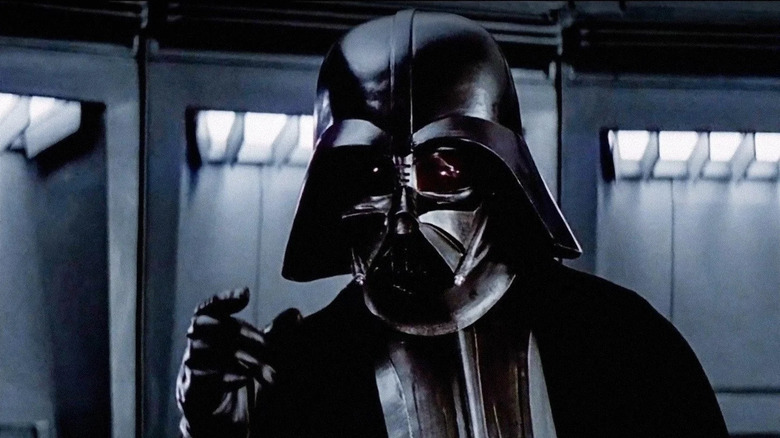
Vader is one of the first characters we see in "Star Wars," when he emerges from smoke to enter the fleeing rebel ship. His debut serves as a powerful hook for the audience. From his imposing black armor (carried with flair by actor David Prowse) to his heavy breathing, we want to know what this guy's deal is. When we hear the baritone of James Earl Jones from behind Vader's mask, we want to know even more!
Vader's costume is so iconic now that it almost transcends critique, but it truly was an impressive feat of costume design. He resembles a samurai, a black knight, and an alien warlord all at once, and his skull-like breathing mask is so perfectly villainous. Even with the technical and budget constraints limiting Vader's power onscreen, "Star Wars" shows the character's to-be-trademark wrath, pride, and dry wit.
Vader delivering the first demonstration of the Force by choking a sneering Admiral Motti (Richard LeParmentier) for his disturbing lack of faith? No-one has ever forgotten that. As the fallen Jedi apprentice of Luke's mentor Obi-Wan (Alec Guinness), Vader is set up as the perfect foil for our hero — but at the same time, he was enough of a mystery for sequels to invent a man behind the mask.
2. Noah Cross (Chinatown)
Paramount
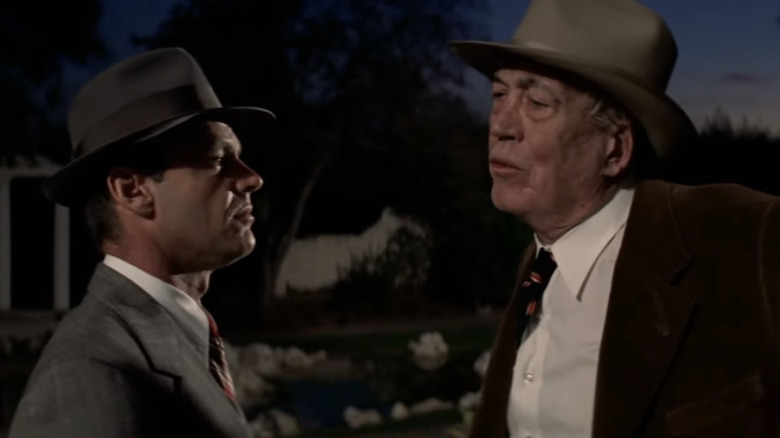
Noah Cross (John Huston), twist villain of 1974's "Chinatown," has only a few scant minutes onscreen and yet remains one of the most deplorable evildoers in all of cinema. "Show don't tell" is evergreen writing advice, but "Chinatown" offers a compelling counterargument. When Cross' daughter Evelyn (Faye Dunaway) drops the bombshell that Kathryn (Belinda Palmer) is "my sister and my daughter," horror and revulsion goes right through your dot-connecting brain.
Yes, the avuncular businessman Noah Cross raped his own daughter. Cross' other crimes are numerous. He murdered Evelyn's husband Hollis Mulwray (Darrell Zwerling) personally, not even keeping the blood off his hands (if not soul) with a hitman he could definitely afford. He's also a swindler en masse, diverting water from farm land to purchase it (literally) dirt cheap and then develop it, all in the name of buying "the future." But even those horrific crimes look like small potatoes next to his parenting. And he's not done, because he wants to abuse Katherine like he did Evelyn.
Even scarier than Cross' actions is the fact that, like so many other powerful and monstrous men, he gets away scott free. Is there a more sickening ending than him spiriting a screaming Katherine away, his hand covering her mouth, all with plenty of police watching? As Cross isn't shy about saying, he's old, and he suggests that age and money only made him into a monster.
"Most people never have to face the fact that at the right time and the right place, they're capable of anything," Cross says to Jake Gittes (Jack Nicholson). Are they, though? Greed engenders more and more perverse greed. Does America shape rich men into villains like Cross as they attain power, or does it allow men like him to grab that power?
1. Michael Corleone (The Godfather)
Paramount
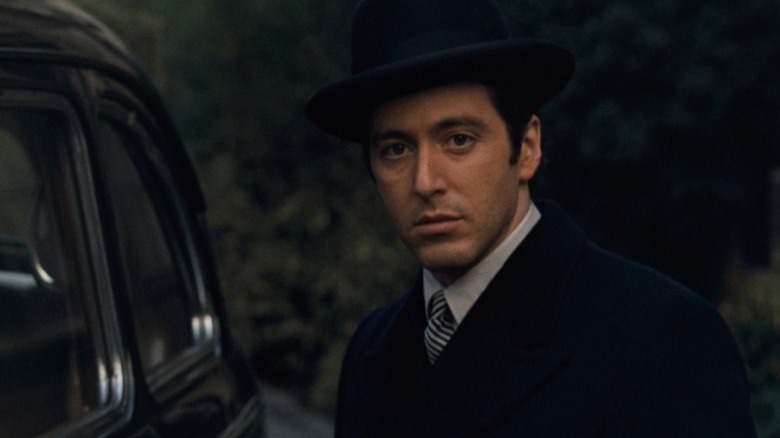
There's no better film of the New Hollywood era than Francis Ford Coppola's 1972 classic "The Godfather," and no character who better embodies its subversive storytelling than Don Michael Corleone (Al Pacino) — the hero and villain all in one. Since the 1990s, the antihero has increasingly become the domain of television (see: "The Sopranos," "Breaking Bad," etc). But it was film, specifically the saga of Michael Corleone, that set the blueprint.
"The Godfather" is a tragedy, a fall from grace for a crime family's white sheep. Michael begins as a war hero, but after an assasination attempt on his father, Vito (Marlon Brando), he gradually becomes not just the Godfather's son, but his heir.
The movie's title, on the surface, refers to Vito. Yet, keep in mind the baptism scene where Michael (godfather to his nephew) renounces evil. Meanwhile, a montage shows Michael's enemies being murdered on his orders. With his rise to power and moral descent completed, "The Godfather Part II" is an epic of Michael's coldhearted ruthlessness. The climax of his arc is his greatest sin: he orders his own brother, Fredo (John Cazale), murdered.
1990's "The Godfather Part III" explored an aged Michael's heavy guilt. Really, though, the ending of "Part II" — where a pensive Michael sits silent and alone, clearly unconvinced the power was worth it — conveys that too. In the mob, living with your victory is the punishment.

 English (US) ·