
 3 hours ago
7
3 hours ago
7

Published Oct 17, 2026, 5:00 AM EDT
Has every strip for the last 37 years been set in a cat's delusions?
 Image: Project G Productions
In 2012, Randall Munroe introduced the concept of "today's lucky 10,000" in his webcomic xkcd. He posits that any widely-known fact or idea spreads at a rate of roughly 10,000 people per day. There's really no such thing as something that "everyone knows." If someone you know isn’t familiar with something that you think is obvious, that’s not a failure of theirs. It just means they’re one of the people who get to learn about it today.
If you pay attention to online pop culture, especially on social media and microblogging platforms, you can often see some version of Munroe's lucky 10,000 theory in real time, as new audiences constantly rediscover old material.
One of the best examples of this recycling process comes from, of all places, Jim Davis's Garfield. 99% of the time, Garfield is a simple gag-a-day comic that relies on a handful of go-to punchlines: an orange cat that eats too much, a stupid dog, and their weird owner. It’s a strip that deliberately revels in the mundane, with jokes about coffee, laziness, and gluttony. Then there's that remaining 1%.
There are a handful of truly weird comics in the back alleys of what one hesitates to call the "Garfield canon." A useful example is the 1984 graphic novel anthology His 9 Lives, which includes a prose detective story, a science fiction parody, a chase sequence, and a weirdly effective horror short. There’s also the animated special Garfield in the Rough, which ends with an actual fight scene between Garfield and a wild panther.
The single strangest story in the actual newspaper comic, however, might be a G-rated horror arc that’s often nicknamed "Alone."
Missing: fat orange cat
 Garfield for October 23, 1989Source: Jim Davis/Paws Inc.
On Oct. 23, 1989, the week before Halloween, readers opened their newspapers to find a distinctly different sort of Garfield. Davis's usual flat 2D layouts were replaced with moody backgrounds and Dutch angles, as Garfield wakes up to find himself alone in an empty house.
Garfield quickly discovers that not only are Jon and Odie gone, but the house looks like it’s been abandoned for years.
 Garfield for October 24, 1989Source: Jim Davis/Paws Inc.
No one has lived there for a long time, including Garfield himself. It's as if Jon and Odie simply got up and walked out at some point years ago. Did they deliberately leave Garfield behind? Is Garfield a ghost? Is this a post-apocalyptic Garfield AU? What’s happening?
 Garfield for October 25, 1989Source: Jim Davis/Paws Inc.
"After years of taking life for granted," the Oct. 28 strip reads, "Garfield is shaken by a horrifying vision of the inevitable process called 'time.' He has only one weapon... denial."
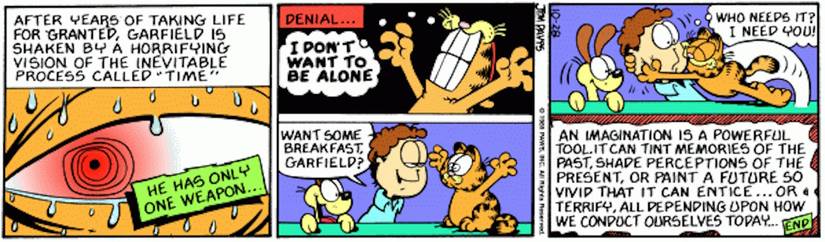 Garfield for October 28, 1989Source: Jim Davis/Paws Inc.
Garfield proceeds to freak out, at which point he seems to return to the present with Jon and Odie. The end. The moral of the story is that you should prize every moment with your loved ones, just in case you suddenly wake up in a dark future where none of you actually exist. (It is not a widely applicable moral.)
"An imagination is a powerful tool," the strip's narrator says to close out the story arc. "It can tint memories of the past, shade perceptions of the present, or paint a future so vivid that it can entice... or terrify."
The most obvious interpretation is that the "Alone" arc was simply a nightmare of Garfield’s. After this, the strip went back to its usual daily routine and has, for the most part, stayed there for 37 years.
That hasn't stopped fans from speculating, of course. Every time "Alone" comes back up in online discourse, a few more people independently conclude that the arc may never have actually ended. For nearly 40 years, this theory argues, every successive Garfield strip has been an elaborate delusion of Garfield's as he wanders through a cold, abandoned house. If the Internet loves one thing, it's dark interpretations of children's media, so the "Alone" theory of Garfield is likely to be with us for as long as Garfield itself.
Davis's only public comment on the "Alone" arc appears to have been in 1998's 20 Years & Still Kicking, a Garfield anniversary collection. That in itself is almost admirable. Davis simply threw these strips into the world like a live grenade, then let them speak for themselves for a full nine years.
"During a writing session for Halloween, I got the idea for this decidedly different series of strips,” Davis wrote. “I wanted to scare people. And what do people fear most? Why, being alone. We carried out the concept to its logical conclusion and got a lot of responses from readers. Reaction ranged from 'Right on!' to 'This isn't a trend, is it?'"
This isn't that out of character for Davis. While he's always been honest about how Garfield was originally made as a commercial enterprise, Davis has occasionally let some high weirdness into the comic. As noted above, that tendency is usually funneled into "safer" media like original graphic novels, but Garfield can go to some dark places (below).
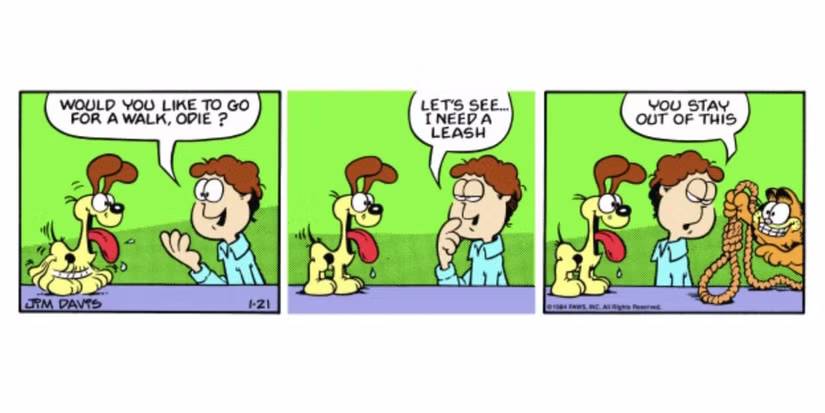 Garfield for January 21, 1984Source: Jim Davis/Paws Inc.
For almost 40 years, though, the "Alone" arc has, well, stood alone. It's a brief dip into surreal horror that makes Garfield feel like a wholly different strip, and new fans will suddenly discover it every few years until the end of time. Maybe that ought to be the next cartoonists' challenge: make a successful children's comic for 11 years, then for just one week, turn it into the scariest thing you can think of.




 English (US) ·