
 1 week ago
26
1 week ago
26
In the 1910s, the United States was pushing a brutal idea wrapped in polished language: assimilation. At the center of it stood the off-reservation Native American boarding school system—one of the most aggressive tools used by the United States government to reshape Indigenous identity. The mission was blunt and cruel: “Kill the Indian, save the man.” And the cost of that mission was paid by children.
Native American kids were taken from their families—often forcibly—and placed hundreds of miles away in rigid, military-style schools. The first thing to go was their hair. Then their clothes. Then their names. Their languages were banned. Their traditions mocked or erased. Everything familiar was stripped away in the name of “progress.”
The photographs from this era are haunting because they were never meant to be. Many of these images were staged, polished, and distributed as propaganda—proof, at least to policymakers, that assimilation was working. Children posed stiffly in uniforms. Classrooms looked orderly. Faces stared straight into the camera, expressionless. To the public, it was framed as success.
But when you look closer, the truth leaks through the frame. The fear in the eyes. The forced posture. The silence. These photos don’t celebrate education—they document loss. They capture the moment when childhood, culture, and identity were systematically taken away.
Today, these images stand as historical witnesses. They tell a story not of improvement, but of survival. Of resilience in the face of cultural erasure. And they remind us that history isn’t just written in textbooks—it’s frozen in faces that were never allowed to smile freely.
#1. Fort Shaw Indian School Basketball Team 1904 World’s Fair
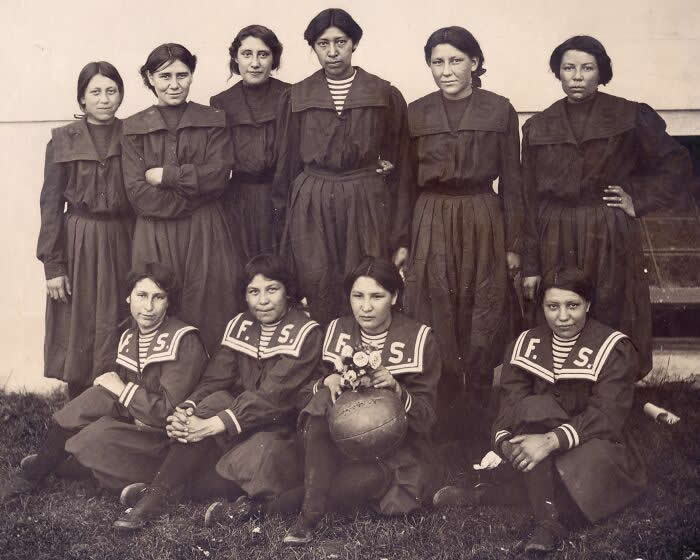
Image Source: Jessie Tarbox Beals
#2. Group Of School Girls, Many Indigenous, At Fort Spokane

Image Source: National Park Service
#3. Before Entering School

Image Source: sapiens.org
#4. While Teaching On The Hopi Reservation In Arizona, Bratley Likely Posed This Image Of His Student Ruth Honavi Having Her Hair Made Up In The Butterfly Style

Image Source: www.sapiens.org
#5. Hotograph Of Children And Grounds Of Carson/Stewart Indian School

Image Source: U.S. National Archives and Records Administration
#6. Young School Grirls Attending Sewing Class At Albuquerque Indian School

Image Source: U.S. National Archives and Records Administration
#7. Students At The Carlisle Indian Industrial School In Carlisle, Pennsylvania

Image Source: J.N. Choate, courtesy of the Cumberland County Historical Society
#8. Carlisle Indian School, Pennsylvania

Image Source: U.S. National Archives and Records Administration
#9. Female Students Posed Outside, Sac And Fox Indian Schools, Oklahoma, Circa 1910s

Image Source: Newberry Library
#10. Carlisle School Students

Image Source: Beinecke Rare Book & Manuscript Library, Yale University
#11. Chiricahua Apaches Four Months After Arriving At Carlisle

Image Source: Beinecke Rare Book & Manuscript Library, Yale University
#12. A Children’s Program; Washington’s Birthday

Image Source: National Park Service
#13. Native American Girls Were Trained To Be Productive, Subservient Homemakers In The Mold Of Victorian Norms

Image Source: sapiens.org
#14. Boys Were Schooled In Farming, Carpentry, And Metalworking

Image Source: www.sapiens.org
#15. Living Conditions At The Schools Were Stark. Children Lay Three To A Bed At The Cantonment Boarding School On The Cheyenne And Arapaho Reservation

Image Source: www.sapiens.org
#16. At The Cantonment Boarding School, Children Erected Play Tipis That Allowed Them Some Measure Of Staying Connected To Their Plains Cultures

Image Source: www.sapiens.org
#17. Very Early Class Of Young Boys With Flags At The Albuquerque Indian School

Image Source: U.S. National Archives and Records Administration
#18. School Girls Participating In A Festival At The Albuquerque Indian School In New Mexico

Image Source: National Archives and Records Administration
#19. Young Native American Children Learn To Sing A Song At The Carlisle Indian Industrial School

Image Source: National Museum of the American Indian photo
#20. Group Of Indian Boys From The Mission School In Sitka

Image Source: U.S. National Archives and Records Administration
#21. Students In An Art Class At Phoenix Indian School

Image Source: Office of Indian Affairs, Department of the Interior
#22. Little Girls Praying Beside Their Beds, Phoenix Indian School, Arizona

Image Source: U.S. National Archives and Records Administration
#23. Mary R. Hyde, Matron, And Students

Image Source: J. N. Choate
#24. Teacher And Young Boys Posed For Photograph At A Native American Boarding School

Image Source: Wikimedia Commons
#25. The Photographer Is Unknown, But It Was Likely Taken By Frank Fuller Avery, The Superintendent Of Fort Spokane Indian Boarding School

Image Source: National Park Service
#26. Children Working In A School’s Garden

Image Source: Wikimedia Commons
#27. A Photo Of Home Economics Class At The Pipestone Indian Training School In Minnesota With Several Girls In Aprons Working On Kitchen Tasks

Image Source: Pipestone County Historical Society via Minnesota Digital Library
#28. Students And Staff Of The Pipestone Indian Training School In Minnesota Posing For A Photo By A School Bus

Image Source: Pipestone County Historical Society via Minnesota Digital Library
#29. Hotograph Of Children And Grounds Of Carson/Stewart Indian School

Image Source: Bureau of Indian Affairs
#30. Photograph Of Children And Grounds Of Carson/Stewart Indian School

Image Source: U.S. National Archives and Records Administration
In Summary
What were Native American boarding schools?
They were government-run schools designed to assimilate Indigenous children by removing them from their families and cultures.
Why were children forced into these schools?
Assimilation policies aimed to erase Native American identity and replace it with Euro-American customs.
Why do these photos feel unsettling today?
They were often propaganda images masking trauma, cultural loss, and forced separation.
Were Native languages allowed in these schools?
No. Speaking Native languages was typically punished.
Why are these photos important now?
They help document historical injustice and preserve the truth of Indigenous experiences.




![20 Years Later, One of the Best Sitcoms of the 21st Century Returns With Hilarious First Look [Exclusive]](https://static0.colliderimages.com/wordpress/wp-content/uploads/2026/02/malcolm-in-the-middle-life-s-still-unfair-feature.jpg?w=1600&h=900&fit=crop)

 English (US) ·