
 3 weeks ago
35
3 weeks ago
35
Quick, comfortable, roomy, and agile for a large electric SUV.
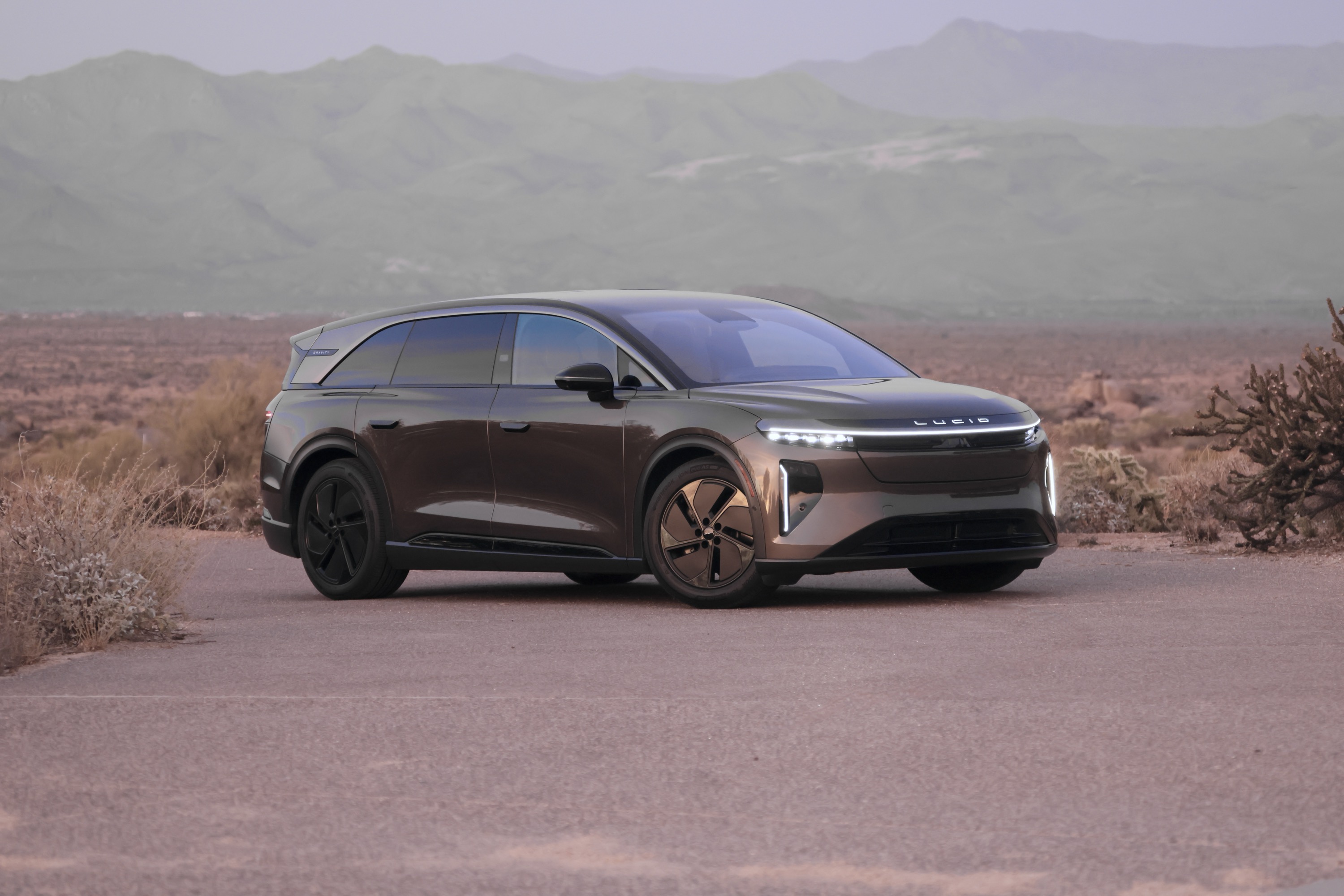
The Lucid Gravity offers huge amounts of interior room. Credit: Jim Resnick
The Lucid Gravity offers huge amounts of interior room. Credit: Jim Resnick
When Lucid introduced the Air electric sedan in late 2021, the first Air Dream Edition I tested packed over 1,100 hp (820 kW) and carried a $180,000-plus window sticker. It’s easily the most powerful street car I’ve tested; the only vehicle I’ve driven with more power was a purebred race car with a third the mass, and it was on a proper track. Its combustion engine was also about 1,000 times louder than the Air, helping to remind us that “combustion” really does mean explosion after explosion.
For Lucid’s second act, the company debuted the Gravity electric SUV last year, and I’ve just tested the 2026 Gravity Touring, which starts at about $82,000 in the US, including the required destination charge.
My test model carried a bevy of options, including a 22-speaker audio system, the Comfort and Convenience package, third-row seating, a Dynamic Handling package (combining rear-wheel steering and three-chamber air suspension), a luxury seating package (bundling Nappa leather and massaging and ventilated front seats), and special metallic paint.
Also fitted was Dream Drive 2.0 Pro, an optional collection of active driver assists beyond the standard fare (adaptive cruise control, lane departure warning and lane keeping, blind spot warning, and drowsy driver alert) to offer hands-free driving assist, automatic lane change assist, and even an alert to warn of impending curb rash while parking. Over-the-air software updates occur automatically. Together, all the options raised our test vehicle’s cost to $107,200.
Lucid also builds a more expensive Grand Touring version, starting at over $100,000. While the Touring uses a 16-module, 89-kWh battery pack, the Grand Touring’s 22-module pack delivers 123 kWh, and power output grows from 560 hp (418 kW) to 828 hp (617 kW). The Touring’s driving range of 337 miles (542 km) increases to 407 miles (655 km) in the Grand Touring, too.
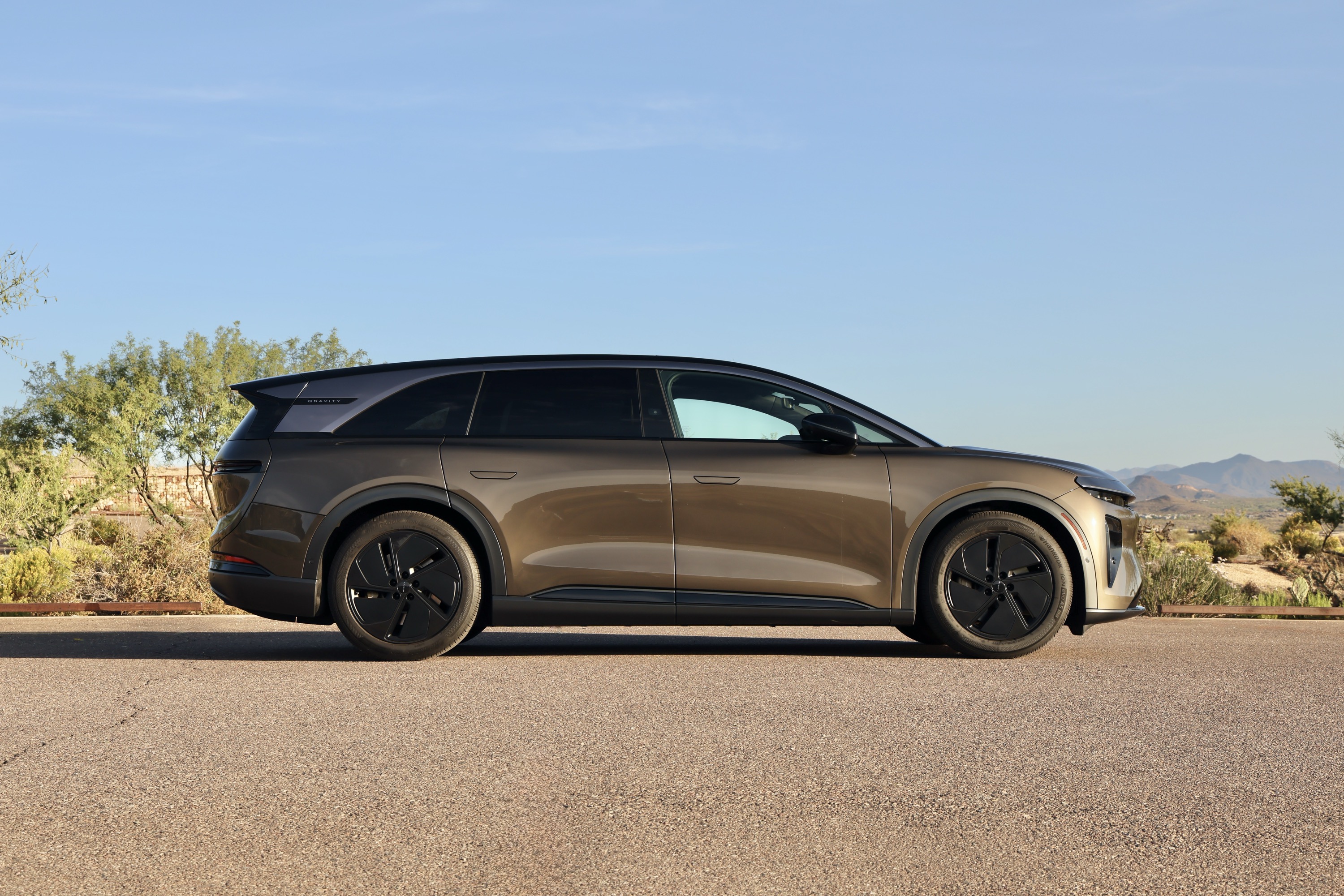
This might be the entry-level Gravity, but it’s none the worse for that.
Credit: Jim Resnick
This might be the entry-level Gravity, but it’s none the worse for that. Credit: Jim Resnick
On paper, that all sounds like a substantial difference in power and range, but in practice, it really isn’t. After a week with the Touring, I never needed more power, nor did I feel the driving range was shy of the mark compared to a combustion-engine SUV of similar size with a decently provisioned fuel tank.
Charging up the Gravity proved easy at any one of several local Tesla Supercharger stations. Since the Gravity has an NACS port and I have a Supercharger account, there was no messing around—the Lucid supports plug-and-charge (ISO 15118) and will verify account details with compatible chargers as part of the handshake procedure, so there’s no messing around with apps.
From one full-up charge, a mixture of suburban and highway driving yielded 320 total miles (514 km) of range. That’s close enough to the EPA estimate that most owners are unlikely to feel shortchanged.
More importantly, the Gravity retains the charging performance that has become one of Lucid’s defining strengths. During one charging session, the Gravity reached 95 percent state of charge from 15 percent in 31 minutes. Lucid also claims the Gravity can add up to 200 miles (321 km) on an 11-minute charge, though that requires a 400 kWh DC fast charger, according to the company’s consumer website. I averaged 3.3 miles/kWh (18.8 kWh/100 km) consumed in suburban and city driving while netting 3.8 miles/kWh (16.3 kWh/100 km) during steady-speed driving on freeways.
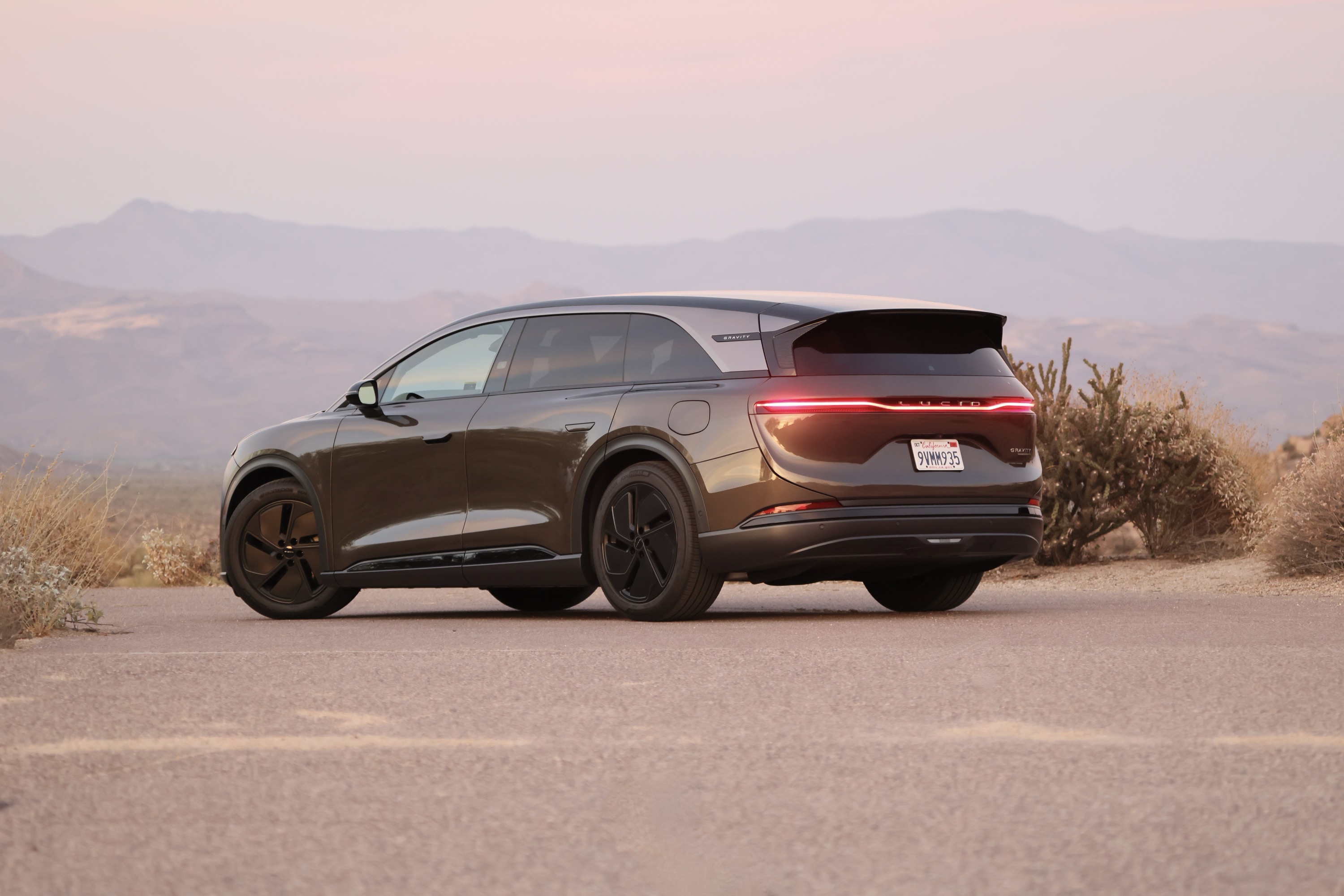
The Gravity is more agile than its size might suggest.
Credit: Jim Resnick
The Gravity is more agile than its size might suggest. Credit: Jim Resnick
Plenty of horses
Using two motors, one under the frunk making 147 hp (110 kW) and a main rear 413-hp (308 kW) motor, the Gravity’s combined output of 560 hp and 811 lb-ft (1,100 Nm) of torque certainly stands out.
Those figures are no match for the Grand Touring’s bonkers 828 hp (617 kW), yet despite this deficit in power, the Touring remains quicker than the overwhelming majority of SUVs, with enough oomph to merge onto the diciest freeway on-ramp, pass several slow cars at once on a two-lane rural highway, or just simply shock your mother-in-law.
Though I did no measured testing, I’d peg the Gravity Touring as extremely fast, with gobs of power on demand at any time, compared to the absurdly fast Grand Touring or any of those 1,000+ hp Airs. Lucid claims a 0–60 time of 4.0 seconds for the Touring. Soberly, though, I’d suggest the real-world performance difference between the top-power Grand Touring and the Touring is less significant than the difference in stats columns.
Despite the acceleration, it’s the polish that impressed me the most. Steering is precise and feels naturally weighted from parking lot speeds to cruising on the interstate. The optional three-chamber air suspension strikes a pleasing balance between ride comfort and body roll control, isolating occupants from rough pavement without allowing the vehicle’s considerable mass (at about 5,200 pounds/2,360 kg) to feel unwieldy.
The steering wheel can give Austin Allegro vibes. Jim Resnick
Lucid also fits serious braking hardware, with six-piston Brembo-built front calipers clamping giant 15-inch rotors. Over twisty sporty-car roads, the Gravity didn’t exactly become a Ferrari, but it negotiated tight corners, hills, heavy braking, and gravel-covered patches with way more talent than I anticipated. Interestingly, in everyday driving, even when throttle-closed regenerative braking is switched off, the Gravity still slows markedly, as if regen is engaged.
Visually, the Touring is mostly indistinguishable from the more expensive Grand Touring, which is fortunate because its design is one of the vehicle’s strongest assets. The proportions look coherent, and the surfaces are aerodynamic without looking experimental. The illuminated front fascia, full-width lighting elements, and expansive glass roof create a modern aesthetic that feels premium rather than performative.
The test vehicle wore optional Supernova Bronze metallic paint. Coupled with the standard Stealth Appearance package, the flat-sided wheels, and the broad-shouldered look of the front-end graphic and front lights, the Gravity Touring is handsome, but it doesn’t really shave much visual weight. It certainly looks like it weighs 5,200 lbs, even though it wears it well.
The brighter silver paint contrasting the greenhouse and A and D pillars against the darker bronze lower body somewhat detracts from the overall look. And a two-tone aesthetic doesn’t really sync with a “Stealth” Appearance package, visually or linguistically. Because the Gravity appears to be lower than most SUVs, there’s a large station wagon feel to the form that I like.
Inside, the clean, almost Scandinavian design follows the same philosophy. The driver’s environment is dominated by Lucid’s Clearview Cockpit, which combines a sweeping 34-inch curved 6K OLED display with a 12.6-inch central touchscreen. It’s sophisticated and information-rich without feeling overwhelming, and instruments and displays are clearly visible.
The squared-off steering wheel (akin to the current Corvette’s) remains unconventional though less problematic than it initially appears. Unlike a yoke, it doesn’t really alter the driving experience. It just asks for a brief adjustment period.
The cavernous inside
There’s plenty of passenger room, and the front seats offer great comfort and outstanding massage functions. Though the giant A pillars blocked more than their fair share of the driver’s view at the 10- and 2 o’clock positions, front-seat occupants enjoy nearly 41 inches (1,041 mm) of legroom, while rear passengers get even more, at 42.6 inches (1,082 mm). There should also be an industry award for a third-seat row that can swallow an adult—the Gravity would win.
Cargo space measures 56 cubic feet behind the second row and expands to a healthy 112 cubic feet (3,171 L) with the seats folded and slid forward. (The standard Ford Expedition offers 108.5 cubic feet (3,072 L) with all rows folded, as a comparison.) That’s enough room to accommodate bulky cargo with the ease of a minivan.
There are execution issues, though. Although the fantastic Clearview Cockpit display is larger than the Air sedan’s, some interior materials do not meet the standard set by the design itself. Also, the interior panel on my test vehicle was disappointing—and not just for a $100,000 vehicle; it would be lackluster on the $45,000 Subaru I tested immediately afterward.
The cargo area’s removable carpeted panels that plug the gap between seatbacks and the rearmost bulkhead felt cheap and home-built. Even the floor mats were thin and had already started curling at the corners. And though the third-row seats accommodated my 6-foot, 1-inch (1.85 m) frame, they folded and erected awkwardly.
The Gravity’s frunk. Jim Resnick
Software execution is an increasingly important consideration in modern cars, and the Gravity’s is excellent. Smartphone integration (Apple CarPlay, in my case) proved quick and simple, with reconnection on subsequent start-ups happening very quickly. The test vehicle showed a bit of latency when playing music from my phone, with graphics from a prior track still displayed after the next track’s audio started.
Speaking of audio, the 800 W Surreal Sound Pro system, with 22 speakers around the cabin, deserves mention. It sounds superb. It employs Dolby Atmos signal processing, and though I personally don’t care for elaborate signal processing with my audio (I’m a musician), the Touring’s processing didn’t get alien like some systems. I could also disable it when I wanted. The best of the Burmester audio systems in various large Mercedes are still top in my automotive book, but the Gravity’s Surreal system comes close.
Objectively, the Gravity Touring undercuts the top-shelf Grand Touring by about $20,000 while preserving nearly everything that makes the Gravity compelling. It gives up some battery capacity and a measure of outright performance but retains the exceptional packaging, charging capability, and the balance of ride quality, comfort, refinement, and design.
As a great second act for a new company, the Lucid Gravity also builds anticipation for its mid-size act 3.

A veteran of journalism, product planning and communications in the automotive and music space, Jim reports, critiques and lectures on autos, music and culture.








 English (US) ·