
 Merie Wallace/©Fox Searchlight/courtesy Everett Collection

Published Feb 26, 2026, 4:04 PM EST
Diego Pineda has been a devout storyteller his whole life. He has self-published a fantasy novel and a book of short stories, and is actively working on publishing his second novel.
A lifelong fan of watching movies and talking about them endlessly, he writes reviews and analyses on his Instagram page dedicated to cinema, and occasionally on his blog. His favorite filmmakers are Andrei Tarkovsky and Charlie Chaplin. He loves modern Mexican cinema and thinks it's tragically underappreciated.
Other interests of Diego's include reading, gaming, roller coasters, writing reviews on his Letterboxd account (username: DPP_reviews), and going down rabbit holes of whatever topic he's interested in at any given point.
Sign in to your Collider account
There has never been a film critic quite like Roger Ebert from the Chicago Sun-Times. Perhaps the most famous man who's ever exercised the profession, Ebert was someone whose opinions were founded on the sharpest, most profound knowledge of cinema history. As such, when talking about the films that Ebert considered the greatest of all time, all cinephiles should give themselves the time to check them out at least once in their lives.
Extrapolating the films that Ebert considered the greatest of all time isn't an endeavor entirely stripped from subjectivity, since there were multiple movies that the director talked about in his Great Movies list and his many submissions to the decennial Sight and Sound Poll of the Greatest Films of All Time. But when looking at the tremendous praise he had for masterpieces both modern (like The Tree of Life) and much older (like The General), one can conclude on a list of ten films that Ebert would very likely have no complaints about calling the best ever made.
10 'The Tree of Life' (2011)
 Image via Searchlight Pictures
Due to his artsy, slow-burning cinema, Terrence Malick can sometimes be a bit of an acquired taste, and boy was that taste acquired by Roger Ebert. The director typically loved Malick's work, but no film more than what most would agree is the director's magnum opus: The Tree of Life. It's certainly a challenging film, but one so beautiful and philosophically profound that it's no wonder Ebert loved it as much as he did.
In his write-up talking about his submission for the 2012 Sight and Sound poll (the last one he ever participated in, one year before his passing), the critic said that he had to include one 21st-century film. Though he was split between this and Charlie Kaufman's Synecdoche, New York, he opted for Malick's masterpiece due to its being "more affirmative and hopeful." In his review, he called it "a film of vast ambition and deep humility," comparing its "boldness of vision" to Stanley Kubrick's 2001: A Space Odyssey. Ebert loved the film for its scale, its intimacy, and the fact that it's one of the most visually stunning movies of the last 25 years.
9 'Raging Bull' (1980)
 Image via United Artists
Ebert frequently cited Martin Scorsese as his favorite filmmaker of all time, and as such, no conversation about which movies the critic considered the best ever made could possibly be complete without at least a mention of Scorsese. As it happened, it was Raging Bull, Scorsese's visceral biopic about American boxer Jake LaMotta, that Ebert favored over all other Scorsese gems.
It's no wonder, since Raging Bull is one of the definitive masterpieces of the 1980s. Ebert once called it Scorsese's Othello, "the greatest cinematic expression of the torture of jealousy." In his review of the film, the critic praised Robert De Niro's career-defining performance, Paul Schrader's stunning script, and Scorsese's deeply personal direction. Scorsese has gone into detail several times about how the film saved his life, and that undoubtedly contributed to Ebert's profound admiration for it.
8 'The General' (1926)
 Image via United Artists
In his 2012 write-up for the Sight and Sound poll, Ebert mentioned that he felt like he needed to include a silent film, and there's very little doubt one can notice in his tone when he points to Buster Keaton's The General. Indeed, it is generally regarded as one of the best silent movies of all time, the masterful work of one of the greatest minds that has ever graced cinematic comedy.
In his review of the movie, Ebert first addressed the elephant in the room and said that Keaton's "best movies have aged better than those of his rival, Charlie Chaplin." Following that bold statement, he praised the movie's "graceful perfection," exploring what makes Keaton so timeless and The General so iconic. It's a hilarious film with its star at his very best, and a must-see for all those who love movies that make them laugh.
7 'Apocalypse Now' (1979)
 Image via United Artists
His oeuvre has its fair share of stumbles, but it would be silly to deny that Francis Ford Coppola is one of the greatest, most important, and most groundbreaking directors in Hollywood history. He made not just one, but arguably several of the most ambitious movies of the 20th century. Still, very few films in general—let alone Coppola films—have ever been more ambitious than the Vietnam War epic Apocalypse Now.
It's a hellishly gut-wrenching film, and Ebert held it in absurdly high esteem. In his review, he called it "one of the key films of the century," expressing admiration for the abundance of unforgettable sequences, the killer soundtrack, the stunning visuals, and the award-worthy performances. Some war films are criticized for glamorizing or romanticizing war, but Apocalypse Now is one of those masterworks that take the "war is Hell" themes to unprecedented heights.
6 'Vertigo' (1958)
 Image via Paramount Pictures
Alfred Hitchcock, the Master of Suspense, was another director for whom Ebert always held a deep admiration. No conversation with the critic about the best films of all time would have ever been complete without talking about Hitchcock. As such, it's no wonder that Ebert's known Sight and Sound submissions always included a Hitchcock outing.
For a while, it was Notorious that was on Ebert's list, but for his 2002 submission, the critic switched to Vertigo, saying it was "the better of two nearly perfect films." It is, indeed, one of the most perfect classics with complex storytelling and a true gem of cinema. In his review, Ebert called Vertigo Hitchcock's "most confessional" movie, "dealing directly with the themes that controlled his art." He expressed admiration over the film's performances and visuals, but also the way it—either consciously or subconsciously—functions as a deep-dive into Hitchcock's view and control of women.
5 '2001: A Space Odyssey' (1968)
 Image via MGM
Many would call Stanley Kubrick the greatest filmmaker who ever lived. Ebert might not have gone for that particular superlative, but in the obituary he wrote for Kubrick, he did call him "one of the greatest of film directors, and perhaps the most independent and self-contained," so it's really not that far off. Of Kubrick's many vastly acclaimed masterpieces, most critics—Ebert included—would point to 2001: A Space Odyssey as the director's magnum opus.
A millennia-spanning epic that deals with human nature in a way that no other sci-fi film has before or has since.
It's far and away one of the most ambitious sci-fi masterpieces of all time, a millennia-spanning epic that deals with human nature in a way that no other sci-fi film has before or has since. Ebert said it was "a great visionary leap, unsurpassed in its vision of man and the universe," and in his review, he called it "the work of an artist so sublimely confident that he doesn’t include a single shot simply to keep our attention." Ebert was a big fan of the music, the infinitely analyzable ending, and Kubrick's unrestrained vision.
4 'Floating Weeds' (1959)
Like any great film critic, Ebert was well-versed in overseas cinema almost just as much as he was in American cinema, and there were few international film industries that he was fonder of than Japan's. The great master Yasujirō Ozu was an auteur that Ebert particularly admired, and Floating Weeds was the critic's favorite Ozu gem.
A remake of Ozu's own 1934 black-and-white silent film A Story of Floating Weeds, Floating Weeds is a true masterpiece, with Ebert considering it a film of "hypnotic visual beauty" in his list of the greatest motion pictures ever made. In his review, the critic praised Ozu as "the quietest and gentlest of directors," and he said that Floating Weeds was beautifully familiar, atmospheric, and naturalistic.
3 'La Dolce Vita' (1960)
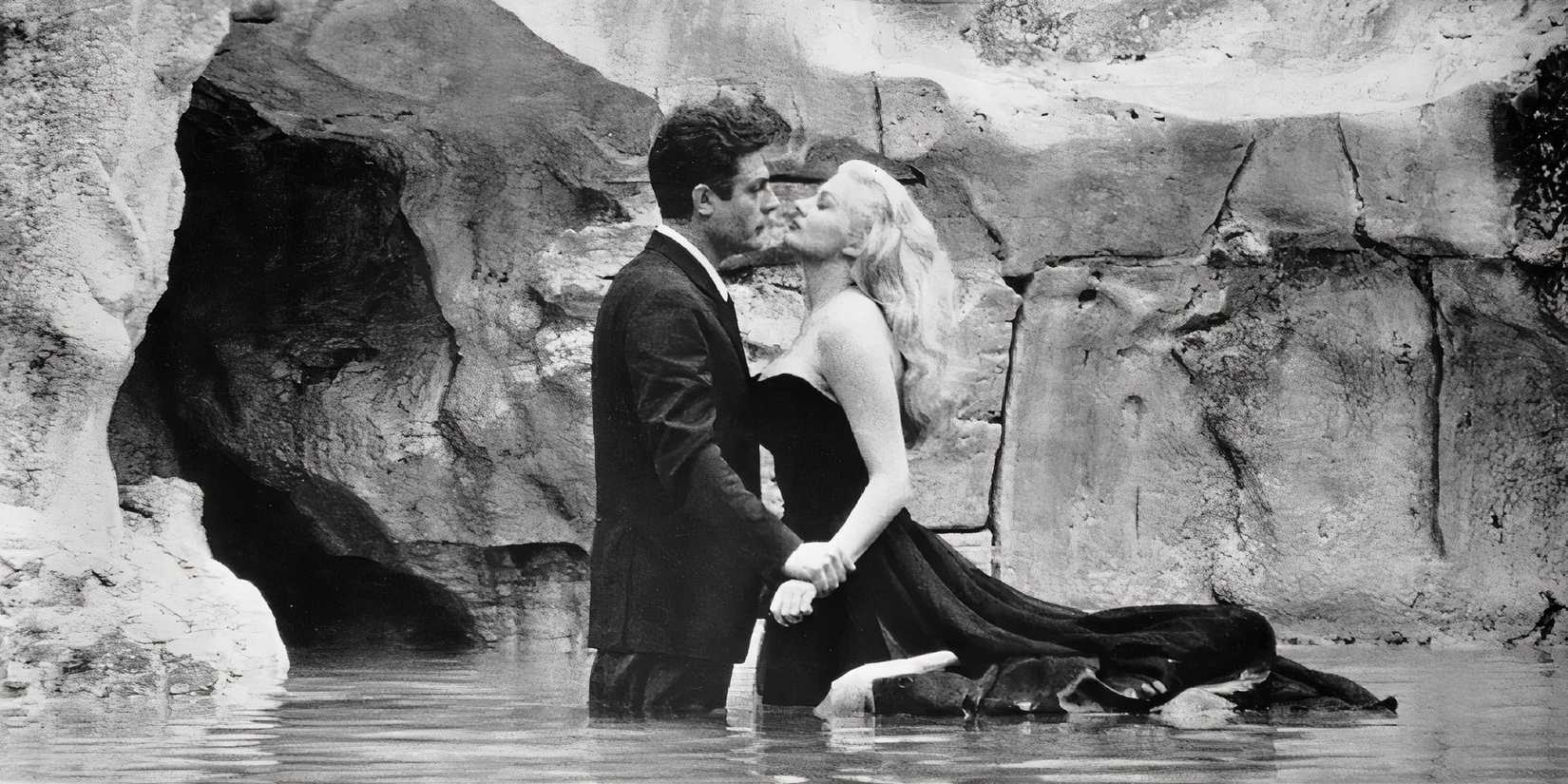 Image via Cineriz
There have been many excellent Italian filmmakers throughout history, but none have ever quite lived up to how legendary Federico Fellini was, and how exceptional the legacy he left behind has remained over the years. La Dolce Vita is generally regarded as his best movie, one of the most perfectly-written epics ever made, and Ebert certainly wouldn't have disagreed.
In his 2012 Sight and Sound write-up, the critic said that La Dolce Vita had become a touchstone in his life, which makes it unsurprising that he thought it was one of the greatest motion pictures in history. In his review, Ebert expressed admiration for the way the movie "leaps from one visual extravaganza to another," as well as for the excellent performances and Fellini's energetic direction.
2 'Casablanca' (1942)
 Image via Warner Bros. Pictures
Perhaps the most romantic Hollywood picture ever made, Casablanca was a smash hit upon release whose success surprised even those involved in its production. Today, it's such a mainstream classic that its perfection hardly surprises anyone. Ebert certainly considered it one of the most perfect World War II movies ever, and for good reason.
When he wrote about the ten greatest films ever made, Ebert said that even though the romance, the humor, and the intrigue at the heart of Casablanca were masterful, it was its enthralling characters that really made it so special and timeless. In his review, the critic said that even "seeing the film over and over again, year after year, [he found] it never grows over-familiar," and that's probably why this has never ceased to be the huge classic it's always been.
1 'Citizen Kane' (1941)
 Image via RKO Radio Pictures
When he wrote about the ten greatest films ever, and he inevitably got to the topic of Orson Welles' Citizen Kane, Ebert reminisced about a recent university screening he had attended, where the film was analyzed shot-by-shot. He said, "We took 10 hours and really looked at this film, which is routinely named the best film of all time, almost by default, in list after list. Maybe it is. It’s some movie." That maybe it is, from a critic of Ebert's caliber, may just be the biggest snippet of praise any film could ever aspire to.
It's well-deserved praise, too. Citizen Kane is undoubtedly, at the very least, one of the best movies of the 20th century. It's almost unbelievable that it was Welles' cinematic debut both as a director and as an actor (not counting two previous credits as a narrator), and Ebert made sure to take note of that in his review of the movie. He praised the film's structure, writing, and "bravura visual moments," making it clear why he probably thought this was the greatest film ever made.




 English (US) ·