
If the K-drama world is known for something, it's unusual plots, genre-bending, and numerous plot twists. A typical K-drama usually has an overarching plot, a smaller long-term plot within it, and character-based twists and turns. They're often predictable, but sometimes, they leave viewers with their jaws on the floor from the shock.
Whether it's a legal crime thriller, a time-traveling mystery, or a soapy drama about the wealthy, a good plot twist can make or break a show. And if there are many, well, that drama is binge-watching material with a lot of potential. Here are the ten greatest K-dramas with the most plot twists.
10 'Stranger' (2017–2020)
 Image via Signal Entertainment Group
Stranger, unlike other plot-twist dramas, hides its plot twists in procedural details, and they're never based on cheap thrills. Just as you think the protagonists have found the puppet master, the show peels back another layer, revealing that the true villain was hiding in plain sight. Lee Soo-yeon, the show's writer, spent years researching the Korean legal system to make sure the script was rooted in accuracy, looking back on some real-life corruption cases that echoed throughout South Korean modern history.
Stranger follows Prosecutor Hwang Si-mok (Cho Seung-woo), who lost his emotions due to childhood brain surgery, making him a ruthlessly logical investigator. When he’s assigned to a corruption case, he partners with the tenacious police officer Han Yeo-jin (Bae Doona), and as they keep finding new evidence, they realize that the prosecution and the police have their hands in some sinister work. In Stranger, every clue seems to point in a different direction, and it's where all the best plot twists hide; it is a greatly addictive procedural series that will win you over fast.
9 'The World of the Married' (2020)

The World of the Married is a K-drama you've probably never heard of; it's a remake of the BBC's Doctor Foster, but with a signature K-drama intensity. Every episode ends with a revelation that changes the characters' relationships, and the answers are thrown out like emotional grenades; the series' second half introduces twists that completely reverse the power dynamics, keeping viewers on their toes. The World of the Married was the highest-rated drama on Korean cable television in 2020, but it was widely condemned for its depictions of violence and sex.
The World of the Married follows Dr. Ji Sun-woo (Kim Hee-ae), who appears to have everything: a respected career, a loving husband, and a devoted son. When she learns of her husband's affair with the young Da-kyung (Han So-hee), her perfectly constructed life begins to crumble. However, the affair is only the first secret. As Sun-woo delves deeper, she discovers betrayals involving her closest friends, finances, and even her own child. The drama follows her quest for revenge and the devastating consequences that ripple through everyone around her, introducing plot twist after plot twist and carrying heavy emotional consequences.
8 '365: Repeat the Year' (2020)
 Image via MBC TV
With only 12 episodes, 365: Repeat the Year packs a twist into almost every episode. The mechanics of time travel reveal a final-episode secret that reframes the entire series. Unlike many time-slip dramas, 365 uses its sci-fi premise to fuel a tight, Agatha Christie-style whodunit, with shocking and logical twists. This is another series you probably never heard of, but it's worth a watch for mystery lovers who enjoy various plot twists per series.
365: Repeat the Year is based on Japanese novelist Kurumi Inui's novel Repeat. Ten people are given the opportunity to travel back in time exactly one year, hoping to correct their past mistakes. However, following the "reset," the participants start dying one by one under mysterious circumstances. What begins as a chance at redemption quickly turns into a desperate race to find out who—or what—is responsible for the murders and whether the time travel was part of a larger, more sinister plot.
7 'Kairos' (2020)
 Image via OH Story
Kairos is a masterclass of time-travel mystery K-dramas. It follows two leads from different timelines, forcing viewers to constantly reevaluate what they know; if a character appears innocent in one timeline, they become suspicious in another. The show's main plot twist is hidden behind layers of misdirection that hold up even on rewatching, and each episode ends with a cliffhanger that makes the mystery more profound. The show's title, Kairos, is an ancient Greek word that means "the right, critical moment"—a fitting theme for a time-travel drama.
Kairos follows Kim Seo-jin (Shin Sung-rok), a successful corporate executive whose perfect life is shattered when his daughter is kidnapped, and his wife dies after her disappearance. As he reaches rock bottom, he receives a phone call from Han Ae-ri (Lee Se-young), a woman living in the past—precisely one month earlier. They race against time, connecting for a minute on the phone every day, to prevent the tragedy with Seo-jin's daughter from ever happening. However, every change they make has unexpected consequences, and the lines begin to blur.
6
'Beyond Evil' (2021)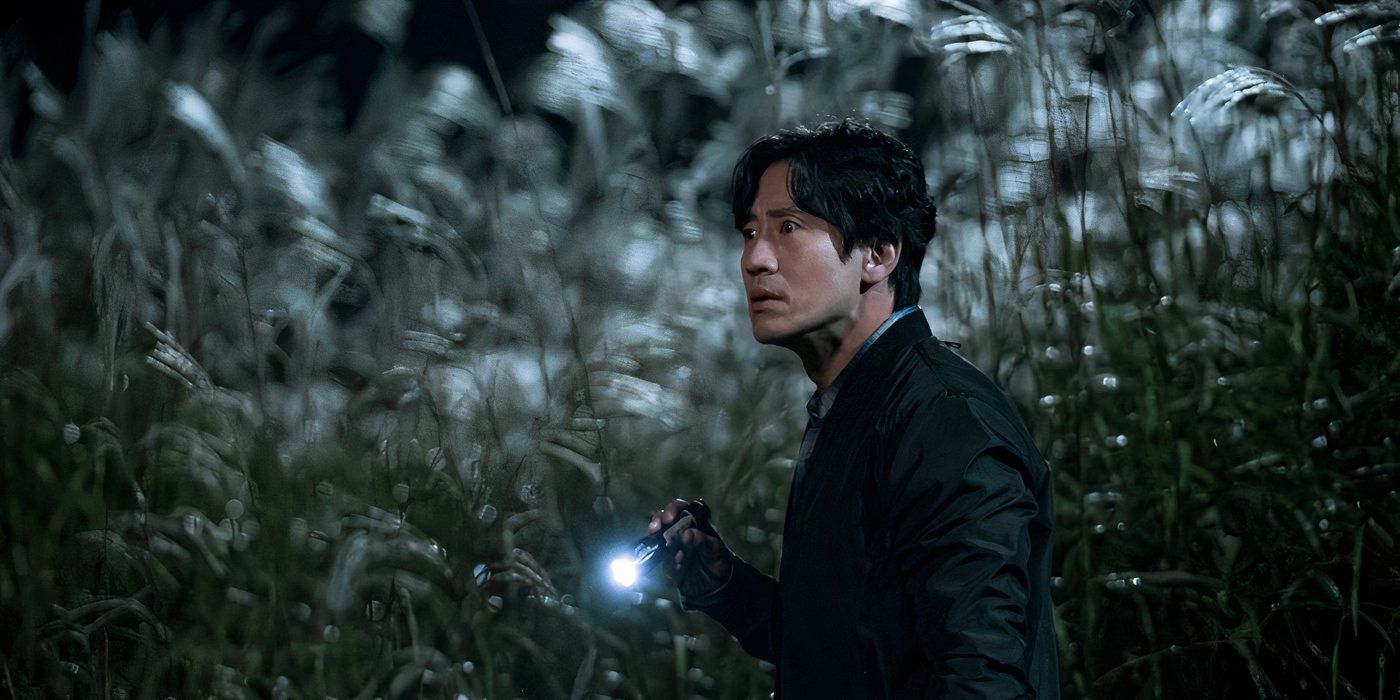
Beyond Evil is a well-known psychological thriller that uses plot twists to make viewers distrust characters before switching things up and changing their perceptions; the ending can even change their perception of the entire series. The drama's Korean title, Gwimul, means Monster and refers to the show's main question: who is the real monster? Shin Ha-kyun and Yeo Jin-goo deliver exceptional performances, while the show won the Baeksang Award for Best Drama due to its intricate storytelling and dark themes.
Beyond Evil is set in the small, sleepy town of Manyang, where a series of murders resembles a cold case from 20 years ago. The local Detective Lee Dong-sik (Shin), who was once a promising police officer, gets partnered up with an arrogant young officer, Han Joo-won (Yeo), who is transferred to Manyang from Seoul. The two form an uneasy partnership, running their investigation like a game of cat-and-mouse, with each man suspecting the other. It's a bold series with a lot of interesting twists, and one big one that changes the viewers' entire perspective on the protagonists.
Collider Exclusive · TV Medicine Quiz Which Fictional Hospital Would You Work Best In? The Pitt · ER · Grey's Anatomy · House · Scrubs
Five hospitals. Five completely different ways medicine goes sideways on television — brutal, chaotic, romantic, brilliant, and ridiculous. Only one of them is the ward your instincts were built for. Eight questions will figure out exactly where you belong.
🚨The Pitt
🏥ER
💉Grey's
🔬House
🩺Scrubs
FIND YOUR HOSPITAL →
01
A critical patient comes through the door. What's your first instinct? Medicine under pressure reveals who you actually are.
AStay completely present — block everything else out and work through it step by step, right now. BTriage fast and delegate — get the right people on the right problems immediately. CTrust my gut and move — I work best when I stop overthinking and just act. DAsk the question everyone else is ignoring — what's the thing that doesn't fit? ETake a breath, make a joke to cut the tension, and then get to work — panic helps no one.
NEXT QUESTION →
02
Why did you go into medicine in the first place? The honest answer says more about you than the one you'd give in an interview.
ABecause I wanted to be where it matters most — right at the edge, when someone's life is actually on the line. BBecause I wanted to help people — genuinely, one patient at a time, in a system that makes it hard. CBecause I was drawn to the intensity of it — the stakes, the drama, the feeling of being fully alive. DBecause medicine is the most interesting puzzle there is — and I needed a problem worth solving. EBecause I wanted to make a difference — and also, honestly, I didn't know what else to do with my life.
NEXT QUESTION →
03
What do you actually want from the people you work with? Who you want beside you under pressure is who you are.
ACompetence and calm — I need people who don't fall apart when things get bad. BTrust and reliability — I want to know that when I pass something off, it's handled. CConnection — I want colleagues who become family, even if that gets complicated. DIntelligence and the willingness to be challenged — I have no interest in people who just agree with me. EFriendship — people I actually like spending twelve hours a day with, because those hours are going to happen either way.
NEXT QUESTION →
04
You lose a patient you fought hard to save. How do you carry it? Every doctor who's worked a long shift has had to answer this question.
AI carry it. All of it. I don't look for ways to put it down — that weight is part of doing this work honestly. BI process it and move — you have to, or the next patient suffers for the one you just lost. CI feel it deeply and lean on the people around me — I don't think you're supposed to handle that alone. DI go back over every decision — not to punish myself, but because I need to understand what I missed. EI grieve it genuinely, find some way to laugh about something unrelated, and try to be kind to myself — imperfectly.
NEXT QUESTION →
05
How would your colleagues describe the way you work? Your reputation on the floor is usually more accurate than your self-image.
AIntense and completely present — no small talk during a shift, but exactly who you want there. BSteady and dependable — not the flashiest in the room but never the one who drops something. CPassionate and occasionally chaotic — brilliant on the hard cases, prone to drama everywhere else. DBrilliant and difficult — right more often than anyone else, and everyone knows it, including me. EWarm and self-deprecating — not the most intimidating presence, but genuinely good at this and easy to like.
NEXT QUESTION →
06
How do you feel about hospital protocol and procedure? Every institution has rules. What you do with them is a choice.
AProtocol is the floor, not the ceiling — I follow it until the patient needs something it can't provide. BI respect it — the system is broken in places, but the structure is there for a reason and I work within it. CI follow it until my instincts tell me not to — and my instincts are usually right, even when they cause problems. DRules are for people who haven't thought hard enough about when to break them. EI try to follow it and mostly do — with a few memorable exceptions that still come up in meetings.
NEXT QUESTION →
07
What does this job cost you personally? Nobody works in medicine without paying a price. What's yours?
AEverything outside these walls — I've given this job my full attention and the rest of my life has gone around it. BMy idealism, mostly — I came in believing the system could be fixed and I've made a complicated peace with that. CStability — my personal life has been as chaotic as the OR, and that's not entirely a coincidence. DMy relationships — I am not easy to know, and the people who've tried to would probably agree. EMy sense of gravity — I use humour as a coping mechanism, which not everyone appreciates in a hospital.
NEXT QUESTION →
08
At the end of a long shift, what keeps you coming back? The answer to this question is the most honest thing about you.
AThe fact that it's real — that nothing else I could be doing would matter this much, right now, today. BThe patients — individual human beings who needed something and got it because I was there. CThe people I work with — I have walked through impossible things with these people and I'd do it again. DThe next unsolved case — there's always another puzzle, and I'm not done yet. EBecause despite everything — the exhaustion, the loss, the absurdity — I actually love this job.
REVEAL MY HOSPITAL →
Your Assignment Has Been Made You Belong In…
Your answers have pointed to one fictional hospital above all others. This is the ward your instincts, your temperament, and your particular brand of dysfunction were built for.
The Pitt
You are built for the most unsparing version of emergency medicine television has ever shown — one that puts you inside a single fifteen-hour shift and doesn't let you look away.
- You need your work to be real, not romanticised — meaning over drama, honesty over aesthetics.
- You find purpose inside the work itself, not in the chaos surrounding it.
- You've made peace with the fact that this job takes from you constantly, and gives back in ways that are harder to name.
- Pittsburgh Trauma Medical Center demands exactly that kind of person — and you would not want to be anywhere else.
ER
You are the person who keeps the whole floor running — not the most brilliant in the room, but possibly the most essential.
- You show up, do the work, absorb the losses, and come back the next day without needing the job to be anything other than what it is.
- You care about patients as individual human beings, not as cases to solve or dramas to live through.
- You believe in the system even when it fails you — and you understand that emergency medicine is about holding the line just long enough.
- ER is television about endurance. You have it.
Grey's Anatomy
You came to medicine with your whole self — your ambition, your emotions, your relationships, your history — and you have never quite managed to leave any of it at the door.
- You feel things fully and form deep attachments to the people you work with.
- Your personal and professional lives are permanently, chaotically entangled — and that entanglement drives both your greatest disasters and your most remarkable saves.
- You understand that extraordinary medicine often happens at the intersection of clinical skill and profound human connection.
- It's messy at Grey Sloan. You would not have it any other way.
House
You are drawn to the problem above everything else — the symptom that doesn't fit, the diagnosis hiding underneath the obvious one.
- You're not primarily motivated by the patient as a person — though you are capable of caring, even if you'd deny it.
- You work best when the stakes are highest and the standard answer is wrong.
- Princeton-Plainsboro exists to house one extraordinary, impossible mind — and everyone around that mind is there because they're smart enough to keep up.
- The only way forward here is to think harder than everyone else in the room. That is exactly what you do.
Scrubs
You understand that medicine is tragic and absurd in almost equal measure — and that the only sane response is to hold both of those things at the same time.
- You are warm, self-aware, and funnier than most people in your field.
- You use humour to get through terrible moments — and at Sacred Heart, that's not a flaw, it's a survival strategy.
- You lean on the people around you and let them lean back. The laughter and the grief are genuinely inseparable here.
- Scrubs is a show about learning to become someone worthy of the job. You are still very much in the middle of that process — which is exactly right.
↻ RETAKE THE QUIZ
5 'Sky Castle' (2018–2019)
 Image via JTBC
Sky Castle redefined K-drama twists by delivering major revelations in nearly every episode. Even the first episode ends with a shocking death that appears straightforward, but later episodes reveal that it was anything but. Backstories are revealed in layers, with a particular emphasis on the character of Kim Joo-young (Kim Seo-hyung), one of the greatest K-drama villains of all time—and a woman with a complicated story. Her final twist was so shocking that it became a cultural phenomenon, propelling Sky Castle to become one of the highest-rated dramas on Korean cable television, breaking viewership records despite the lack of major stars.
Sky Castle is an exclusive luxury neighborhood populated by elite professionals such as doctors, lawyers, and professors who will go to any length to ensure their children's admission to prestigious universities. The drama follows families who hire "coordinator" Kim Joo-young, a mysterious tutor who promises guaranteed admissions but requires unethical sacrifices. When a tragedy strikes one family, the community's carefully constructed facade crumbles, revealing secrets about affairs, fraud, and even murder. The show sparked real-world debates about Korea's highly competitive educational system, and inspired many other stories about the elite and the wealthy.
4 'Signal' (2016)
 Image via tvN
Signal is often deemed one of the greatest K-dramas ever made, and it's admirable for its ability to rewrite the rules of its own narrative just as viewers start to believe they have it figured out. Signal is based on real-life crimes, such as the Hwaseong serial murders, which were solved in 2019 with DNA evidence, three years after the show aired. Many credit Signal for putting public pressure on cases like this one, prompting the police to reopen some other cold cases.
Signal follows modern-day profiler Park Hae-young (Lee Je-hoon), who communicates with detective Lee Jae-han (Cho Jin-woong) from the 1980s via an abandoned walkie-talkie. They use this to solve cold cases that have haunted Korea for decades, but as they change the past, the present changes as well. While the true plot is to solve the murders that plague modern perception, an overarching twist is Detective Lee's fate and the implications for the present-day characters. The central mystery revolves around his disappearance, and the finale includes a twist that changes the show's time travel plot. Season 2 was created, but it is unclear whether it will be released due to a scandal related to Cho.
3 'Flower of Evil' (2020)
 Image via tvN
Flower of Evil has twists that are as shocking as they are emotionally devastating. The show redefines its premise multiple times, until the final twist lands with such a heavy impact that it turns the thriller into a deep, emotional exploration of identity and love. Lee Joon‑gi delivers a career-best performance as a character who isn't black or white—the viewer's perception of him changes from episode to episode, with plot twists and shifts happening in every single installment. If you tried to explain this to someone going in blind, it would be impossible. All that's left is to say, "Watch it and see."
Flower of Evil follows Baek Hee-sung (Lee), who appears to have the perfect life: he is a devoted husband and father and owns a successful metalworking studio. His wife, Cha Ji-won (Moon Chae-won), is a homicide detective who has no idea that her husband is actually Do Hyun-soo, the son of a notorious serial killer living under an assumed name. Ji-won's investigation into cold cases related to Hyun-soo's past strains their marriage as Hee-sung (or Hyun-soo) tries to hide more secrets from her. Flower of Evil is incredibly entertaining and twisty, and fans of classic K-drama leads will adore Lee as the protagonist here.
2 'Mouse' (2021)
 Image via Prime
Mouse is arguably the most twist‑heavy K‑drama on streaming. The first major revelation about the seemingly gentle protagonist hits early, but the show continuously one‑ups itself. For example, it adds a secondary controversial twist about an identity crisis, keeping the audience in constant uncertainty over the real intentions of the show's characters. Mouse was inspired by a real‑life case of a child psychopath in Korea, sparking debate about whether neurological testing could predict violent behavior. Choi Ran, the writer of the show, was curious about the lack of remorse from the killer during his sentencing, so he wanted to explore whether psychopathy has a genetic predisposition.
Mouse follows Jung Ba-reum (Lee Seung-gi), a rookie cop who becomes obsessed with his new case—an apparent copycat of the psychopath known as the "Headhunter," who terrorized Korea many years ago. As the investigation progresses, Ba‑reum discovers more about himself, questioning whether the distinction between good and evil lies within himself. The drama essentially explores what someone like Ba-reum would do if they were a psychopath, questioning their own minds and identities. Mouse was one of the hottest dramas of 2021 and fans still speak of it with great fondness.
1 'The Penthouse: War in Life' (2020–2021)

It may be Mouse, but it may also be The Penthouse: War in Life that holds the title for the most twists per episode in K‑drama history; it leaves no character safe and no plot development too absurd. The first season alone features a murder mystery with at least three different "solutions" before the real killer is revealed. Later seasons introduce twins, fake deaths, and a villain’s backstory that completely redefines the timeline. It’s a drama that proudly embraces its own insanity, making every twist a must‑see event. Writer Kim Soon‑ok wrote the series before it was aired (so it wasn't written while airing), which is interesting, as people's reactions couldn't impact the narrative, leading to a much bigger shock value.
The Penthouse: War in Life is set in a 100-floor luxury penthouse of a Gangnam apartment complex. This extravaganza of a show follows a trio of wealthy women: Shim Su-ryeon (Lee Ji-ah), Oh Yoon-hee (Eugene), and Cheon Seo-jin (Kim So-yeon), whose ambitions lead to betrayal, murder, and revenge. What starts as a rivalry over sending children to a prestigious arts school quickly turns into a web of affairs, swapped identities, and serial killings. Over the course of three seasons, characters die and then return, allies become enemies, and nearly every child's true parentage is called into question. The Penthouse had a controversial character and received some criticism, but it stood the test of time thanks to its numerous soapy plot twists.






 English (US) ·