
 Image via Tri-Star Pictures
Published Jun 15, 2026, 11:45 PM EDT
Michael Block is a 14 time GLAM Award nominated writer, producer, and host of the podcast Block Talk. Throughout his time in the entertainment industry, he has worked on and off Broadway as a stage manager, written several produced plays, critiqued hundreds of theatrical performances, drag and cabaret shows, and has produced events randing from drag competitoons to variety concerts!
On Block Talk, he interviews nightlife personalities, covers the wide world of entertainment through features, ranking episodes, and recaps ALL of Drag Race, as well as Dragula and Survivor. He has interviewed hundreds of RuGirls that span the globe at DragCon NYC, DragCon LA, and DragCon UK.
In his free time, he makes one-of-a-kind jewelry and gift baskets with his mom. He is a proud member of the LGBTQ+ community.
Sign in to your Collider account
The broad umbrella that is science fiction has allowed filmmakers to take their audiences to galaxies far, far away or terrify them about the potential threats of artificial intelligence. Whether on Earth or in space, the sci-fi films we adore have pushed our imaginations to the brink as we ponder the what-ifs. With such a vast ability to tell stories, sci-fi subgenres have provided some unique narratives, especially in the crime department.
While we might think of sci-fi as space adventures, the truth is, there’s also a hell of a lot of crime! For this list, we are going to examine the greatest crime sci-fi movies of all time. From dream heists to cyber cops patrolling the streets, these sci-fi crime thrillers have given us extraordinary cinematic moments we continue to celebrate. Even in advanced, futuristic civilizations, crimes are aplenty!
10 'Gattaca' (1997)
 Image via Sony Pictures Releasing
Directed by Andrew Niccol, Gattaca tells the story of a society strictly divided by genetic engineering where parents can choose their children's traits, creating an elite class of "Valids." Vincent (Ethan Hawke), a naturally conceived "In-valid" born with a weak heart, assumes the identity —including blood and hair samples— of genetically superior but paralyzed athlete Jerome Morrow (Jude Law), to travel to space. Just before Vincent's scheduled launch, a mission director is murdered at the facility, and an eyelash Vincent drops at the crime scene brings the police sniffing around, forcing him to evade genetic background checks.
A retrofuturistic thriller that questions humanity’s spirit in the face of ambition and perseverance, Gattaca brings an all-star cast to a genuinely fascinating premise. Between identity theft and murder, crime is more than abundant. By slipping into a neo-noir-style murder mystery, Gattaca remains gripping from start to finish, and through the exploration of genetic engineering and biometrics, it forces a conversation about a future where DNA dictates your destination. The atmosphere built for the film is a key factor in its brilliance, pairing sleek retro-futurism with stark, cold architecture. Even with crime front and center, the film is a genuine underdog story.
9 'Predestination' (2014)
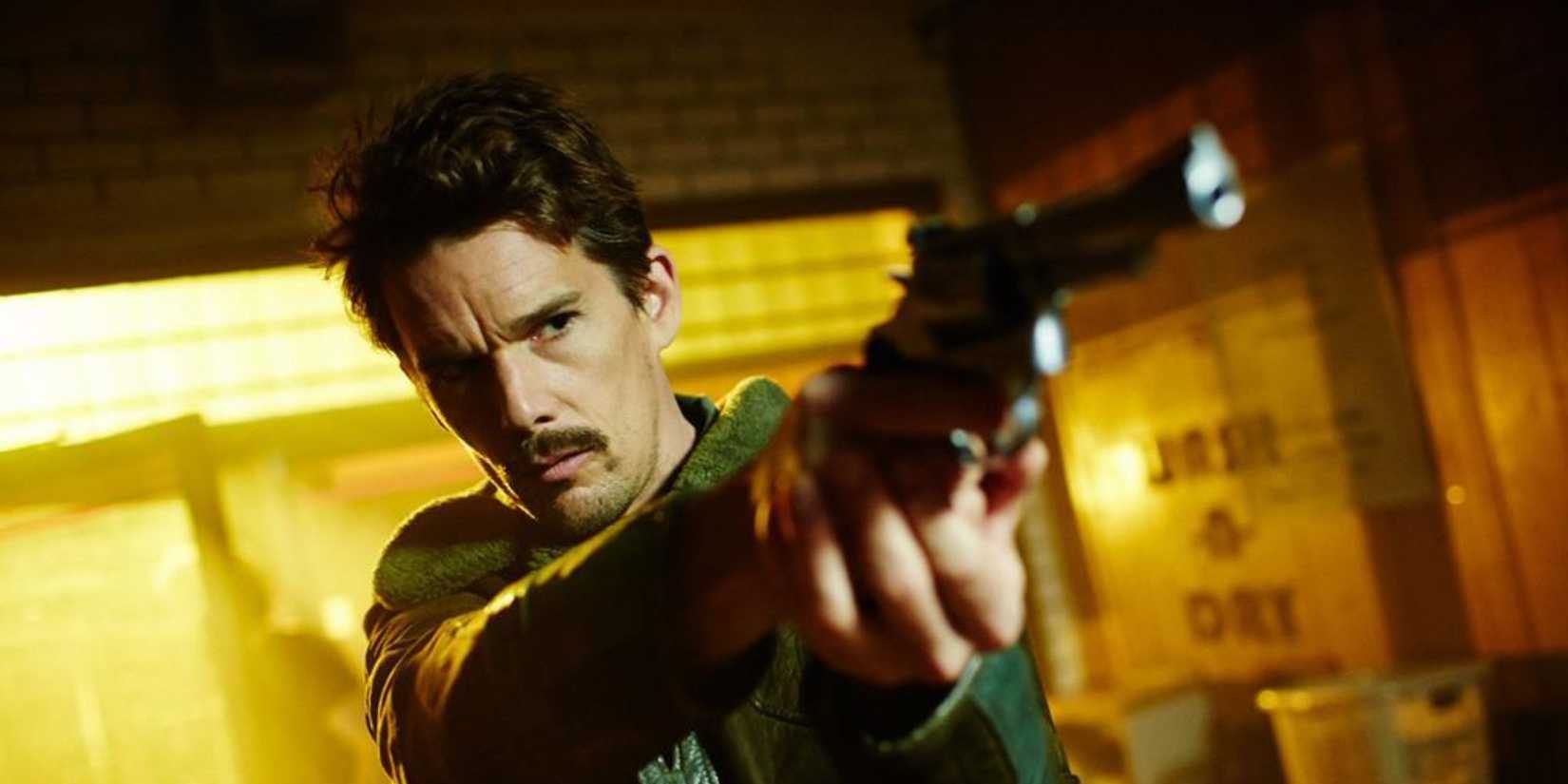 Image via Pinnacle Films
Shall we continue praising Ethan Hawke by discussing another of his exceptional films? This time, it’s 2014’s Predestination. Directed by Michael and Peter Spierig, the thriller follows Temporal Agent (Ethan Hawke) as he travels through history to stop major crimes before they happen, including the mass-casualty terrorist known as the "Fizzle Bomber." As he investigates future crimes, he meets a mysterious confession-story author (Sarah Snook) who shares a story that leads to a major clue about mind-bending time travel and the bootstrap paradox.
An airtight thriller that flawlessly honors madcap science in order to keep you guessing what the big twist might be, the Spierigs' film elevates typical time-travel tropes into a tragic, character-driven study of identity and fate. Predestination leaves no loose ends while ensuring the story never veers into uncontrollable territory. It’s a carefully plotted story that works as a slow-burning crime caper. Once again, Hawke does extraordinary work, providing a melancholic, grounded presence as the story’s emotional anchor. If you’re coming to the film fresh, you’d expect Snook to dominate, and she does in a breakout performance that's almost chameleon-like, finding great nuance to a part that easily could have veered into cheesy territory.
8 'Dark City' (1998)
 Image via New Line Cinema
Being accused of murder is quite horrible when you can’t remember a single thing; that’s the premise of Dark City. Directed by Alex Proyas, Dark City follows John Murdoch (Rufus Sewell), an amnesiac man who awakens in a perpetually dark, noir-style metropolis. Accused of a string of murders, he soon ventures into the city, a dangerous setting that seems to change all the time.
Dark City is all about establishing a mood, and Proyas does so impeccably. Drawing inspiration from German expressionism in classical cinema, the oppressive atmosphere plays an essential role in the storytelling. For a story that could easily be overwhelming and confusing, the lore and worldbuilding are excruciatingly clear, quite fascinating, and it keeps the narrative gripping. The film uses a classic noir setup to establish the story; you’re hooked on a grounded crusade for the truth. A breathtaking film, we’d likely be championing Dark City today had it not been for the Wachowskis' masterpiece a year later.
Collider Exclusive · Sci-Fi Survival Quiz Which Sci-Fi World Would You Survive? The Matrix · Mad Max · Blade Runner · Dune · Star Wars
Five universes. Five completely different ways the future went wrong — or sideways, or up in flames. Only one of them is the world your instincts were built for. Eight questions will figure out which dystopia, galaxy, or desert wasteland you'd actually make it out of alive.
💊The Matrix
🔥Mad Max
🌧️Blade Runner
🏜️Dune
🚀Star Wars
TEST YOUR SURVIVAL →
01
You sense something is deeply wrong with the world around you. What do you do? The first instinct is often the truest one.
APull on every thread until I understand the system — then figure out how to break it. BStop asking questions and start stockpiling — food, fuel, weapons. Questions don't keep you alive. CKeep my head down, observe carefully, and trust no one until I know who's pulling the strings. DStudy the patterns. Every system has a rhythm — learn it, and you learn how to survive it. EFind the people fighting back and join them. You can't fix a broken galaxy alone.
NEXT QUESTION →
02
In a world of scarcity, what resource do you guard most fiercely? What we protect reveals what we believe survival actually requires.
AKnowledge. If you understand the system, you don't need resources — you can generate them. BFuel. Everything else — movement, power, escape — runs on it. CTrust. In a world of fakes and informants, a truly reliable ally is rarer than any commodity. DWater. And after water, information — the two things empires are truly built on. EShips and credits. The galaxy is big — you survive it by being able to move through it freely.
NEXT QUESTION →
03
What kind of threat keeps you up at night? Fear is useful data — if you're honest about what you're actually afraid of.
AThat reality itself is a lie — that everything I experience has been constructed to keep me compliant. BA raid. No warning, no mercy — just the roar of engines and then nothing left. CBeing identified. Once someone with power decides you're a problem, you're already out of time. DBeing outmanoeuvred — losing a political game I didn't even know I was playing. EThe Empire tightening its grip until there's nowhere left to run.
NEXT QUESTION →
04
How do you deal with authority you don't trust? Every dystopia has a power structure. Your approach to it determines everything.
ASubvert it from the inside — learn its rules well enough to weaponise them against it. BIgnore it and stay out of its reach. The further from any power structure, the better. CAppear to comply while doing exactly what I need to do. Visibility is the enemy. DManoeuvre within it carefully. You can't beat a system you refuse to understand. EResist openly when I have to. Some things are worth the risk of being seen.
NEXT QUESTION →
05
Which environment could you actually endure long-term? Survival isn't just tactical — it's physical, psychological, and very much about where you are.
AUnderground bunkers and server rooms — cramped, artificial, but with access to everything that matters. BOpen wasteland — brutal sun, no shelter, constant movement. At least the threat is honest. CA dense, rain-soaked city where you can disappear into the crowd and nobody asks questions. DMerciless desert — extreme heat, no water, and something enormous living beneath the sand. EThe fringe — backwater planets and busy spaceports where the Empire's attention rarely reaches.
NEXT QUESTION →
06
Who do you want in your corner when things fall apart? The company you keep is the clearest signal of who you actually are.
AA tight crew of believers who've seen behind the curtain and have nothing left to lose. BOne or two people I'd trust with my life. Any more than that and someone talks. CNobody, ideally. Alliances are liabilities. I work alone unless I have no choice. DA community bound by shared hardship and mutual survival — people who need each other to last. EA ragtag team with wildly different skills and total commitment when it counts.
NEXT QUESTION →
07
Where do you draw the line — if you draw one at all? Every survivor eventually faces a moment that tests what they're actually made of.
AI won't harm the innocent — even the ones who'd report me without hesitation. BI do what I have to to protect the people I've chosen. Everything else is negotiable. CThe line shifts depending on who's asking and what's at stake. DI draw a long-term line — nothing that compromises my people's future, even if it'd help now. ESome lines, once crossed, can't be uncrossed. I know which ones they are.
NEXT QUESTION →
08
What would actually make survival worth it? Staying alive is one thing. Having a reason to is another.
AWaking others up — dismantling the illusion so no one else has to live inside it. BFinding somewhere — or someone — worth protecting. A reason to keep moving. CAnswers. Understanding what I am, what any of this means, before time runs out. DLegacy — shaping the future in a way that outlasts me by generations. EFreedom — for myself, for others, for every world still living under someone else's boot.
REVEAL MY WORLD →
Your Fate Has Been Calculated You'd Survive In…
Your answers point to the world your instincts were built for. This is the universe your temperament, your survival instincts, and your particular brand of stubbornness were made for.
The Matrix
You took the red pill a long time ago — probably before anyone offered it to you. You're a systems thinker who can't help but notice the seams in things.
- You're drawn to understanding how the system works before figuring out how to break it.
- You'd find the Resistance, or it would find you — your instinct for spotting constructed realities is the machines' worst nightmare.
- You function best when you have access to information and the freedom to act on it.
- The Matrix built an airtight prison. You'd be the one probing the walls for the door.
Mad Max
The wasteland doesn't reward the clever or the well-connected — it rewards those who are hard to kill and harder to break. That's you.
- You don't need comfort, community, or a cause larger than the next horizon.
- You need a vehicle, a clear threat, and enough fuel to outrun it — and you're good at all three.
- You are unsentimental enough to survive that world, and decent enough — just barely — to be something more than another raider.
- In the wasteland, that distinction is everything.
Blade Runner
You'd survive here because you know how to exist in moral grey areas without losing yourself completely.
- You read people accurately, keep your circle small, and ask the questions others prefer not to answer.
- In a city where humanity is a legal designation rather than a feeling, you hold onto something that keeps you functional.
- You're not a hero. But you're not lost, either.
- In Blade Runner's world, that distinction is everything.
Dune
Arrakis is the most hostile environment in the known universe — and you are precisely the kind of person it rewards.
- Patience, discipline, and political awareness are your core strengths — and on Arrakis, they're survival tools.
- You understand that the long game matters more than any single victory.
- Others come to Dune and are consumed by it. You'd learn its logic and earn its respect.
- In time, you wouldn't just survive Arrakis — you'd begin to reshape it.
Star Wars
The galaxy far, far away is vast, loud, and in a constant state of violent political upheaval — and you wouldn't have it any other way.
- You find meaning in being part of something larger than yourself — a cause, a crew, a rebellion.
- You'd gravitate toward the Rebellion, or the fringes, or whatever pocket of the galaxy still believes the Empire's grip can be broken.
- You fight — not because you have to, but because standing aside isn't something you're capable of.
- In Star Wars, that willingness is what makes all the difference.
↻ RETAKE THE QUIZ
7 'Upgrade' (2018)
 Image via Universal Pictures
Another entry in the underrated masterpiece department comes the gripping Leigh Whannell cyberpunk action thriller Upgrade. Set in a hyper-connected near future, the story follows mechanic Grey Trace (Logan Marshall-Green), an analog purist living with his wife, Asha (Melanie Vallejo). When a corrupted self-driving car crash leaves Asha dead and Grey a quadriplegic, a rogue billionaire offers him a controversial cure: SYNAPSE, a clandestine evolution of the original STEM (Simon Maiden) implant that merges directly with the spinal cord.
Mixing a steadfast revenge thriller with a terrifying AI crime story, Upgrade is a brutal, full-throttle story with a killer twist. Through a grimy cyberpunk atmosphere with a technophobic lead character, Whannell expertly makes the setting quite claustrophobic. In turn, Marshall-Green delivers a career-best performance. A clever twist on the body-snatcher story, Grey’s journey is mesmerizing, as he slowly figures out who’s in control. While there are quite a few films that watch a lead character embark on a daring quest alongside a crime-finding artificial intelligence cohort, Upgrade’s iteration is refreshing.
6 'Minority Report' (2002)
Steven Spielberg has made extraordinary science fiction films in nearly every decade of his storied career. At the turn of the century, his entry was the exceptional Minority Report. Set in Washington, D.C., in the year 2054, the story follows a specialized police unit called "Precrime" that uses three psychic humans—the "precogs"—to predict and prevent murders before they happen. The plot shifts into overdrive when the head of the Precrime unit, Captain John Anderton (Tom Cruise), is unexpectedly identified by the precogs as the perpetrator of a future murder, forcing him to go on the run to prove his innocence.
A high-octane philosophical thriller, Minority Report forces a rich conversation about fate and free will, the ethical boundaries of preventative law enforcement, and the consequences of government surveillance. The high-profile combination of Cruise and Spielberg proved worthy. Looking back today with a new lens, Minority Report was ahead of the curve in its exploration of personalized targeted advertising, biometric surveillance, and gestural computer interfaces. Perhaps we should be worried if the concept of precogs arrives next!
5 'Blade Runner 2049' (2017)
 Image via Warner Bros. Pictures
Rarely are sequels better than the original, especially when it helps to reboot a franchise, but Blade Runner 2049 sure came close! Directed by Denis Villeneuve, Blade Runner 2049 serves as a sequel to the 1982 classic. Fret not, we’ll get to Blade Runner soon. The sci-fi noir crime drama follows Officer K (Ryan Gosling), an LAPD "blade runner" who hunts and decommissions rogue synthetic humans known as replicants. After uncovering a buried secret that proves replicants can reproduce biologically, K embarks on a quest to find Rick Deckard (Harrison Ford), a former blade runner who has been missing for 30 years.
At its heart, Blade Runner 2049 works as a smart dissertation on humanity and personhood, marrying a hard-boiled detective story with a philosophical exploration of the nature of the soul. Villeneuve takes the gritty confines of the original and deliberately forces his audience to absorb the world, from the radioactive, blood-red ruins of Las Vegas to the rising sea walls of Los Angeles. Though Ford is more than present, it is Gosling’s story; together, they work profoundly well, alongside a dynamite ensemble. Every frame, every sound, every image of this film is worth watching. Some may call it better than the original, but that’s a tough sell.
4 'Looper' (2012)
 Image via Sony Pictures Releasing
Science fiction writers love time travel, but not every screenwriter can tackle the loop well. Fortunately for writer-director Rian Johnson, his skill set is on full display in Looper. Johnson’s masterpiece tells the story of Joe (Joseph Gordon-Levitt), a 2044 "looper" who kills targets sent back in time by future syndicates. When his older self (Bruce Willis) is sent back to be killed, he escapes, causing young Joe to hunt his future self, who is trying to kill a child destined to become a crime boss.
Johnson treats time travel not as a magical plot device but as a dirty, illegal method used by future mobsters, thus subverting common tropes for a whip-smart crime thriller. Looper is a satisfying story that lets the themes of aging, regret, and the cyclical nature of violence mirror the science-fiction element that drives it. The film navigates the potential paradoxes by focusing first on the characters' emotional arcs. Like many time-travel-based stories, the script tackles the morality and ethics of attempting to change timelines and the potential consequences that accompany them. Gordon-Levitt and Willis have stellar chemistry, and Emily Blunt provides the necessary groundedness and emotion, truly anchoring the latter part of the film.
3 'A Scanner Darkly' (2006)
 Image via Warner Bros.
One of the more distinctive films of the early aughts was A Scanner Darkly. The adult animated sci-fi thriller from Richard Linklater is based on the 1977 novel by Philip K. Dick and is set in a future America that lost its war on drugs. Undercover narcotics cop Bob Arctor (Keanu Reeves) becomes addicted to a mind-altering substance known as Substance D, causing him to suffer a fractured psyche and lose grip on his own reality. As he investigates the source, his brain deteriorates, causing him to spy on himself unknowingly.
A brilliant take on surveillance, paranoia, the loss of identity, and the devastating consequences of addiction, A Scanner Darkly is an introspective philosophical work with groundbreaking rotoscope animation that feels off and slightly dreamlike. This unique technique is not just stylistic; it is integral to the plot, enabling the representation of the scramble suit. It might feel disorienting, even psychedelic, but it’s instrumental. A Scanner Darkly forces you into questioning personal identity crises through the war on drugs and the dangers of surveillance, resulting in a scathing satire directed to perfection.
2 'Blade Runner' (1982)
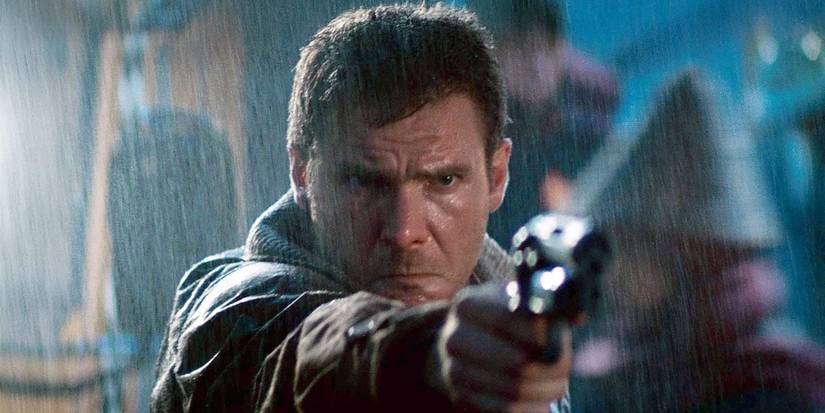 Image via Warner Bros.
An adaptation of Philip K. Dick's novel Do Androids Dream of Electric Sheep? Blade Runner tells the story of Rick Deckard (Ford), a burnt-out blade runner tasked with hunting down and retiring rogue androids—known as replicants— engineered for slave labor but escaped to Earth. Set in the year 2019, the revolt is led by Roy Batty (Rutger Hauer), who seeks their creator, the bioengineers at the powerful Tyrell Corporation, to demand an extension of their lifespans. Throw in a sci-fi love story between Deckard and Rachael (Sean Young), a Replicant girl, and you have a tremendous neo-noir science fiction film.
Directed by Ridley Scott, Blade Runner is all about its atmosphere, as Scott crafts a breathtaking, moody, gritty cyberpunk future set against crime-thriller tropes. Deckard works well as a hard-boiled detective within the world's specificity. The neon-lit metropolis may look stunning, but how the urban decay is infused gives the world its unique identity. All these years later, there is still a timelessness to Blade Runner— and not just because the franchise continues to expand. Perhaps it’s Barry’s final iconic monologue that the film resonates still today.
1 'Inception' (2010)
 Image via Warner Bros.
No one has played with a dream heist quite like Christopher Nolan. Inception follows Dom Cobb (Leonardo DiCaprio), a professional thief who steals corporate secrets by infiltrating his targets' subconscious. A chance to have his criminal history erased as payment for the implantation of another person's idea into a target's subconscious sends him back into action. Blurring the lines between dream and reality, this multi-layered film uses corporate espionage and a dream heist as the backdrop against a twisted, complex dreamscape.
Tackling themes of memory, grief, and the perception of reality, Inception is one of the most fascinating films ever made. The meticulous heist planning is profound, setting up the mind as the “scene of the crime.” Nolan’s ability to engross audiences while blowing their minds is unmatched. Toss in a masterclass in editing and sound design, and Inception stands out as a unique beast. With a brilliant cast, Inception is an action-packed adventure that goes to places other films never dreamed of (pun intended). The legendary ending is still debated to this day, an expert combination of sci-fi and crime that makes it the pinnacle of the category.







 English (US) ·