
Nothing beats Ray Barone's (Ray Romano) life in Everybody Loves Raymond. Long Island gets a lot more exciting thanks to the Barone family. Ray and his wife, Debra (Patricia Heaton), are living the dream, neighborhood family life. With a career in sports journalism, a spacious two-story house, and their adorable children, there's nothing that could spoil their happiness.
Except, they practically live across the street from Ray's endearingly overbearing parents: Frank (Peter Boyle) and Marie (Doris Roberts), plus Ray's envious brother Robert (Brad Garrett). There's never a dull day with this family, and sometimes, the Barones find themselves in unsavory situations, leading to some of the show's most problematic episodes. Without further ado, here are the Everybody Loves Raymond episodes that have aged like milk.
"Bad Moon Rising"
Season 4, Episode 22
 Image via CBS
Never mess with someone who's on their period. Debra's really going through it during her time of the month. However, instead of being there for Debra's needs, Raymond keeps his distance from her. The last thing he wants to do is upset Debra, who seems caught up in extreme mood swings.
Television has a way of villainizing menstruation, even though it's a natural part of life that women experience every month. As a result, women are unfairly portrayed as irrational during this time. Debra is reduced to an exaggerated, "crazy" version of herself. What's even worse is that Raymond accuses her of using her period as an excuse to nitpick him.
"The Article"
Season 3, Episode 8
 Image via CBS
When Raymond's not at home, he's busy working as a sports columnist at Newsday. One day, his colleague Andy (Andy Kindler) asks for advice, and Raymond delivers it bluntly. Debra urges him to apologize, but to his surprise, Andy's article ends up being published in Sports Illustrated — without using any of Raymond's input.
Helping someone should come from genuine intentions, but Raymond's reaction is unbelievably petty and unprofessional. He can't stand that Andy succeeded without him, or that his advice didn't matter. It's jealousy at its worst, and he struggles to accept that someone with less experience on the sports desk could get ahead of him.
"The Faux Pas"
Season 9, Episode 11
 Image via CBS
As the saying goes, "silence is golden." Raymond, however, is a total blabbermouth, and his loose tongue ends up humiliating the entire family when he says the most out-of-pocket things. After making an insensitive joke about his sons' friend's dad, he doesn't offer a sincere apology — he only doubles down and keeps justifying it.
Everything that comes out of Raymond's mouth only makes things worse. There's no taking back a joke where he calls his sons' friend's dad a janitor — when he's actually a school custodian. It spirals further when Frank and Marie jump to stereotypical assumptions, thinking the dad must be Black because of his "lowly" job.
"Captain Nemo"
Season 1, Episode 11
 Image via CBS
Raymond's not just good at writing about sports — he plays them, too. A basketball aficionado, he spends his free time coaching his team. However, he's disappointed when someone else is chosen as captain instead of him. When his bruised ego gets the better of him, Debra calls him out for not letting someone else have their moment.
Raymond's love for basketball isn't problematic. What's more concerning is his obsession with feeling needed. In reality, Debra continuously urges him to take some time for the family, but he chooses to spend any free hour on the court rather than with his wife and children, making him come off as a red-flag husband.
Collider Exclusive · TV Medicine Quiz Which Fictional Hospital Would You Work Best In? The Pitt · ER · Grey's Anatomy · House · Scrubs
Five hospitals. Five completely different ways medicine goes sideways on television — brutal, chaotic, romantic, brilliant, and ridiculous. Only one of them is the ward your instincts were built for. Eight questions will figure out exactly where you belong.
🚨The Pitt
🏥ER
💉Grey's
🔬House
🩺Scrubs
FIND YOUR HOSPITAL →
01
A critical patient comes through the door. What's your first instinct? Medicine under pressure reveals who you actually are.
AStay completely present — block everything else out and work through it step by step, right now. BTriage fast and delegate — get the right people on the right problems immediately. CTrust my gut and move — I work best when I stop overthinking and just act. DAsk the question everyone else is ignoring — what's the thing that doesn't fit? ETake a breath, make a joke to cut the tension, and then get to work — panic helps no one.
NEXT QUESTION →
02
Why did you go into medicine in the first place? The honest answer says more about you than the one you'd give in an interview.
ABecause I wanted to be where it matters most — right at the edge, when someone's life is actually on the line. BBecause I wanted to help people — genuinely, one patient at a time, in a system that makes it hard. CBecause I was drawn to the intensity of it — the stakes, the drama, the feeling of being fully alive. DBecause medicine is the most interesting puzzle there is — and I needed a problem worth solving. EBecause I wanted to make a difference — and also, honestly, I didn't know what else to do with my life.
NEXT QUESTION →
03
What do you actually want from the people you work with? Who you want beside you under pressure is who you are.
ACompetence and calm — I need people who don't fall apart when things get bad. BTrust and reliability — I want to know that when I pass something off, it's handled. CConnection — I want colleagues who become family, even if that gets complicated. DIntelligence and the willingness to be challenged — I have no interest in people who just agree with me. EFriendship — people I actually like spending twelve hours a day with, because those hours are going to happen either way.
NEXT QUESTION →
04
You lose a patient you fought hard to save. How do you carry it? Every doctor who's worked a long shift has had to answer this question.
AI carry it. All of it. I don't look for ways to put it down — that weight is part of doing this work honestly. BI process it and move — you have to, or the next patient suffers for the one you just lost. CI feel it deeply and lean on the people around me — I don't think you're supposed to handle that alone. DI go back over every decision — not to punish myself, but because I need to understand what I missed. EI grieve it genuinely, find some way to laugh about something unrelated, and try to be kind to myself — imperfectly.
NEXT QUESTION →
05
How would your colleagues describe the way you work? Your reputation on the floor is usually more accurate than your self-image.
AIntense and completely present — no small talk during a shift, but exactly who you want there. BSteady and dependable — not the flashiest in the room but never the one who drops something. CPassionate and occasionally chaotic — brilliant on the hard cases, prone to drama everywhere else. DBrilliant and difficult — right more often than anyone else, and everyone knows it, including me. EWarm and self-deprecating — not the most intimidating presence, but genuinely good at this and easy to like.
NEXT QUESTION →
06
How do you feel about hospital protocol and procedure? Every institution has rules. What you do with them is a choice.
AProtocol is the floor, not the ceiling — I follow it until the patient needs something it can't provide. BI respect it — the system is broken in places, but the structure is there for a reason and I work within it. CI follow it until my instincts tell me not to — and my instincts are usually right, even when they cause problems. DRules are for people who haven't thought hard enough about when to break them. EI try to follow it and mostly do — with a few memorable exceptions that still come up in meetings.
NEXT QUESTION →
07
What does this job cost you personally? Nobody works in medicine without paying a price. What's yours?
AEverything outside these walls — I've given this job my full attention and the rest of my life has gone around it. BMy idealism, mostly — I came in believing the system could be fixed and I've made a complicated peace with that. CStability — my personal life has been as chaotic as the OR, and that's not entirely a coincidence. DMy relationships — I am not easy to know, and the people who've tried to would probably agree. EMy sense of gravity — I use humour as a coping mechanism, which not everyone appreciates in a hospital.
NEXT QUESTION →
08
At the end of a long shift, what keeps you coming back? The answer to this question is the most honest thing about you.
AThe fact that it's real — that nothing else I could be doing would matter this much, right now, today. BThe patients — individual human beings who needed something and got it because I was there. CThe people I work with — I have walked through impossible things with these people and I'd do it again. DThe next unsolved case — there's always another puzzle, and I'm not done yet. EBecause despite everything — the exhaustion, the loss, the absurdity — I actually love this job.
REVEAL MY HOSPITAL →
Your Assignment Has Been Made You Belong In…
Your answers have pointed to one fictional hospital above all others. This is the ward your instincts, your temperament, and your particular brand of dysfunction were built for.
The Pitt
You are built for the most unsparing version of emergency medicine television has ever shown — one that puts you inside a single fifteen-hour shift and doesn't let you look away.
- You need your work to be real, not romanticised — meaning over drama, honesty over aesthetics.
- You find purpose inside the work itself, not in the chaos surrounding it.
- You've made peace with the fact that this job takes from you constantly, and gives back in ways that are harder to name.
- Pittsburgh Trauma Medical Center demands exactly that kind of person — and you would not want to be anywhere else.
ER
You are the person who keeps the whole floor running — not the most brilliant in the room, but possibly the most essential.
- You show up, do the work, absorb the losses, and come back the next day without needing the job to be anything other than what it is.
- You care about patients as individual human beings, not as cases to solve or dramas to live through.
- You believe in the system even when it fails you — and you understand that emergency medicine is about holding the line just long enough.
- ER is television about endurance. You have it.
Grey's Anatomy
You came to medicine with your whole self — your ambition, your emotions, your relationships, your history — and you have never quite managed to leave any of it at the door.
- You feel things fully and form deep attachments to the people you work with.
- Your personal and professional lives are permanently, chaotically entangled — and that entanglement drives both your greatest disasters and your most remarkable saves.
- You understand that extraordinary medicine often happens at the intersection of clinical skill and profound human connection.
- It's messy at Grey Sloan. You would not have it any other way.
House
You are drawn to the problem above everything else — the symptom that doesn't fit, the diagnosis hiding underneath the obvious one.
- You're not primarily motivated by the patient as a person — though you are capable of caring, even if you'd deny it.
- You work best when the stakes are highest and the standard answer is wrong.
- Princeton-Plainsboro exists to house one extraordinary, impossible mind — and everyone around that mind is there because they're smart enough to keep up.
- The only way forward here is to think harder than everyone else in the room. That is exactly what you do.
Scrubs
You understand that medicine is tragic and absurd in almost equal measure — and that the only sane response is to hold both of those things at the same time.
- You are warm, self-aware, and funnier than most people in your field.
- You use humour to get through terrible moments — and at Sacred Heart, that's not a flaw, it's a survival strategy.
- You lean on the people around you and let them lean back. The laughter and the grief are genuinely inseparable here.
- Scrubs is a show about learning to become someone worthy of the job. You are still very much in the middle of that process — which is exactly right.
↻ RETAKE THE QUIZ
"The Disciplinarian"
Season 7, Episode 15
 Image via CBS
It's the ultimate parenting clash between Raymond and Debra. Debra gets a lot of flak for being the strict rule-enforcer in the house, while Raymond coasts as the fun parent — the one who swoops in with comfort when the kids get upset with their mom for being too tough. Sick of being the "bad guy," Debra challenges Raymond to discipline the kids instead of her.
It's unfair that mothers like Debra are reduced to the "mean parent." She's the one holding everything together at home, so it makes sense she expects more discipline from everyone. Meanwhile, Raymond does the bare minimum and still gets the most attention from the kids.
"The Children's Book"
Season 2, Episode 8
 Image via CBS
Kids love a good bedtime story, and Raymond and Debra agree. Instead of buying new books, they decide to write their own for the kids. Raymond is initially against the idea since he writes for a living, but after Debra insists, they agree to collaborate — though it quickly turns into a competition to see who can write the better story.
It ends up being an unhealthy portrayal of marriage. Sure, couples can have different ideas, but Raymond crosses a line when he starts undermining Debra's input. At the same time, even though the project was Debra's idea, she could have been more open to Raymond's suggestions.
"Boob Job"
Season 4, Episode 1
 Image via CBS
No episode ends well when it relies on a gag about some stranger's chest. At a parent-teacher house party, Debra cheekily tells Raymond that one of the parents has undergone plastic surgery. She only means it as a joke, but Raymond goes home fixated, wondering whose breasts they might be.
Apart from Raymond's creepy boob obsession, the episode becomes one continuous schtick about women's bodies. It also leans into not-so-nice comments about people who choose these procedures, calling them superficial and fake. After all, a woman's body is her choice. Debra acts like she's better for sticking with her natural assets, but really, she just comes off as judgmental.
"Italy"
Season 5, Episodes 1 and 2
 Image via CBS
Raymond and his family are finally visiting the motherland. Kicking off the new season with a trip to Italy, they're in for a surprise when the version they get isn't all gelato, Vespas, and the Leaning Tower of Pisa. Instead, they find themselves stuck in a quiet countryside village, far away from the comforts of home — like a proper bed or even a hot shower.
The Everybody Loves Raymond special is a stereotypical take on Italy, filled with tropes like overly passionate Italians talking with their hands and beautiful women on every corner. It's so typically American of the Barones to barge into Italy with their sense of entitlement. Instead of reveling in the joy of being reunited with long-lost family, they're constantly bickering about things they find foreign.
"What Good Are You?"
Season 5, Episode 12
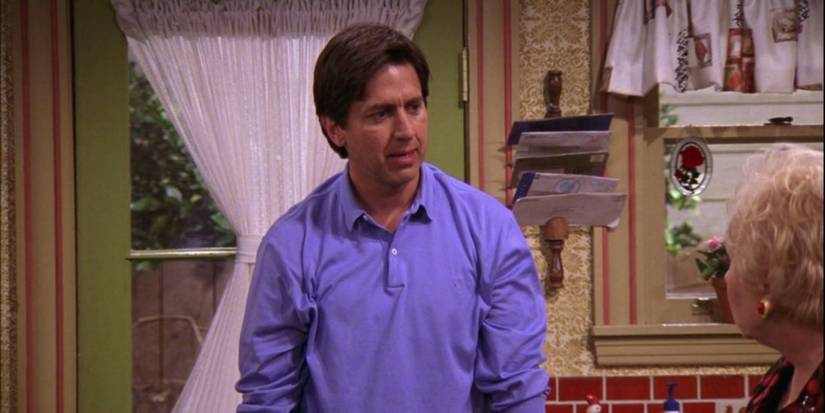 Image via CBS
One night while watching TV, Debra suddenly starts choking on her food. Instead of saving her, Raymond barely looks away from the screen. She eventually clears her throat by herself, but the damage is done. She's mad that Raymond didn't help when it was clearly a life-or-death situation.
The incident sticks with Raymond, and instead of apologizing, he starts questioning his masculinity. But that's not really the issue. He may love his family, but he lacks the awareness to recognize when they actually need his help. It's not about whether he's "man enough" — it's about him coming off as a bumbling, inattentive partner.
"Bully on the Bus"
Season 4, Episode 13
 Image via CBS
It's not easy learning about your kid's misdeeds. Raymond is surprised when he discovers that Ally (Madylin Sweeten) is being bullied on the bus. But after he tails her (by riding on the same bus), he's even more shocked to find out that Ally's the one who's been taunting other students.
Oddly enough, Debra doesn't seem to take the situation seriously. Instead of backing Raymond up, she brushes it off like he's making a bigger deal out of it than it is. In response, Raymond calls her pushy and even blames Ally's behavior on her. Instead of reprimanding Ally, the situation ends up becoming another bickering session between Raymond and Debra.

Everybody Loves Raymond
Release Date 1996 - 2005
Showrunner Phil Rosenthal
Directors Gary Halvorson, Will Mackenzie, Jerry Zaks, Kenneth Shapiro, Steve Zuckerman, Jeff Meyer, Michael Lembeck, Brian K. Roberts, John Fortenberry, Michael Zinberg, Jeff Melman, Ken Levine, Alan Kirschenbaum, Andy Ackerman, Asaad Kelada, Michael Lessac, Paul Lazarus, David Clark Lee, Rod Daniel, Wil Shriner
-

-

Patricia Heaton
Debra Barone








 English (US) ·