
 Image via Twentieth Century-Fox

Published Mar 20, 2026, 11:09 PM EDT
Jeremy has more than 2300 published articles on Collider to his name, and has been writing for the site since February 2022. He's an omnivore when it comes to his movie-watching diet, so will gladly watch and write about almost anything, from old Godzilla films to gangster flicks to samurai movies to classic musicals to the French New Wave to the MCU... well, maybe not the Disney+ shows.
His favorite directors include Martin Scorsese, Sergio Leone, Akira Kurosawa, Quentin Tarantino, Werner Herzog, John Woo, Bob Fosse, Fritz Lang, Guillermo del Toro, and Yoji Yamada. He's also very proud of the fact that he's seen every single Nicolas Cage movie released before 2022, even though doing so often felt like a tremendous waste of time. He's plagued by the question of whether or not The Room is genuinely terrible or some kind of accidental masterpiece, and has been for more than 12 years (and a similar number of viewings).
When he's not writing lists - and the occasional feature article - for Collider, he also likes to upload film reviews to his Letterboxd profile (username: Jeremy Urquhart) and Instagram account.
He has achieved his 2025 goal of reading all 13,467 novels written by Stephen King, and plans to spend the next year or two getting through the author's 82,756 short stories and 105,433 novellas.
Sign in to your Collider account
The 1980s ended a long time ago, but the movies released during that decade remain. And you can watch them end again and again, unlike the decade itself, because you had to be there to see/experience that ending. Movie endings are much easier to talk about, in any event, and are also probably easier to talk about than the ending of a period of time spanning 10 years.
These 1980s movies have some of the best endings of that decade, with some being uplifting, others being memorably soul-crushing, and then the rest falling somewhere in between (most importantly, falling in between effectively). There will be unavoidable spoilers here, but when you're talking about movies that are between about 37 and 46 years old, the act of spoiling doesn’t feel like quite so much a writing-related crime.
10 'Stand by Me' (1986)
 Image via Columbia Pictures
If a crowd-pleaser is something that would genuinely prove engaging to anyone who watches it, then Stand by Me would have to qualify, even if it’s not really exciting or action-packed the way more typical blockbuster-scale crowd-pleasers are. See, Stand by Me is very sad, and on the more serious side of things as far as coming-of-age movies go, but it does conclude in a way that feels bittersweet.
Maybe it’s more bitter than sweet, but to add a maybe to that maybe, maybe that’s why it works as well as it does. The central character, a writer in his adulthood (like so many Stephen King characters who grow beyond childhood), reflects that he has never had – and will never have – friends like the ones he did when he was 12. He’s clearly thankful for the time he had with them, but sad they all drifted apart, and devastated that one of them died while still quite young. But he has his memories and a son of his own, so there’s a little by way of sweet to wash down all the bitter.
9 'Brazil' (1985)
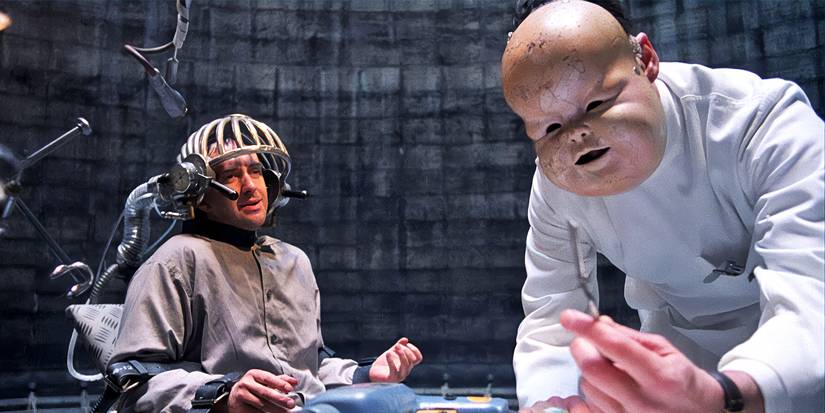 Image via Universal Pictures
Not much bittersweetness to be found here, because Brazil is nothing but heavy-going, with the ending being especially downbeat. Okay, it is a sometimes entertaining movie, because it’s a dark comedy on top of being a dystopian film, but the humor is exceptionally dark, the whole feel of the movie is nightmarish, and lots of it attempts to be disorientating and ultimately very trippy.
Eventually, Brazil's protagonist collapses psychologically and is no longer able to tell reality from fantasy.
It succeeds at all those things, so calling Brazil a chaotic watch would be a pretty big understatement. The protagonist here, a man named Sam Lowry, has more and more of his life fall apart as the movie goes along, and then eventually, he collapses psychologically, and is no longer able to tell reality from fantasy. Maybe his brain breaking at the very end is almost merciful, considering the hellish time he’d had in the film up until that point, but it’s still very much a miserable and nihilistic ending.
8 'Ran' (1985)
On the topic of heavy-going movies that came out in 1985, here’s Ran, which rivals Seven Samurai for the crown of “all-time best Akira Kurosawa film,” if you're feeling ambitious enough to pick just one movie. With Ran, the story here is about an aging warlord who has three sons who all want to be his successor, and once he reveals his plans regarding his succession, things fall apart rather spectacularly.
Basically, a family conflict explodes into all-out war, and by the end of it, just about everyone’s either dead or in a very perilous situation where death is almost imminent (like a blind character alone and lost on top of a cliff; literally the last place the audience sees him). No one wins in Ran, and the futility of the way it all wraps up contributes quite significantly to the film being an overall masterpiece.
7 'Scarface' (1983)
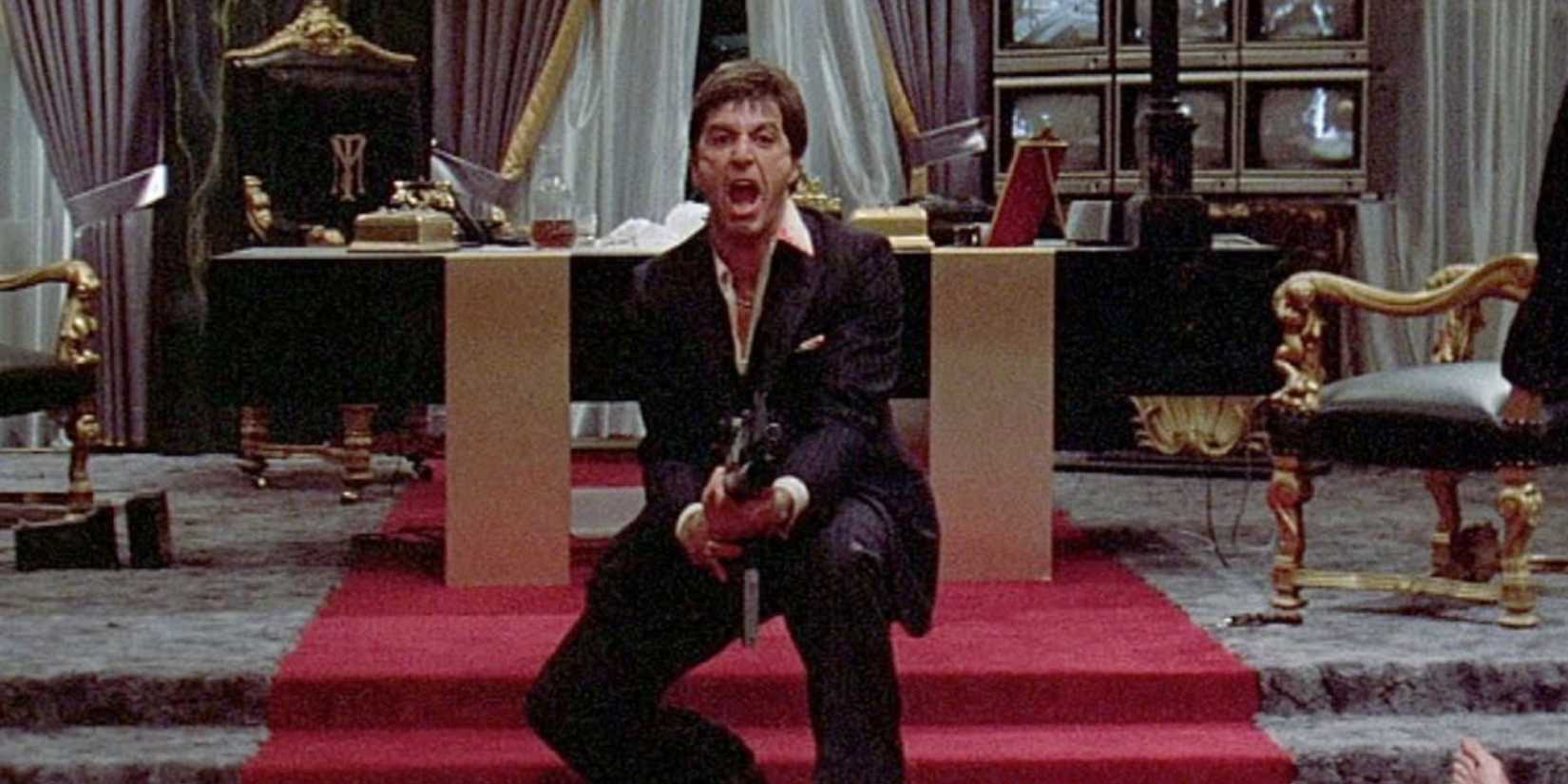 Image via Universal Pictures
Full disclosure: this article was done, and The Thing was originally on here, but then the very silly writer was looking over the article before scheduling it, and realized he’d forgotten to put Scarface in the ranking. And that seemed like too big an oversight to just let slide, and so even though a decent amount of time was spent thinking and writing about The Thing’s ending, and why it worked so well as something that kept the paranoia going long after the movie was over, it had to go. The ending was just not as cool as Scarface’s.
You could argue it’s overblown and too simplistic, but seeing the fall hit this hard in a rise-and-fall gangster story is just glorious. Tony Montana doesn’t go down without a fight, and he does indeed die like he lived: ridiculously, violently, profanely, and explosively. It’s a great payoff to a great movie, and really, it elevates the whole movie from (already) great to genuine all-timer status.
6 'The Last Temptation of Christ' (1988)
 Image via Universal Pictures
It says quite a lot that The Last Temptation of Christ is one of Martin Scorsese’s most ambitious movies, since the filmmaker has made his fair share of epics. You might find the casting a little surprising, and the film also has a reputation for being controversial, but those things shouldn’t put you off watching The Last Temptation of Christ, and nor should the fact that it’s a religious movie (should you be a non-religious person).
The Last Temptation of Christ is best described as an alternate depiction of some events in the Gospels, reframed in a way that makes it function as a psychological drama about Jesus Christ. The most controversial scenes were part of the temptation the title alludes to, but he does resist, and it’s cathartic when he does, at the film’s end. His ultimate sacrifice feels arguably more meaningful, from a certain point of view, with this approach, even if humanizing Jesus in this way did count as blasphemy in the eyes of some.
5 'Once Upon a Time in America' (1984)
 Image via Warner Bros.
Describing what kind of movie Once Upon a Time in America is before laying out how it ends might make the whole thing sound super anticlimactic and disappointing, but it really does all work in execution. It’s an epic gangster movie that unfolds in non-chronological order, and has an aging criminal reflecting on both his childhood and adult life, all the while struggling with a lack of closure regarding some aspects of his past in old age.
It’s something of a tragedy, but not one where you feel sorry for the characters, because they do some reprehensible things (okay, lots of classical tragedies are like that, but still). Once Upon a Time in America has a downfall of sorts for its central character, too, but not in the way old-school gangster movies had them. Things get weird and dreamy, not to mention ambiguous (and more so than the ending for the aforementioned The Thing), and yet what seems like a lack of sense kind of makes sense, once you sit with it for a while and give the whole thing some more thought.
4 'The Cook, the Thief, His Wife & Her Lover' (1989)
 Image via Palace Pictures
At its core, The Cook, the Thief, His Wife & Her Lover is a straightforward movie about a cycle of violence and revenge that involves the four titular characters (with the cook having the most passive role in the film). The style here, and the approach toward telling that story, on the other hand? All that makes it feel very much distinct from your average revenge movie, it has to be pointed out.
Still, when it wraps up, there is a certain amount of catharsis that comes with seeing the thief’s comeuppance, especially because he’s been a particularly heinous monster to everyone – but most of all, his wife – throughout the entire film. The Cook, the Thief, His Wife & Her Lover delivers catharsis while also being absolutely confronting and kind of nauseating, all in ways best experienced/discovered on one’s own, should your stomach be up to the task.
3 'The Empire Strikes Back' (1980)
 Image via 20th Century Studios
It would be weird to talk about great endings found in movies from the 1980s without a mention of the second Star Wars film, The Empire Strikes Back. Okay, yeah, it’s Episode V if you want to watch them in chronological order, but it was the second one made overall. And maybe it’s better to watch them in order of release, because the biggest and most famous surprise regarding the ending of The Empire Strikes Back gets ruined otherwise.
But then again, it’s also common knowledge at this point about who Darth Vader really is. And also, it’s really just one part of the overall ending here, which feels satisfying even while leaving so much up in the air. There’s an emotional resolution or at least an emotional release here, even if all the different narrative threads still have to be wrapped up, and it’s a wonder it all works so well without feeling too depressing or ambiguous in a detrimental/disappointing way.
 Image via Universal Pictures
E.T. the Extra-Terrestrial ends in the way it has to: E.T., the titular alien, does indeed achieve his goal of “phoning home” and then getting picked up by his fellow aliens (the ones who accidentally left him on Earth at the start). He does it with a little help from his friend, Elliott, but then the two inevitably have to bid each other farewell once the overall goal has been achieved.
So you know it’s coming, but it’s still surprisingly hard-hitting when it happens. If it’s a bittersweet ending, then it’s one that’s probably a little more sweet than bitter, because it is ultimately a moment of triumph. It’s just a testament to the quality of the overall movie, then, that watching such a goodbye, no matter how much it “had” to happen, ends up feeling the way it does.
1 'Cinema Paradiso' (1988)
 Image via Titanus
Like Stand by Me, Cinema Paradiso is a coming-of-age movie that both begins and ends with the central character as an adult reflecting on his childhood, and maybe it is an easy way to make such a movie emotional, but both films pull it off well regardless. With Cinema Paradiso, there is more time spent with the protagonist as an adult, and part of his journey throughout the film does also involve his life as a teenager (so it’s a little more sprawling overall).
Cinema Paradiso ends with a meaningful gift being left to the protagonist, Salvatore, by the film projectionist who served as his father figure, and it drives home the idea that the whole movie is a love letter to cinema in more ways than one. It involves a montage that makes Salvatore break down crying, but crying happy tears, and that’s probably what most viewers of Cinema Paradiso will find themselves doing at the exact same time, too.

Cinema Paradiso
Release Date February 23, 1990
Runtime 174 Minutes
Director Giuseppe Tornatore
Writers Giuseppe Tornatore, Vanna Paoli
-

-
Enzo Cannavale
Spaccafico
-
Antonella Attili
Maria Di Vita - Younger
-



 English (US) ·