


Published Aug 25, 2026, 9:00 AM EDT
Tom is a Senior Staff Writer at Screen Rant, with expertise covering everything from hilarious sitcoms to jaw-dropping sci-fi epics.
Initially he was an Updates writer, though before long he found his way to the TV and movies team. He now spends his days keeping Screen Rant readers informed about the TV shows of yesteryear, whether it's recommending hidden gems that may have been missed by genre fans or deep diving into ways your favorite shows have (or haven't) stood the test of time.
Tom is based in the UK and when he's not writing about TV shows, he's watching them. He's also an avid horror fiction writer, gamer, and has a Dungeons and Dragons habit that he tries (and fails) to keep in check.
Sign in to your ScreenRant account
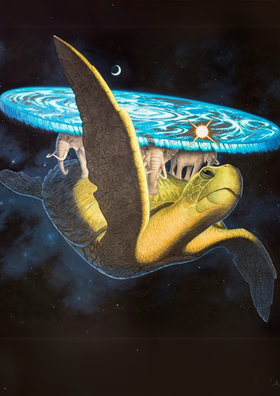
The fact that they’re on a flat plate on the back of four elephants standing atop a space turtle is already a strong clue that the best locations in Discworld are going to be some of the most inventive in fantasy literature. Terry Pratchett's worldbuilding takes the absurd premise that is the Disc and uses it to create everything from sprawling cities and haunted forests to entire dimensions with a single function or purpose.
The locations in Terry Pratchett's Discworld series are just as important as its characters, with the settings of the books shaping and crafting the narrative and tone just as much as the people that populate them. Some become recurring settings for entire subseries, while others appear only briefly but still leave an enormous impression. All of them, however, contribute to the rich geographical tapestry that makes Discworld a literary fantasy world like no other.
Fourecks

Fourecks, also known as XXXX or EcksEcksEcksEcks, is Discworld's most remote landmass and the setting of 1998’s The Last Continent. Its enormous deserts, bizarre wildlife, and perpetually complicated weather make it one of Terry Pratchett's most distinctive creations. The continent is unmistakably a comic reimagining of Australia, with towns with names like Dijabringabeeralong and Bugarup, dangerous native wildlife, and eccentric settlers all contributing to its deliberately exaggerated identity. Even its name is a joke, reflecting the fact that nobody was quite sure what the place was actually called.
Fourecks is an especially memorable Discworld location thanks to the fact that Pratchett doesn't simply transplant familiar Australian stereotypes into it. He subjects the entire concept to the series' supernatural logic, with Australian Aboriginal beliefs and ideas like The Dreaming being just as important as fantasy characters who greet one another by saying “G’day mate." It may be a setting designed around one enormous joke, but the commitment to that joke makes and sincerity behind it make Fourecks one of the best Discworld locations despite only appearing in one book.
Omnia
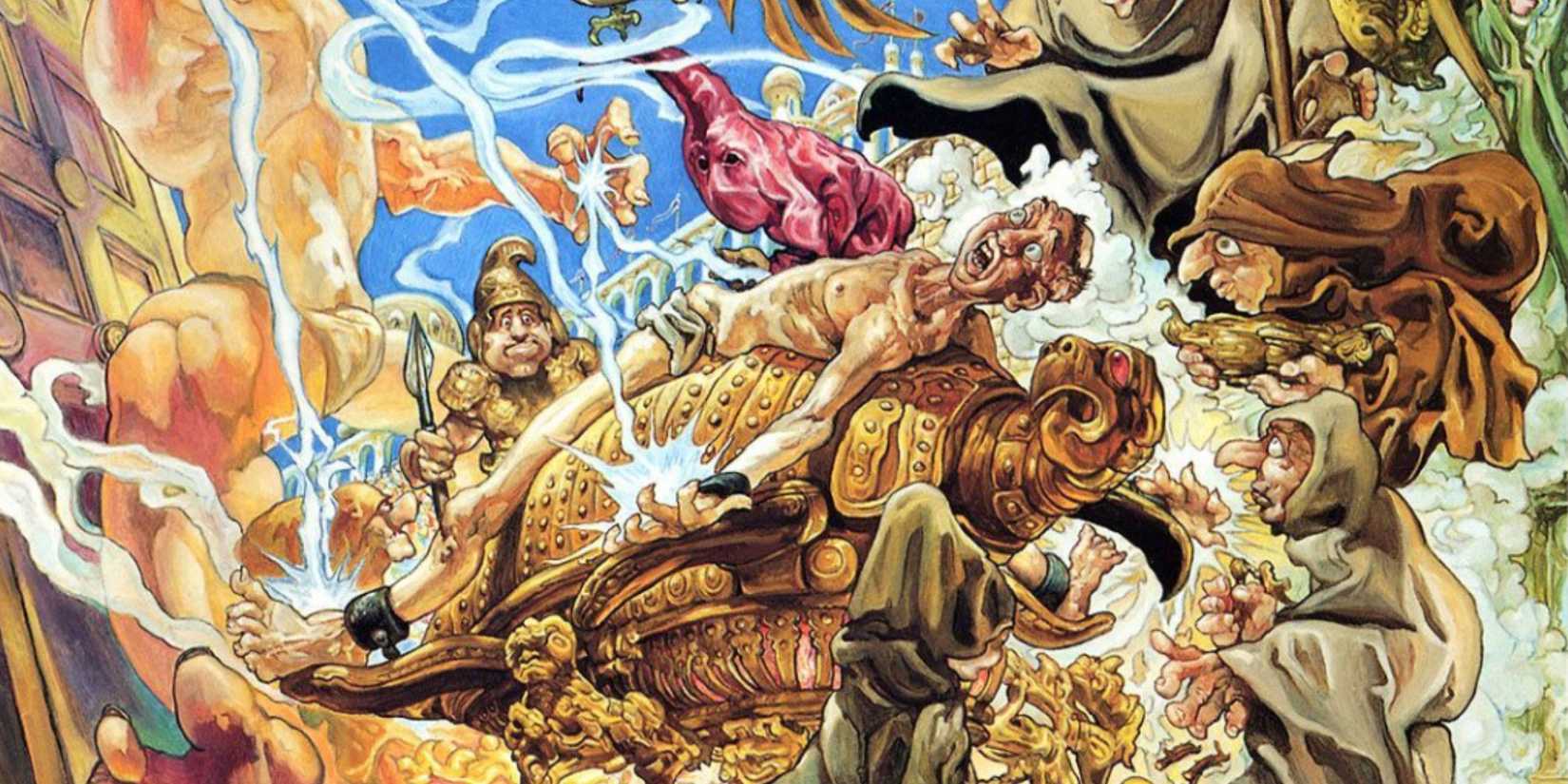
Omnia initially appears to be one of Discworld's more straightforward fantasy nations: a powerful desert theocracy dominated by the Church of Om and ruled from the city of Kom. Pratchett, however, turns the familiar fantasy image of the religious empire into a sharp satire of institutional power, dogma, and the tendency of organizations to become more concerned with rules than with the beliefs that supposedly created them. Kom itself combines the imagery of a holy city but runs on the kind of bureaucratic machinery found in an enormous modern religious institution.
Its defining appearance is 1992’s Small Gods, where Omnia is used as the perfect setting for Terry Pratchett to explore the relationship between faith and organized religion through the unique narrative lens of a Discworld story. The country's history of conquest and intolerance provides plenty of darker material, but the novel's comedy ensures that Omnia never becomes overwhelmingly grim. Small Gods is set centuries before the other Discworld novels, but Omnia in the Disc’s present-day timeline in books like 1998’s Carpe Jugulum (which features an Omnian priest who gets caught up in a fight against vampires) is just as interesting.
Klatch

Located around 550 miles Rimwards (South) of Anhk-Morpork, Klatch is simultaneously a wider continent and a single nation. The continent stretches around the Circle Sea and encompasses radically different societies. However, it’s the nation of Klatch, whose capital city is Al Khali, that makes the region one of the best Discworld locations. With an aesthetic that parodies Middle Eastern fantasy and fairy tales like Sinbad the Sailor and Ali Baba & The Forty Thieves, Klatch is Terry Pratchett masterfully playing with conventional fantasy ideas about mysterious lands beyond the genre’s many familiar European-inspired regions.
The setting becomes especially entertaining when Klatch’s relationship with Ankh-Morpork takes center stage. For example, 1997’s Jingo uses the region as the backdrop for a political crisis that satirizes the Imperialism of the British Empire and the ease with which countries can turn an absurd dispute into a potentially catastrophic conflict. Just like Fourecks and many other Discworld settings, Klatch initially feels like a prolonged satire of a single real-world location and culture, but quickly becomes something much, much deeper that deliberately challenges readers’ preconceptions.
Überwald

Few Discworld locations commit as completely to parodying a whole genre like Überwald, which is the home of many of the Disc’s most prominent noble vampire and werewolf families. Its name is even a play on Transylvania (which means “the land beyond the forest” in Latin, whereas Überwald means the same thing in German). However, while it deliberately evokes Gothic horror, Pratchett's interpretation is not merely a collection of genre clichés. Überwald has its own complicated social structures, especially when it comes to the uneasy coexistence of supernatural species like vampires, werewolves, dwarfs, and trolls.
The setting is particularly prominent in 1999’s The Fifth Elephant, which sends the City Watch into a region where vampire aristocrats and dwarf politics collide. It also plays a major role in Carpe Jugulum, which brings an Überwald vampire family into conflict with the witches of Lancre. The result is a location where almost every mountain and castle feels like it belongs to a Gothic horror story, but Pratchett then dismantles expectations with jokes, political commentary, and characters who are considerably more complicated than their traditional fantasy archetypes.
Oi Dong

Oi Dong is a relatively obscure Discworld location, but its appearance in 2001’s Thief of Time makes it incredibly memorable and a near-perfect example of what makes the geography of the Disc so endearing. Found in the region known as Enlightenment Country, Oi Dong is the home of the History Monks, an ancient monastic order whose purpose is to manage the flow of time. It does not have the enormous narrative footprint of Ankh-Morpork, but its brief role contributes to one of Pratchett's strangest corners of worldbuilding.
The fun of Oi Dong comes from the way Thief of Time treats its geography as something almost inseparable from philosophy. It's a place where history, time, and geography itself are all connected to and shaped by the monks' peculiar responsibilities. The wider region of Enlightenment Country is also used by Pratchett to parody stereotypical depictions of mystical Eastern lands without turning the location into a conventional fantasy kingdom. Oi Dong is important because of what it represents: Discworld geography can become an extension of Pratchett's biggest conceptual ideas, and sometimes a relatively small location can open the door to an entire cosmic system.
Dunmanifestin

Faith and religion are important in Discworld, and atop Cori Celesti, the gigantic spire at the center of the Disc, sits Dunmanifestin, the home of the gods. It is about as detached from ordinary Discworld life as a setting can get without travelling to an adjacent dimension such a L-Space or Death's Domain, and the deities that inhabit it literally play games involving the fates of mortals below. The gods' great hall contains a representation of the Disc that functions as a game board, turning the entire world into something they can observe and manipulate. At its core, Dunmanifestin is a wonderfully literal expression of Pratchett's approach to mythology.
The gods in Discworld are powerful, but they are also petty, argumentative, and frequently ridiculous. Their lofty home resembles the traditional divine realms of fantasy and mythology, particularly Mount Olympus, while simultaneously lambasting the grandeur associated with such places. Its appearances are relatively limited, with 1983’s The Color of Magic establishing it and 2001’s The Last Hero providing an especially close look at where the gods of the Disc actually live. The setting works because Pratchett takes one of fantasy's oldest concepts, the home of the gods, and makes it feel like the genre’s most dysfunctional residents' association.
Lancre

Lancre is the heart of Discworld's Witches subseries and one of the clearest examples of Terry Pratchett turning a familiar fantasy setting into something much richer. A small kingdom in the Ramtop mountains, Lancre contains the sort of forests, mountains, castles, and isolated villages that might ordinarily serve as the backdrop for a traditional fairy tale. Instead, Pratchett fills it with iconic witches like Granny Weatherwax and Nanny Ogg, using it as a backdrop for the coven facing supernatural problems that are usually far stranger than anyone anticipated and, invariably, analogies for real-world issues and ideas.
This Discworld setting first becomes truly central in 1988’s Wyrd Sisters, where Lancre provides the stage for Pratchett's playful assault on Macbeth and other Shakespearean traditions. A key reason Discworld stories set in Lancre resonate is its subversive familiarity, and not just with other fantasy. It’s one of the most intimately human locations on the Disc. In Lancre, Pratchett balances enormous supernatural events with tiny details about village life. For Granny Weatherwax and Nanny Ogg, Lancre is not simply a setting; it is their community, responsibility, and home.
Death's Domain

The most iconic Discworld location that isn’t actually on the Disc itself, Death's Domain is one of Terry Pratchett’s most effective examples of a character's personality becoming architecture. It's the same symbiotic character-locale relationship that literally shapes the landscape and structures of Oi Dong and Dunmanifestin, but more directly. The home of Death is a vast, strange estate where the conventions of ordinary reality have very little authority. It contains dark gardens, a maze, a golf course, and countless bizarre details that reflect Death's attempt to understand human interests despite fundamentally not being human himself.
The Domain appears most memorably in the Death-focused novels, such 1987’s Mort, 1991’s Reaper Man, and 1996’s Hogfather. Death is a fascinating Discworld character, as he routinely grows tired of his role and seeks to connect more with humanity, and his domain is a physical manifestation of that contradiction. It is enormous and imposing, yet often strangely domestic; it belongs to a Grim Reaper who has developed an interest in cats, family life, doorknobs, and every other facet of human behavior. Death's Domain makes the cosmic feel personal, allowing some of Discworld's biggest questions about mortality to emerge from one of its funniest locations.
The Unseen University

The Unseen University is Discworld's greatest institution of magical academia and one of its most frequently recurring locations. Situated in Ankh-Morpork, the university is home to a collection of wizards whose academic titles, bureaucratic habits, and general reluctance to do unnecessary work make the Disc’s magic school a world away from the likes of Hogwarts. Its enormous library is especially important, containing magical texts and connecting to L-Space, which allows books and knowledge to literally shape reality (overseen by a librarian who is, coincidentally, an Orangutan).
The Unseen University appears in dozens of Discworld novels. It is one of Pratchett's most sustained parodies, simultaneously poking at fantasy wizard schools and real-world academic institutions. The faculty meetings, obscure departments, and endless magical experiments become funnier because the wizards often possess enormous power while displaying remarkable academic laziness (Archchancellor Ridcully, the Disc’s Dumbledore equivalent, regularly voices his opinion that students should be banned). It’s a Discworld setting that evolves alongside the series, becoming a dependable source of comedy while also being an outlet for Terry Pratchett to explore concepts like the relationship between magic and science alongside the inherent absurdity of university education.
Ankh-Morpork

It’s hard to argue against Ankh-Morpork being the best Discworld location, as it’s the centerpiece of the majority of the Disc’s greatest stories. A sprawling city divided by the river Ankh and dominated by competing guilds, a remarkably modern system of governance and politics headed by the Patrician, and an extraordinary concentration of eccentric personalities, Ankh-Morpork best demonstrates Terry Pratchett’s ability to make a setting feel both completely absurd and strangely believable. The city is not simply a backdrop; it's a living, breathing location that feels just as much like a Discworld character as its thousands of inhabitants.
That versatility explains why Ankh-Morpork appears across so many different Discworld subseries. For example, the City Watch stories use its streets to explore policing, politics, and social change, while novels such as 2000’s The Truth, 2004’s Going Postal, and 2007’s Making Money use different parts of the city to examine everything from journalism and communication to finance and sport. The city consequently grows across the 41 Discworld novels, gradually becoming more modern and complicated. Ankh-Morpork features in dozens of different stories because it works so well as a canvas for Terry Pratchett’s weirdest and wildest ideas. Far more than a fantasy city, Ankh-Morpork is the setting that best captures why the Discworld is one of the most inventive settings in the genre’s history.
Video Game(s) Discworld MUD
Cast David Jason, Charles Dance, Michelle Dockery, Marc Warren, Anna Chancellor, Richard Coyle, Ingrid Bolsø Berdal, Adam Hugill, Jo Eaton-Kent, Wendell Pierce, Ralph Ineson, James Fleet, Terry Pratchett
Created by Terry Pratchett





 English (US) ·