

Published Oct 2, 2026, 6:00 AM EDT
Greer Riddell is a London-based culture journalist and critic writing on film, television, audience behaviour, and the wider media industry. She is a Writer and Social Media Coordinator at Collider and TV Editor at FILMHOUNDS.
Her recent collaborations include Netflix, Warner Bros., DC Studios, Hulu, and Disney+, producing features on titles including Saturday Night Live UK, Severance, Sitcoms, Buffy the Vampire Slayer, and Stranger Things. Her recent reviews include Peaky Blinders: The Immortal Man, Stranger Things: Tales From ‘85’, Scrubs Season 10, and The Boroughs. Her work has also included coverage of UK film festivals and features published in Film Stories Magazine.
Editor's Note: The following conversation contains plot spoilers for Netflix’s East of Eden.
Summary
- In an interview with Collider, Zoe Kazan said Netflix’s East of Eden puts Cathy Ames at its center to explore why she acts as she does, without excusing her.
- Kazan and Jeb Stuart said the seven-episode format gives the story room to show how one generation’s choices affect the next.
- Kazan said her grandfather Elia Kazan’s 1955 film initially made her hesitant to adapt the novel, though her own connection to Steinbeck’s book drew her to it.
John Steinbeck’s East of Eden, the 1952 epic novel based on the biblical story of Cain and Abel, is widely considered his most ambitious work. Set in California’s Salinas Valley, the tale tracks the intertwined lives of the Trask and Hamilton clans, exploring the inheritance of family, the pull of nature and nurture, and whether generations are destined to repeat the sins of those who came before them.
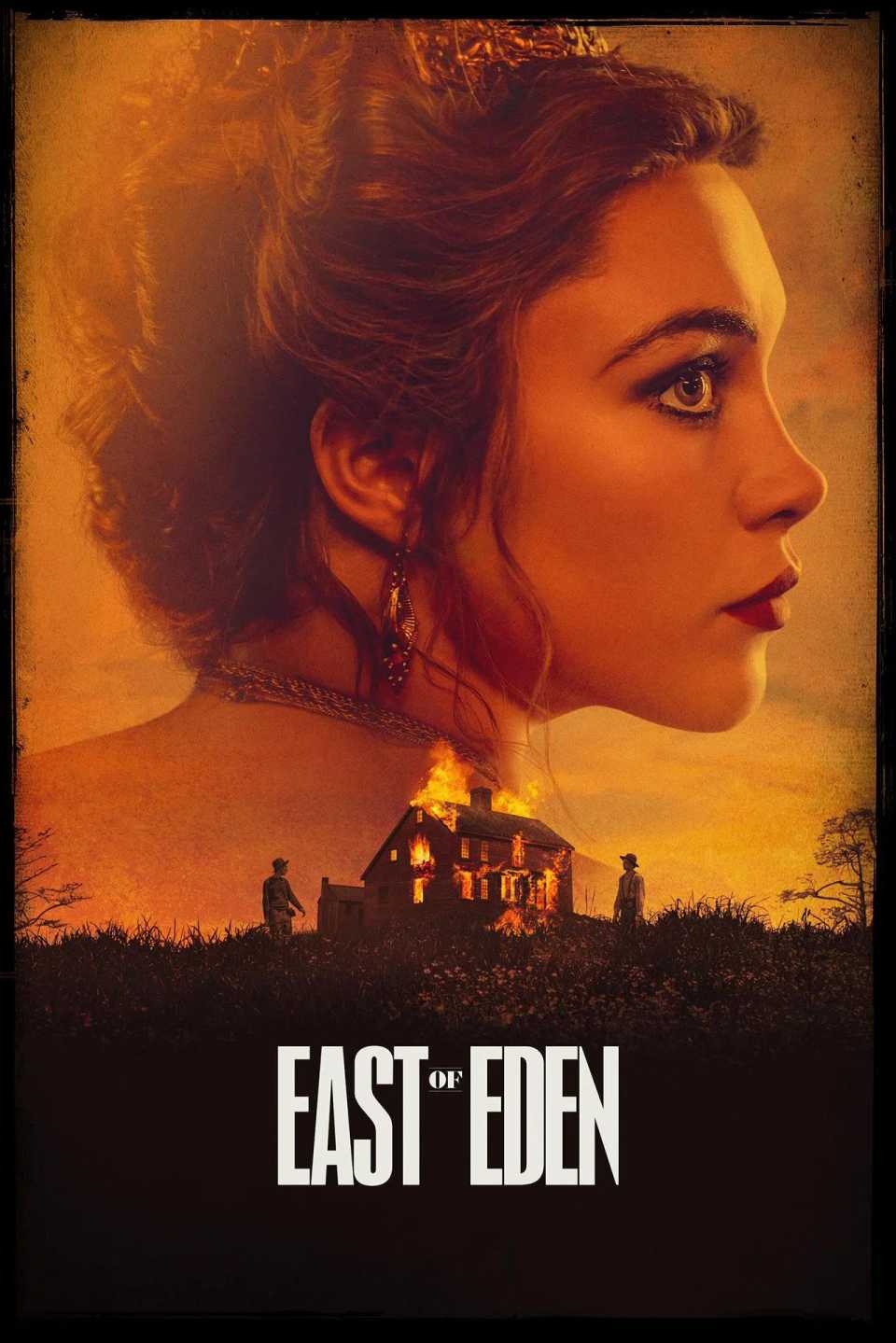
Now Zoe Kazan (The Big Sick) and Jeb Stuart (Die Hard) are leading Netflix’s own ambitious adaptation, telling the story across seven hour-long episodes. Premiering on October 1, East of Eden will follow brothers Adam (Christopher Abbott) and Charles Trask (Mike Faist), whose rivalry begins on their father’s farm. Charles is aggressive and jealous of his gentler brother Adam, who eventually escapes west with his wife, Cathy Ames (Florence Pugh), hoping to begin a new life. Instead, the same rivalry resurfaces in their twin sons, Cal (Joseph Zada) and Aron (Joe Anders), as they wrestle with their mother’s abandonment, compete for their father’s attention, and inherit the consequences of their parents’ choices. Kazan and Stuart joined Collider to discuss the new series and why Cathy Ames is at its heart.
Netflix’s ‘East of Eden’ Asks Us to Consider the Woman Behind Cathy Ames’ Monstrous Acts
 Image via Netflix
Netflix’s new adaptation of East of Eden sees Florence Pugh serve as an executive producer, with her and Kazan having worked together on this retelling since 2020. Steinbeck originally conceived Cathy as satanic, an evil woman who manipulates and destroys people for her own amusement and profit, calling her a “psychic monster” with a “malformed soul.” Yet it is this character, perhaps more than any other, that drew Kazan and Pugh to East of Eden. She takes center stage in their new series, which asks audiences to look beyond the label of “monster” and consider the “why” and the woman underneath it.
Cathy may be the focus of this new series, but Kazan isn’t excusing her actions, and we’re not being asked to redeem her. “I think it's maybe… being perceived that way, but actually an adaptation is just how you read the book, right?” clarifies Kazan. The showrunner is keen to point out that this is her own personal interpretation of the story, saying, “Everybody is going to have their own reading. And that's what's so great about being a reader is that you can have a private and personal experience of it.”
Kazan is also interested in highlighting the way Steinbeck’s own opinion of Cathy evolves throughout his writing. “He begins by saying, ‘She's a monster, and there are monsters born to human parents.’ About a hundred pages later, he says, ‘I've described her as a monster, but now that I've gotten out my glasses and looked at her closely and read the footnotes, I begin to wonder if it is true.’” Kazan and Stuart zoomed in on Steinbeck’s nuanced portrayal of Cathy: “It is easy to say she was bad, but there is little meaning unless we know why.” They hope to honor his impulse. They want viewers to join them in seeing Cathy as “human” and “wonder about who she is and find her mysterious and complicated and as interesting as we do.”
A character as complex as Cathy needs time to imprint on an audience, and an episodic approach allowed Kazan and Stuart to really explore the depths of her psyche. “I wouldn't have wanted to make this as a feature film,” says Kazan, who praises the 1955 movie as “a classic for a reason” but points out that it focuses solely on a slim part of the story. Adapting the novel as a series for Netflix allowed her to focus on the element of the book she loved the most.
The “intergenerational aspect” needs space to truly connect and show audiences the ramifications of the characters' choices on the next generation, and “you can only do so by moving characters through time.” Stuart agrees and feels a feature would limit the much-needed shifts in tone for East of Eden, saying, “a film has a tendency to certainly have a tone that goes through all two hours… you almost have to have that with the long form.” A series feels like a worthy format for such an epic piece of storytelling, which Steinbeck refers to as “the book” of all books. “It's almost like reading a different chapter” in each episode, says Stuart.
Motherhood Changed How Zoe Kazan Connected With the Characters in ‘East of Eden’
 Image via Netflix
Steinbeck wrote to a friend about East of Eden that it was the culmination of everything he had been able to learn about his craft over the years, claiming everything else he had written — including The Grapes of Wrath and Of Mice and Men — had been “in a sense, practice for this.” When asked what Kazan and Stuart had taken from their previous projects and put into practice on East of Eden, Jeb Stuart, who co-wrote the Academy Award-nominated The Fugitive in 1993, shared, “Every project you work on, you learn something.” He added that it was an exciting change from “being a writer and writing it to suddenly, you know, being a producer and… bringing it to life.”
For Kazan, who first read the story at 15 years old, the adaptation allowed her to approach the same material from a different position as a young mother. Now looking at the story “with the perspective of looking down to the next generation,” Kazan shares that she was no longer reading it in relation to Cathy but instead in relation to Cal. There were other times when she identified with Hoon Lee’s character, Lee, too, who “shows up in a daily way for these boys.” Motherhood also allowed her to understand in a new way “Adam's struggle wanting to be a different kind of father than he had, but necessarily inevitably repeating things from the past.”
A perspective on parenthood is very fitting for East of Eden’s subject matter, but Kazan also shared that it helped with the production: “As a producer, I feel like that your job is very similar to the job of a parent.” While on set, she took the “tools” she has gained as a mother and applied them to collaborating with the cast and crew, sharing that “means holding boundaries that your children may not like and that means coming with kindness and understanding.”
Zoe Kazan Took a Different Approach to ‘East of Eden’ Than Her Grandfather Elia Kazan
East of Eden, as a story, has several layers of biography. The Hamilton family in the novel is said to be based on the real-life family of Samuel Hamilton, Steinbeck's maternal grandfather. A young Steinbeck himself also appears briefly in the novel as a minor character. The book’s themes include how much of your life is dictated by nature or nurture, what gets passed down through the generations, and whether the cycle can be broken or you are doomed to repeat it from birth. It also links to the biblical story of brothers Cain and Abel, something Steinbeck wanted to make clear with all of his C and A names!
This new adaptation is particularly interesting to examine in an autobiographical context, considering it is being adapted by Zoe Kazan, the granddaughter of Elia Kazan. He was responsible for directing the 1955 film East of Eden, starring James Dean. Elia Kazan had seen Dean on stage in New York and, after an audition, gave him the lead role, effectively introducing him to the world. So was Kazan almost destined to revisit this story, drawn to something passed down through her own family? The showrunner confirmed that she came to the book long before watching the movie, so her attraction to Cathy Ames and East of Eden’s familial themes came first and foremost from “Steinbeck's work and not really [her] grandfather's.”
Steinbeck uses the debated Hebrew word “timshel” as a major theme in the novel. Lee explains the meaning as “Thou mayest,” signifying human free will and the power to choose between good and evil rather than humans being doomed by fate, genetics, or family history to repeat sin. In the spirit of free will, for Kazan, her grandfather’s involvement in the story was “if anything... a deterrent.” She felt at times during the development process “like I don't really want to take that on and what am I doing and am I crazy for wanting to step right into that shadow.” However, she also acknowledges that she “would be a very poor artist” to “not think about [her] own family as [she] adapted this.”
Kazan and Stuart’s ultimate aim with this new telling of East of Eden is that “viewers will walk away thinking about their own families.” The question of how much a parent’s choices affect the next generation naturally caused the team to think about their own relatives while putting the production together. Kazan shares that she “thought about [her] grandfather… [her] children and [her] grandparents on the other side of my family and all the things that we carry with us our country's history.”
So East of Eden’s influence goes beyond the coincidence of separate generations adapting the same source material for the screen. Instead, it highlights the natural similarities we all share in our hopes for our families and for our world as a whole. Jeb Stuart agrees that East of Eden “transcends the time period.” Despite being written in 1952 about characters from 1862 to 1918, the novel remains relatable in 2026, so “it's not a modern retelling…as much as it's the telling of the story is universal.”
East of Eden premieres on Netflix on October 1.
Release Date 2026 - 2026-00-00
Network Netflix
Directors Garth Davis




 English (US) ·