
 1 month ago
38
1 month ago
38
Photography is an art form of trade-offs. When the shutter speed goes up, the aperture must come down. Higher ISO raises the exposure but hurts the image quality. A brighter maximum aperture means more cost and more weight. Everything is based on a give-and-take relationship, and balancing these factors is key to success.
Photography is a complicated art, and the learning curve is steep. It’s easy for beginners to get confused by what is essential, what is important, and what is frivolous, and one of the biggest misconceptions is that the more expensive a lens is, the better your photography will be. This is most apparent when discussing f/1.2 prime lenses.
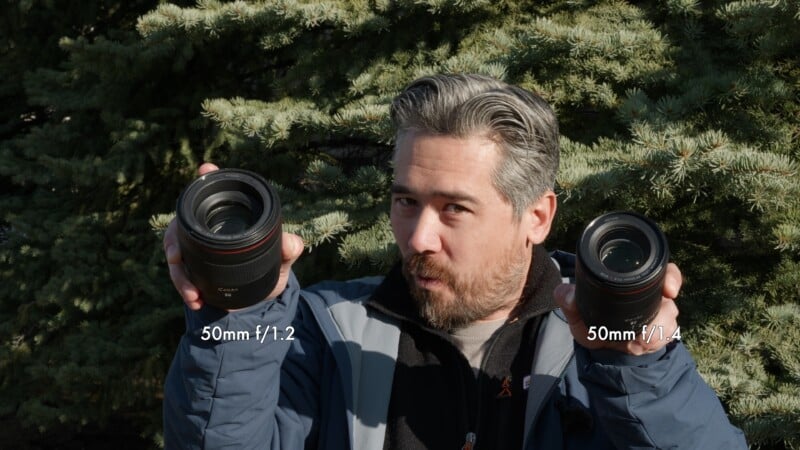 Choosing an f/1.2 lens means that the price and size go way up.
For context, I would like to make some things clear right off the bat. I’m all for lens designers trying weird and wonderful optical formulas, or even just making a lens simply because they can. Sometimes, a lens can be a way to flex your engineering talents or to show that an artistic concept can also work as a tool. I also think ultra-fast glass has its place, and that f/1.0 or f/0.95 lenses do have utility in some situations, despite the large amount of glass and exorbitant price tags that come with them.
 Don’t get me wrong. Sometimes I enjoy having an f/1.2 aperture, like on this Nikkor 35mm lens. However, the wider angle helps to moderate the ultra-shallow depth of field.
However, when we talk about fast prime lenses, we are usually talking about 85mm, 50mm, and 35mm lenses. All three of these focal lengths can be made as fast as f/1.2, but all three of these lengths are also commonly made with f/1.4 apertures, and it is here that the benefits of a brighter lens become scant.
 This was shot on a Sirui Aurora 85mm f/1.4 lens. But I shot it at f/2 to help keep both eyes in focus. I rarely even use the widest aperture on these faster lenses.
I love most f/1.4 lenses, due to the shallow depth of field that can be achieved and the vast amounts of light that can be collected when the sun sets. They also tend to be manageable in size and within reach of most budgets. But when a lens is pushed to provide an f/1.2 aperture, the main problems that I have with them are the extra bulk and vastly higher cost when very little is gained in return.
 Shallow depth of field can be very dramatic-looking but I shot this at f/1.4. Using an f/1.2 lens would not have made this photo better.
These lenses are marketed as the pinnacle of performance and subsequently come with premium prices. I also find that when any lens is pushed to an extreme, it becomes very difficult to maintain optical performance. You can read that as maximum aperture being associated with maximum complexity.
In order to keep the lenses sharp and optically well-corrected, incredibly advanced technology and processes have to be utilized, which makes the costs go up and up. Let’s also remember that any lens, regardless of maximum aperture, performs at its worst when shot at the widest apertures. This is where you will see the least amount of sharpness and the most chromatic aberrations.
 Shooting at f/1.2 provides beautiful bokeh, but you can also see plenty of bluish LoCA along the edges of the out-of-focus text.
The appreciable optical benefits are also fairly minor. Going from an f/1.4 lens to an f/1.2 lens only nets a third-stop of light and the difference in depth of field is almost imperceptible. It’s rare that I even use f/1.4 in a lot of situations because I struggle for more depth of field, not less.
Back in the days when cameras performed quite poorly at higher ISO settings, the extra light could be desperately needed, but nowadays we are spoiled for quality, and able to push ISO numbers we never would have dared in the past.
 The Canon RF 45mm f/1.2 is an awesome lens with beautiful bokeh and shallow depth of field. The bright aperture was also handy in this low-light situation.
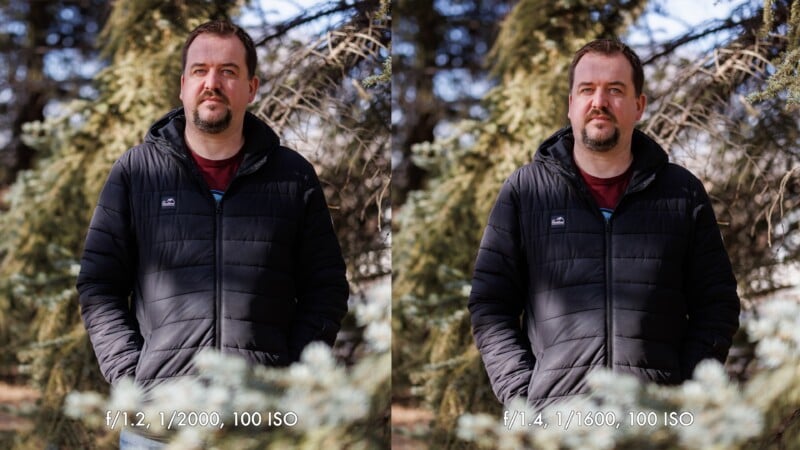 You only gain a third stop of light over an f/1.4 lens. The benefit in today’s world is quite minor.
Portrait photography is a discipline that often finds shallow depth of field to be highly desirable. I like having the option for at least an 85mm f/1.8 in order to get that shallow look that is occasionally needed. However, in most cases, unless the subject’s eyes are completely parallel to the sensor plane, one of the eyes will drift out of focus, even at f/1.8. I also don’t often like it when the nose also looks blurry in the shot, and forget about doing any quartered-off shots. Most of my portrait work is shot at f/4 or f/5.6, when even an f/1.8 lens is superfluous.
 This portrait was shot at f/1.4 and you can see that the nose is quite blurry. The background looks great but I should have shot this at a tighter aperture.
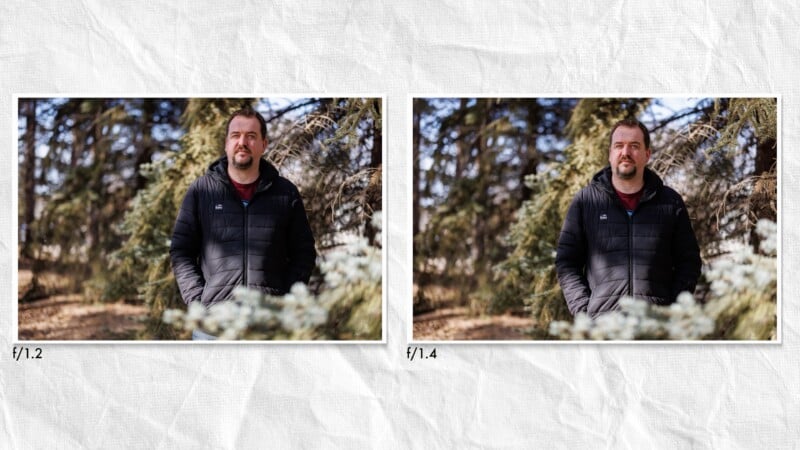 A side by side comparison shows almost no real difference between the look of f/1.2 and f/1.4.
I really want to get across that the purpose of this article is intended as a PSA to help educate newer photographers about what features might not be as important as they first seem.
There are some scenarios where an f/1.2 maximum aperture is desirable, but I think this is rarely the case. I could see why a working pro might be ok with the extra expense, especially in a studio environment, for the rare times that minimal depth of field could be used creatively. However, for the rest of us, consider that the extra bulk and cost might not be worth it for the minor benefits that an f/1.2 aperture can provide.
By all means, look at purchasing some faster f/1.4 prime lenses for the situations where you want shallow depth of field, but take pause before assuming that you need or even want the minor differences that an f/1.2 lens will bring. Buying lenses is always about the right tool for the job, and I hope this helps provide some clarity on what the best tool might be for you.






 English (US) ·