
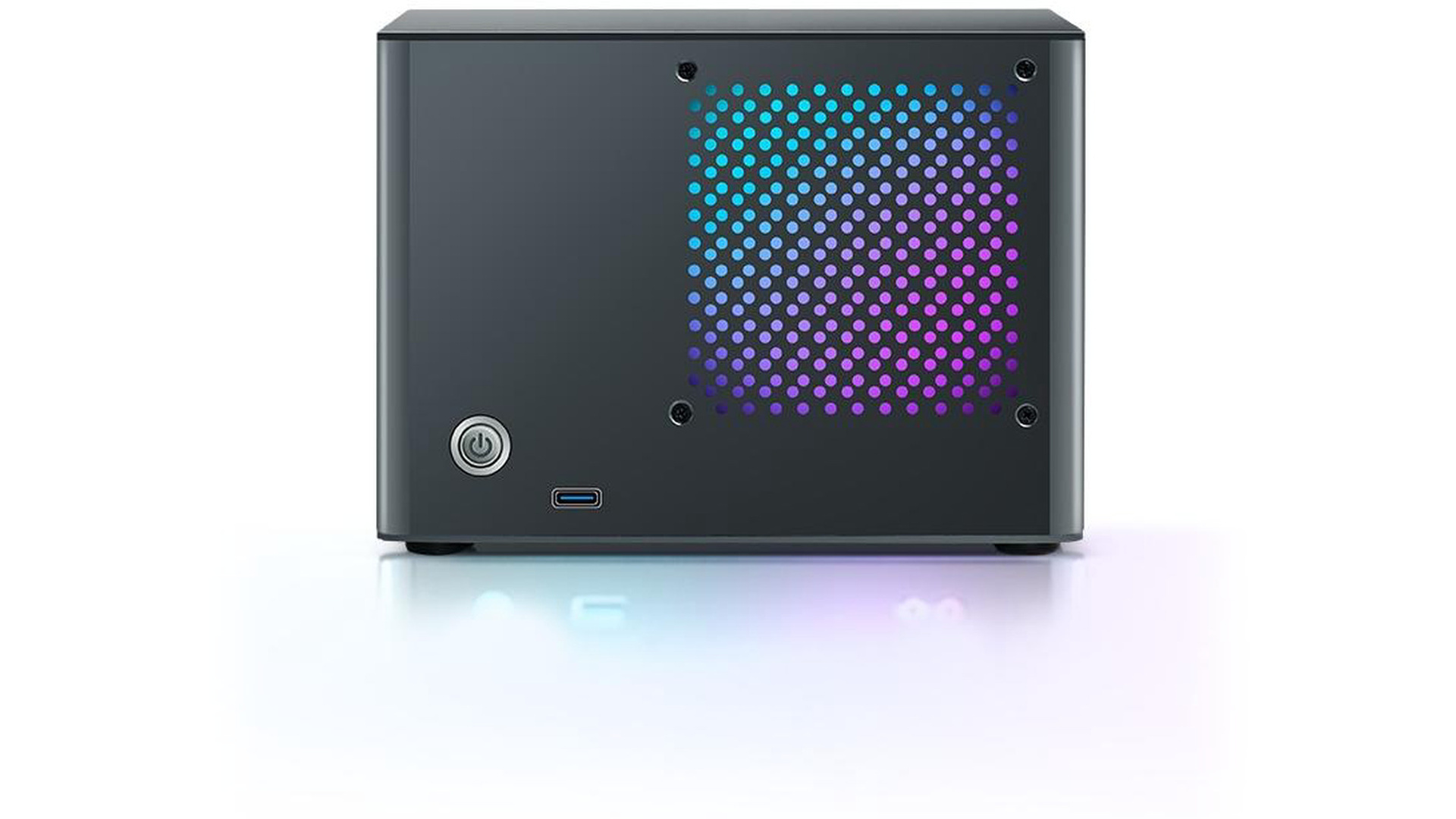
- Rmatamini's P99S packs a 16GB Tesla V100, Core i7-10850H, 16GB RAM and 512GB SSD into a 5.6L box for $699 on Newegg
- The same 16GB V100 PCIe card costs a whopping $584 new on Amazon, and renewed units can be had for $410
- Nvidia's R580 driver branch is Volta's last; CUDA 13 no longer targets the card, and potential buyers need to contend with a relatively new seller in tow
A new Newegg listing squeezes an Nvidia Tesla V100 with 16GB of HBM2 into a 5.6-liter box - and asks just $699 for the lot.
The Rmatamini P99S "Mini AI Workstation" pairs Nvidia's 2017 data center accelerator with a mobile-centric Intel Core i7-10850H, 16GB of DDR4, a 512GB NVMe SSD, a 700W power supply, and Windows 11 Pro, and ships free from China.
The number that makes this interesting sits on another site: HP's version of the same 16GB V100 PCIe card is selling new on Amazon for $584 through a third-party seller with only two units left in stock; Take that at face value, and the rest of the computer costs as little as $115.
A $584 card in a $699 box?
Amazon's pricing is where one would currently find a brand-new V100 GPU, which has seen a surge in demand due to both the relevance of older silicon and the fact that it uses HBM2, which holds its own in bandwidth compared to newer consumer-grade GPUs.
One could argue that a fairer comparison would involve a potentially refurbished unit that can be found for as low as $410 on Amazon, visible from the same listing as the new SKU. This means the mini PC itself costs either ~$115 or ~$290, depending on how one values the Tesla V100 GPU in a 16GB trim.
The V100, which once commanded a staggering $10,000 or higher price tag, is arguably dated silicon before fading away, but it is drawing attention again, and as much to do with today's market as with the card. Fast memory has become the most expensive part of any AI build.
TechRadar's analysis tied runaway graphics card pricing to AI demand for RAM in January, and a TechSpot analysis, published in February, found 16GB RTX 5060 Ti cards up 22% globally in roughly three months, a trend that has yet to break. Nvidia itself raised the price of the DGX Spark from $3,999 to $4,699 in February, citing memory supply constraints, for a machine whose early reviews had already flagged memory bandwidth as a limitation. Compact Ryzen AI Max+ 395 systems such as the MINIX ER939-AI start at $3,150.
Against that backdrop, the V100's spec sheet looks oddly current. Nvidia's datasheet rates it at 900GB/s of memory bandwidth, about twice the 448GB/s of an RTX 5060 Ti 16GB. Token generation in large language models leans heavily on bandwidth, which is why hobbyists such as Oscar Molnar spent 2026 bolting retired V100 GPUs into desktops.
The best public numbers come from YouTube channel Hardware Haven, whose tests Wccftech reported in May 2026. A modded V100 16GB produced about 130 tokens per second on gpt-oss-20b, compared to roughly 90 for an RX 7800 XT, and 108 tokens per second on Gemma 4 e4b, compared to 76 for an RTX 3060. Capped at 100W, it still managed 95 tokens per second while the whole system drew 170W at the wall.
Plenty of caveats in tow
In practice, 16GB holds mixture-of-experts models such as Gemma 4 26B-A4B entirely on the card, according to Andrew Leech's V100 LLM kit, but denser 30B-class models will not fit, and 16GB of system RAM leaves little room to offload the overflow to the CPU. RmataMini PC also sells a 32GB SKU of the same, with a bump to 32GB of DDR4 RAM, for an eyewatering $1,500, marked down from a sticker price of $2,000.
The biggest long-term caveat is software: Nvidia's driver deprecation schedule names the R580 branch as the last to support Volta, alongside Maxwell and Pascal. ComputingForGeeks notes that CUDA 13 can no longer build code for the V100, and that vLLM now requires a newer compute capability than Volta's 7.0. Ollama y llama.cpp still works on CUDA 12 builds, and community forks such as the 1Cat vLLM build keep the card useful, but the window is closing rather than opening. As Leech's kit notes, Volta's tensor cores support only FP16, so BF16 and newer low-precision formats are off the table.
The host platform is modest but adequate. The Core i7-10850H is a 45W laptop chip from 2020 with six cores, 12 threads, and 16 PCIe 3.0 lanes, matching the V100's PCIe 3.0 interface. Because the V100 has no outputs, displays are driven by the CPU's iGPU.
The seller is also relatively new, and RmataMini PC has a single seller rating; the product has none; warranty questions are referred back to the seller; and returns are for refund only, within 30 days.
For someone who wants a small, ready-made CUDA box with 16GB of 900GB/s memory and has no interest in sourcing adapters, fans, and ducts, $699 is an excellent price in a market where memory keeps getting more expensive.
But a finite software runway from Nvidia and a considerably pricier, but available 32GB SKU mean that users have much to consider before they take the plunge here for anything that could require more memory or a more current CUDA version in the near future.

Follow TechRadar on Google News and add us as a preferred source to get our expert news, reviews, and opinion in your feeds.





 English (US) ·