
 3 weeks ago
34
3 weeks ago
34
A steel frame cargo bike with a unique twist: You can let it choose your gear.
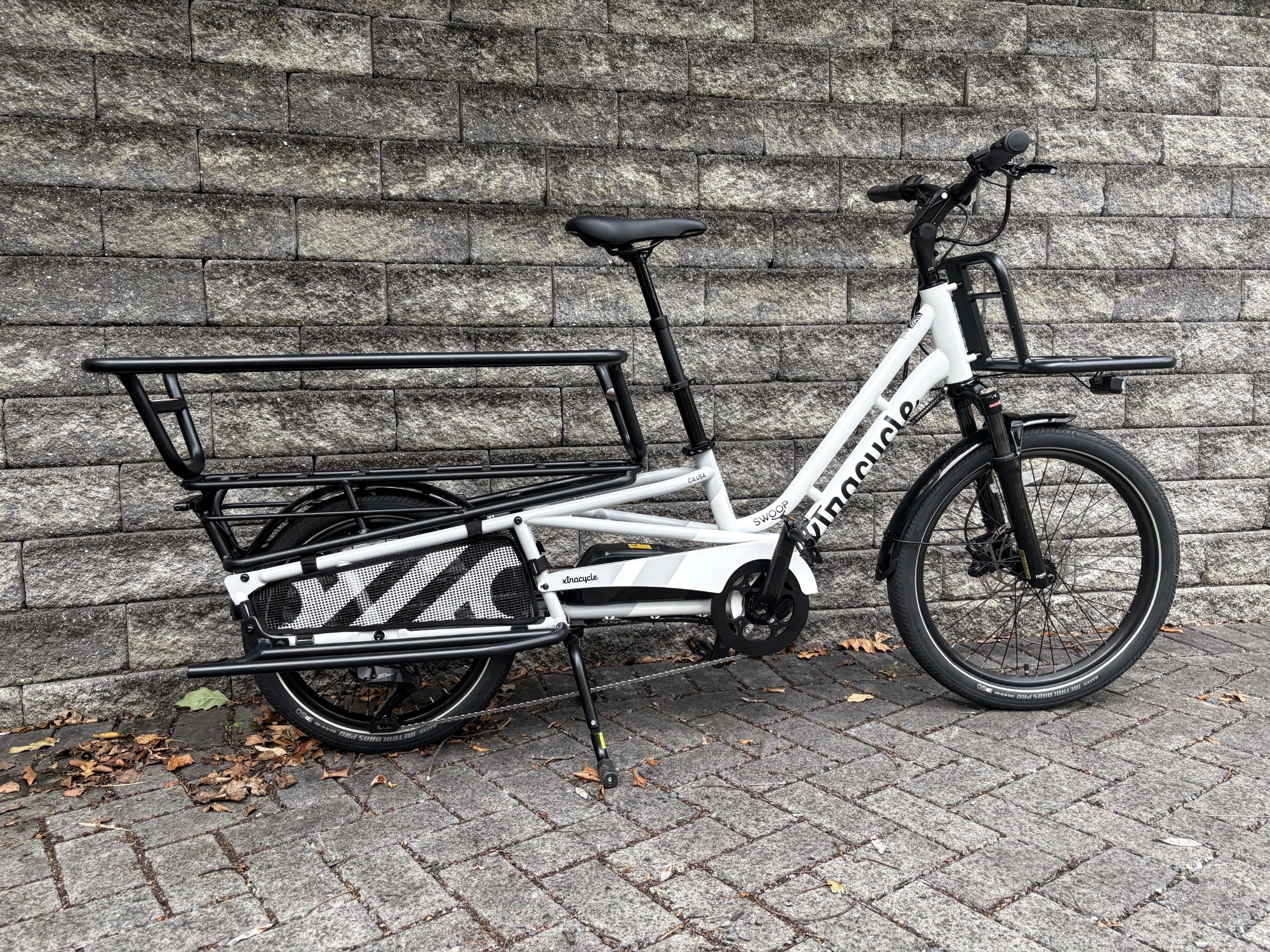
The Velotric Discover M e-bike we reviewed earlier this year had a feature I found somewhat annoying: It would sporadically block much of the display with an alert telling me I should be in a different gear. While the implementation bugged me, the concept made a certain degree of sense; most e-bikes now know your cadence, how much torque you’re generating, and how that power is being translated into speed. That’s everything you need to know to determine an optimal gear.
Somewhere in the back of my mind, I thought, “If you’re so smart, why don’t you just shift for me?”
I was completely unaware that Shimano had already developed a system that did exactly that. And for the past few weeks, I’ve been using it on a $4,500 cargo bike from Xtracycle called the Swoop ASM that let me see what it’s like to hand control of my gears to an electronic brain.
The short answer is that the electronics on the Swoop really are smart enough to figure out when it should be shifting. But the system is less adept at the actual shifting process, making for rides that are less smooth than they could be when it’s active. But you can shut that feature off, and the Swoop will shine as a fantastic cargo bike.
Swooping in
Xtracycle got its start providing cargo trailers for mountain bikes and then branched into dedicated cargo bikes. The Swoop ASM is a long-tail cargo bike with what’s called a mullet setup: a larger tire up front and a smaller one in back. The small wheel is designed to help keep the weight held by the large rear rack a bit closer to the road. It also has a front suspension to help cushion the ride.
Notably, the bike is built with steel tubes. Most manufacturers’ lineups use a mix of either carbon fiber and aluminum because those two materials can be made into the exact same shape, simplifying manufacturing. But other materials still have their fans, as they can offer distinct combinations of weight, stiffness, and vibration dissipation.
I haven’t owned a steel tube bike since the 1990s, but the Swoop was a good reminder of why it still has its fans. It’s relatively lightweight (just under 70 lbs/31 kg) for its size, its ride is very comfortable, and it was surprisingly responsive when I stood in the pedals to accelerate away from stops. Despite its highly specialized geometry, the Swoop felt like a fundamentally good bicycle.
There are limits to how well a single frame size can adapt to different body sizes, but Xtracycle does its best to widen the comfort window. It includes a double-telescoping seat post to maximize the seat-pedal distance flexibility. There’s also a quick release on the front handlebar clamp, making it easy to tweak the angle where the grips meet your hands. I found settings that were relatively comfortable but still a bit short of ideal for my 6-plus-foot (188 cm) frame—even with the seat post at its recommended maximum, I could touch the toes of both of my feet down while seated.
Beyond that, plenty of nice touches make this a solid cargo bike. These include protective covers for the rear wheel and chain to keep clothing and limbs from accidentally getting entangled. A robust U-shaped kickstand keeps the bike stable even if you park it when fully loaded, and there’s a front cargo rack that can hold some baggage.
The rear rack can be outfitted with a large range of accessories; mine came with the default setup meant for carrying passengers. This means footrests extending out at the level of the rear hub and two handgrip bars running parallel to the bench seating. But remove a soft cover, and the metal beneath reveals a series of slots that allow a wide variety of attachments to be fitted into place.
You can also use one of Xtracycle’s bag attachments in this setup; I was provided one that ran the full length of the rear attachment and held a fair amount of cargo. Adding a second would have handled all of my typical shopping needs. (While having only one bag might seem awkward, the bike performed very well with everything I was carrying loaded on one side.)
The only problem is that this hardware makes the rear wheel extremely difficult to reach. I struggled to lock the back tire to anything, and I considered myself fortunate to not have to figure out how to deal with a flat.
Smooth assistance
All those basics make the Swoop a solid entry into the cargo bike market. What sets it apart is its use of a Shimano Cues Di2, one of the component maker’s low-end electronic shifting systems. Its mere existence surprised me, since I thought Shimano was reserving electronic shifting for higher-end component lines. But the company not only took it lower in the range; it added a couple of surprise features to its electronic shifting.
First, the basics: the drivetrain uses a single chainring on the cranks and a 10-speed rear cassette. The rear derailleur requires only a power source and control signals—no cable required. Once properly aligned with the cassette gears, it executes a perfect shift every time it’s told to. This shift includes a brief period when the derailleur over-travels to ensure the chain engages the next ring along, then drops back into the optimal location for continued cycling.
The Cues Di2 derailleur. It’s ostensibly low end, but performed great. John Timmer
Everything in the system—the derailleur, the controllers, and the motor—takes power from a single removable battery. If the battery’s charge is good, you’re set to ride.
The mid-motor offers three levels of assist, adjusted through a controller on the left side that also includes the power button and a simple display. Shifting is controlled by the one on the right, which lacks a display. Separating the two allows each to be fairly minimalist, making it easy to find the control you need by feel.
On its own, the system worked beautifully. Shifting was fuss-free, and each change was blissfully silent. The assist worked well, and its three levels seemed to cover any needs short of going up steep hills with lots of cargo. This is not a bike that lets you skimp on pedaling in hot conditions; there’s no throttle, and even the highest setting of assist still requires you to exert some force on the pedals. But the motor definitely cuts down on the effort you have to make.
The battery, while looking fairly compact, easily handled dozens of miles without needing a recharge, which means several days of typical errands. While the battery lacks a carrying handle, it’s easy to take it out to charge it, as it pivots sideways out of the frame. When in place, it acts as a protector that keeps anything on the left side of the bike from sliding through the frame and getting tangled in the chain.
This is the first Shimano e-bike system I’ve tested, and it was just as good as you’d expect from a company that has come to dominate cycling drivetrains. Shimano Cues may be its lower-end system, but there’s no apparent skimping on the quality. And that’s before the bonus surprises Shimano has included.
The fun stuff
Somewhere in one of the controllers, Shimano’s software gathers all the relevant information about your ride: how fast you’re going, how much force your feet are exerting on the cranks, what gear you’re in, and how fast your legs are churning (and possibly more?). And it uses that data to do a couple of interesting things.
One is what it calls Free Shift. Normally, a bike can’t shift to a different gear unless you’re turning the pedals to move the chain, which can potentially create problems. For example, you could move the derailleur down a gear but not complete the shift before stopping, meaning that the shift would be made when you start pedaling again, and the chain is under a lot of tension as you crank away from a full stop. Or you could move the derailleur several gears over without the chain following.
But the whole point of having a motor is to move the chain. So if you shift without pedaling and the bike isn’t stationary, the Cues system will use the motor to move the chain just enough to complete the shift. It does so without speeding up the bike at all.
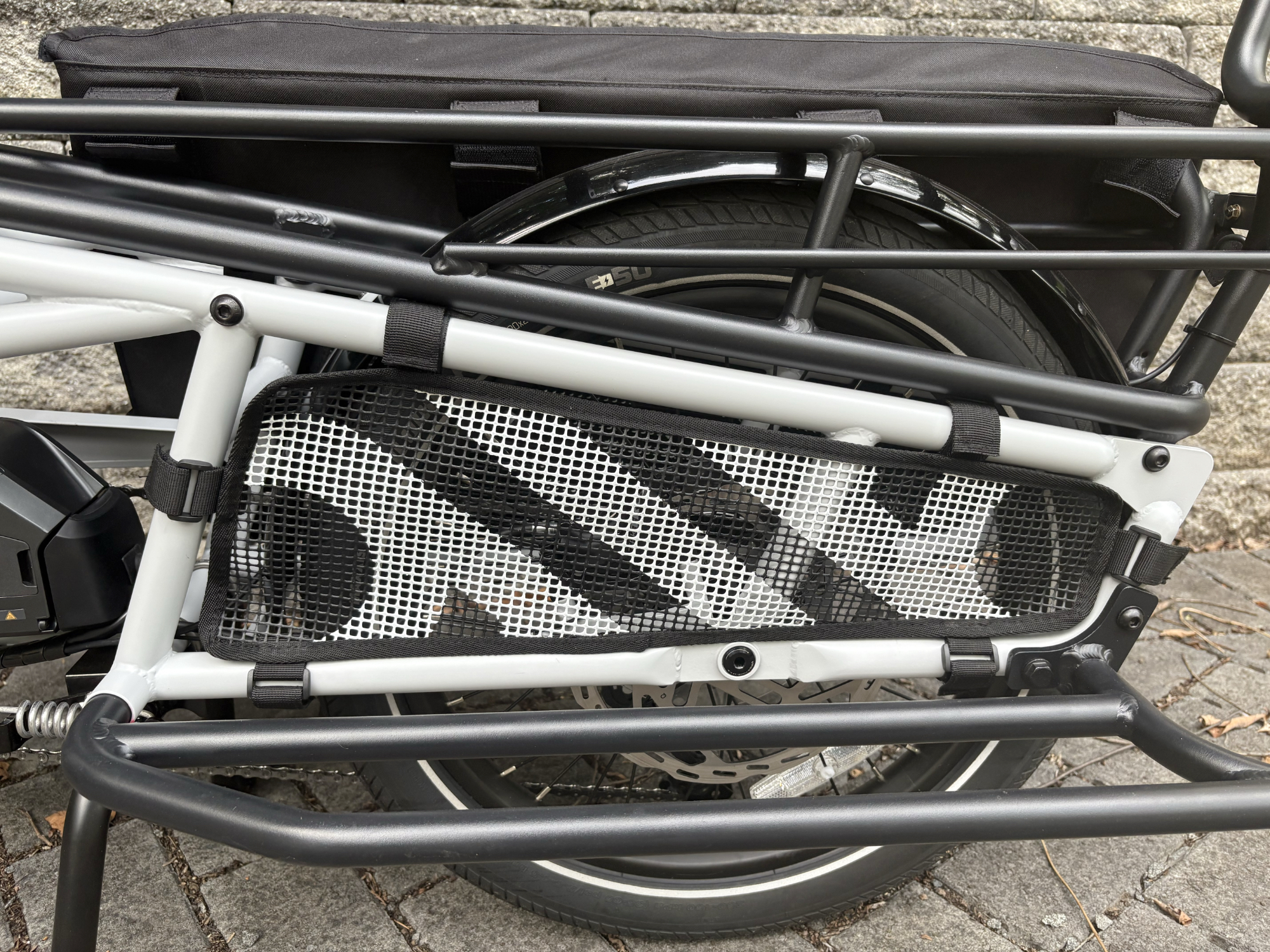
Getting at the rear wheel may require removing the mesh panel that keeps passengers’ limbs and clothing from hitting the spokes.
Credit: JOHN TIMMER
Getting at the rear wheel may require removing the mesh panel that keeps passengers’ limbs and clothing from hitting the spokes. Credit: JOHN TIMMER
Practically, this means that as you coast to a stop, you can simply hit the downshift button a few times, and the system will go into a low gear to make it easy to start up again without requiring you to turn the cranks. It’s … weird. Decades of cycling experience have programmed me to instinctually move my legs when I shift. Those instincts are suddenly superfluous.
It gets even weirder if you enable the automatic transmission. Shimano has included two settings, one for general riding and one for hauling cargo or passengers. When the system recognizes that you can get more out of your pedaling in a different gear, it will simply move you into that gear. That includes doing all the downshifting as you’re coasting to a stop and rolling back up through the gears again as you accelerate away from it.
Let me make that clear: You can coast to a stop without turning the cranks or touching the shifter, and you’ll still be in a different gear when you start up again.
The system is remarkably good at matching when I feel a shift is needed—Shimano’s programmers have done a fine job. Because of that, it’s pretty easy to induce a shift by altering your pedaling, as well. You can tell when it’s close, and just a bit more force will cause the system to send you up a gear. It’s kind of pointless to do so, since the buttons that shift up and down still work when it’s in auto mode, but I found myself doing it regardless.
The downside is that these shifts are not situations where instinctual actions are superfluous. To execute a smooth shift, you have to ease tension off the drivetrain by pedaling with less force, allowing the chain to slide over onto a neighboring gear with a bit less stress. Failing to do so can make for a clunky, inefficient shift and wear down components over time.
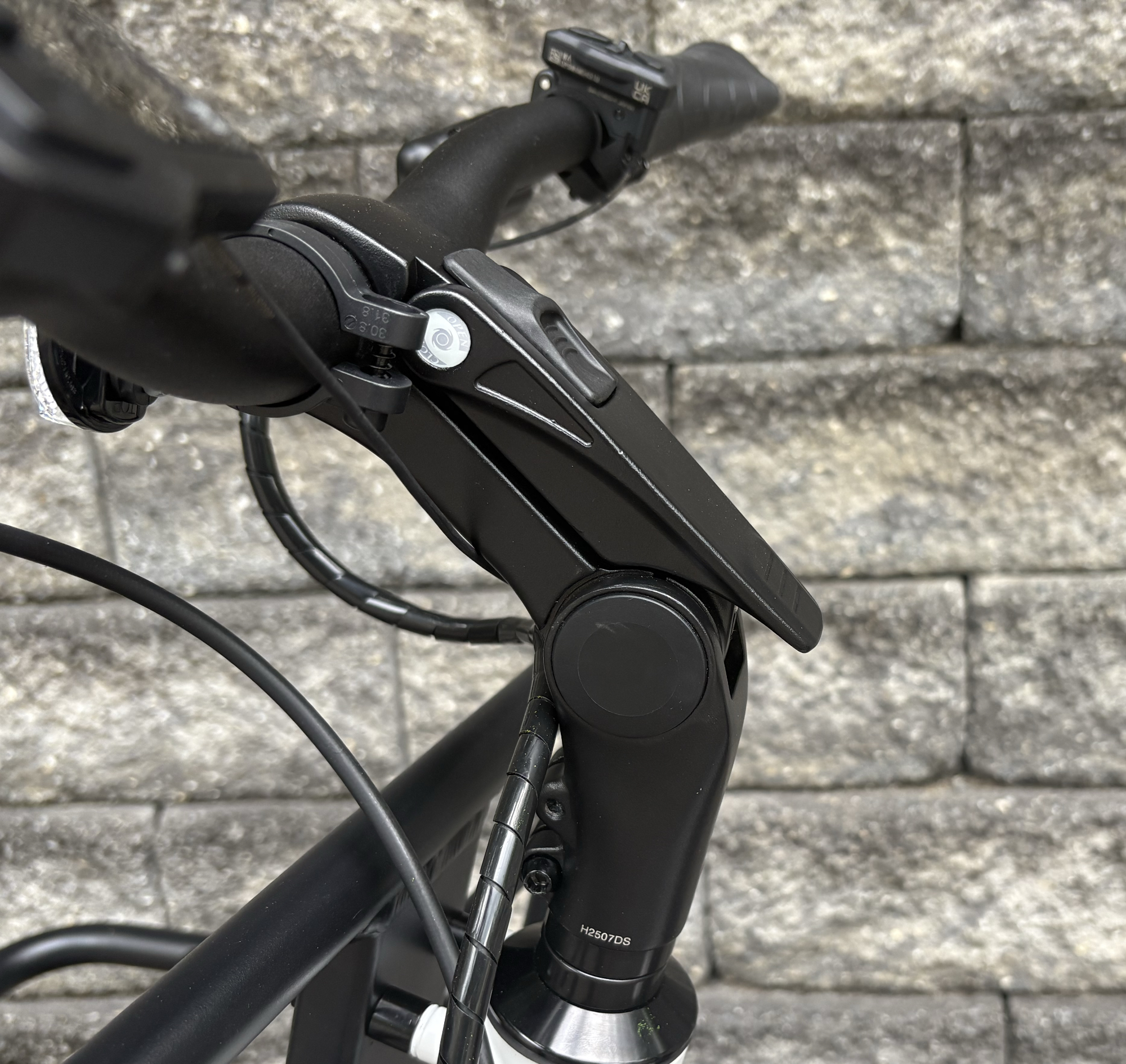
A nice touch: a quick release on the stem lets you adjust their angle to match your height.
Credit: John Timmer
A nice touch: a quick release on the stem lets you adjust their angle to match your height. Credit: John Timmer
My problem with the automatic transmission mode was that I could tell when a shift was likely to come, but I couldn’t predict its precise moment. So it typically came while I was pedaling away happily, with full tension on the chain, making for a loud and awkward shift. This was especially unpleasant when accelerating away from a stop, when the bike would make three or four clunky shifts in rapid succession, each emitting a noise that told me I’d just done something I’d spent years learning to avoid. Living in a neighborhood with lots of four-way stops meant I sometimes experienced that every single block.
Shimano is not stupid, and these systems use parts that are specifically hardened to handle the added strain and wear. But it still felt bad every time I heard and felt that clunk.
A solid contender
The Swoop is not an inexpensive bike; at $4,500, it sits somewhere between the Trek Fetch+ 2 and the Urban Arrow Family I’ve reviewed previously. While it lacks the latter’s capacious cargo tub, the longtail form factor provides a much more bicycle-like riding experience. I’d rate its ride as superior to the Trek because of its frame and front suspension made for a more pleasant ride.
I also prefer Shimano’s drive system to the Bosch used by the other two bikes. It just felt better integrated with my pedaling, plus a bit quieter and less intrusive. The electronic shifting is a bonus—it’s not needed, but it definitely makes for a nice experience, and one where Shimano’s integration means you don’t have to worry about the status of the two additional batteries needed by many electronic systems. I don’t think I’d use the automatic shifting, but I could see where a less experienced cyclist might feel they benefit from it.
So while it’s on the pricier side, the cost seems to be in line with the features it offers. If those features are important to you, the Swoop is definitely worth consideration.
In the end, though, I’m not a huge fan of electronic shifting. I hate worrying about battery levels just to ride my bike, and I like the feel of a well-aligned mechanical shifter clicking into place. But even I have to admit that Shimano’s software does a fantastic job of shifting at the right times, and I think the system could really work well for anybody who hasn’t learned to associate a clunky-sounding shift with bad things.
The good
- Steel-framed long-tail provides a good ride experience for a cargo hauler
- Electronic shifting comes to budget components
- One battery powers it all
- Solid array of options for hauling cargo and/or kids
The bad
- Supposedly rated for riders taller than me, but I found it a bit small
- Rear tire is hard to get to
The ugly
- Clunk Clunk Clunk Clunk

John is Ars Technica's science editor. He has a Bachelor of Arts in Biochemistry from Columbia University, and a Ph.D. in Molecular and Cell Biology from the University of California, Berkeley. When physically separated from his keyboard, he tends to seek out a bicycle, or a scenic location for communing with his hiking boots.








 English (US) ·