
 3 weeks ago
73
3 weeks ago
73
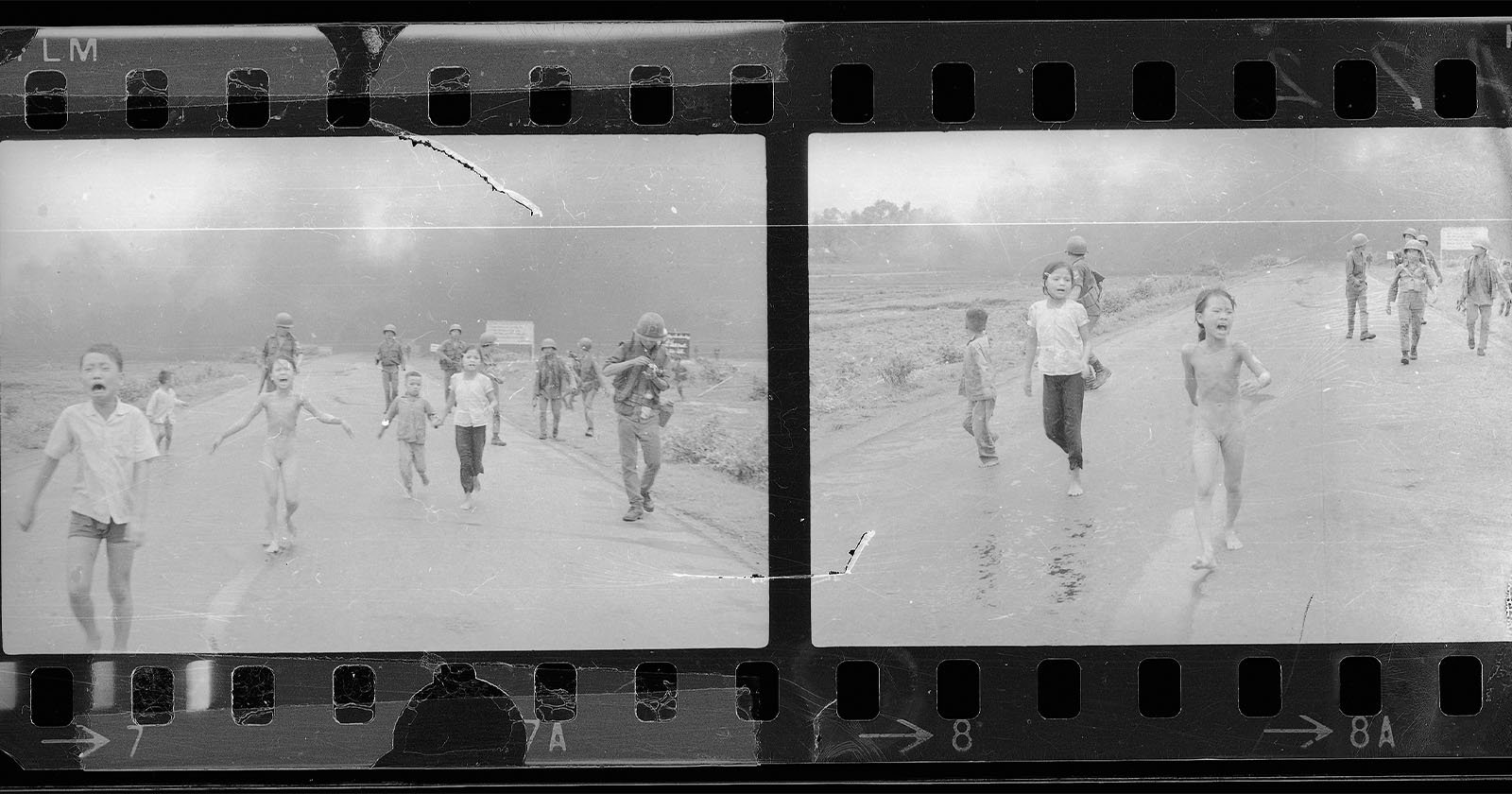 The two surviving negatives of ‘Napalm Girl’ held by the AP. | Associated Press
Lawyers for Nick Ut have filed a detailed legal submission to a court in France, which will hear a criminal defamation case brought against Netflix and the VII Foundation over claims made in The Stringer documentary.
The submissions to the court, viewed by PetaPixel, include testimony by many key witnesses who were present on the day the famous Napalm Girl photo was taken.
Photographer David Burnett, who was on the road in Trang Bang on June 8, 1972, says he witnessed Ut racing toward the village that had just been hit by a napalm strike. Burnett says he doesn’t believe that Nguyen Thanh Nghe — the person The Stringer names as the real author of Napalm Girl — was ever in a position to capture the iconic photo. Burnett missed the moment because he was swapping the film in his camera.
The Testimony of ‘Napalm Girl’
The photo, officially titled The Terror of War, is most famous for the badly burned nine-year-old Phan Thi Kim Phuc running in horror away from the village.
Phuc has always stood by Ut, and has submitted testimony to the court calling The Stringer an “outrageous and false attack on Nick Ut.” While her memory is understandably hazy from that day, she says her uncle has always insisted that not only did Ut take the photo, but he also drove her to the hospital — something the documentary also casts doubt on.
The Bookkeeper
A crucial character who was never mentioned in The Stringer film, or in hardly any of the resulting coverage, is the office secretary Tu Pease, known as Miss Tu. She kept the books and was in charge of paying freelancers.
The film claims that Nghe was paid a miserly $20 by the Chief of Photos in Saigon, Horst Faas, for taking arguably the greatest news photo of all time. Miss Tu, who was in the AP office when the negative arrived, says she witnessed an excited Ut handing the film over to the darkroom technician, Jackson Ishizaki.
Not only that, but Miss Tu says she was the only person in AP who paid local stringers. She kept a record of all such payments, which were sent over to AP’s New York office. In her sworn testimony, Miss Tu dismisses the claims made in the documentary and also says that Faas would never have paid such a paltry amount for a photo like Napalm Girl.
 Netflix
Other testimonies include those by Peter Arnett and Fox Butterfield, who were also present and involved on that fateful day over 50 years ago. As well as the sworn statements, the filings also focus on Carl Robinson, the photo editor at the center of The Stringer who says he was the one who switched the credit on the behest of Horst Faas.
“Carl Robinson opposed publication of the photograph in 1972 and harbored longstanding resentment concerning the impact of the image and the broader consequences of the Vietnam War,” Ut’s lawyers James Hornstein and Martin Pradel argue.
“The submissions further state that Carl Robinson’s wife and family were Vietnamese and that the family suffered significant consequences after the fall of Saigon. The filings argue that Carl Robinson later directed bitterness and hostility toward Nick Ut.”
Included in the filings are excerpts from Robinson’s own book, The Bite of the Lotus, published in 2019. The book made no mention of Ut not being the author of Napalm Girl, but does spell out his simmering resentment toward Ut, the United States, and the Associated Press — an organization he was dismissed from.
The filings also challenge Nghe’s claims, who, aside from Napalm Girl, has “no portfolio of other Vietnam War images, no negatives and no other corroboration that he ever took a single picture during the Vietnam War.”
Ut’s legal team also takes aim at the reconstruction of events that day that appears in the movie, arguing the methodology is “speculative, selective, and inconsistent with accepted scientific standards.”
“Nick Ut maintains that he took the photograph on June 8, 1972, and that The Stringer presents a distorted and deeply misleading account that ignores overwhelming evidence confirming his authorship,” Hornstein and Pradel say.
Under French defamation law, the burden rests on the defendants to prove the truth of their accusations. The trial is expected to start next year.







 English (US) ·