
 2 weeks ago
36
2 weeks ago
36
NASA’s cost estimate for SR-1 Freedom is $2.1 billion, but that doesn’t include the helicopters.
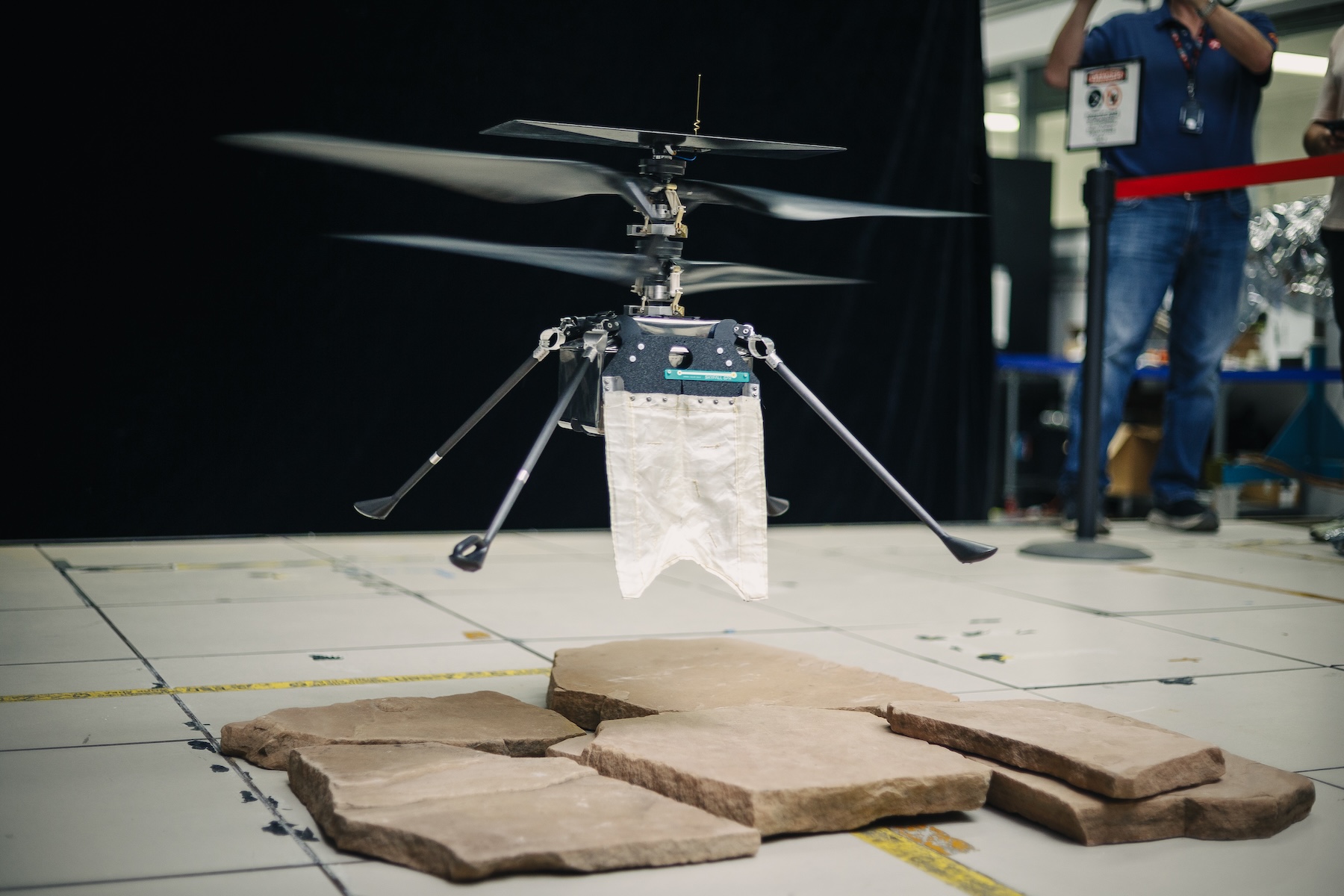
One of AeroVironment's prototype Mars helicopters. Credit: AeroVironment
One of AeroVironment's prototype Mars helicopters. Credit: AeroVironment
For the first time in more than 30 years, NASA has no firm plans to send any new landers or rovers to Mars. Instead, the agency’s near-term focus at the red planet is on aerial drones, a pioneering mode of exploration that didn’t seem realistic until a few years ago.
The first real use of drones for science at Mars will come with the SkyFall mission, a fleet of three helicopters set for launch as soon as late 2028. SkyFall’s helicopters will ride to the red planet with NASA’s Space Reactor-1 “Freedom” mission, which has the primary objective of demonstrating nuclear electric propulsion in deep space.
The launch schedule is aggressive for SR-1 Freedom and SkyFall, projects that didn’t even exist in NASA’s portfolio six months ago. NASA’s plan for the SR-1 Freedom mission, estimated to cost $2.1 billion, calls for repurposing the core module of the canceled Gateway lunar space station into a testbed for nuclear electric propulsion. SkyFall will build on NASA’s success with the Ingenuity helicopter, an experimental vehicle that became the first rotorcraft to fly on another world in 2021.
NASA’s Jet Propulsion Laboratory is partnering with AeroVironment, a developer of high-altitude drones, to design and build the three SkyFall helicopters, plus one spare. The same team was behind the Ingenuity helicopter that landed on Mars with NASA’s Perseverance rover five years ago.
Development underway
AeroVironment announced last week that it received a contract from JPL to “co-design and co-manufacture” the three SkyFall helicopters. Ingenuity flew 72 times before a crash landing in early 2024, far exceeding the mission’s original plan of five test flights. Engineers are building on the Ingenuity design for the SkyFall helicopters. The new vehicles will be somewhat larger than Ingenuity—about 2.5 kilograms (5.5 pounds) instead of 1.8 kilograms (4 pounds)—with upgraded rotors to handle a heavier payload.
SkyFall will show that “Mars helicopters can be built as a repeatable product line, not a one‑off delivery,” said Jeff Rodrian, head of AeroVironment’s MacCready Works division, the company’s advanced research and development organization.
AeroVironment is responsible for the helicopters’ rotor systems, airframes, structures, avionics integration, and accommodation for science payloads, the company said in a press release. JPL will develop the power system, electronics, algorithms, and software, along with a ground-penetrating radar to search for shallow subsurface ice below the Martian surface. Each helicopter will also carry a suite of cameras and sensors to gather data on the Martian atmosphere.
This is an upgrade over Ingenuity, which carried two cameras but lacked any sophisticated scientific instruments. Ingenuity’s range was limited by a requirement to communicate through a base station on the Perseverance rover, while SkyFall will be capable of transmitting and receiving data through communications relay orbiters flying overhead.
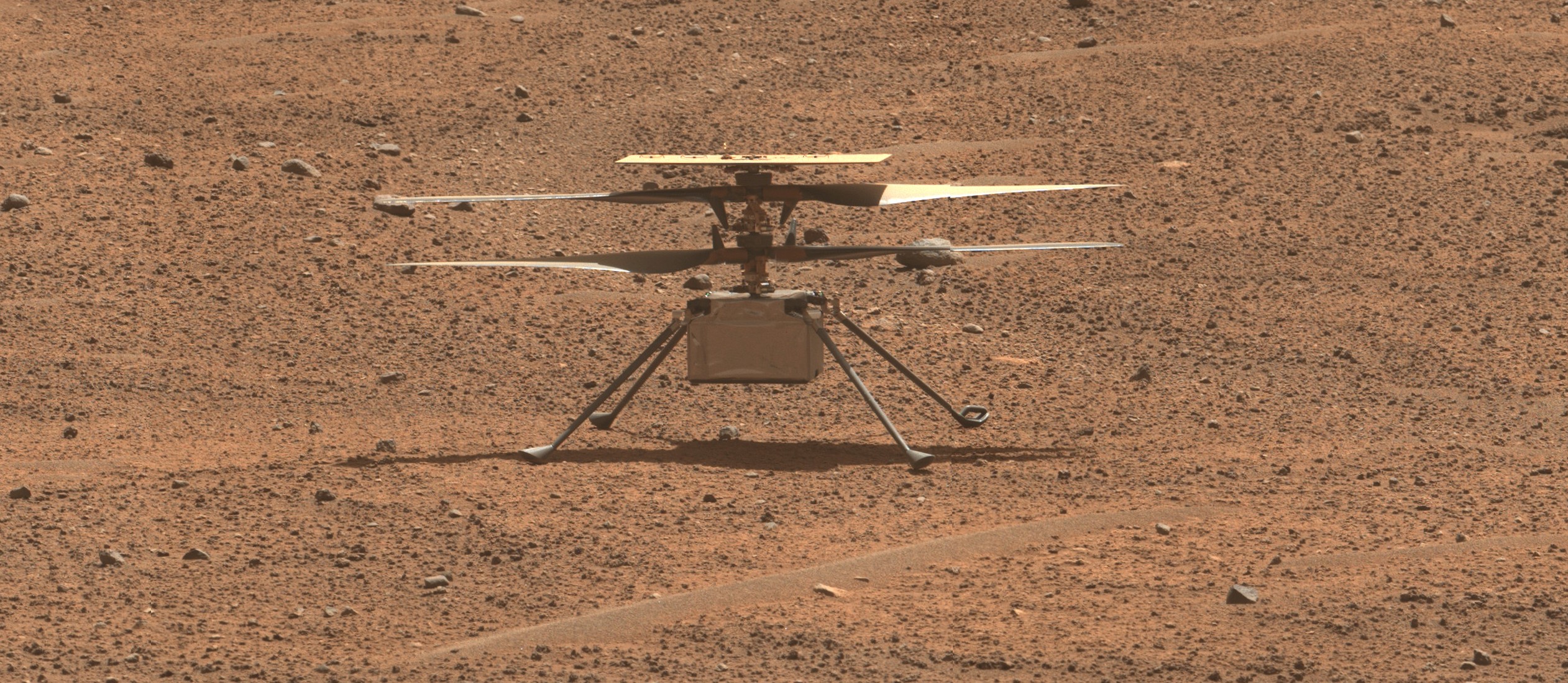
This view of NASA’s Ingenuity Mars Helicopter was generated using data collected by the Mastcam-Z instrument aboard the agency’s Perseverance Mars rover on Aug. 2, 2023.
Credit: NASA/JPL-Caltech/ASU/MSSS
This view of NASA’s Ingenuity Mars Helicopter was generated using data collected by the Mastcam-Z instrument aboard the agency’s Perseverance Mars rover on Aug. 2, 2023. Credit: NASA/JPL-Caltech/ASU/MSSS
“We were looking at NASA’s launch plans, trying to find out when we might be able to stick out our thumb and hitch another ride in the belly of a rover or a lander or anything else that was going to the surface of Mars,” said Will Pomerantz, head of space ventures at AeroVironment. “And it became clear, especially as the Mars Sample Return plans changed, that there wasn’t likely to be anything headed to the surface of Mars any time soon, and we didn’t want to necessarily have to wait.”
So engineers came up with a new method of delivering the SkyFall helicopters to Mars. Instead of riding piggyback on a Mars rover, as Ingenuity did, SkyFall will separate from the SR-1 Freedom spacecraft on approach to the red planet. They will enter the Martian atmosphere cocooned inside a protective heat shield, then release to autonomously land themselves under their own power.
“That was really the start of the conversation for what became now known as the SkyFall maneuver,” Pomerantz said. “We do think that this is achievable. We think we can have a mission where you have helicopters that get thrown overboard… that come out of an entry capsule, as that is initially coming in through the Martian atmosphere, and don’t require a lander platform or a rover platform to get themselves to the surface.
“We got really excited about that idea,” he continued. “Again, it sort of opens up new operational modes and new launch windows, frankly, to do surface exploration of Mars at a new price point, which is really exciting to me, and maybe going to places that wouldn’t be feasible to go to with any other mode of exploration.”
Cost caps and mass limits
NASA has not disclosed the projected cost of the SkyFall mission, and an agency spokesperson declined to provide Ars with the value of JPL’s contract with AeroVironment.
Despite the upsides, drones like SkyFall come with limitations.
Advancements in miniaturization now make it feasible to fit payloads like radars onto platforms as small as SkyFall. But there’s no room to cram a full rover-class suite of instruments onto a Mars helicopter. That means, at least for now, no robotic arms, drills, or payloads to search for evidence of past or present life. The mission of SkyFall’s ground-penetrating radars harkens back to NASA’s decades-old strategy guiding Mars exploration: follow the water.
NASA Administrator Jared Isaacman announced the agency’s endorsement of the SkyFall mission, along with SR-1 Freedom, in March. NASA’s clear priority under the Trump administration is setting up a Moon base on the lunar surface. Isaacman also champions nuclear propulsion and is seeking opportunities for “wins” that are affordable and achievable within the next few years. SkyFall fits the bill.
“We have been hard at work now for a couple of months,” Pomerantz said. “We are once again on time and on budget, those magical words that I have not gotten to say that many times previously in my aerospace career, but I’ve gotten to say about every single Mars helicopter project that we’ve done here at AV.”
One recent breakthrough in ground testing involved the larger rotor blades that will fly on the SkyFall helicopters. The Martian atmosphere is thin, just 1 percent the density of air at sea level on Earth, so helicopters flying on Mars must spin their rotors faster than on Earth to generate lift. Heavier vehicles need more lift than lighter ones, so the rotors on SkyFall will be larger than those on Ingenuity. That means the tips of the rotors on SkyFall will slice through Martian air at supersonic speed. Ingenuity’s designers intentionally kept their rotors from exceeding Mach 1 because they worried about the blades shattering.
Engineers placed SkyFall-size rotor blades into a test chamber earlier this year and spun them at a top speed of Mach 1.08 without damaging them.
“We were able to take the rotor tips up above the speed of sound,” Pomerantz said. “That gives us huge confidence in the ability to operate the vehicles in the most efficient way. That also gives us a huge amount of confidence in the ability to do the SkyFall maneuver itself and to go through the sort of regime of that very first flight, where we’re going to come off that entry capsule and find our way down to the ground.”
NASA is still in the process of selecting a landing site for SkyFall, but the search for buried water ice could take the helicopters closer to permanent ice caps at the Martian poles. Engineers at Jet Propulsion Laboratory and AeroVironment are working on a larger solar panel for improved power production at high-latitude locations, Pomerantz said. It’s also too early to know how scientists will use the helicopters. They could fly off in different directions after arriving at Mars, or they might perform coordinated observations together.
“It is a super cool mission. It is a technology demonstrator in its own right, demonstrating this SkyFall maneuver,” Pomerantz said. “Then, also, the goal is that we will serve a science mission, flying around with dedicated science instruments, including the ground-penetrating radar.”
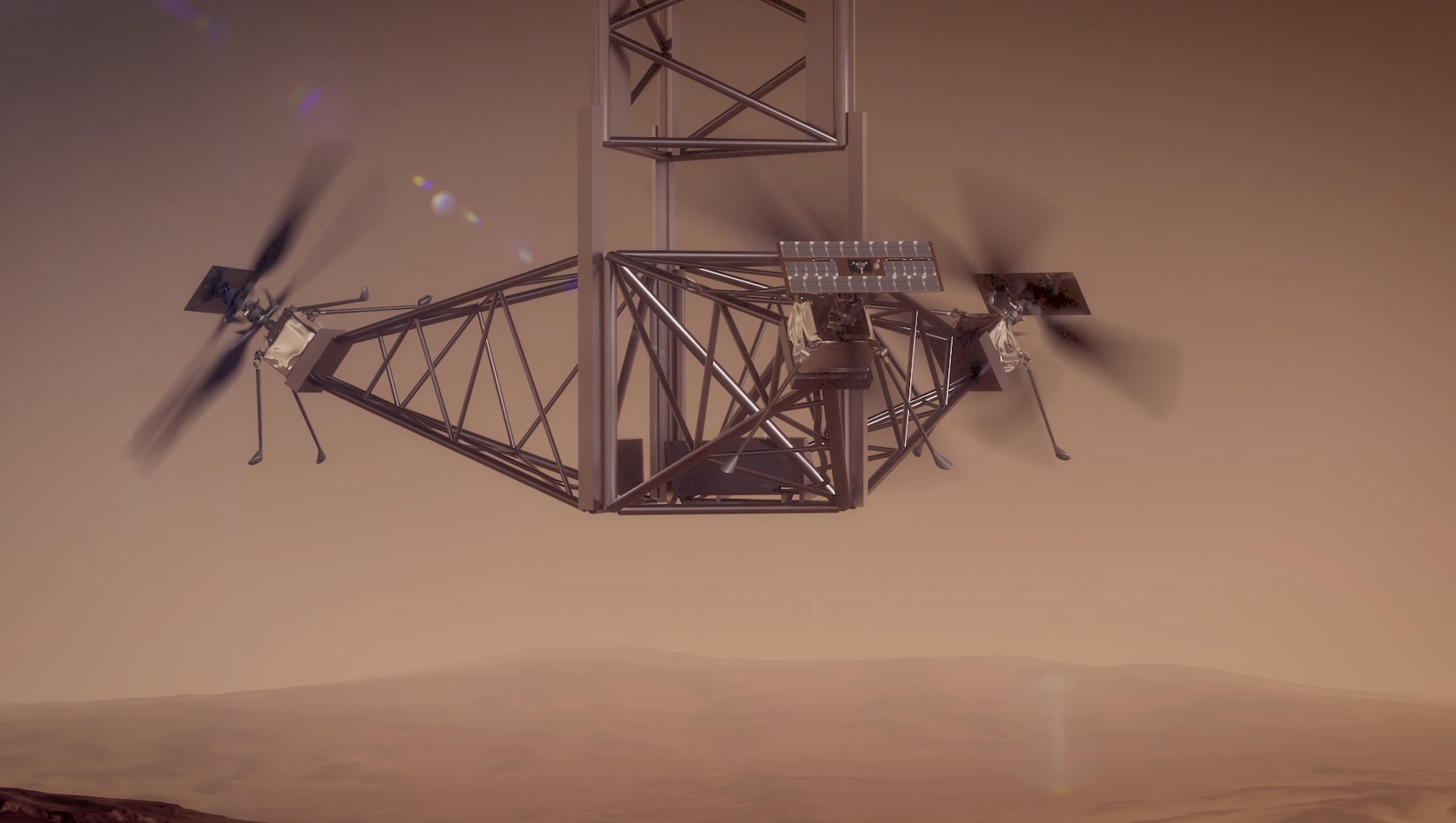
Artist’s illustration of the SkyFall helicopters preparing for deployment on Mars.
Credit: NASA/JPL-Caltech
Artist’s illustration of the SkyFall helicopters preparing for deployment on Mars. Credit: NASA/JPL-Caltech
Helicopters and little else
Despite the excitement of SkyFall, these are hard times for NASA’s Mars Exploration Program. The space agency canceled an effort to robotically bring rock samples from Mars back to Earth due to ballooning costs, including one independent estimate of $11 billion. NASA’s most recent Mars rover, the Perseverance mission, landed on the red planet in 2021 for the purpose of collecting specimens for eventual return to Earth. The Perseverance mission alone has cost NASA approximately $3 billion to date.
At the same time, NASA’s budget for planetary science missions has declined over the last several years. The Trump administration would like to see it cut even more.
This isn’t to say the Mars program is dead. NASA is a junior partner on the European Space Agency’s Rosalind Franklin mission, a rover set for launch in 2028 to drill into Mars’ crust in search of biomarkers. Two modest orbiters, part of NASA’s ESCAPADE mission, are on the way to Mars after launching last year to study the interaction between the Martian atmosphere and the solar wind.
NASA’s strategy for future Mars exploration now looks a lot like the agency’s approach to the Moon: Buy commercial. This could pay off in the long run, but like NASA’s experience with commercial lunar missions, the learning curve will likely be steep, especially for landers. Eight years in, NASA’s program for robotic commercial lunar landers, known as CLPS, still hasn’t hit a stride. The agency’s partnerships with SpaceX and Blue Origin on human-rated Moon landers are a separate matter.
NASA’s new commercial Mars strategy is starting to blossom. In June, the space agency announced a partnership with Relativity Space to develop a commercial orbiter to carry several science instruments to Mars for NASA’s Ames Research Center. NASA and Relativity have not disclosed technical or financial details about the agreement.
NASA is expected to announce the winner of a competition to develop a Mars Telecommunications Network later this year. The network will augment and replace communications relay capacity currently provided by NASA’s aging science orbiters at Mars to link ground controllers with the Perseverance and Curiosity rovers exploring the Martian surface.
Each of these missions could be candidates for delivering more helicopters to Mars, Pomerantz said.
“My aspiration, certainly, and our perspective at AeroVironment, is there should be helicopters going to Mars in every launch window that we have, and they should be riding along with pretty much every other system that’s going to the Mars surface, and now even to Mars orbit,” he said. “They do just unlock these really cool capabilities for the science community, and for the human exploration community eventually, and the only way that happens is if they are easy to insert, because they’re always ready, they’re always on time, and they don’t cost that much.
“One of the things I love about helicopters is that they are great regional explorers,” Pomerantz said. “We are able to fly a kilometer-plus per flight. It may be possible in some latitudes, eventually, to fly more than once per day. Again, I’m not saying that’s going to happen on these particular helicopters, but the category of Mars helicopter technology allows you to do that.”

Stephen Clark is a space reporter at Ars Technica, covering private space companies and the world’s space agencies. Stephen writes about the nexus of technology, science, policy, and business on and off the planet.





 English (US) ·