
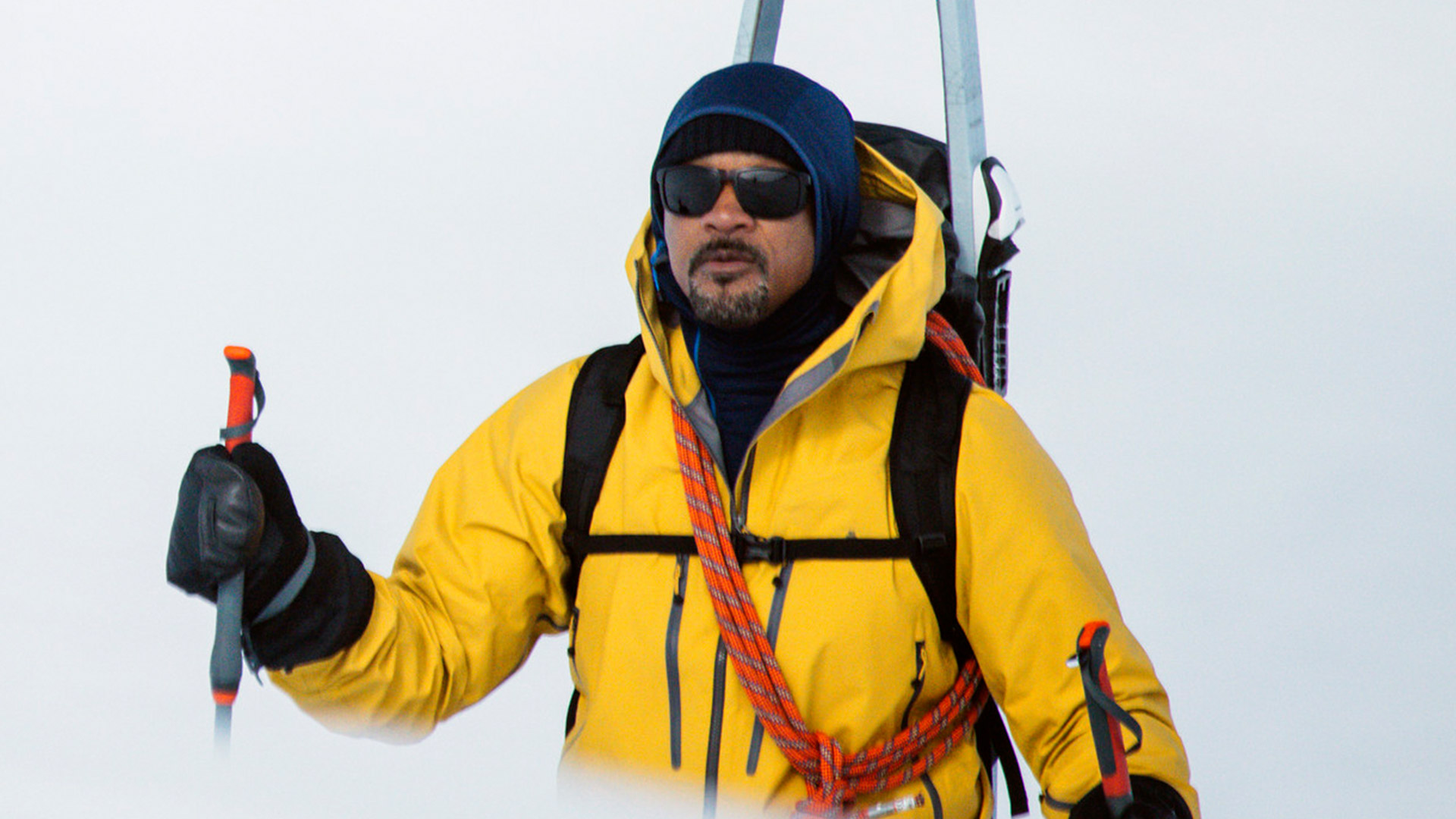
In the first episode of National Geographic's Pole to Pole with Will Smith expedition series, Richard Parks, a polar athlete who holds the record for being the fastest to ski solo, unsupported, and unassisted from the coast of Antarctica to the South Pole, says that his job on the show is to "keep Will alive".
With winds exceeding 70mph and temperatures dropping as low as minus 52 degrees Celsius, Antarctica is widely considered to be the harshest desert environment on Earth. That makes a filmed expedition from the South Pole to the North Pole, with a Hollywood A-lister in tow, a logistical nightmare.
And it’s not just the challenge of navigating toward a moving target in one of the most isolated, heavily regulated, and unforgiving environments on the planet. As Parks explains while discussing the series’ first episode, which sees him help Smith ski roughly 700 miles from the Polar Plateau to the geographical centre of the South Pole, this is also a place where even the toughest technology struggles to survive.
Pole to Pole with Will Smith | Official Trailer | National Geographic - YouTube

"Antarctica has never been shot this way before. The cinematic lenses, the quality of camera. I’m not sure it ever will be again. To be part of that level of ambition was incredible," Parks said.
"I’ve shot in Antarctica before, self-shot, and made programs I’m really proud of. But being able to shoot on ARRI cameras and truly immerse the audience in that environment was something else entirely."
To be clear, this isn't the first time that one of the best cinema camera brands around has been taken to Antarctica. Cinematographer Ben Joiner used ARRI's ALEXA 35 to shoot Secrets of the Penguins in 2023. Still, Pole to Pole remains one of the very few TV shows to have done it. To get an idea of all the tech that was needed to film Pole to Pole, see camera operator Robert Taylor's Instagram post below, which reveals they used the ARRI ALEXA Mini LF.
"A lot of my expeditions have been solo or lightly supported, and for 15 years I’ve been trying to bring those experiences to life for family, friends and clients," Parks, who personally shoots on Sony cameras, said.
"Through Pole to Pole, we’re able to immerse people in that world properly and that’s really special."
‘I snapped three headphones on my last solo expedition’
Pole to Pole with Will Smith is far from Parks' only extreme adventure. A seasoned explorer, he previously became the fastest person to complete the Explorer’s Grand Slam, reaching all seven summits and standing at both the North and South Poles in less than seven months.
Drawing on lessons from years of expeditions, Parks revealed early on in the trip with Smith how he keeps morale high in brutally uncomfortable conditions. Music, it turns out, plays a key role.
"There’s a great moment in episode one where music becomes part of the story," he said. "That was early on, I’d only just met Will, and suddenly I’m dancing with my hero on the ice. Completely surreal."
On Parks' Antarctic playlist are tracks like The Supremes 'Where Did Love Go', which proved to be an unexpected ice-breaker for the pair who'd just met filming the show. But bringing music into the polar wilderness isn’t as simple as throwing a player into a backpack. Space and weight are limited, especially given the added consideration of how it will be powered.
"Where weight allows, and where the limits of the expedition allow, I bring tech, but it’s not just the weight of the devices. It’s the weight and size of the solar panels needed to charge them," Parks revealed.
Beyond this, there's also the added factor that plastic breaks down more quickly in extreme temperatures. "In Antarctica especially, the cold affects everything. It makes materials brittle – even steel, but especially plastic. One of my biggest challenges is managing cables. Any repeated bending beyond their elastic limit and they fracture," Parks said, before adding: "Duct tape is absolutely essential."
Battery life is another constant concern. Parks avoids Bluetooth entirely due to its power drain, opting instead for wired headphones and plenty of spares. "If I take a music player, I’ll bring three sets of wired headphones, because one or two will break. On my last solo expedition, Team Quest, I snapped all three just due to the environment. It’s absolutely brutal."
Alongside consumer-grade gear like Garmin GPS devices, Antarctic expeditions rely heavily on satellite communications, “particularly the Iridium system,” Parks notes. That’s why one of the project’s most significant technical milestones was the team becoming the first to use Starlink in Antarctica.
"There were a lot of genuine firsts on this project", Parks said, and he's not kidding. Across the series, the expedition documents the discovery of a new species of giant anaconda and a world-first sample of a microbe that could help scientists better understand how the planet will respond to climate change.
For Parks, that broader message matters most because he hopes the series will spark "more conversations around climate and our planet".
"What I took from the whole project was a sense of connectivity," he explains. "The scale and ambition allow us to see these environments not in isolation, but as interconnected systems. The Amazon is connected in real time to Antarctica. Indigenous communities in Bhutan face challenges similar to those in the Amazon.
"At a time when the world feels very divided, that sense of connection, human and environmental, felt incredibly hopeful."
The first two episodes of Pole to Pole with Will Smith are now streaming on Hulu and Disney+.
Follow TechRadar on Google News and add us as a preferred source to get our expert news, reviews, and opinion in your feeds. Make sure to click the Follow button!
And of course you can also follow TechRadar on TikTok for news, reviews, unboxings in video form, and get regular updates from us on WhatsApp too.








 English (US) ·