
 3 weeks ago
41
3 weeks ago
41

Published Jul 17, 2026, 8:00 PM EDT
An explainer on who they are in the movie and the real-world history
 Image: Universal Pictures
Throughout Christopher Nolan’s epic The Odyssey, there are plenty of threats both seen and unseen. From the towering Cyclops to the wrathful god Poseidon, Odysseus and his soldiers must contend with all of them. Perhaps the most ominous threat though is the “Sea People” or the “People from the Sea,” a force mentioned throughout the film as a danger to Ithaca and its neighbors in the Mediterranean.
Warning: Major spoilers for The Odyssey below
As they are explained in the film, the Sea People are a storied force of invaders that who and attack various lands. In Ithaca, as Queen Penelope (Anne Hathaway) awaits the return of her husband King Odysseus (Matt Damon), she not only has to contend with scores of potential suitors pressuring her to remarry, but she feels that Ithaca is threatened by these mysterious Sea People. To be safe from them, Ithaca needs a king who can raise an army to defend it. The Sea People are mentioned several other times in the film as a mysterious, marauding threat to various lands.
The details of the Sea People are not explicitly revealed in the film, and specifically who they are may be up to interpretation. Towards the end of the film, Odysseus implies that he and his army may be a contributor to the stories of the Sea People. His army came from the sea, then used the wooden horse to trick the Trojans. Then they invaded and laid waste to Troy. As a result, they gave birth to — or at least contributed to — the idea that People from the Sea are a threat. They also ushered in an age of lawlessness which gave rise to people who are now taking advantage of societal decline.
While the original text of The Odyssey does not explicitly say that Odysseus’ forces are the Sea People, it is a popular theory held by scholars and historians. This is primarily because of an episode within The Odyssey called the “Cretan Lie.” It occurs when Odysseus returns to Ithaca disguised as a beggar. He then approaches his loyal pig farmer Eumaeus (played by John Leguizamo in the film) and tells him a made-up story about attacking Egypt. While the story Odysseus tells is meant to be a false one, it is the contextual basis for the idea that Odysseus and his forces are the Sea People. And this, like much of what’s in The Odyssey, mixes legends and fantasy with real-world history.
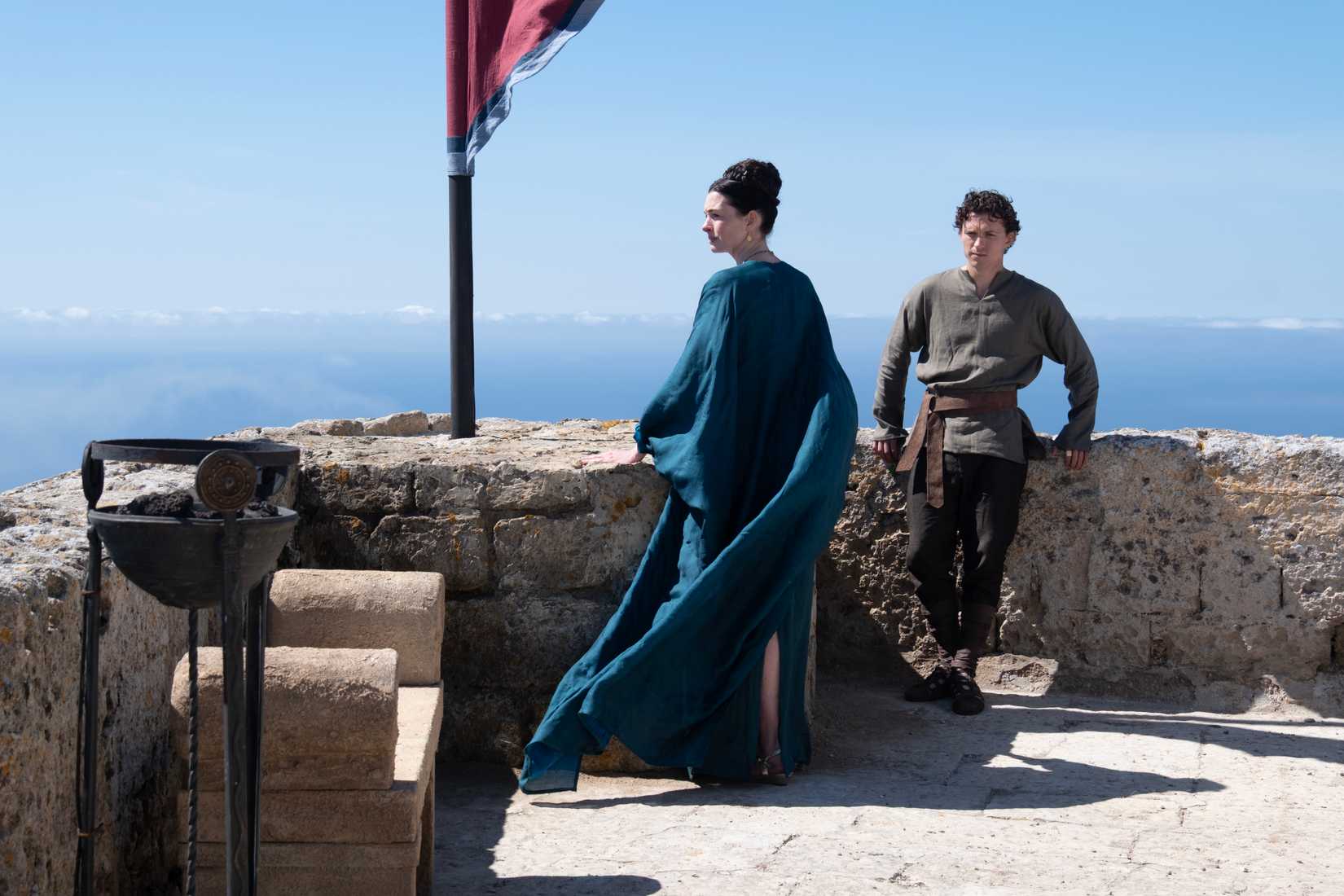 Image: Universal Pictures
In the real world, the Sea Peoples — as they are commonly called — refer to a loose confederation of several different kinds of people (hence “peoples”) who attacked Egypt and other Eastern Mediterranean regions around 1200 BC, or at the end of the Bronze Age (when The Odyssey takes place). The most explicit proof of their existence comes from translated inscriptions from an Egyptian temple known as Medinet Habu, though they’re also referred to elsewhere in other Egyptian inscriptions. In each case, various peoples were mentioned as being part of the invading forces, like the Peleset, the Shekelesh, and a handful of others. For the most part, historians have not been able to nail down which people the Egyptians are referring to, though ”Peleset” is confirmed to be the Philistines from Canaan, and historians speculate the Shekelesh came from Sicily.
In other words, historians aren’t really sure who the Sea Peoples were, so some of them very well could have been Greek. What is also a mystery is whether or not the Sea Peoples brought about the end of the Bronze Age with their raids, or if they were merely a symptom of an already-declining society, though it seems like the latter was more likely.
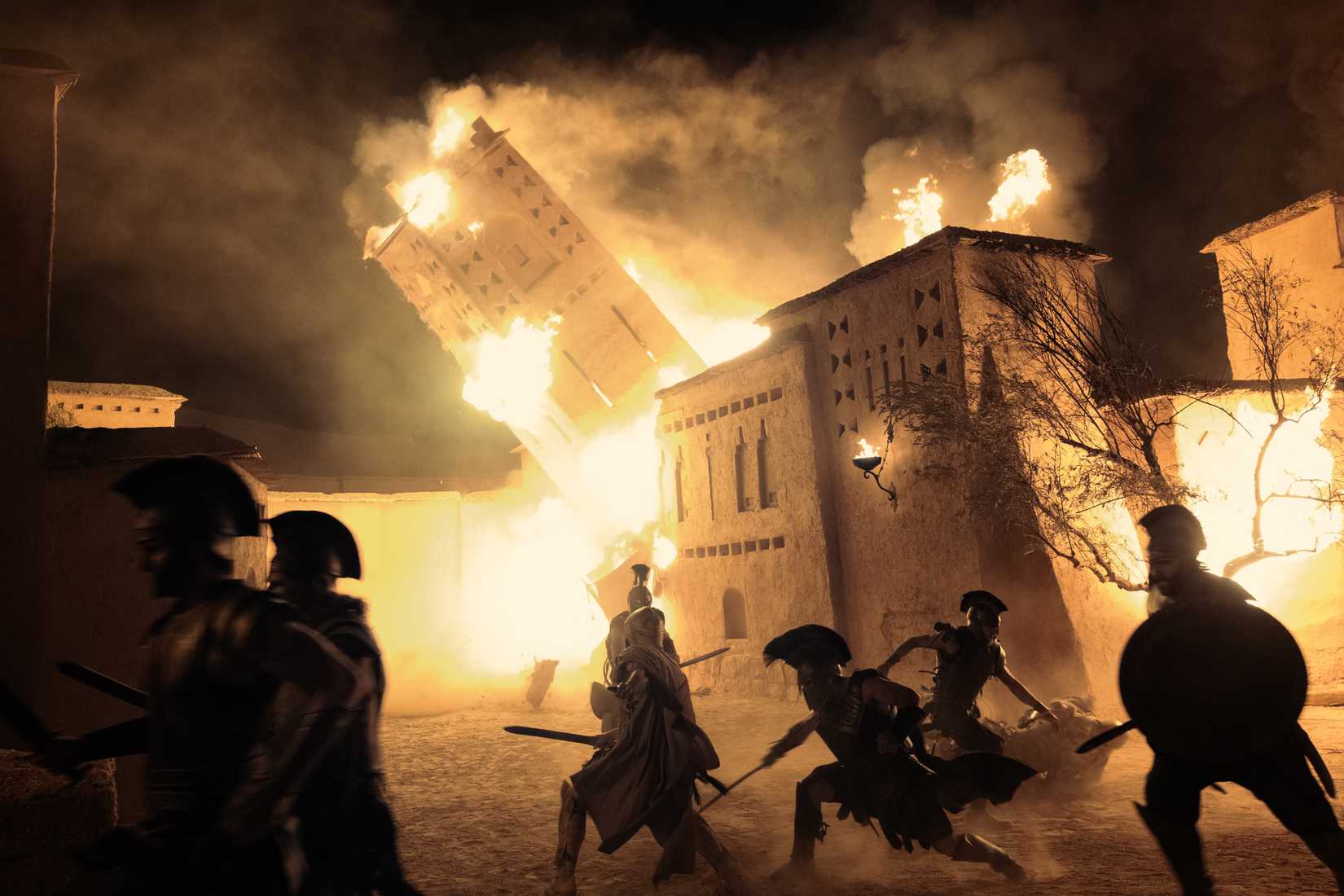 Image: Universal Pictures
The understanding of the Sea Peoples, though, is that they were not trained armies. Instead, they were a looser confederation of people, somewhere in between an invading army and a band of pirates, but they included whole families and societies, not just soldiers.
So, while the implication that the Odysseus’ soldiers are the Sea Peoples is a legitimate interpretation of The Odyssey, it doesn’t exactly align with the real-life historical records from ancient Egypt. That said, if you’ve got Sea Peoples at your door, I still wouldn't accept any big wooden horses from them.
The Odyssey is in theaters now.





 English (US) ·