
Acquired by Oxylabs in 2024, Webshare continues to operate as an independent provider focused on budget-friendly and self-service proxy deployment. Rather than incorporating Oxylabs’ comprehensive scraping APIs or AI unblocking tools, Webshare maintains its own lean infrastructure, which counts over 80 million residential IPs and 400,000 datacenter proxies spanning 195 countries.
Designed for individual users and organizations who need raw connection speed and protocol flexibility, the platform fulfills more than 650 billion proxy requests per month. Along with affordable pricing, there is a no-credit-card free tier for those who may be on the fence about what Webshare brings to the table.
Webshare offers a customizable pricing structure built upon a permanent free plan that provides 10 proxies with 1GB of monthly bandwidth and a full set of features (no credit card required).
Latest Videos FromTechRadar
When it comes to the paid proxy infrastructure, it’s split into three primary product lines, the first being rotating residential proxies. Metered by bandwidth across an 80 million+ IP pool, plans start at $3.50/GB for 1GB ($2.45/GB under annual billing) and scale down to $1.40/GB for enterprise volumes (3,000GB+).
Things get a bit more varied with static residential proxies, which also come in private and dedicated forms. Backed by telecom providers like AT&T, Sprint & Cox Communications, shared static residential plans start at $6.00/month for 20 addresses ($0.30/proxy) and go up to $0.225 per proxy for 10,000 proxies. Private packages (shared with at most 2 users) begin at $23.16/month for 25 IPs ($0.926/IP), and the entry dedicated tier costs $42.00/month for 20 IPs ($2.10/IP).
It’s a similar thing with datacenter proxies, which Webshare sells under the Proxy Servers moniker. Shared server proxy packages start at $2.99/month for 100 addresses ($0.0299/proxy), decreasing to $0.0179/proxy at higher volume tiers. Private options kick off at $18.52/month for 25 IPs ($0.741/IP), while dedicated private proxies start at $26.60/month for 20 IPs ($1.33/IP).
All the plans feature 500 default concurrent threads (with upgrades available up to 3,000) and access to a 100+ Gbps network backbone. Webshare maintains a 48-hour refund window for paid purchases, provided your usage stays below 1GB (or 0.1GB for rotating residential) and fewer than 1,000 proxies are used. Cancellations are completed instantly by reverting to the free plan through the dashboard settings.
You set off your Webshare adventure with a simple registration via email or an existing Google profile. Once registered, you’ll be redirected to a dashboard with access to all of Webshare’s features, including granular management and integrations.
Rotation Residential IPs
Webshare routes its rotating residential proxy traffic through ethically sourced, peer-consenting devices. Put differently, the platform operates an opt-in network where endpoint owners are compensated for sharing bandwidth.
Residential IPs are rather useful in several cases, with an emphasis on data collection tasks that trigger rapid bot mitigation.
For example, a hotel comparison site needs to scrape price lists from many hotel websites. However, hotel websites often discourage scraping by placing IP and geo-restrictions. Suppose a US-based hotel blocks foreign IPs from accessing its website. Webshare lets you bypass it by choosing a US proxy IP address to view the website and scrape pricing information.
Rotating residential IPs are also a boon for localized e-commerce price monitoring and travel fare aggregation. By cycling requests through authentic home connections, scraping pipelines get to bypass geographic blocks and IP rate limits without flagging security systems.
Webshare’s residential network spans 195+ countries and provides global reach across major markets, including the US, UK, Germany, Japan, China, France, Australia, and Canada. The total residential pool exceeds 80 million IPs, which puts it well ahead of mid-tier competitors while maintaining lower entry barriers than legacy enterprise providers like Bright Data or Oxylabs.
Moreover, this is the only product line that supports targeting down to the country, city, state, ZIP code, and ASN level. That said, state and ZIP code targeting are restricted to US locations, while ASN targeting runs across the global pool.
Static Residential IPs
First, let’s clarify the full lineup here. Like virtually all of its peers, Webshare offers static residential IPs, which represent a faster alternative to their residential counterpart. Technically, these are still residential IPs, albeit sourced directly from ISPs.
The provider then singles out private and dedicated versions on its Products page, which are simply exclusivity levels. Shared static residential proxies are split among multiple users, whereas private static residential proxies are shared with up to 2 users, and dedicated versions are 100% exclusive to the user.
In other words, it’s the same underlying proxy type; the difference is solely how many people are using the IP.
Static IPs are also more reliable because the IP doesn’t change with each session, unlike the unstable Wi-Fi connections of the device owners. They are issued for long-term use and are harder to detect, which helps you stay anonymous as you browse.
These static endpoints support speeds up to 1 Gbps, and the network maintains a pool of over 100,000 static ISP addresses globally. You can manage your proxies in an intuitive dashboard and utilize them to bypass geo-restrictions and browse the web without revealing your actual IP address to third parties.
Proxy servers
Webshare operates a fleet of datacenter proxy servers containing over 400,000 IPs built on a 100+ Gbps aggregate network backbone with a 99.97% uptime SLA. Just like with shared IPs, users can deploy datacenter IPs across three models depending on performance needs and budget limits.
Shared proxies are the entry-level tier that pools IP addresses among multiple active accounts. Pricing starts at $2.99 per month for 100 proxies (scaling down to $0.0179 per proxy at scale), which offers high bandwidth efficiency for low-risk scraping.
Private proxies are a hybrid tier where each IP is shared with a maximum of one to two other accounts. This significantly reduces neighbor noise and target site bans while keeping costs low (starting at $18.52/month for 25 proxies).
Lastly, dedicated proxy servers are 100% isolated single-tenant proxies reserved exclusively for your account. Dedicated plans start at $26.60 per month for 20 IPs with 250GB of included bandwidth, ideal for high-concurrency target sites.
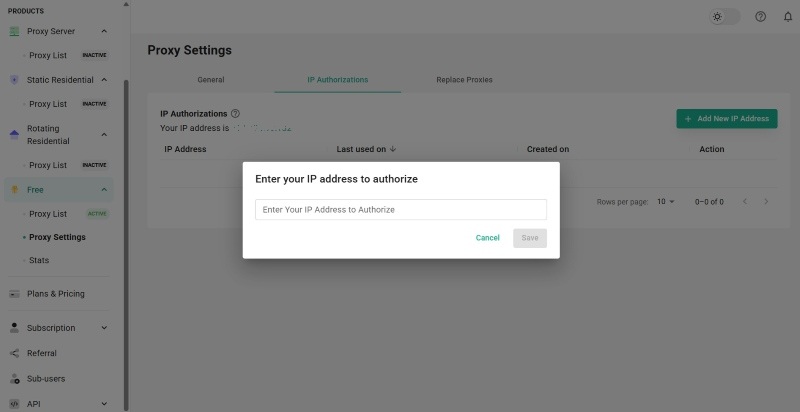
If you surpass your bandwidth allocation, you can pay extra fees to get as much bandwidth as you need. You can also pay additional fees for unlimited IP authorizations, high concurrency, and a high-priority network (recommended when using proxy servers for time-sensitive data scraping).
All datacenter tiers support HTTP and SOCKS5 protocols, cover 50+ country locations, and offer configurable add-ons for expanded concurrency, high-priority network routing, and extra bandwidth allocations.
Chrome Extension
Rounding out the offer is a browser extension for Google Chrome that lets users rotate proxies at the click of a button. This extension is ideal for individual users whose primary use case for Webshare is bypassing geo-restrictions. Whenever you encounter a geo-restriction, just choose a proxy IP from the relevant country and refresh the website to view the previously restricted content.
New users can test the extension via Webshare’s permanent free tier, which includes 10 datacenter proxies and 1GB of monthly bandwidth without requiring a credit card.
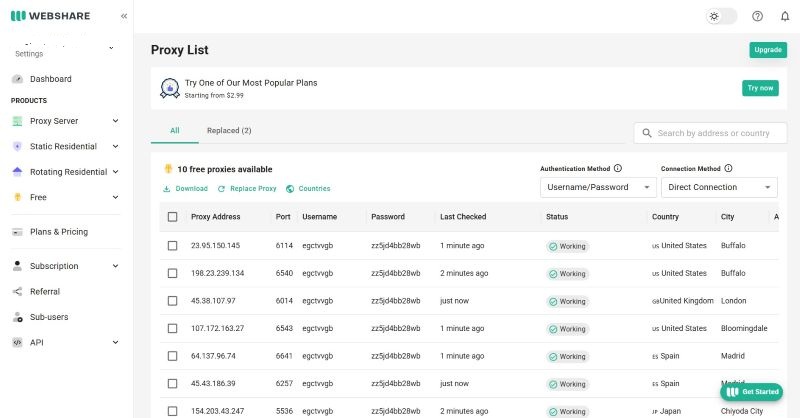
Webshare offers an intuitive control panel dashboard that makes configuration straightforward. From your dashboard, you can set up any proxy type in your plan. Whether managing any of the proxies on offer, you can deploy and configure them with a few clicks. You can view, download, or configure your proxy list, with automated or manual IP replacements available (including Auto-Replace, On-Demand Refresh, or API-driven swaps).
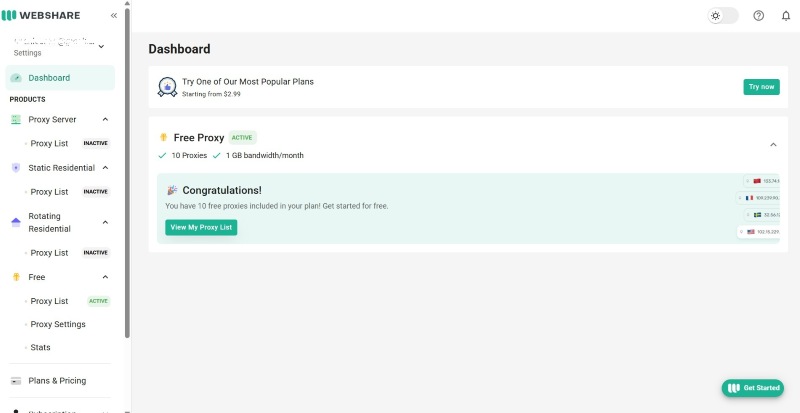
The dashboard displays detailed real-time analytics, including bandwidth consumption, error rates, and activity statistics, to name a few data points. This telemetry allows you to monitor proxy health and performance at a glance. Additionally, the UI features a native toggle to switch between Dark Mode and Light Mode.
Webshare provides support through both interactive chat and self-service resources. In-dashboard assistance is driven by Webby, the vendor’s AI support agent, which guides users through structured troubleshooting flows for common proxy and billing issues. If Webby, for some reason, can’t resolve your query, you can request an immediate escalation to a live human support agent directly within the chat interface.
The Help Center contains detailed user guides and manuals for all its features, teaching users how to deploy and manage proxies effectively. Webshare provides extensive technical documentation for its APIs, making it easy to integrate its proxies into external applications. The API documentation guides users in configuring Webshare’s proxies to perform their required tasks.
You have access to an FAQ section with solutions to common problems. The Webshare blog provides numerous tutorials on integrating your proxies with other applications. We found this section very helpful when testing the app and its integrations. Direct ticketed support is available via email, though there's no telephone support option.
There’s no shortage of competition in the proxy software market. We’d like to single out Decodo (formerly Smartproxy), Bright Data, and PacketStream as the most noteworthy Webshare rivals.
Decodo has a more expansive proxy network than Webshare. It offers 125 million+ IPs (including 115 million+ residential IPs), compared to Webshare's 80 million+ residential pool. The competitor offers search engine, social media, and e-commerce scraping APIs, whereas Webshare focuses purely on proxy endpoints without dedicated scraping APIs.
The tradeoff is that Webshare has more affordable proxies (starting at $3.50/GB down to $1.40/GB, compared to Decodo’s $3.75/GB starting rate).
PacketStream is a peer-to-peer proxy service, unlike Webshare, which offers a wider range of datacenter, static ISP, and residential networks. It’s far more affordable at a flat $1/GB (though it requires a $50 minimum deposit) and reimburses users who contribute their bandwidth to its network at $0.10/GB.
The drawback is that PacketStream offers only residential proxies: there are no static residential (ISP) proxies or dedicated proxy servers like Webshare. PacketStream’s peer-to-peer, decentralized nature also makes its IPs less reliable: the platform has no control over the internet speed of the device whose IP you share.
Bright Data offers the same proxies as Webshare, though it also provides web scraping APIs, a Scraping Browser, Web Unblocker, and ready-made datasets to use instead of scraping from scratch. It has a significantly larger IP pool (400+ million total IPs, including 72+ million residential IPs) than Webshare and is overall a more feature-rich enterprise tool.
However, expect to pay significantly more for Bright Data’s proxies (starting around $4.00 to $8.00/GB for pay-as-you-go residential) than you will for Webshare.
Webshare is a reliable and budget-friendly proxy provider that does a great job in its field. It’s easy to use, has a permanent free tier, a free Chrome extension, and an intuitive control panel that makes the management and monitoring of your proxy usage a walk in the proverbial park.
That said, it has its drawbacks, like the absence of phone support and the missing built-in web scraping APIs or automated AI unblockers offered by enterprise proxy providers. Still, for developers and SMBs seeking fast and flexible proxy infrastructure that won’t put a dent in their wallets, Webshare remains a great choice.








 English (US) ·