
 3 weeks ago
41
3 weeks ago
41
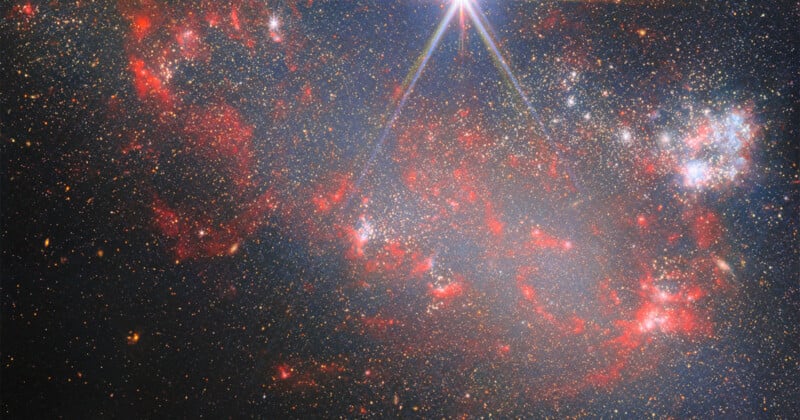
The latest ESA/Webb Picture of the Month captures the irregular galaxy Arp 263 in infrared light, showing the very odd final phase of a long-past galactic merger.
As ESA explains, Arp 263, which is also cataloged as NGC 3239, is among the “most remarkable and strange galaxies” in American astronomer Halton Arp’s Atlas of Peculiar Galaxies. What makes Arp 263 so strange is its chaotic shape.
Astronomers believe the galaxy’s weird appearance is due to a past galactic merger. Beyond its shape, additional evidence for this includes the galaxy’s pair of short, curved tails, which are just outside Webb’s field of view. These are often seen as a result of gravitational interactions, like when a pair of galaxies collide.
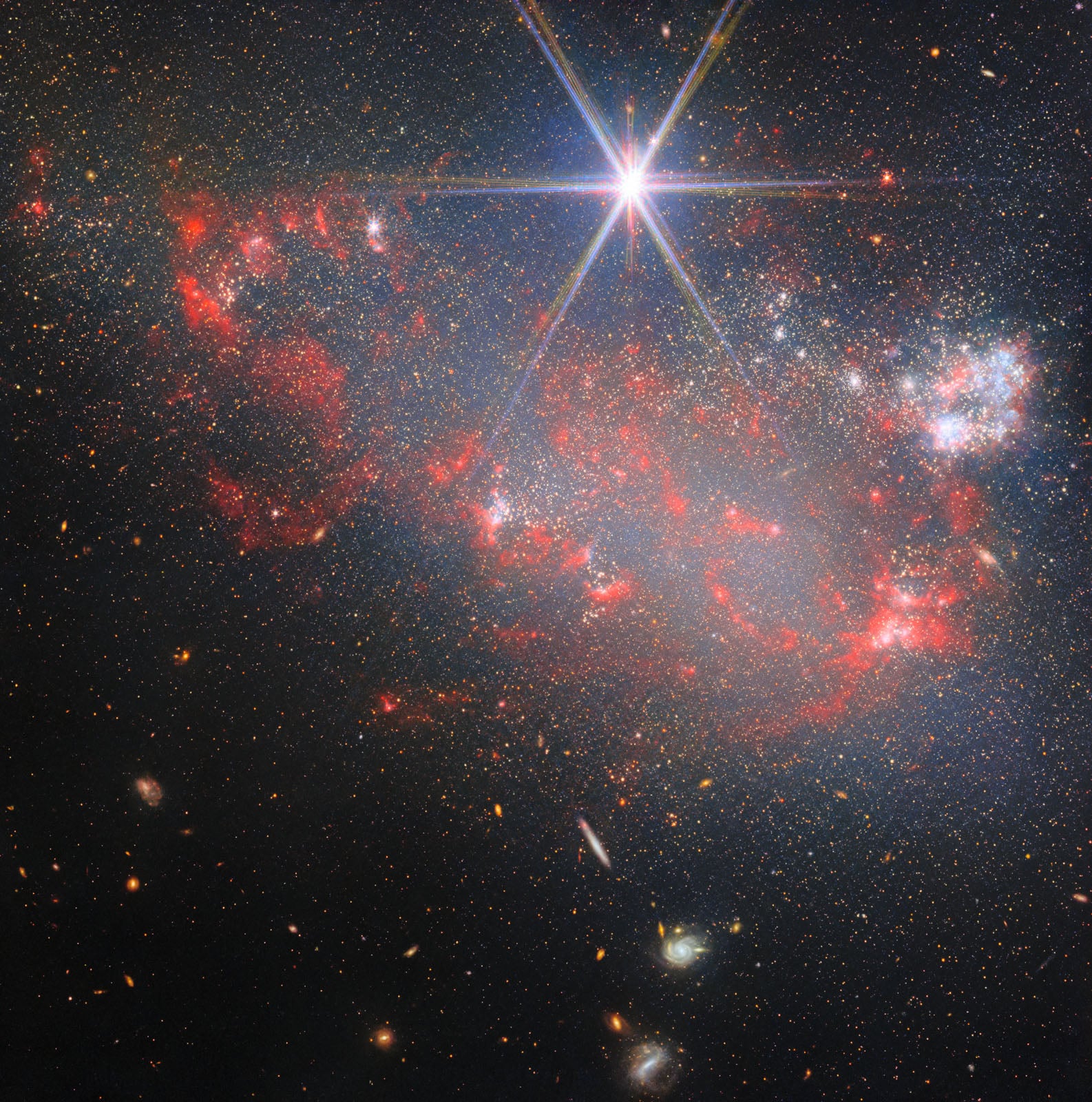 Arp 263 — James Webb Space Telescope (NIRCam), 2026 | Credit: ESA/Webb, NASA & CSA, A. Leroy
Arp 263 is also rife with new star formation, which is also typical of a galaxy “whose gas has been seriously shaken up.”
å
When galaxies merge, there is often still visual evidence of a second galaxy. In Arp 263’s case, a potential former companion galaxy is missing in action. It’s possible that the companion galaxy was so small that its material has already been absorbed into Arp 263. Another explanation is that the companion galaxy was “simply much more heavy than it was bright, making it difficult to spot as a remnant.”
Even with the James Webb Space Telescope’s (JWST) exceptional resolution and sensitivity, the $10 billion space telescope’s Near-Infrared Camera (NIRCam) can’t solve these longstanding mysteries. However, JWST can provide a look at never-before-seen details within Arp 263, including a clear view of the many stars forming inside the galaxy’s thick gas.
“Dust spread throughout the galaxy glows with the light, here shown in red, emitted by complex molecules; around the star-forming regions we also see — in blue colors — hydrogen gas, ionized by starlight and emitting its own light in turn. The most intense area of star formation features a curved chain of compact star clusters, leading to the largest and brightest star-forming nebula. Webb allows us to peek into this stellar nursery and see the stars that have formed within,” ESA writes.
The brightest area of the frame is a shining star, BD+17 2217, which is actually part of the Milky Way Galaxy. Arp 263 itself is about 25 million light-years away, and many more distant galaxies are clearly seen in the frame, including very distant ones that appear as small orange dots. Many of them are hundreds of millions of light-years away.
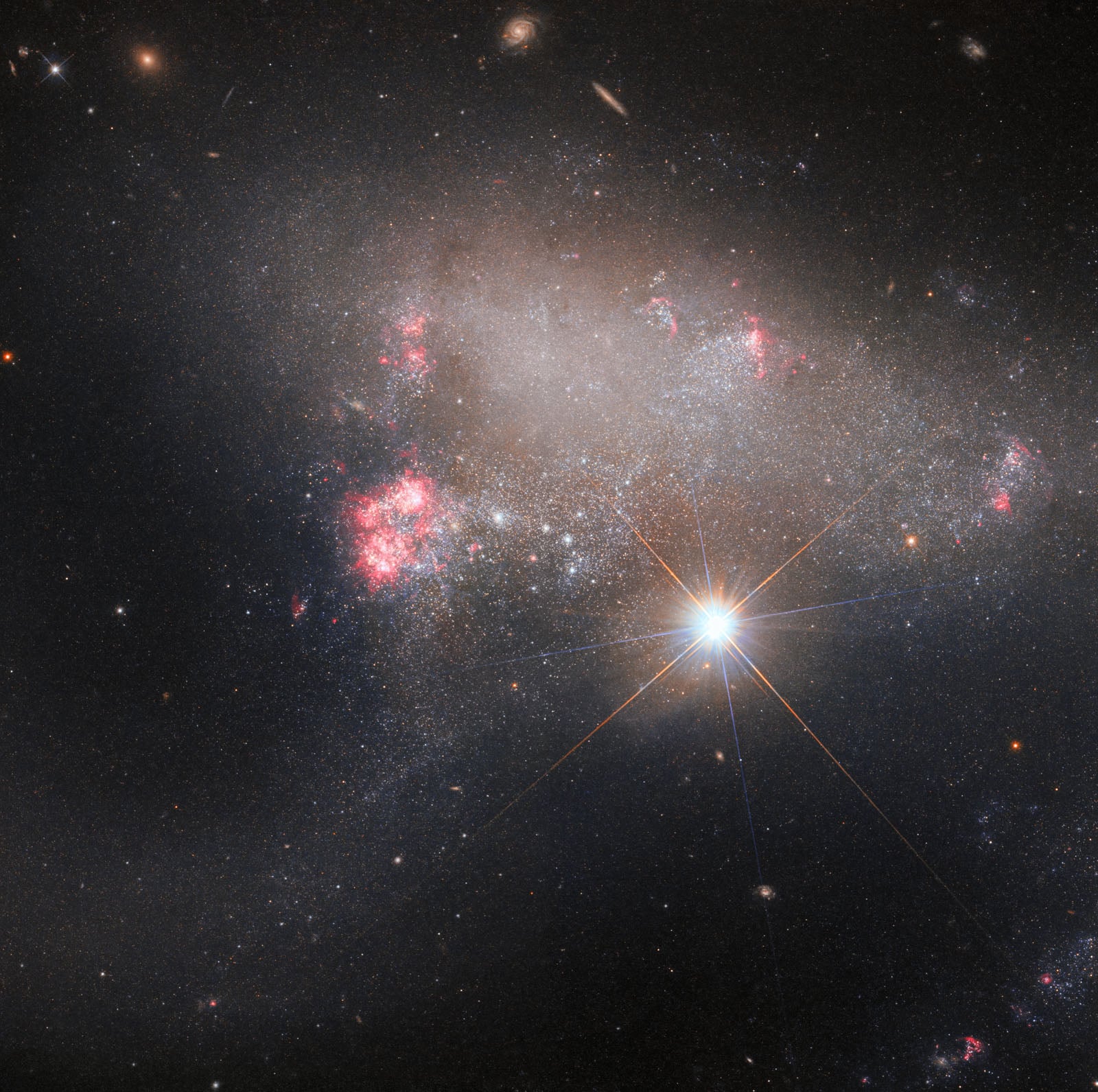 Arp 263 — Hubble Space Telescope (2023) | Credit: ESA/Hubble & NASA, J. Dalcanton, A. Filippenko
Scientists are interested in Arp 263 because it offers robust data on star formation and how stars form in different ways across galaxy types. This is far from the first time astronomers have used a space telescope to study Arp 263, as the venerable Hubble Space Telescope took a gander at the weird galaxy just a few years ago. Hubble’s view is very different from Webb’s, reflecting just how advanced Webb’s cameras truly are.
Affiliate Disclosure PetaPixel articles may include affiliate links; we may earn a commission if you buy through one.







 English (US) ·