
 3 weeks ago
31
3 weeks ago
31
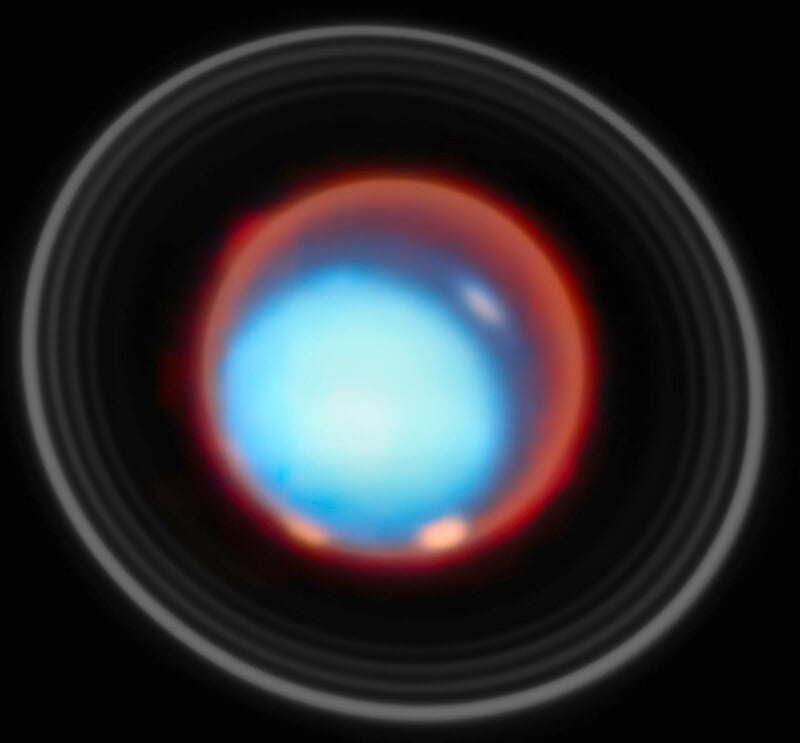 ‘For the first time, an international team of astronomers have mapped the vertical structure of Uranus’s upper atmosphere, uncovering how temperature and charged particles vary with height across the planet. Using Webb’s NIRSpec instrument, the team detected the faint glow from molecules high above the clouds. These unique data provide the most detailed portrait yet of where the planet’s auroras form, how they are influenced by its unusually tilted magnetic field, and how Uranus’s atmosphere has continued to cool over the past three decades. The results offer a new window into how ice-giant planets distribute energy in their upper layers.’ | Credit: ESA/Webb, NASA, CSA, STScI, P. Tiranti, H. Melin, M. Zamani (ESA/Webb)
The James Webb Space Telescope (JWST) captured the first-ever vertical photo of Uranus’ ionosphere, revealing the mysterious planet’s auroras.
Using Webb’s NIRSpec instrument, or Near Infrared Spectrograph, an international team of astronomers mapped the vertical structure of Uranus‘ upper atmosphere for the first time. The research uncovered key insights into how temperature and charged particles vary with altitude across the planet, the seventh planet from the Sun.
Uranus, a gaseous ice giant, is a relatively little-photographed planet. Compared to the beautiful, high-resolution photos different satellites and space probes have captured of Mars, Jupiter, and Saturn, Uranus and its even more distant planetary sibling, Neptune, are very rarely captured in close-up photos. Part of the reason why is that Uranus and Neptune are very far away, a problem Webb’s exceptional camera system and massive mirrors have solved. For example, in 2022, scientists used the James Webb Space Telescope to capture one of the clearest photos in decades of Neptune’s rings and moons. Last year, scientists used Webb to discover a new moon orbiting Uranus.
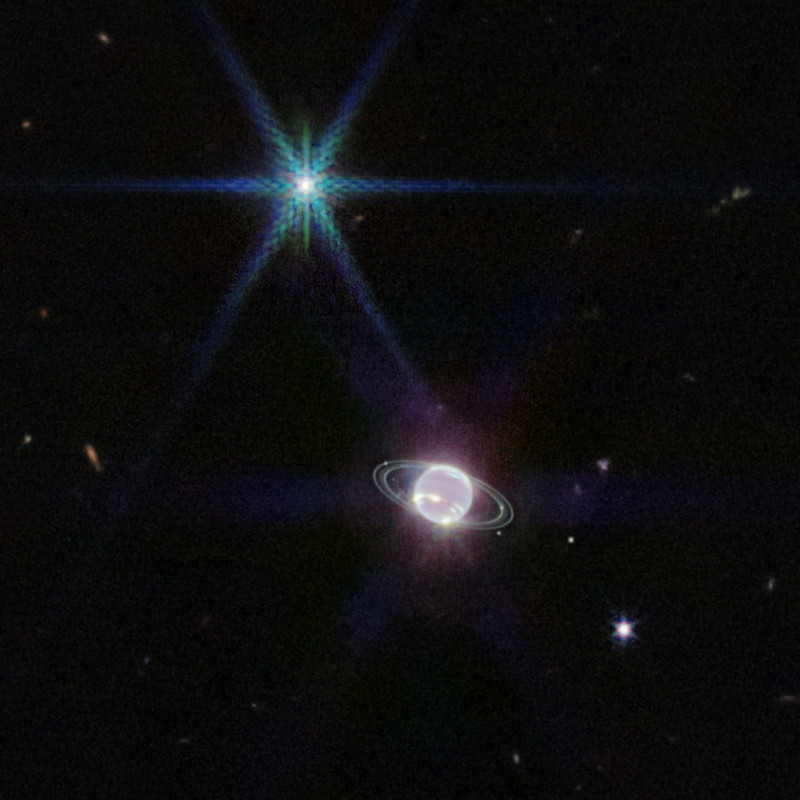 This image of Neptune and seven of its 14 known moons was captured by Webb’s NIRCam (Near Infrared Camera) instrument.
Using Webb’s incredible imaging capabilities, the new image of Uranus shows the planet’s upper atmosphere in three dimensions. Webb peered at Uranus for 17 hours, nearly a full planetary rotation, and collected a ton of valuable data, creating the timelapse below.
“These unique data provide the most detailed portrait yet of where the planet’s auroras form, how they are influenced by its unusually tilted magnetic field, and how Uranus’s atmosphere has continued to cool over the past three decades. The measurements show that temperatures peak between 3000 and 4000 km, while ion densities reach their maximum around 1000 km, revealing clear longitudinal variations linked to the complex geometry of the magnetic field,” the European Space Agency (ESA) explains.
“This is the first time we’ve been able to see Uranus’s upper atmosphere in three dimensions,” says Paolo Tiranti of Northumbria University in the United Kingdom. Tiranti led the research, which is detailed in a newly published research paper. “With Webb’s sensitivity, we can trace how energy moves upward through the planet’s atmosphere and even see the influence of its lopsided magnetic field.”
The collected data show that Uranus’ upper atmosphere continues to cool, as it has since the early 1990s. The average temperature of the upper atmosphere was measured at around 426 kelvins (150° C).
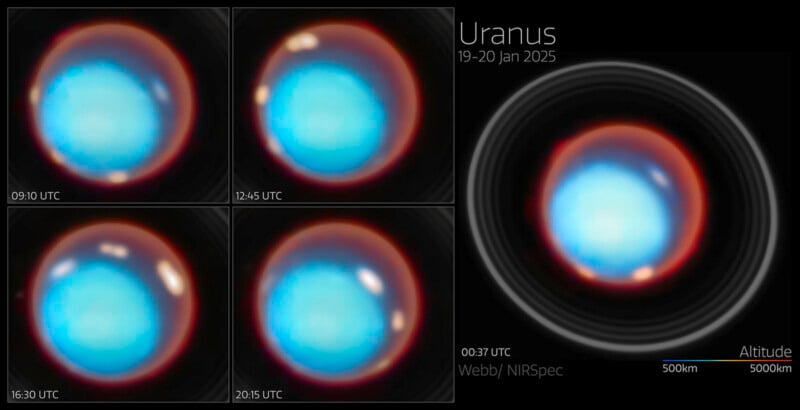
The images also show a pair of bright auroral bands near the ice giant’s magnetic poles.
“Uranus’s magnetosphere is one of the strangest in the Solar System,” Tiranti continued. “It’s tilted and offset from the planet’s rotation axis, which means its auroras sweep across the surface in complex ways. Webb has now shown us how deeply those effects reach into the atmosphere. By revealing Uranus’s vertical structure in such detail, Webb is helping us understand the energy balance of the ice giants. This is a crucial step towards characterizing giant planets beyond our Solar System.”
Image credits: ESA/Webb, NASA, CSA, STScI, P. Tiranti, H. Melin, M. Zamani (ESA/Webb). ‘JWST Discovers the Vertical Structure of Uranus’ Ionosphere‘ was published in Geophysical Research Letters, and authored by Paola I. Tiranti, H. Melin, L. Moore, E. M. Thomas, K. L. Knowles, T. S. Stallard, K. Roberts, and J. O’Donoghue.








 English (US) ·