
Gabriela Nguyen is both like many in her generation and also unlike any Gen Z I've met before. She grew up in Silicon Valley and had access to social media via her trusty iPod Touch when she was just 10. What followed was years of social media and technology use across a range of devices, including iPhones, and like many of her cohort, she met her first boyfriend on Tinder.
Now, at 24, she's off all social media and major platforms, no longer uses a smartphone, and is the founder of Appstinence, a non-profit organization dedicated to helping people quit addictive technology.

In Nguyen's view, that's the point of these platforms, encouraging you to depend on them. Nguyen and her small team founded Appstinence almost two years ago while still students at Harvard's School of Education. For Nguyen, her own moment of truth came during the pandemic.
She described to me how, like everyone else, she went into lockdown during COVID in 2020.
"I slip, like, eerily easily into quarantine. And I'm thinking, like, ‘Oh, I have evaded natural selection.'" She said she initially had this feeling of almost superiority because while everyone else was freaking out about being locked inside, she was thinking, "‘Okay, I'm inside.’ But then I realize that...I sort of quarantined before quarantine had begun, where I would just be inside on my phone."
That was a realization I had, and that took me until I was in college to realize, ‘Oh, okay, well, that's actually really sad.’ And then ironically, that made me depressed. I was like, ‘Wow, that's quite unfortunate.’ This whole, ‘No, but I can't see people.’ I did not feel that for much longer than I should have."
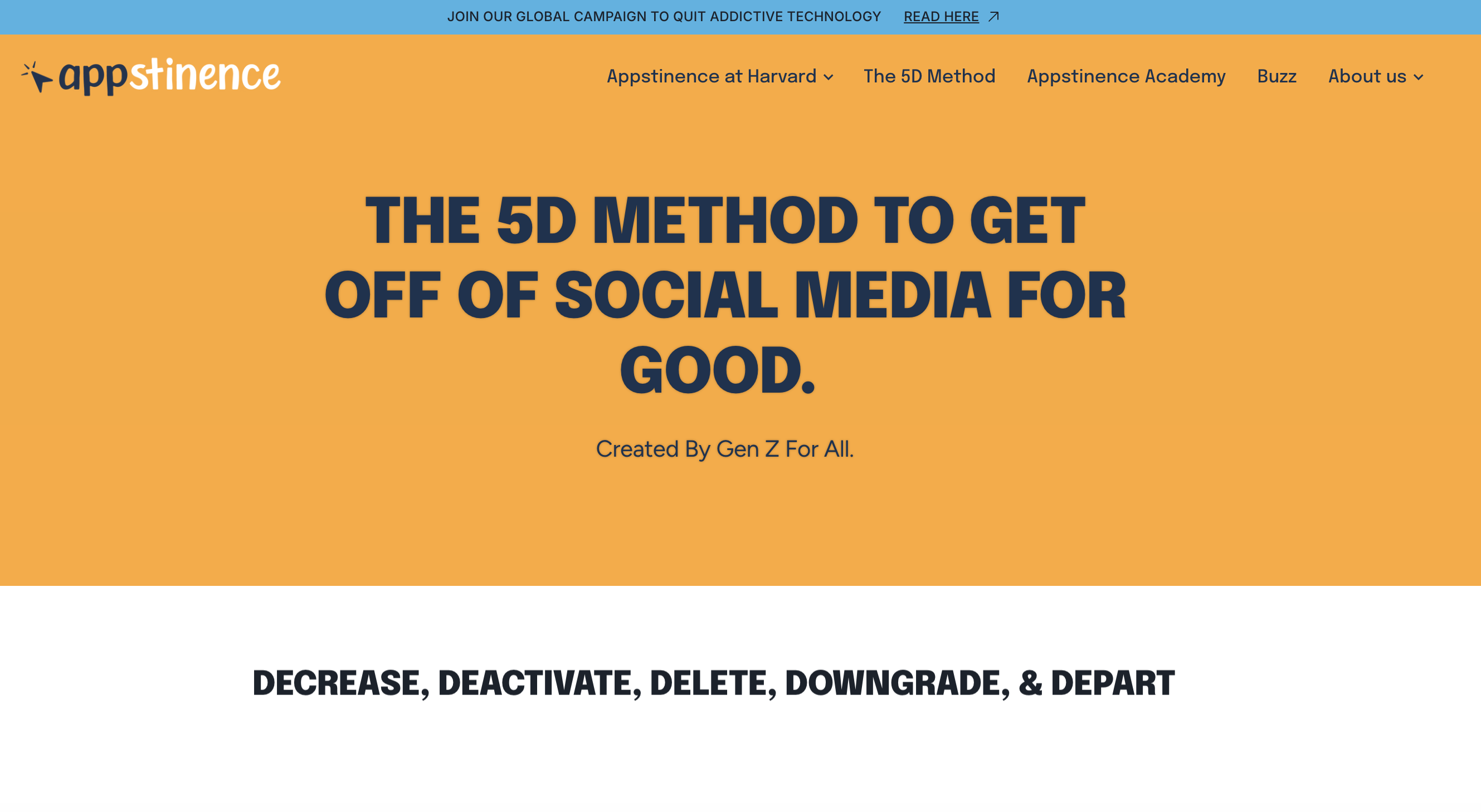
Together with her small team of quasi-volunteers (some have other full-time jobs), Nguyen developed the "5D Method," for disengaging with these technologies and platforms, which is, quite simply:
- Decrease
- Deactivate
- Delete
- Downgrade
- Depart
Appstinence's work is gliding, to an extent, in the tailwind of another anti-tech provocateur, The Anxious Generation Author and Social Psychologist Jonathan Haidt, who has proposed four norms to protect kids from social media:
- No Smartphones Before High School
- No Social Media Before 16
- Phone-Free Schools
- More Independence, Free Play, and Responsibility

The alignment is such that Appstinence continues to work with Haidt's team at New York University.
How Appstinence works
What does Appstinence do? It offers Appstinence Academy, which, for now, includes free direct services like private coaching (often remote but will soon be in person in New York), fields questions from people curious about the movement, and has conducted sessions in far-flung locations like Kenya and Australia. Nguyen told me it's clear this is not just a US, upper-crust, intellectual, or white American problem.
Nugyen admitted that the private coaching is done fairly minimally, "just because it's very time-consuming 1-on-1 coaching, with the people who want a private session to talk about why they can't put their phone down or their computer or whatever their issue is."
At the center of this debate about tech overuse is Gen Z, Nguyen's generation that was literally raised on technology and is now, in some instances, trying to reject it or at least embrace the antithesis of it with retro tech and gadgets or no-tech (vinyl, records, film cameras, in-person meet cutes).
"There's definitely a convergence for this larger, what I would call, we’re calling, the tech resistance movement. This idea of not having technology be the mediator in which we experience our lives, but at the same time, I think the part that's difficult about realizing that is, just for a lot of Gen Z, just a limitation of age."
It seems that her generation may have more trouble envisioning a world without constant tech contact. "If you grew up on these platforms, imagining what your life would be without it is kind of gets lost in this like mushy nothingness," she explained. Noting that they might associate it with movies and TV shows from the 1950s and 1960s, as opposed to reality.
Nguyen recounted the tale of two different "clients," as she calls them: one a man in his mid-30s and the other an 18-year-old. For the former, the time they worked together was relatively short, and "a lot of the work was just helping him to remember how he used to go about his day."
But for the 18-year-old, it took "several months to get him just to this one day he happened to have while he was on vacation, and it was a total epiphany for him. He's like, ‘I was able to go through the whole day without social media.’"

Signs your addicted
People who come to Appstinence are often in some emotional turmoil as they try to get a handle on what has become, whether or not they describe it as such, an addiction.
"I think the biggest flags for people who come to us...the people were very frazzled, and the desperation is quite high. The frustration as well, the feeling of, 'I've tried everything, and then this doesn't work' or, 'My life is on here, and I don't want to leave it.' ...There's a lot of emotional turmoil as well."
Clients feel, as perhaps many do when they cannot figure out how to give up social media or some other part of their tech addiction (video games, online gambling and sports betting, adult content, AI companions), trapped.
"At the same time, their emotions are so tied up in it. Their social capital is there, increasingly more as they get older. Their professional capital is also there, as well. So they feel kind of backed into a corner," said Nugyen.
As you might've guessed, Appstinence is not focusing solely on Gen Z. The group is open to clients of all ages. Nyguent told me many start by telling her, "Hey, I'm not Gen Z, but...'"
"I think that's one thing that has been very interesting and a pleasant surprise through doing this work, was that how many people of all different age groups would come with the same lines, and the same claims of like, ‘I feel trapped. I don't know what to do. I feel like my life is slipping away.’ That kind of language, and they could be 20, or they could be in their prime middle age, or they could be grandparents with the Gen Alpha kids, all saying kind of the same things."
The struggle is real

One of the areas Nguyen focuses on is the language of tech compulsion and how to address it. When I brought up 'Digital Detox,' a term popularized more than a decade ago, Nguyen told me that while a digital detox is "a good means to an end," it also implies that at some point, allowing those "toxins back in."
"That is part of the malaise of especially my generation that we're waiting, we wanted something more radical – to use the R word– than a detox than screen time hacks, than how to strip your feed so it's not as bad or 'Here's the plugin that you can use and screen time apps,' and all that kind of stuff."
We need more nuanced language around the way we relate with technology
Gabriela NguyenNguyen doesn't see screen control apps and tools as reaching the level of "deep self-commitment," necessary to regain control. Appstinence is about a commitment to not returning to the apps and platforms that are, in Nguyen's view, designed to addict you.
Ever the realist, Nugyen described to me how ineffective screen time limits can be for most Gen Z and Gen Alphas, based on her own experience.
"I can tell you that as someone who used to have [a situation] where my dad would want to take my phone before I went into my bedroom at night; if my parents were to limit me to say 20 minutes or something like that on Instagram, that wouldn't have done anything. I knew my way around the apps. I could do everything I wasn't supposed to do in 20 minutes on Instagram. So we need more nuanced language around the way we relate with technology."
On the front lines of a new AI fight
For some, the latest such tech might be Artificial Intelligence (AI).
Nguyen told me that Appstinence's internal discussions about the use of AI revolve around "companionship, anything that's supposed to mimic human intimacy....things like Replica, CharacterAI, young adults using ChatGPT for therapy and relationship advice, and that kind of stuff. We're against the use of these, especially for children."
Nguyen is clearly worried about any generation using these tools as human replacements.
While it may be early days in developing an Appstinence policy for AI, she has some clear ideas.
"We also want to encourage other people in our generation to be the types of people who do not even want to have an AI friend."
Once again, the issue cuts across generations: "How do we have parents and Gen Z also become the types of people and raise the types of kids who do not wish to have an AI friend?"
After your life becomes so robust, being based in the physical world, there is, to a great degree, an indifference that I can have about it; that buzz, that goes on on TikTok, is not my concern. I don't feel the draw to look at it.
Gabriela NguyenDoes Appstenece work? For Nguyen, at least, it has. She now uses the minimalist cellphone Mudita Kompakt (Polish company) for calls and texts, and describes feeling "indifference" to platforms she was once addicted to, like TikTok.
"After your life becomes so robust, being based in the physical world, there is, to a great degree, an indifference that I can have about it; that buzz, that goes on on TikTok, is not my concern. I don't feel the draw to look at it."
Mostly.
"Of course. If I were to re-download it, get a smartphone again, redownload it, and start a habit of looking at it, I would get back in. But there is not that centrifugal force that I feel like I'm caught in," she said.
Appstinence is running on grants, both current and they hope future, plus Nguyen's potential upcoming book deal. It's ultimately a small operation with big aspirations. Nguyen, though, thinks it's already a success.
"By one of the initial metrics, when I first started Appstinence, which was to inject into the conversation, a serious consideration of actually abandoning these platforms and building your life outside of them, by that metric, I feel like this endeavor has already succeeded."
Follow TechRadar on Google News and add us as a preferred source to get our expert news, reviews, and opinion in your feeds. Make sure to click the Follow button!
And of course, you can also follow TechRadar on YouTube and TikTok for news, reviews, unboxings in video form, and get regular updates from us on WhatsApp too.





 English (US) ·