
 4 hours ago
5
4 hours ago
5
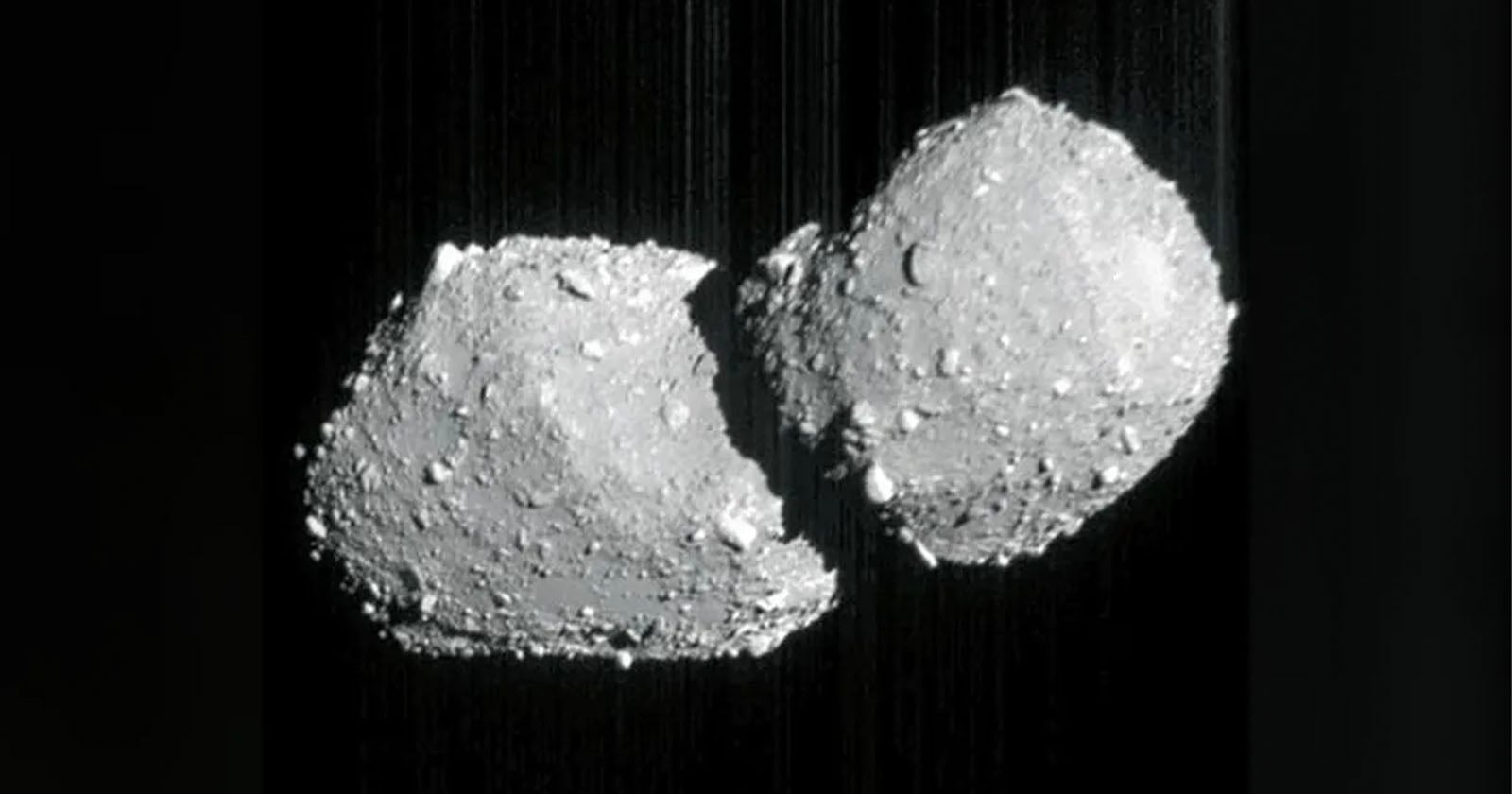 The Torifune asteroid.
The Japanese space agency has captured a remarkable image of a double-headed asteroid some 62 million miles (100 million kilometers) from Earth.
The Japan Aerospace Exploration Agency (JAXA) snapped a photo of Torifune, a 1,475-foot (450-meter) asteroid, as its Hayabusa2 probe made a high-speed close pass to the space rock that’s about the length of the Empire State Building.
The flyby occurred yesterday (July 5) at 6.30 p.m. Japan Standard Time. Hayabusa2 flew approximately within six miles (10 kilometers) of Torifune.
Torifune was snapped with the probe’s onboard Optical Navigation Camera –Telescopic (ONC-T), as well as its Thermal InfraRed Imager (TIR).
“These observations continued until immediately before the closest approach to Torifune but could not be conducted after the spacecraft had passed the asteroid,” JAXA says.
“At present, only part of the data acquired by the scientific instruments has been transmitted to Earth. The remaining data will be transmitted to the ground during future operations.”
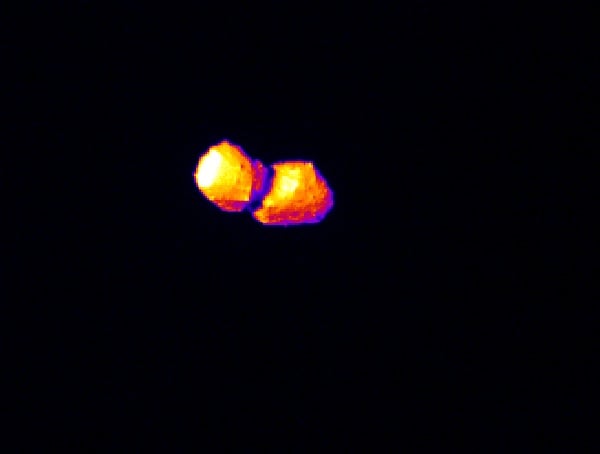 The asteroid as seen by the probe’s Thermal InfraRed Imager.
What is Torifune?
Space.com reports that Torifune orbits the Sun every 383 days and rotates every five hours. It is classified as a near-Earth asteroid that crosses Earth’s orbit.
It has a rocky, weathered surface composed mostly of the silicate minerals pyroxene and olivine. JAXA tells Space.com that the flight to Torifune was a “risky operation” since the team was unsure of the conditions around the space rock.
What is Hayabusa2?
PetaPixel has previously reported on Hayabusa2 back in 2018 after it successfully landed on another asteroid called Ryugu. It collected 5.4 grams of asteroid material and returned the sample to Earth by dropping it in the Australian desert.
The successful probe collects samples that are used by scientists to better understand the history of the Solar System. Researchers discovered that Ryugu contains all five nucleobases found within DNA and RNA, for example.
But after completing the Ryugu mission, Hayabusa2’s efficient propulsion system retained nearly half of its original xenon propellant by the end of its mission, with approximately 30 kg remaining from the 66 kg it carried at launch. So JAXA hatched a plan to visit two more asteroids.
Hayabusa2’s next mission is to visit another asteroid called 1998 KY26, a tiny asteroid at just 36 feet (11 meters), which it is also hoping to land on. JAXA wants to study smaller asteroids to find out more about their structure.
PetaPixel articles may include affiliate links; if you buy something through such a link, PetaPixel may earn a commission.
Love PetaPixel? Go Premium.
PetaPixel is the world’s largest independent photography publication and we’re only able to continue our work with your help. Become a PetaPixel Member now and support our mission to bring you regular, high-quality reviews, features, news, and more.
- Remove banner ads
- Gain access to full-resolution RAW and JPEG Sample Galleries
- Get 5% off orders from KEH.com
- Get a $15 coupon to spend at Moment
- Get 10% off lighting equipment from FJ Westcott
- Get 10% off film development, scanning, and printing from Blue Moon Camera and Machine







 English (US) ·