
 1 week ago
9
1 week ago
9

Published Mar 2, 2026, 12:31 PM EST
It's time to update the legend rule
 Image: Wizards of the Coast
Commander may be the most popular way to play Magic: The Gathering, but for my booster-pack-buying-money, there’s nothing quite like a draft. Whether you roll up to your local game store on a Friday night or gather with friends, nothing beats the experience of ripping open a few packs and throwing together a deck for a quick Magic tournament.
Drafting levels the playing field (you can’t outspend your opponents to win), and best of all, you go home with a bunch of new cards to use in your commander decks. However, there’s a growing problem in draft (along with Magic’s other limited format, sealed) that’s only getting worse as Wizards of the Coast and its parent company Hasbro continue to ramp up Universes Beyond. It comes down to two words: legend rule.
Magic’s three-decade history is full of fantasy and sci-fi creatures, from genre classics like elves and goblins and original creations like phyrexians and eldrazi. A much smaller subset of those creatures are legendary, which means that instead of representing an entire swath of creatures, like say Elvish Piper, the card represents a specific character in the Magic multiverse, like High Perfect Morcant.

The designation of legendary also has a few other implications in Magic. For one thing, legendary creatures are often more powerful and rare than their non-legendary counterparts, though that’s changed in recent years. There’s also the aforementioned legend rule, which states: If two or more legendary permanents with the same name are controlled by the same player, that player chooses one of them, and the rest are put into their owners' graveyards.
That means you can’t play two of the same legendary creature at the same time, or create a copy of one (unless you have some sort of loophole). This doesn’t matter much in commander, where decks are only allowed one copy of each card, but in draft, where there are no such limits, it’s much more relevant.
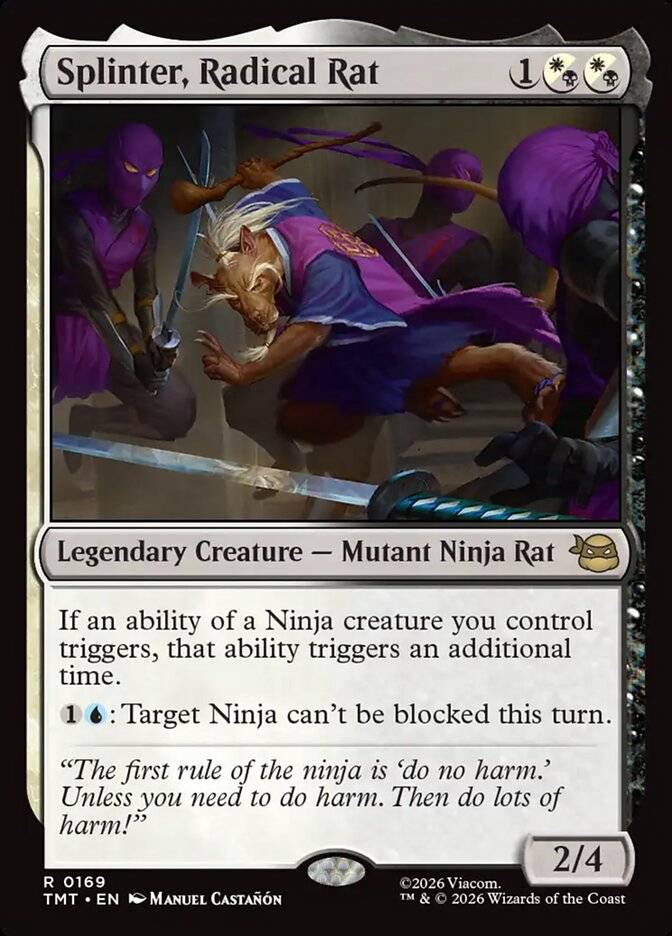
Until recently, this wasn’t a problem. Most sets use legendary creatures sparingly, especially when it comes to common and uncommon cards. However, with Universes Beyond, that’s no longer the case. Last year’s Spider-Man set was chock-full of them, with roughly 70% of the creatures being legendary, including a third of the common creatures. Magic’s latest crossover expansion, Teenage Mutant Ninja Turtles, is no different, and it seems likely that other upcoming Universes Beyond sets like Marvel Heroes and Star Trek will follow suit.
This creates an obvious issue in draft and sealed formats where the best strategy is often to create a consistent deck by grabbing as many of the same creatures as possible. In a Teenage Mutant Ninja Turtles draft, you might be tempted to pick up multiple copies of Leonardo, Big Brother since it synergizes well with itself, but you’ll only be able to play one at a time thanks to the legend rule. (The common versions of each core Turtle are also generally pretty lackluster compared to the uncommon and rare varieties, but that’s another gripe entirely.)

In a recent blog post, Magic’s head designer, Mark Rosewater, addressed this criticism head on. “The number one advantage is more people get to open up a pack with a card of their favorite character,” he wrote.
On one level, this makes sense. Whether you like it or not, the point of Universes Beyond is to bring popular franchises into Magic, and playing with the characters from those stories is a key part of that experience. The latest set even leans into this with a designated turtle slot in each pack. However, a lot of these franchises also don’t have a deep bench of non-legendary creatures to pick from, which is how you wind up with forgettable cards like Taxi Driver in Spider-Man. There simply aren’t enough non-legendary design options to support a full set of Magic cards.

In the same blog post, Rosewater also notes that he’s been “trying to get rid of the drawback (unsuccessfully) for years.”
Well, it may be time to pull the trigger and delete the legend rule — not for all of Magic, but for draft and limited, specifically. After all, draft decks already deviate from other formats by letting you include as many copies of a card as you want in your deck; other formats like standard limit you to four copies per card. Removing the legend rule in this specific case fixes the issue with very few obvious drawbacks (the chances of someone drafting two copies of an uber-strong legendary creature are slim).
This one simple fix could save Magic drafts. Of course, we could also just cancel Universes Beyond entirely. That would solve the issue, too. But until that happens, ditching the legend rule for a couple of specific formats would work just fine.







 English (US) ·