
 3 hours ago
9
Ukraine has changed drone and war-fighting tech to reduce reliance on Starlink.
Elon Musk’s Starlink satellite service has played a pivotal role in supporting Ukraine’s successful resistance to Russia’s full-scale invasion for years. But with Starlink having become increasingly unreliable due to Musk’s political inclinations and the latest surprise disruptions to service in Ukraine, the Ukrainians and Europe as a whole are now facing urgent questions about how to move forward without it.
As the world’s largest communications satellite network, Starlink can typically support high-speed Internet and data streams for any user or vehicle equipped with a relatively compact Starlink terminal. This has enabled Ukraine to maintain vital communications for both civilian purposes and military operations—and has also expanded the Ukrainian military’s capability to remotely control or provide guidance to drones used in both air defense against Russian attacks and for striking back at Russian targets.
“Starlink currently offers some of the best satellite coverage available, with virtually no competitors when you consider the combination of cost, availability, and ease of use,” according to the head of hardware R&D at the Ukrainian defense company BlueBird Tech, who provided comments to Ars anonymously for security reasons. “In practical terms, the main limitation is the need to position the antenna so it can receive signals from the satellites.”
The US government and European countries such as Poland and Germany have paid SpaceX for tens of thousands of commercial Starlink terminals to be sent to Ukraine, as well as covering subscription fees. The US government has also given Ukraine’s military access to a military-grade version of Starlink known as Starshield, which Ukrainian defense companies can also test in their technologies in cooperation with the military, according to the BlueBird Tech representative.
Starlink terminals have also been deployed on Ukrainian ground robots and drone boats operating in the contested Black Sea, in addition to supporting many different aerial drone operations on the battlefield. But even before the latest Starlink disruptions began on October 13, Ukrainian companies and their Western partners had already begun deploying more drones that reduce or eliminate communications reliance on Starlink.
The double-edged sword
The Starlink service provided by Musk’s company SpaceX has proven so invaluable to modern battlefield operations that even Russian military units were using smuggled Starlink terminals—at least before SpaceX shut off access to any Starlink terminal within Ukraine not on a whitelist in February 2026. That shutoff severely disrupted Russian battlefield operations in the early part of the year.
But access to Starlink has become a double-edged sword for Ukraine as well. Early warning signs arose in February 2023, when SpaceX President and COO Gwynne Shotwell confirmed reports that Musk’s company was taking steps to block Ukraine’s military from using Starlink with drones. That followed Musk’s social media comments about not allowing Starlink to be used for “long-range drone strikes.”
The top-down Starlink restrictions returned on October 13, 2026, when Ukrainian government officials and military forces reported that the military-grade Starlink service was being throttled for terminals exceeding speeds of about 99 miles per hour (160 kilometers per hour). This latest restriction was imposed by SpaceX reportedly at Musk’s order and potentially in consultation with President Donald Trump. Musk and the Trump administration have both denied responsibility while pointing fingers at each other.
In practice, the throttling of Starlink in Ukraine has made the satellite service unstable at even lower speeds like 80 miles per hour (130 kilometers per hour), said Michael Kofman, a senior fellow in the Russia and Eurasia Program at the Carnegie Endowment for International Peace, in a social media post on October 19.
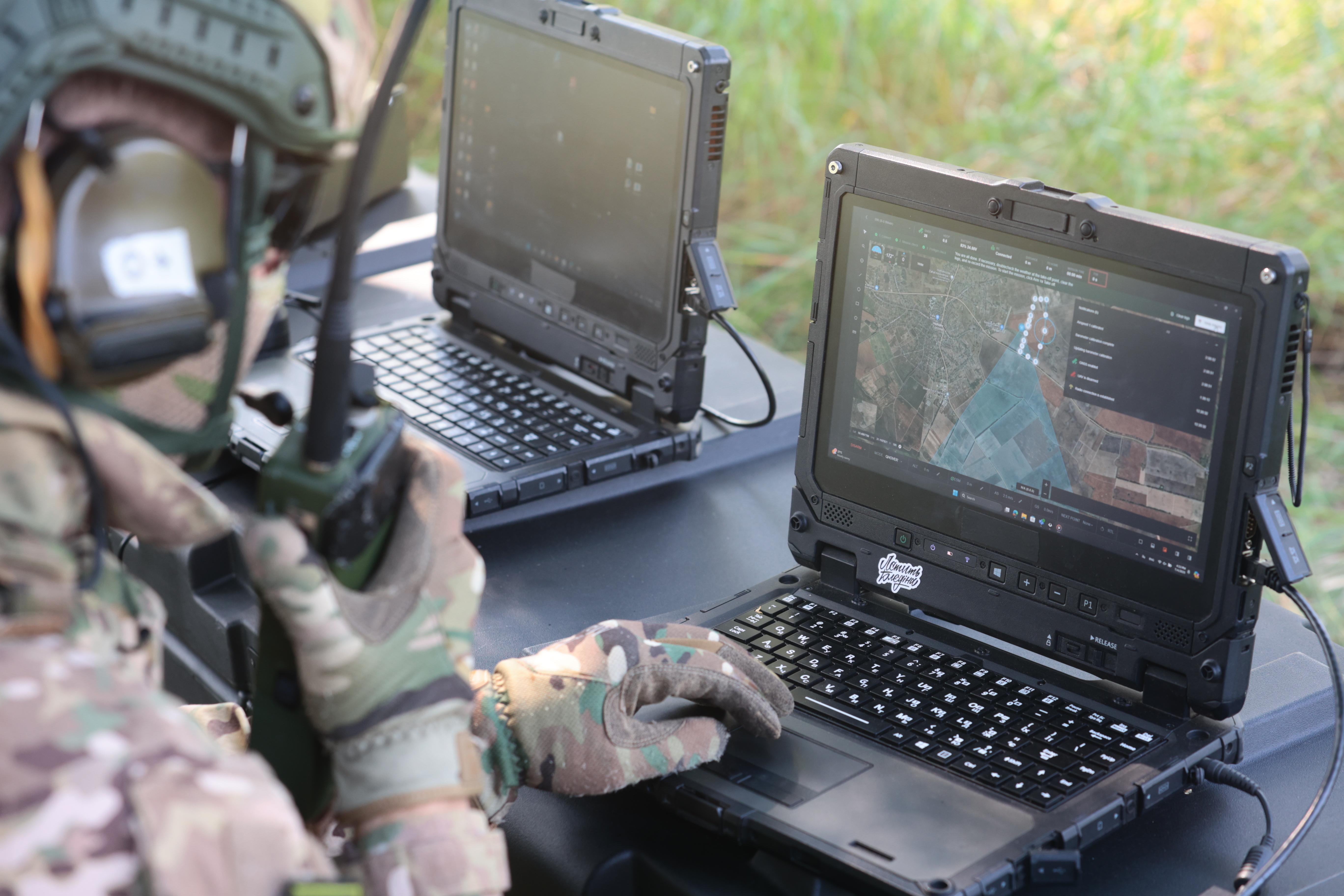
Buntar Aerospace’s AI-driven Copilot software helps human operators manage drone missions.
Credit: Buntar Aerospace
Buntar Aerospace’s AI-driven Copilot software helps human operators manage drone missions. Credit: Buntar Aerospace
Such throttling reportedly disrupted multiple Ukrainian drone missions when it began without warning in the middle of the night. Ukrainian officials and advisers have described multiple impacts on drones that supply frontline units, reconnaissance missions, and mid-range drone strike missions that attack Russian military units and supply lines in Russian-occupied Ukrainian territory.
The new Starlink speed limits have even reportedly interfered with Ukraine’s air defenses that use fast-moving drone interceptors to take down Russian one-way attack drones, according to Ukrainian President Volodymyr Zelenskyy. The Starlink disruption coincided with some of Russia’s largest drone and missile attacks yet on major Ukrainian cities, with Russia having stepped up targeting of Ukraine’s power grid, data centers and even blocks of residential apartment buildings.
Learning to fight without Starlink
Despite the value of Starlink, Ukraine’s military and defense companies have already been figuring out ways to fight on without the satellite service. This is in part because Russian forces have done their best to interfere with Starlink signals on the battlefield, including recently deploying cumbersome jamming systems to create zones of disrupted service within the Russian-occupied parts of Ukraine.
“We don’t tie our products to any single technology, and we don’t manufacture systems that are critically dependent on Starlink,” the BlueBird Tech representative told Ars. “We’ve long been aware of the risks of Starlink jamming along the front line, which is why we’ve avoided using it as the sole means of control and telemetry.”
BlueBird Tech has integrated Starlink terminals in several of its ground-based and airborne systems, but its representative described this as a “small percentage” of its overall product lineup. For example, the company’s Zhakh FPV drones are among the many Ukrainian and Russian drones that can maintain physical communication links with human operators by unspooling a long fiber-optic cable—making them impervious to electronic warfare countermeasures.
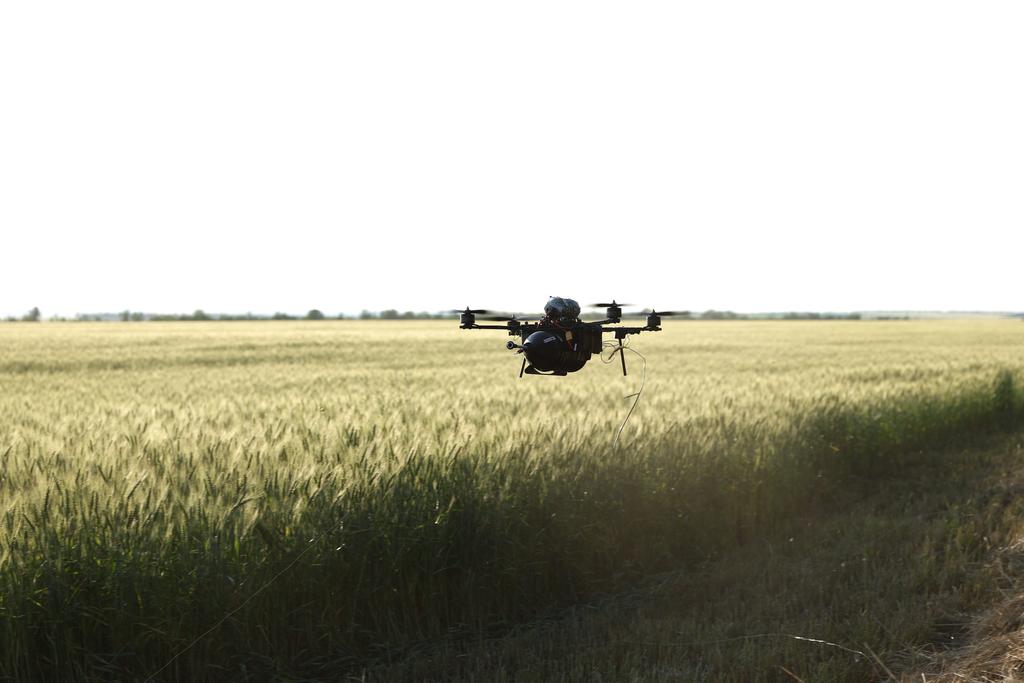
The Zhakh series of FPV quadcopter drones made by the Ukrainian company BlueBird Tech can unspool fiber-optic cable to maintain communications with human operators.
Credit: BlueBird Tech
The Zhakh series of FPV quadcopter drones made by the Ukrainian company BlueBird Tech can unspool fiber-optic cable to maintain communications with human operators. Credit: BlueBird Tech
The Ukrainian company produces multiple types of drones for reconnaissance and strike missions, along with a ground robot, drone detection systems, and electronic warfare systems. It has also begun developing an air-defense interceptor drone.
There are still “certain product configurations for which no direct replacement for Starlink currently exists,” because the satellite service’s “technical capabilities and accessibility make it difficult to substitute in some applications,” the BlueBird Tech representative said. But they also described the company as “actively exploring ways to add redundancy and potentially replace these components in the future.”
Some of the most promising wireless approaches include using ground-based LTE or 5G wireless networks or even turning to laser-based optical communication.
BlueBird Tech is also examining radio-based mesh networks that allow ground transmitters or even radio-equipped drones to act as relay nodes within a larger decentralized communications system. This approach has been increasingly implemented by Russian drone strike missions on Ukrainian cities, as detailed by The Kyiv Independent.
Navigation alternatives and AI guidance
Another Ukrainian defense company, Buntar Aerospace, described having always accounted for the possibility that a communications service like Starlink could become available because of battlefield conditions.
“The recent Starlink and Starshield disruptions did not affect our operations because we had prepared for this scenario in advance,” said Bohdan Sas, cofounder of Buntar Aerospace, in an email to Ars. “Losing access to one communications service does not necessarily mean losing the ability to conduct a mission.”
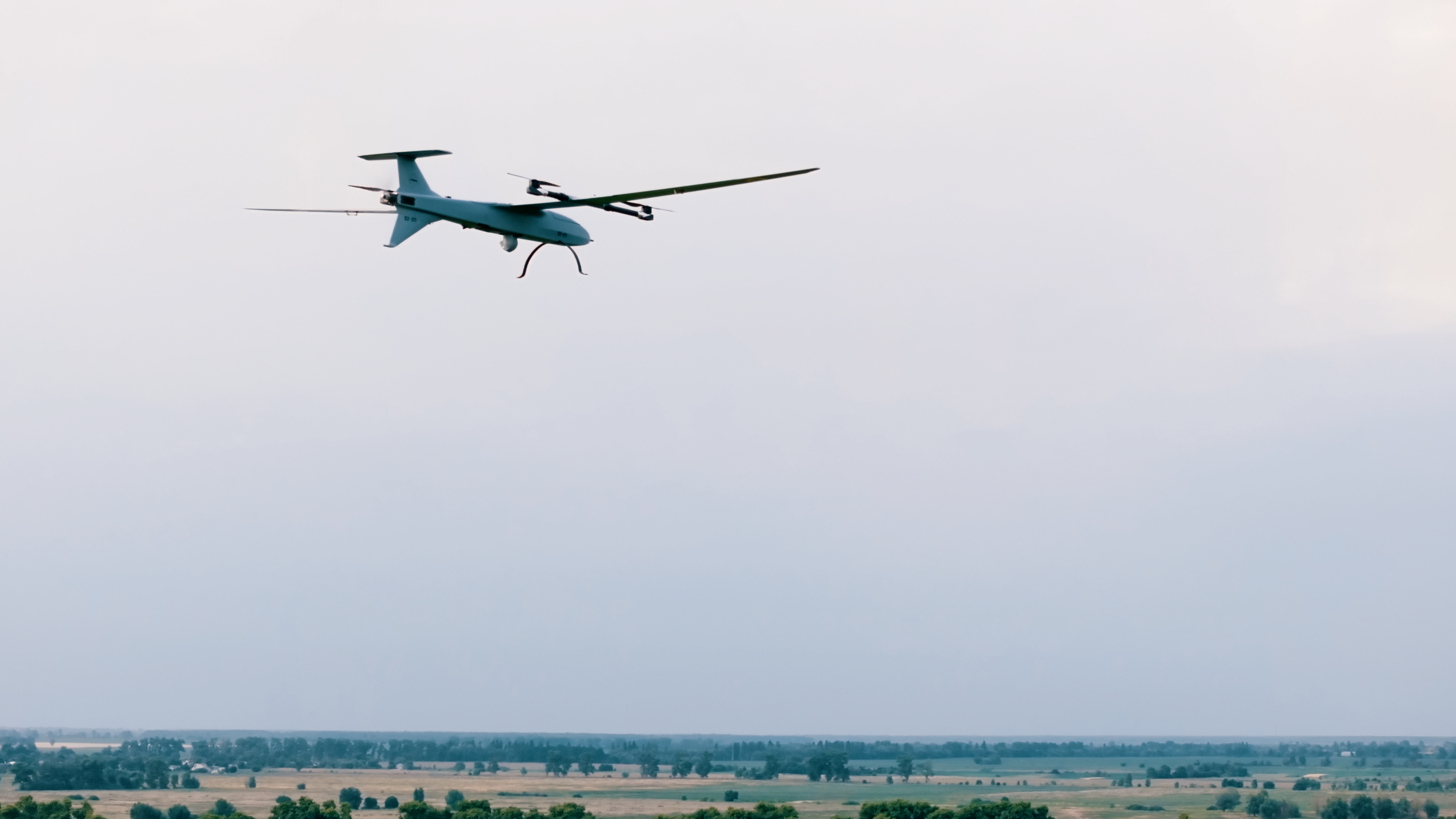
The Buntar-3 reconnaissance drone can integrate Starlink but also has backup communication systems.
Credit: Buntar Aerospace
The Buntar-3 reconnaissance drone can integrate Starlink but also has backup communication systems. Credit: Buntar Aerospace
Buntar Aerospace has provided Ukrainian military forces with fixed-wing reconnaissance drones that can fly up to 62 miles (100 kilometers). The drone’s operations benefit from AI-driven software called Buntar Copilot that can supposedly adapt flight plans for factors such as weather, signal quality or interference, and battery life.
The company describes each data stream from its Buntar-3 drone—such as flight sensor data or its camera video stream—as being transmitted over separate channels to reduce the impact of one dropped stream. Although the drone incorporates a Starlink terminal, it also has alternative communication methods in case any service is disrupted.
“Commercial communications services can provide valuable capabilities, but defense systems must account for the possibility that those services may become unavailable,” Sas told Ars.
Western companies providing drone technologies to Ukraine have also incorporated similar battlefield lessons to reduce reliance on Starlink. For example, German defense company Quantum Systems described its Vector reconnaissance drones deployed in Ukraine as able to communicate with ground control stations via encrypted radio links. It also has “onboard AI and alternative navigation technologies” to perform missions despite GPS jamming or electronic warfare measures.
The SPYS drone interceptor—developed by the company’s German-Ukrainian joint venture Quantum WIY Industries—also uses a ground-based beacon system to navigate without GPS and has AI-based target recognition capabilities coupled with heat-seeking sensors to home in on enemy drones. This particular interceptor does not use Starlink at all.
“As a global neo-prime with European roots, we want Europe to remain fully capable of operating alongside our allies while retaining the ability to act independently when necessary,” said Paul Strobel, a spokesperson for German defense company Quantum Systems, in an email to Ars. “This means Europe must be able to develop, operate and maintain critical technologies, data and capabilities independently.”
The German government has provided funding to supply tens of thousands of these interceptor drones to Ukraine in 2026 and 2027.
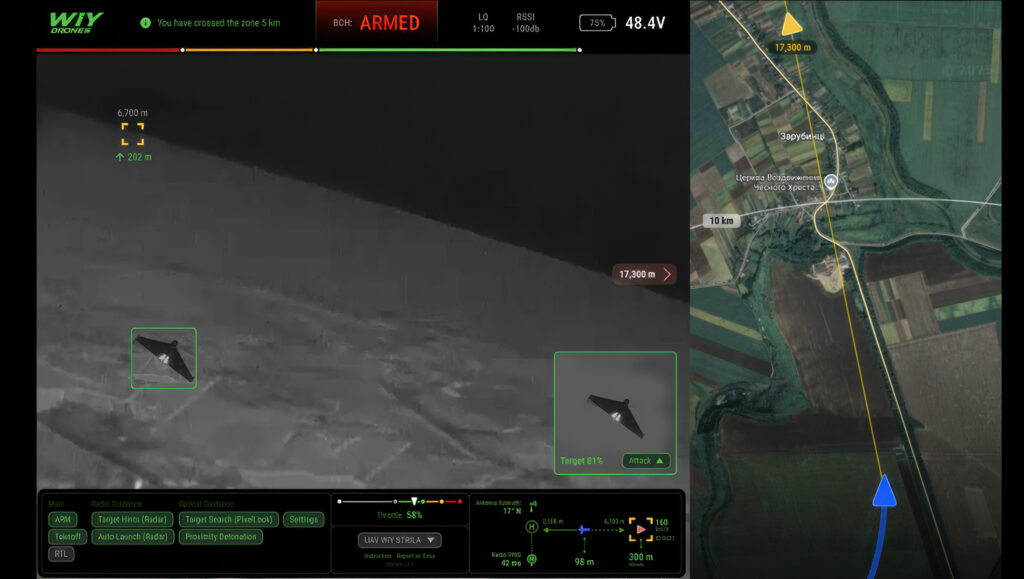
The German-Ukrainian joint venture Quantum WIY Industries is developing interceptor drones that rely on ground-based radio links and onboard AI systems to track and shoot down Russian drones.
Credit: Quantum Systems | WIY Drones
The German-Ukrainian joint venture Quantum WIY Industries is developing interceptor drones that rely on ground-based radio links and onboard AI systems to track and shoot down Russian drones. Credit: Quantum Systems | WIY Drones
European satellite services
Given their governments’ funding for Starlink service in Ukraine, German and Polish leaders have demanded that the Starlink restrictions be removed and asked pointed questions about whether Musk is “playing politics.” But Europe has also been accelerating development of its own sovereign alternatives to Starlink that may prove useful for Ukraine in the future.
The Ukrainians already use Eutelsat’s OneWeb satellite service as a main alternative for some communications, but Eutelsat has just over 600 satellites in orbit compared to Starlink’s 10,000 satellites. This means it cannot support nearly as much data streaming or as many customers for Ukraine or other regions.
The OneWeb terminals are also significantly bigger than Starlink terminals while costing about 45 times more than the latter, The Economist reported. Caleb Henry, author of a book about the history of OneWeb, previously told Ars that the bulkier OneWeb terminals complicated Ukrainian efforts to mount them on drones.
The European Union has already spent six years planning to launch the IRIS² constellation of 348 communications satellites starting in 2029, although that is again a mere fraction of the Starlink constellation’s size. European Union leaders have also been seeking to speed up antitrust approval for a satellite venture called Project Bromo, which could create a large European company to rival SpaceX, Bloomberg News reported.
Separately, Germany plans to build its own communications satellite constellation, SATCOMBw 4, for its own military and NATO. This constellation aims to start with 50 operational satellites by 2029 before expanding to hundreds, according to Euronews.
Just weeks before the latest Starlink disruptions in Ukraine, Finland’s satellite company ICEYE and communications technology firm Nokia also announced plans to build a communications satellite constellation for Europe, according to Bloomberg News. The companies expect to launch up to 50 low-Earth orbit satellites annually from 2028 onward.
But as with Starlink, enemy countermeasures could also disrupt signals from these communications satellite services on modern battlefields. So Ukrainian defense companies and the military will likely keep backup systems and avoid overreliance on satellite signals whenever possible.
“The main lesson is that communications resilience is part of military autonomy,” said Sas at Buntar Aerospace. “Defense technologies must be designed around the realities of the battlefield, where connectivity is never guaranteed.”

Jeremy Hsu is a reporter exploring a wide range of topics across deep tech and AI. He has previously written for New Scientist, Scientific American, IEEE Spectrum, Wired, Undark Magazine and MIT Tech Review, among many other publications, about topics such as deepfakes, data centers, drones, battery tech, robotics, and GPS jamming. He also has a Master of Arts in Journalism from NYU, and a bachelor's degree from University of Pennsylvania in History and Sociology of Science, with a minor in English.








 English (US) ·