
My phone hit one bar outside Shinjuku Station, and the "unlimited" SIM card I'd bought at the airport two hours earlier had already burned through its entire 2GB. Just a dead connection and me standing on a street corner trying to remember which exit led to my hotel.
That trip is why I stopped trusting airport SIM counters.
Once I actually started researching eSIMs instead of grabbing whatever the kiosk pushed, one name kept coming up. Business travelers doing three countries a week swore by it. So did car nerds who care more about their infotainment system's connectivity than its horsepower.
That name was Ubigi.
Ubigi has been around since 2017. It's built by Transatel, part of the NTT Group, so you're on Transatel's own core network rather than a reseller riding someone else's coverage.
Ubigi: Plans and pricing
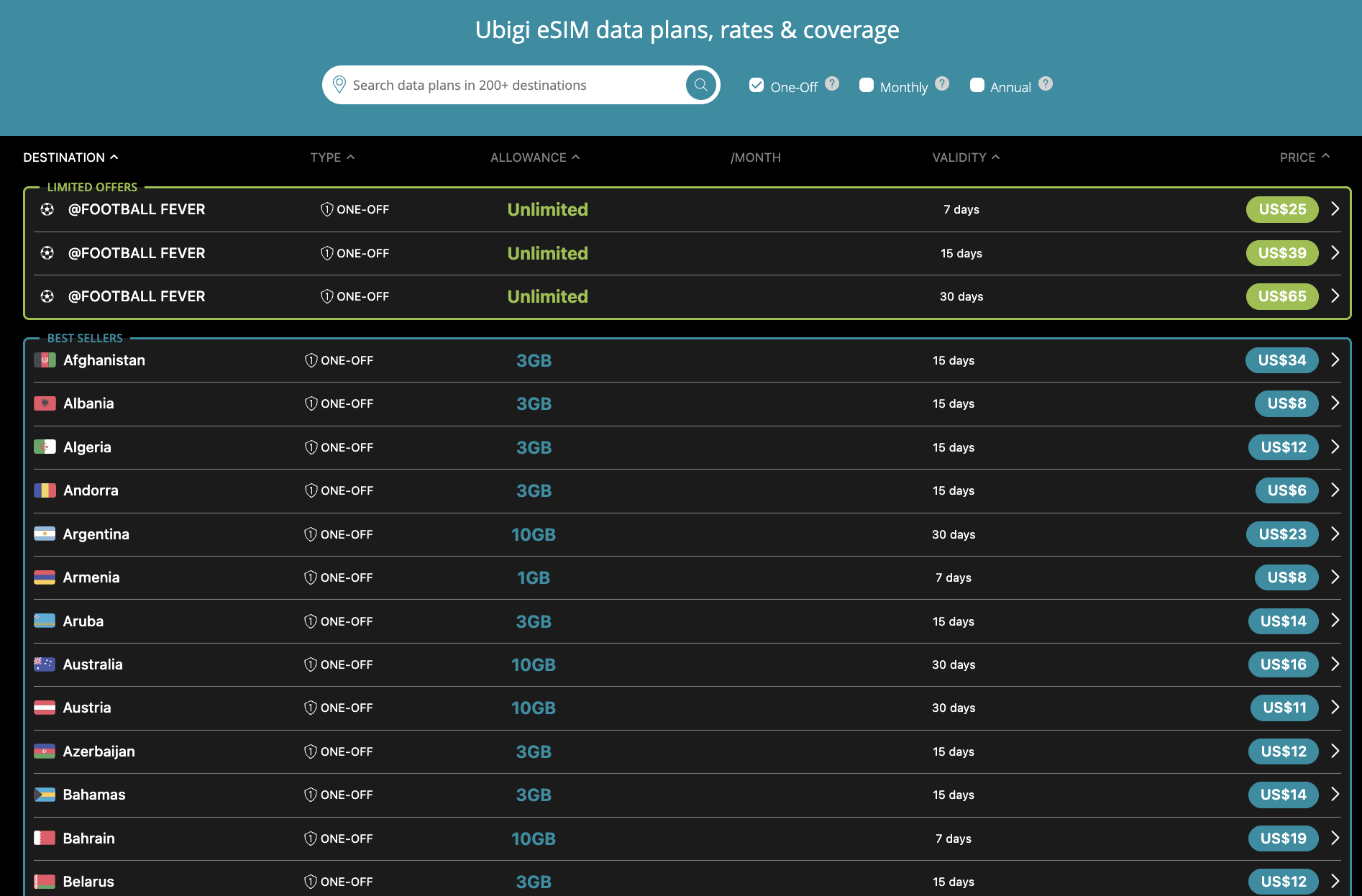
Ubigi offers three plan types, including one-off, monthly, and annual. Every region also comes in two versions: a standard plan and a "Best" version that covers a different, usually narrower, set of destinations at a different data-to-price ratio.
- One-off: Prices vary by region and by standard vs. "Best" version. Standard Asia runs $9 for 1GB over 30 days, while Best Asia's 25GB for 30 days costs $44.
- Monthly: $17/month for 5GB up to $44/month for 20GB, or $180/month unlimited. All cover the full 201-destination World plan.
- Annual: one payment covers 12 months; allowance refreshes monthly at no extra cost. $210 for 5GB/month (60GB total) or $440 for 20GB/month (240GB total).
Listed prices may change due to currency fluctuations or ongoing promotions, so it's worth double-checking the live plan page before you buy.
Swipe to scroll horizontally
Plan Type |
Starting Price |
Data Range |
Validity |
Cancellation |
One-off |
$2 |
500MB-200GB |
1-360 days |
N/A, single purchase |
Monthly |
$17/month |
5GB-20GB/month |
Renews monthly |
Cancel after 3 months |
Annual |
$210/year |
60GB-240GB total |
12 months |
Non-refundable |
Ubigi: Features
- Smart Start: Your plan doesn't start counting down the moment you buy it. The validity period only kicks in once you land at your destination, so you can buy a plan weeks in advance without wasting a single day of data.
- Select Your IP: Switch between your home country's IP and a local one, useful for banking apps or region-locked content that behaves differently depending on where it thinks you're connecting from. It launched in beta for France and US residents, and Ubigi's own site now lists availability extending to Belgium, Japan, Australia, Canada, Germany, Switzerland, Singapore, and the UK too. Worth confirming it's live in your country before counting on it.
- No separate hotspot cap: Tethered data simply counts against your plan's normal allowance; there's no extra fee or reduced limit for sharing your connection with a laptop or tablet.
- Broad device support: Ubigi works with roughly 30 phone, tablet, and laptop brands, not just the usual iPhone-and-flagship-Android list. Older devices, Windows laptops, and less common brands like Fairphone and Panasonic Toughbook are all covered, provided the specific model supports eSIM.
How Ubigi's Lifetime eSIM and Zero Rating Work
The lifetime eSIM specifically covers the profile itself. Once it's installed on your device, Ubigi says it "stays active for future use." That means no new QR code on your next trip. You just buy a new data plan, and it activates on the same profile already sitting on your phone.
To test this, I set up my Ubigi eSIM before a trip to Bangkok, used it for two weeks, and forgot about it entirely once I got home. Three months later, heading to Lisbon, I opened the app, bought a Europe plan, and was online the second I landed. The only catch is switching devices. Ubigi doesn't automatically carry over the profile, so switching to a new phone means reinstalling. You get 5 reinstalls before you need to contact support for a fresh eSIM.
Zero Rating solves a different problem. Normally, running out of data mid-trip means you need Wi-Fi just to load a payment page and buy more. Ubigi keeps the app reachable "even if your data balance is empty," so you can top up without hunting down a hotspot first.
Put those two together, and the setup only happens once. Everything after that is to buy a plan, land, and connect.
Ubigi: Installation and Activation
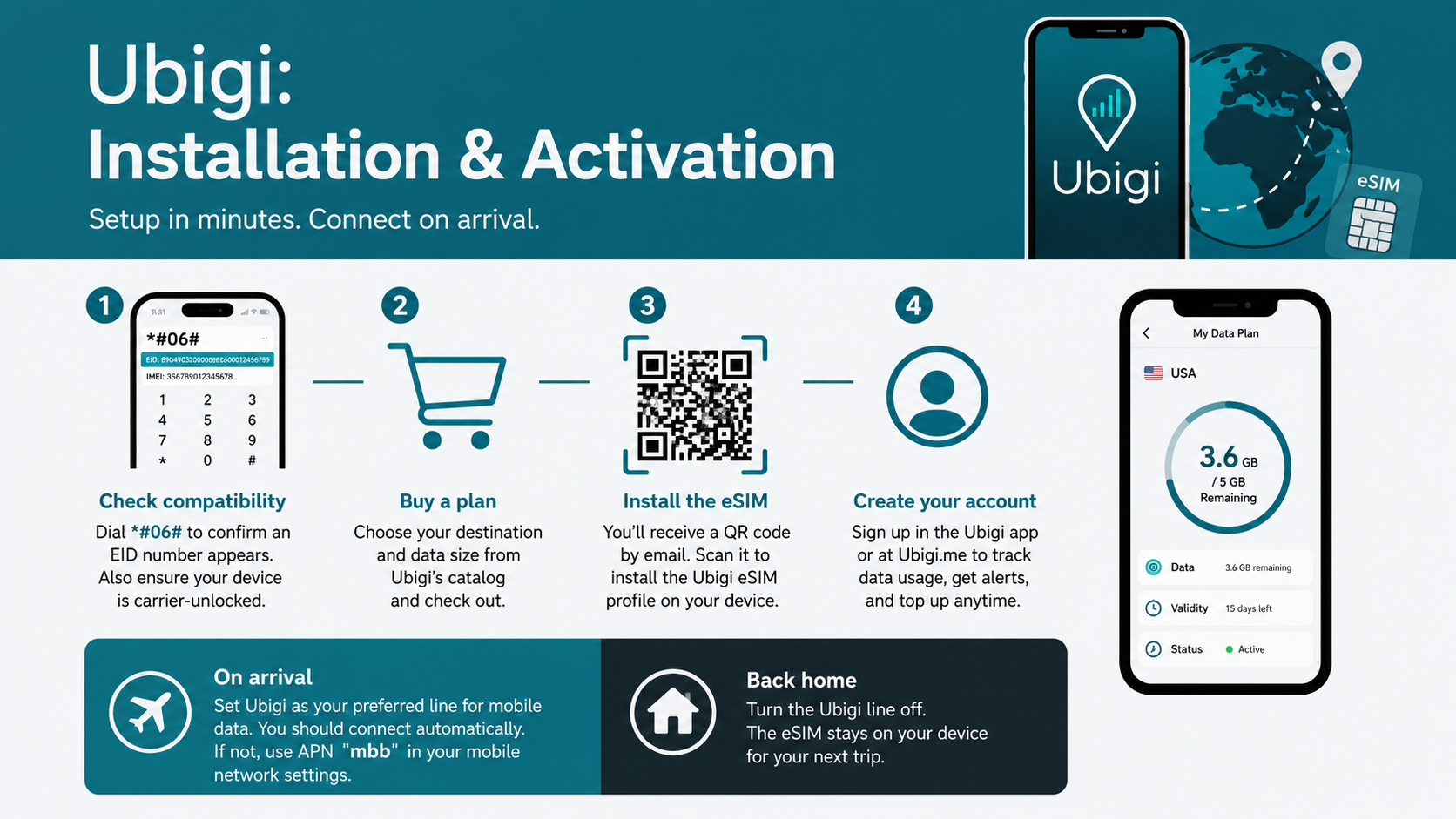
Setup takes a few minutes, and you can do it entirely before you leave home. Ubigi supports iPhone, iPad, Android, Windows 10, and 11. Installation is via QR code or the app on any of them.
Here's the process:
- Check compatibility by dialing *#06# on your phone. If an EID number shows up next to your IMEI, your device supports eSIM. Also confirm it's carrier-unlocked, since a locked phone won't accept a third-party eSIM.
- Buy a plan: Choose your destination and data size from Ubigi's catalog and check out.
- Install the eSIM: You'll get a QR code by email. Press and hold it, or scan it, to install the Ubigi eSIM profile on your device.
- Create your account: Sign up through the Ubigi app or at Ubigi.me to track data usage in real time, get alerts, and top up later.
On arrival, make sure Ubigi is set as your preferred mobile data line. You should normally connect without entering anything else, but if you don't, both Android and iOS let you manually add an APN (Access Point Name) of "mbb" in mobile network settings. When you're home, turn the Ubigi line back off.
Ubigi: Compatible Devices
Ubigi updates this list monthly. Support can vary even within the same device family, so check your exact model on Ubigi's compatibility checker or dial *#06# before buying a plan. Either way, your device needs to be eSIM-enabled and carrier-unlocked.
Here's the compatibility picture by brand:
Swipe to scroll horizontally
Brand |
Compatible Models |
Key Exclusions / Notes |
Apple iPhone |
iPhone XS and XR onward, through the iPhone 17 lineup, plus iPhone SE (2020, 2022) |
iPhones sold in mainland China don't ship with eSIM and aren't compatible. |
Apple iPad |
iPad 7th gen and later, iPad mini 5th gen and later, iPad Air 3rd gen and later, iPad Pro 11" and 12.9" |
The same mainland China exclusion applies. |
Samsung Galaxy |
Galaxy S20 series through S25, Galaxy Z Fold/Flip from the original Fold/Flip through Z Fold7/Flip 7, select Galaxy A, Tab S9/S10, and Galaxy Book models |
Coverage varies by exact model; check the list for A-series and Tab entries. |
Google Pixel |
Pixel 4 and every generation since, including Pixel Fold |
No Pixel 3 or earlier. |
Motorola |
Most Razr and Edge models, plus select Moto G 5G models |
Older or budget Moto G models are excluded. |
Xiaomi |
Xiaomi 12T Pro and newer flagship and T-series models |
Redmi Note (except Note 13/14 Pro+) and POCO lines aren't listed. |
Other Android |
OnePlus (11 and newer, including Open foldables), Oppo Find/Reno series, Honor Magic series, Vivo X-series, TCL, Sony Xperia (10/5/1 series), Sharp Aquos, Nokia (G60/X30/XR21), Fairphone 4+, Crosscall, Rakuten, Revvl, Nuu, myPhone |
Support varies significantly by model and region. |
Windows laptops |
Dell Latitude, HP Spectre/Elite/Probook/Zbook, Lenovo ThinkPad and Yoga, Acer Swift/TravelMate, Asus, Microsoft Surface (Pro, Go, Duo), Panasonic Toughbook |
Needs a cellular-capable chipset and Windows 10/11. |
Ubigi: Support
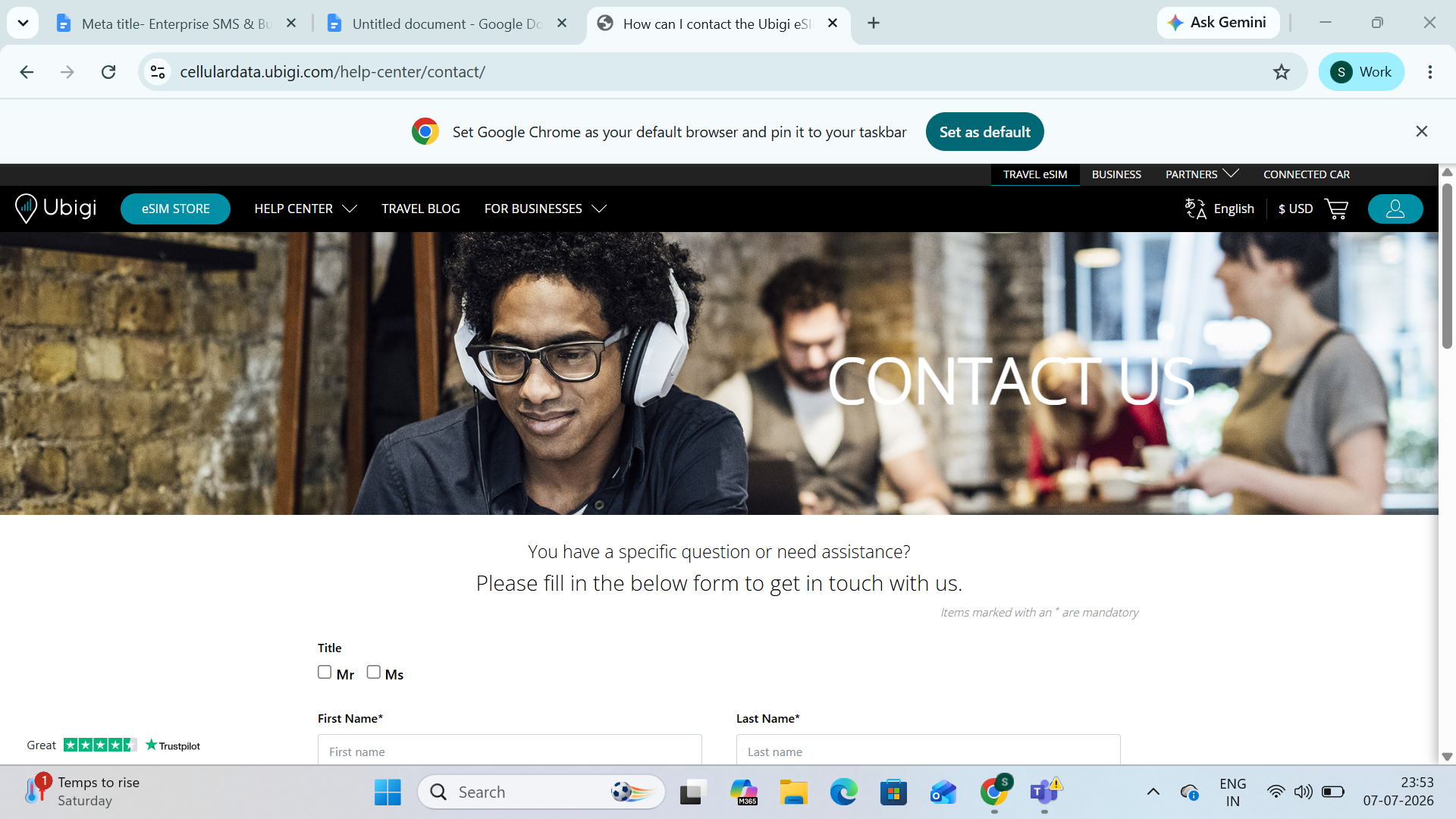
Support starts with a live chat widget on Ubigi's website, staffed by an AI assistant called "Ubi." Ubi handles the easy stuff fine. But anything more complex gets kicked into a support ticket instead of a real back-and-forth, so it acts more like an async help desk than actual live chat. There's no phone line, and you can't reach support inside the app either, only through the website.
Response times depend entirely on when you show up. Reviewers report replies in 10-15 minutes during support hours, but that can stretch to an hour outside them. Worth remembering if your eSIM refuses to activate at 2 am in a country you've never visited.
The help center is where Ubigi actually pulls its weight. Dozens of troubleshooting articles cover iOS, Android, and Windows, from APN settings to moving a profile after you restore a new phone. Between that and the compatibility checker, most setup problems already have a documented fix. You'll rarely need to talk to anyone at all.
Ubigi: Final verdict
For most travelers who fly the same routes repeatedly, Ubigi lands in a strong position. Plans are priced fairly relative to the competition, and the two features covered earlier solve real, specific problems rather than serving as marketing checkboxes.
Where Ubigi asks for a trade-off is in response speed. Support is available via chat and a help center, but it's built around eventual resolution rather than instant back-and-forth; replies can take anywhere from 10 minutes to over an hour, depending on when you reach out.
That's fine if something goes wrong with time to spare, and less fine if you're standing at an airport gate needing an answer in the next five minutes. If real-time support matters more to you than price, easySim or Airalo are worth comparing. For everyone else, Ubigi's own network and the two features above make it one of the more dependable picks in the category.
Ubigi: FAQs
What is Ubigi?
Ubigi is a Transatel brand, part of Japan's NTT Group. Beyond the travel product most people encounter, Ubigi also runs a separate business-focused version for company-issued devices, allowing IT teams to manage eSIM plans across a fleet of employee phones from a single account rather than juggling individual SIMs.
Is Ubigi cheaper than carrier roaming?
Yes, Ubigi is cheaper than carrier roaming, usually by a wide margin. Ubigi's Europe plan makes a strong case. A full 30 days of 3GB costs $7 total. Most carriers charge more than that for a single week of roaming, and that plan doesn't expire the moment your trip ends either.
Does Ubigi support hotspot and tethering?
Yes. Every plan includes tethering at no extra fee, and tethered data is pulled from your existing allowance. The one catch is on unlimited plans. Speed drops once you cross a destination-specific data threshold, so heavy tethering there hits that ceiling faster than regular browsing would.
Does Ubigi work with an iPhone?
Yes, from the iPhone XS and XR through the current 17 lineup and the iPhone Air, plus both the SE (2020) and the SE (2022). Your phone just needs to be carrier-unlocked. The one hard exclusion is iPhones sold in mainland China. Those ship with eSIM hardware disabled, so no Ubigi plan will work regardless of model or iOS version.
Does Ubigi have a mobile app?
Yes, on both iOS and Android, and most of the same functionality is mirrored on the website or at Ubigi.me. Buy a plan on your phone, check usage from a browser later, and your account stays in sync without logging in twice.





 English (US) ·