
 5 hours ago
18
‘Pffff!” Cristian Mungiu lets out an exasperated sigh. We are sitting in the basement of a London hotel, at the end of a long morning of back-to-back interviews for the Romanian film-maker, and his press handler has just snuck into the room to remind him of his next appointment across town. But Mungiu blanks him and leans on to his table, because he wants to tell one more story.
In 2013, Mungiu was part of a delegation of European auteurs who travelled to Brussels to meet the then president of the European Commission, José Manuel Barroso. At the time, the EU and US were in talks to slash barriers to trade between the two economic blocs, and the film-makers were lobbying the Commission to spare their industry from the deal.
If countries weren’t allowed to subsidise their own productions, one argument went, European cinema would become a stolid mush of homogenised co-productions – “Europudding”, as people called it at the time. To those ends, they would no longer be able to create national dramas like Mungiu’s own 4 Months, 3 Weeks and 2 Days, a riveting abortion thriller set in cold war-era Bucharest that had won the Palme d’Or at Cannes in 2007.
Barroso, an economic liberal, was not impressed, and the meeting became heated. “He was very angered that in spite of all his attempts to create a united Europe, people in, say, Estonia were still reluctant to watch a film from Portugal,” says Mungiu, his own frustration with that attitude bubbling to the surface once more. “One Europe? It’s the right direction, sure. But it has still only been tens of years since all these people were fighting each other and everything was based on national states and national cultures. Historically speaking, that wasn’t a long time ago. Let’s go in that new direction, fine – but you can’t pretend we’ve already got there.”
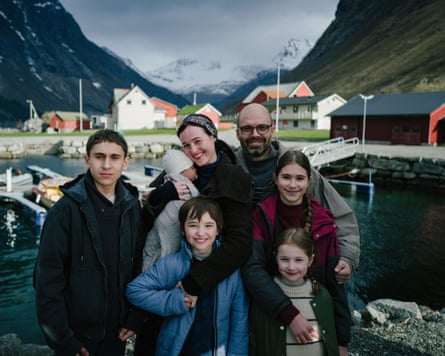
I suspect Mungiu is keen to tell this story for two reasons. His latest film, Fjord, is about people from different European cultures coming together – but also about how different national identities continue to keep them apart. Mihai and Lisbet Gheorghiu, a Romanian-Norwegian couple with five young children, move from Bucharest to her native country in the icy north. The Gheorghius are devout evangelical Christians, yet the liberally minded locals welcome the newcomers with open arms in spite of their anti-modern way of life. Mihai, an engineer, and nurse Lisbet both find employment, the children settle at school; they make friends with their neighbours, headteacher Mats, lawyer Mia and their teen-rebel daughter, Noora.
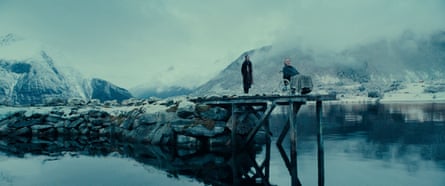
But when a PE teacher notices bruises on the body of the Gheorghius’ eldest daughter, Elia, tolerance turns to distrust. Child protection services become involved, and Mihai does his family no favours when he denies that he has abused his children, but insists that a slap on the bottom can sometimes be necessary, to teach that “you can’t escape punishment when you’re wrong”. Soon, the state separates the parents from their children, including their newborn baby, and the Gheorghius’ family values become a diplomatic incident.
Since his 2007 Cannes triumph, Mungiu has made several films that deal with the social consequences of globalisation and migration – a particularly prescient subject for a Romanian, given that 25% of his compatriots live abroad. Beyond the Hills (2012) and Graduation (2016) revolved around characters who have returned from working abroad or are desperate to leave Romania to do so; 2022’s RMN dealt with protests over Sri Lankan migrant workers in a rural village in Transylvania.
But Fjord – and this is the other reason Mungiu’s encounter with Barroso is relevant – is not just a film about globalisation, but also one shaped by a globalised economy. It is an international co-production of the kind that Mungiu’s delegation had warned the European Commission about, shot in Norway and edited in Romania, its sound designed in Finland and mixed in Denmark. It’s also his first English-language film, and the first to star two Oscar-nominated A-listers, Sebastian Stan and Renate Reinsve. Mungiu almost sounds embarrassed about it: “It has a lot to do with the financing system,” he says. “I’m not a big fan of this system, to be honest,” he adds, sheepishly.
Yet Fjord is no Europudding, but something altogether classier and more refined – more of a Euro-flan, with a bitter layer permeating the sweetness. It still has all the stylistic hallmarks that have made Mungiu the standout film-maker of the Romanian new wave: a pacing that makes viewers feel they are living the Gheorghius’ ordeal in something like real time, but also a renunciation of manipulative edits or closeups that could coerce us into fully taking their point of view.
Fjord is cinema as Rorschach test. How the bruise on Elia’s back came about is never fully explained. Whether you are more outraged by the Norwegian state’s dogmatic liberalism or by the Romanians’ disciplinarian ways is designed to tell you more about yourself than the characters on screen. “We watch too many stories that are there just to confirm to you that you are on the right side of things,” Mungiu says. “In the last 10, 20 years we started making a lot of films in which everything is clear and the author takes you by the hand and tells you what you need to believe: they are the good guys, they are the bad guys.”
Fjord won the Palme d’Or at Cannes this year, putting Mungiu in the distinguished league of directors who have won the most prestigious prize in arthouse cinema twice, which includes such luminaries as Michael Haneke, Francis Ford Coppola and Ken Loach. Ironically, some of the film’s most positive reviews since were from Norway, he says, where “nobody considered the film a criticism of Norwegian society, not even [Norway’s child welfare authority] Barnevernet”.
But not everyone at Cannes thought Fjord was a deserving winner. The two films that scored highest with the critics, interestingly, were also Euro-flans: Polish director Paweł Pawlikowski’s German-language Fatherland and Russian film-maker Andrey Zvyagintsev’s Minotaur, a coproduction between France, Latvia and Germany. In Mungiu’s native Romania, some critics felt the film was unduly forgiving of corporal punishment. In France, one critic complained about Fjord’s “proto-Nazi” portrayal of the child-protection officers. “Beneath its veneer of a fair film, beneath its stated desire to depict two opposing value systems, Cristian Mungiu constantly chooses sides,” wrote David Fonseca in Le Rayon Vert. The trial the film puts on, it declared, was “a sham”.
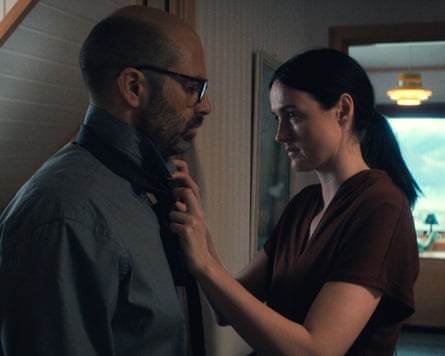
Such withering invective seems over the top, and at the very least ignores the film’s subplot – a nascent homoerotic relationship between the Gheorghiu’s eldest daughter and her neighbour-classmate that shows up Mihai’s autocratic rule within his family. But it’s probably fair to say that Fjord is a conservative film with a small “c”: not in the brash and hectoring way that modern conservative parties are, but doubtful and self-questioning, yet conservative nonetheless in its instinctive distrust of the state.
“I come from this very authoritarian society and I’ve seen that it’s not good to give people too much power because there are natural tendencies to abuse it,” Mungiu says. “I want to make sure that we don’t get back to this situation in which somebody knows better than us what’s good for us – I’ve been there.” He chuckles sardonically. “I have so many fans in France who are communists. Well, I’m so sorry that they didn’t come to spend the 70s with us in Romania. Not to mention the 50s!”
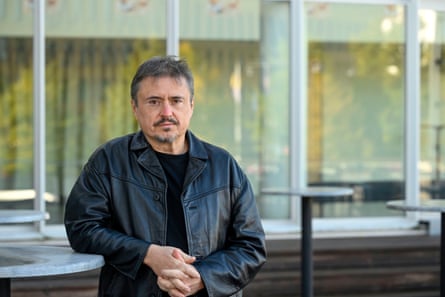
Mungiu does not want to be labelled a conservative. “The fact that I’m presenting these arguments without commenting doesn’t mean for a second that I’m in any way a supporter of conservative values and of all the intolerance that they carry.” His criticism of liberal societies such as Norway, he insists, is above all due to the fact that he has higher expectations of them. “They are more educated, so they should be the ones initiating a dialogue with the other side. The conversation starts when you have this patience to listen.”
In one scene in the film, one of the Gheorghius’ daughters is told that her sexuality is an entry ticket to hell. I ask Mungiu how much patience that young girl should have, listening to these bigots. “I’m aware that it’s more complicated in reality,” he concedes. “But you should ask yourself, why are we in this situation? After years and years of trying to make the world a more liberal place, we ended up by having a more illiberal kind of world. Haven’t we maybe exaggerated in some areas with the way we were trying to force things? It’s like trying to ripen a banana with a hairdryer. It doesn’t work like that. People need time.”
Later, I check the box office figures for Fjord and realise that the film beat Christopher Nolan’s The Odyssey to reach No 1 in Norway on its opening day, which would surely have pleased José Manuel Barroso. In 2026, the idea that Estonians may flock to cinemas to watch a film from Portugal no longer seems quite so absurd. Meanwhile, in Hungary and Serbia, Romania’s neighbouring countries, young voters have toppled Christian nationalist strongmen. People need more time, until they don’t.





 English (US) ·