
 2 hours ago
6
2 hours ago
6
“These are things that tend to be really hard.”
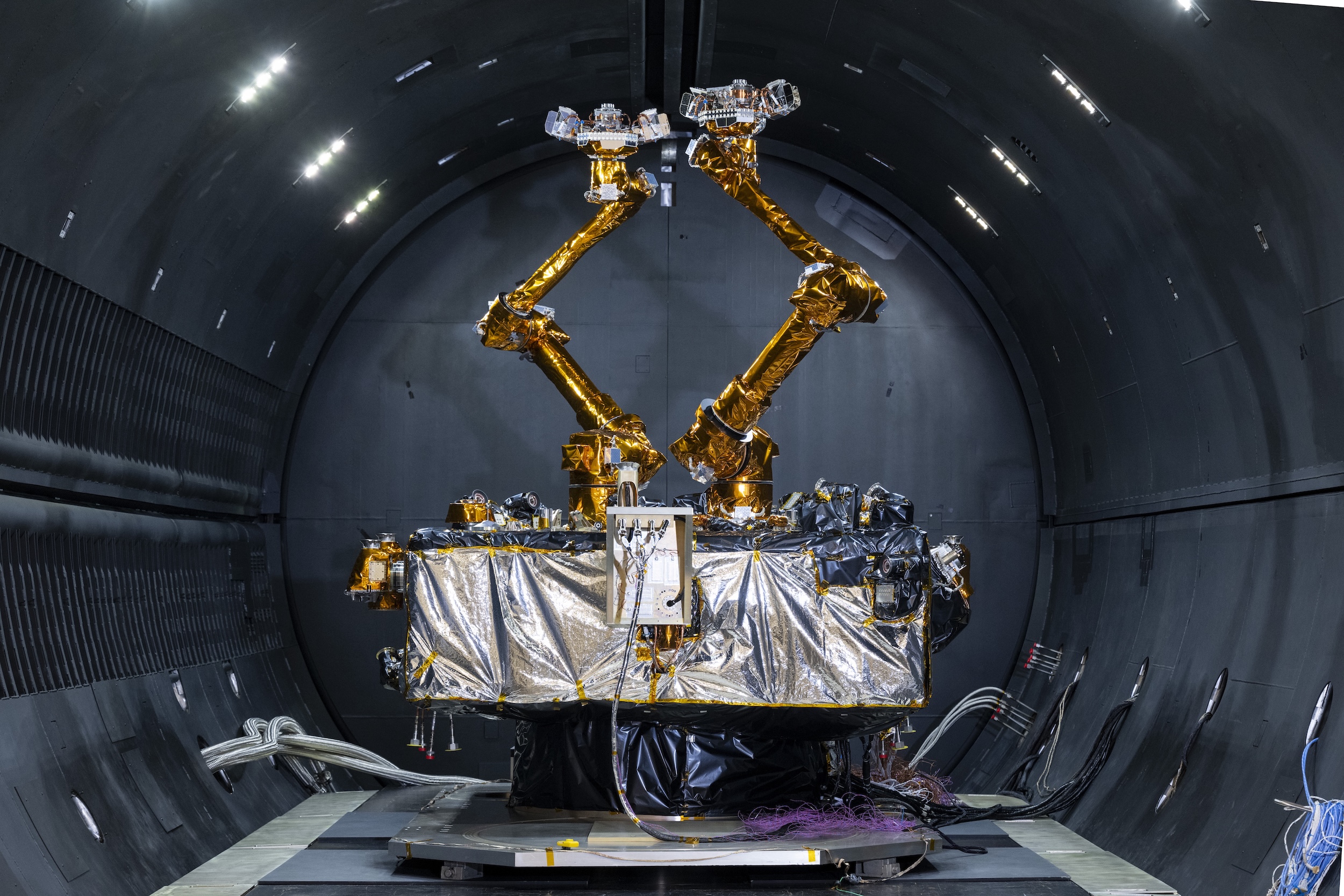
The Robotic Servicing of Geosynchronous Satellites (RSGS) payload resides in the cryogenic thermal vacuum chamber at the US Naval Research Laboratory’s Naval Center for Space Technology in Washington, DC, on October 8, 2024. Credit: US Navy/Sarah Peterson
The Robotic Servicing of Geosynchronous Satellites (RSGS) payload resides in the cryogenic thermal vacuum chamber at the US Naval Research Laboratory’s Naval Center for Space Technology in Washington, DC, on October 8, 2024. Credit: US Navy/Sarah Peterson
A spacecraft fitted with two flexible robotic arms is on the way to geosynchronous orbit after launching earlier this week on a SpaceX Falcon 9 rocket, kicking off a planned decade-long mission to open new frontiers in satellite servicing.
The Mission Robotic Vehicle, owned and built by Northrop Grumman, rocketed into orbit from Cape Canaveral Space Force Station in Florida on Tuesday. Three small propulsion pods, each functioning as standalone spacecraft, accompanied the MRV aboard the Falcon 9 rocket.
The Falcon 9 deployed all four payloads within about an hour of liftoff. It will take about a year for the satellites to maneuver from their initial elliptical drop-off orbit into a circular orbit more than 22,000 miles (nearly 36,000 kilometers) over the equator. At this altitude, the MRV and the three Mission Extension Pods (MEPs) will travel in lockstep with Earth’s rotation, operating in the same kind of orbit as numerous civilian and military communications satellites, missile warning platforms, and a growing number of spy satellites.
That’s when the real fun will begin.
Path to the pad
The Mission Robotic Vehicle is arguably the most advanced servicing satellite ever launched. It’s certainly the most sophisticated orbiting servicer we know anything about. China launched a satellite with a robotic arm into geosynchronous orbit in 2016. Another launch in 2021 deployed the Shijian-21 or SJ-21, spacecraft on a “space debris mitigation” mission. SJ-21 linked up with a defunct Chinese navigation satellite and moved it to a higher altitude for disposal before returning to the geosynchronous belt.
China launched the SJ-25 refueling mission in January 2025, and it docked with SJ-21 a few months later before the satellites went their separate ways, completing what was apparently the first refueling demonstration so far from Earth. The extra gas is expected to give SJ-21 a longer life, giving it the potential to visit and reposition other satellites in geosynchronous orbit.
Northrop Grumman and its subsidiary, SpaceLogistics, have the same idea with the Mission Robotic Vehicle. There are clear military applications for this capability. Last year, the head of US Space Command, Gen. Stephen Whiting, told Congress that China was developing “on-orbit, maneuverable counterspace satellites to target our satellites using dual-use technologies.” He explicitly called out SJ-21 as an example of a mission that China could use “for potential offensive purposes against satellites we rely on to defend the homeland and project power.”
The US Space Force already has a fleet of inspector satellites roaming geosynchronous orbit to observe and report on the activities of foreign spacecraft. US military operators maneuvered one of these inspector satellites near the SJ-21 and SJ-25 satellites during the refueling operation last year.
But military officials hadn’t publicly acknowledged any US-owned satellite with capabilities similar to China’s trio of Shijian satellites. That changes with Northrop Grumman’s MRV mission. The Pentagon’s Defense Advanced Research Projects Agency, or DARPA, spent approximately $420 million to develop the satellite’s robotics payload, alongside hundreds of millions of dollars invested by Northrop Grumman.
The public-private partnership brought Northrop Grumman’s preexisting commercial satellite servicing program together with DARPA’s Robotic Servicing of Geosynchronous Satellites (RSGS) program. These programs originally operated independently.
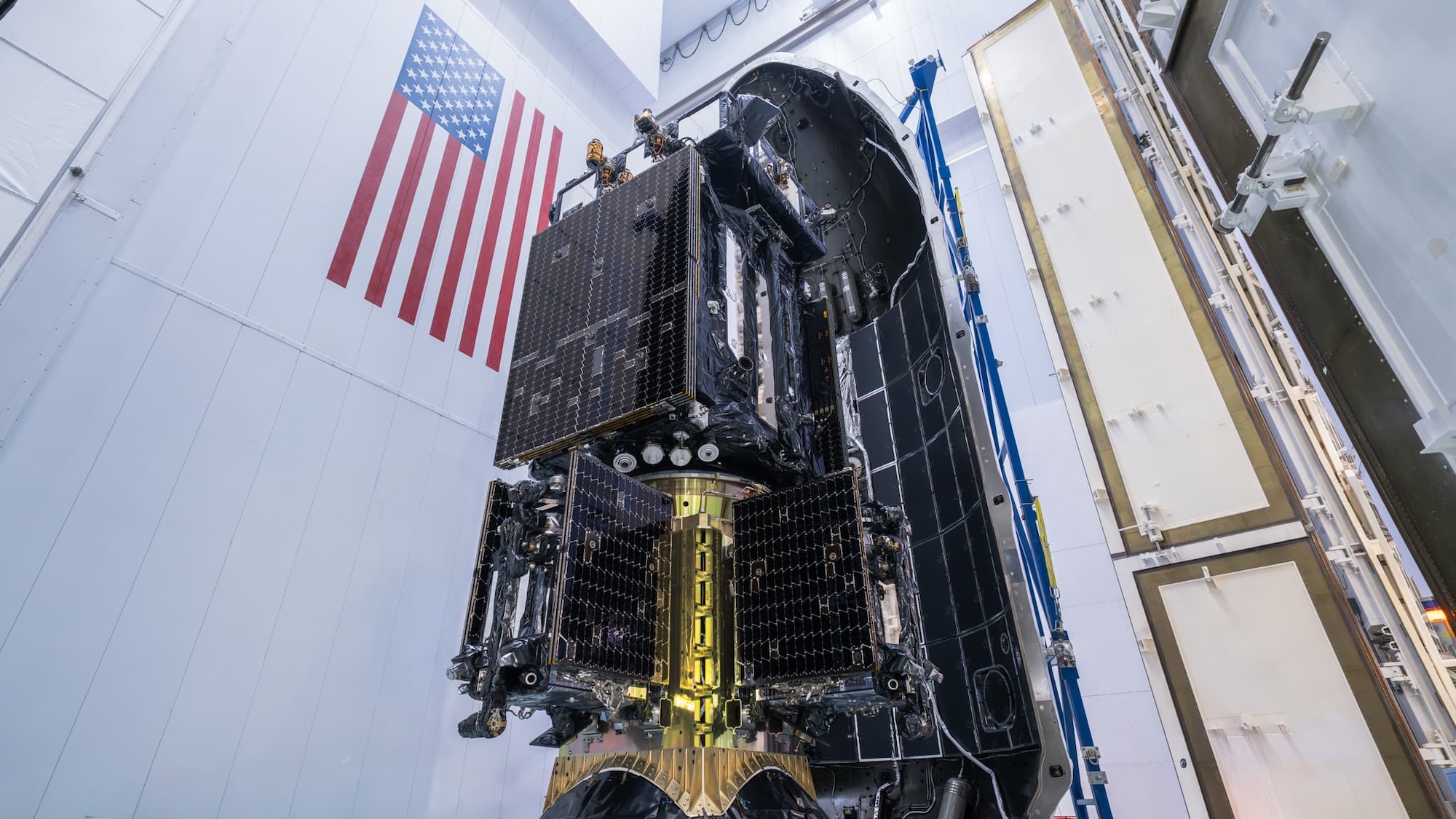
Northrop Grumman’s Mission Robotic Vehicle, with the RSGS payload on top, sits in the upper position on the payload stack awaiting launch on SpaceX’s Falcon 9 rocket. Three Mission Extension Pods are arranged around the cylinder at the bottom of the image.
Credit: SpaceX
Northrop Grumman’s Mission Robotic Vehicle, with the RSGS payload on top, sits in the upper position on the payload stack awaiting launch on SpaceX’s Falcon 9 rocket. Three Mission Extension Pods are arranged around the cylinder at the bottom of the image. Credit: SpaceX
Northrop Grumman developed two satellites called Mission Extension Vehicles and launched them in 2019 and 2020. The MEVs docked with aging commercial communications satellites in geosynchronous orbit to take over pointing and orbit control. The MRV builds on the MEV concept, but thanks to the DARPA-funded robotic arms, the new servicer doesn’t have to commit itself to a single client. It can use the arms to install Northrop’s Mission Extension Pods on multiple geosynchronous satellites.=
This isn’t refueling, but the MRV serves the same end. The Space Force has a separate contract with a company named Astroscale to demonstrate refueling in geosynchronous orbit next year, something no US company has done before. The MRV can also do more than life extension. It can inspect, service, upgrade, or repair satellites that were never designed for it.
DARPA partnered with the Naval Research Laboratory to develop the RSGS robotics payload. More than 20 years in the making, the robotics system was designed to meet Defense Department reliability standards, including redundant robotic arms, avionics, and mission troops. The RSGS payload also features cameras and sensors to allow the MRV to autonomously approach, inspect, capture, and upgrade client satellites that weren’t designed for visitors.
“This journey to the launch pad represents the culmination of a multiple decades-long endeavor of vision, risk, and relentless engineering,” said Bernard Kelm, acting director of NRL’s Naval Center for Space Technology, in a statement. DARPA first funded NRL’s space robotics work in 2002, a small study for a concept called RescueSat. RSGS can trace its lineage back to that initiative.
“RSGS is designed to permanently change this ‘launch-and-abandon’ archetype,” Kelm said. “The RSGS program shifts this paradigm by enabling on-orbit interventions, including inspections, mechanical anomaly resolution, satellite relocation and upgrades.”
This isn’t DARPA’s first foray into satellite servicing. The agency’s Orbital Express mission, launched in 2007, completed several months of rendezvous and docking maneuvers, robotic arm tests, and other servicing demonstrations in low-Earth orbit. DARPA formally established the RSGS program in 2015, building on the robotics work already underway at the Naval Research Laboratory. DARPA initially selected Maxar—now Lanteris Space Systems—to partner on the RSGS program, but the company backed out, and DARPA replaced Maxar with Northrop Grumman in 2020.
NASA’s Goddard Space Flight Center also contributed its engineering expertise to the RSGS program after NASA canceled its own robotic satellite servicing mission in 2024. NASA’s support included the development of dynamic simulation and analysis tools, software verification, and a team of flight robot operators to assist ground controllers during mission operations.
“RSGS is designed to work on satellites that haven’t been prepared, and as a result, it has more complex robotics,” said Jim Shoemaker, RSGS program manager at DARPA. “This was designed as an operational system. Orbital Express had one arm. RSGS has two arms, which is good. It gives you more capability. Plus, it gives you some redundancy if you have an issue with one of the arms during the mission. The other difference here is DARPA is working to transition the capability to industry, so this is a private-public partnership.”
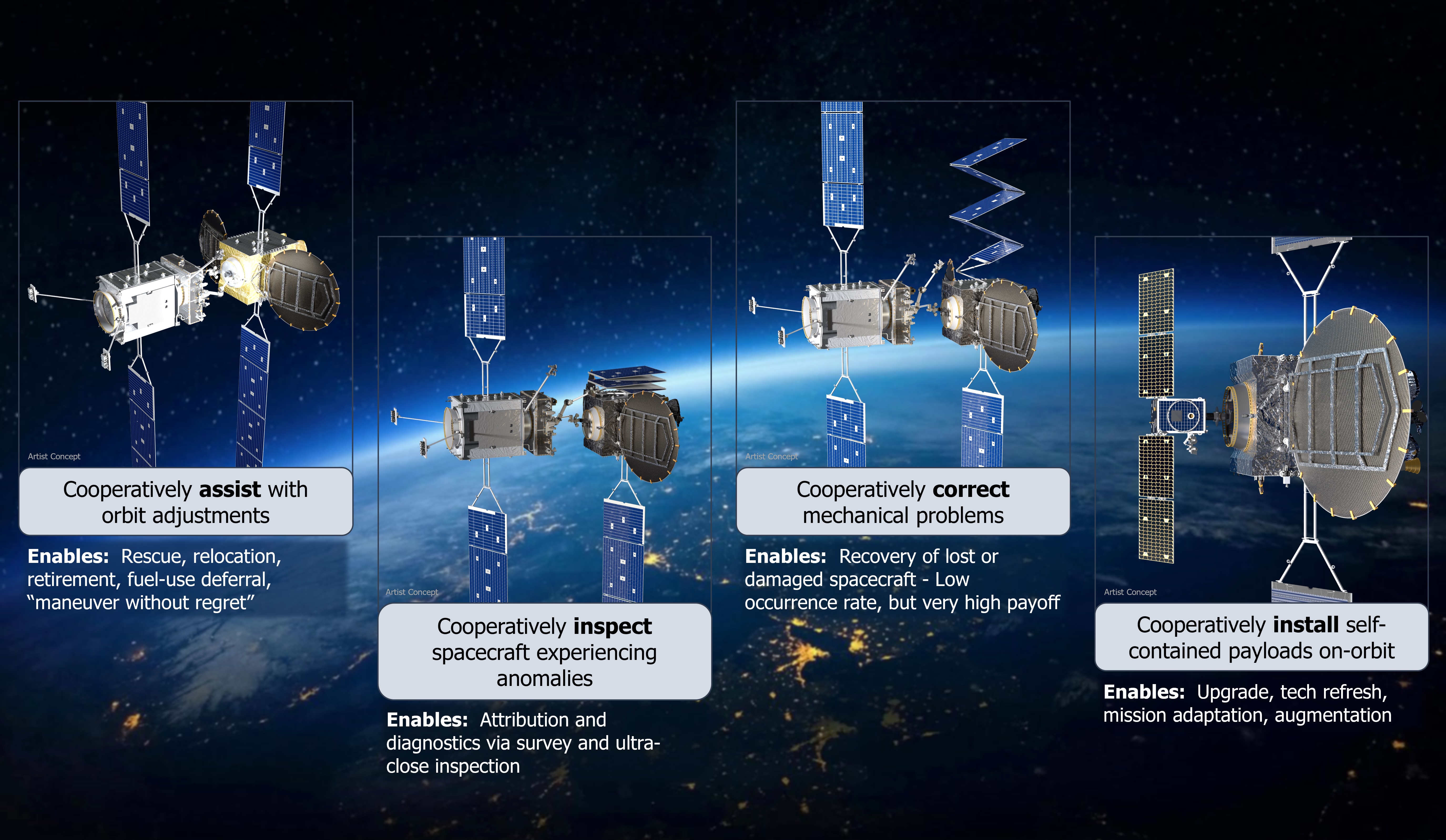
This chart illustrates the capabilities of the Mission Robotic Vehicle.
Credit: Northrop Grumman
This chart illustrates the capabilities of the Mission Robotic Vehicle. Credit: Northrop Grumman
Reaching out
Northrop Grumman’s first three Mission Extension Pods launched on the same rocket as the MRV, but they are flying separately up to geosynchronous orbit using electric propulsion. The pods, each about the size of a dishwasher unit, will loiter there for retrieval by the MRV’s robotic arms. After picking up the first pod, the servicing spacecraft will rendezvous with its first client satellite, lining up precisely with the client to install the pod into its engine compartment. The MEP will latch onto the satellite and take over propulsion for up to eight years, acting as a jetpack, or a smaller version of the MEV, to move the client around geosynchronous orbit as needed.
“You can’t fly this with a joystick from the ground because the time delay is too long,” Shoemaker said in an interview with Ars. “You have to be able to either upload a mission script or let the satellite execute it on its own.”
Engineers extensively tested the robotic arms on the ground, in the full measure of Earth’s gravity. Things will work differently in microgravity.
“Inertia operates differently in space,” Shoemaker said. “When you move the arm one direction, the entire satellite wants to rotate the opposite direction, so every motion of the arms has to be compensated by the control system to keep the satellite in the same position, which is fairly complicated.”
“And then, when you attach yourself to another satellite, you change the dynamics completely because you’ve doubled the mass and the dimensions, and so your control system has to be able to adapt to that new configuration,” he continued. “These are things that tend to be really hard.”
The robotic arms can do more than manipulate Northrop’s propulsion modules. The hands of the arms can accommodate different types of tools. The mission launched this week with two pod capture tools used for grappling the MEPs or any other object with a grapple fixture. The MRV also has two copies of a “Marman ring” tool that will allow the main servicing spacecraft to directly grab onto a client satellite if required.
Northrop Grumman and SpaceLogistics have not identified which satellite will be the first stop for the MRV. The companies have commercial agreements with two communications satellite operators, SES and Optus, to add jetpacks to their spacecraft using the MRV. The Space Force is also expected to use the MRV to visit at least one of its satellites.
Northrop Grumman took ownership of the government-funded robotics payload at launch, but the company still owes DARPA information about the performance of the mission through the first servicing call.
“After they finish that demonstration, DARPA, the government, is sort of out of the driver’s seat because that’s when we really hand things over,” Shoemaker said.
The Space Force will then take over DARPA’s role as the government partner. Northrop Grumman will retain ownership of the satellite and the payload and will remain responsible for day-to-day operations.
“They’ll operate it for 10 to 13 years, which is the mean mission lifetime,” Shoemaker said. “So the US government benefits from getting the servicing capability on orbit without having to pay the long-term care and feeding. As needed, the US government can contract with Northrop Grumman to get services.”
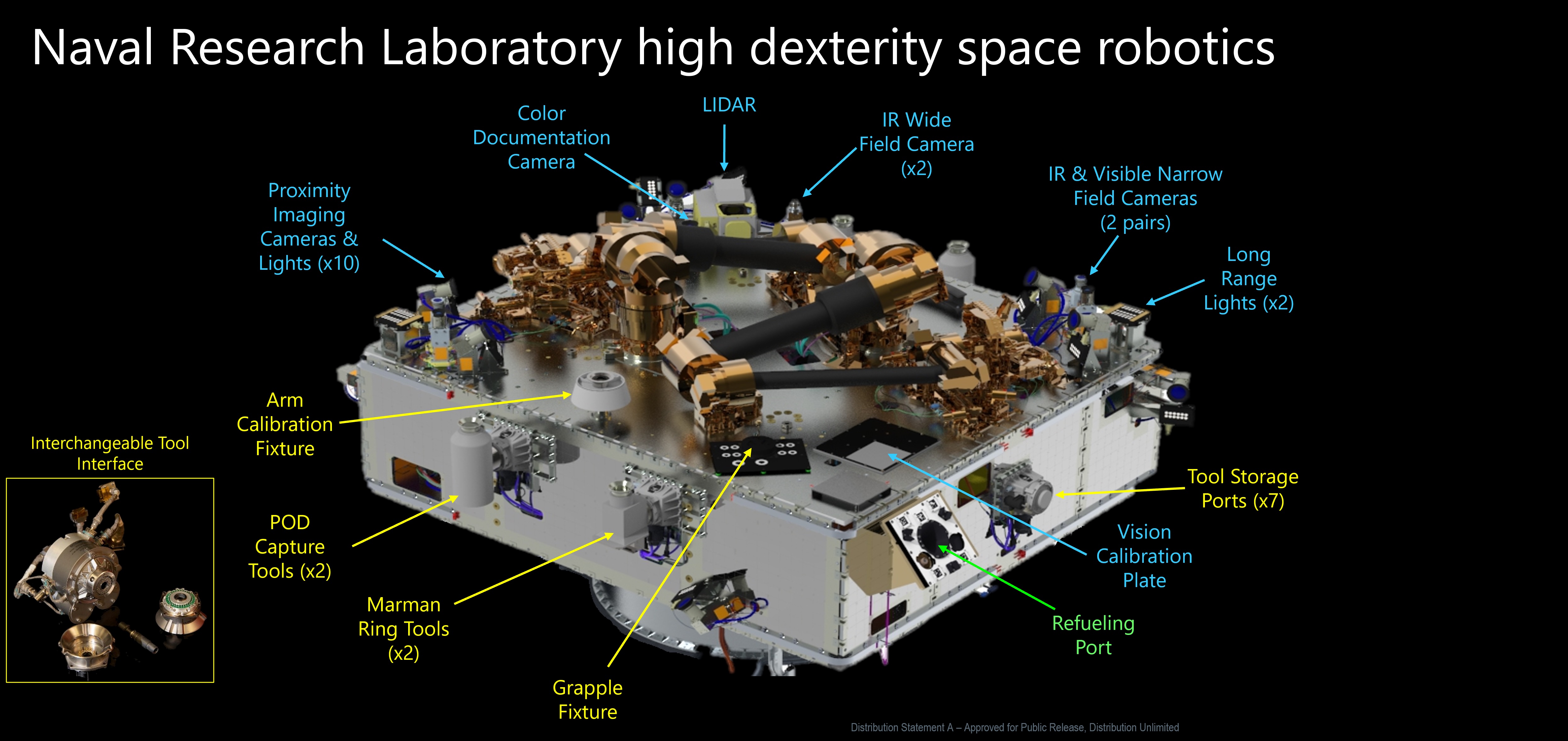
The components of the RSGS payload developed by the Naval Research Laboratory, with support from DARPA.
Credit: Naval Research Laboratory / DARPA
The components of the RSGS payload developed by the Naval Research Laboratory, with support from DARPA. Credit: Naval Research Laboratory / DARPA
Mission managers emphasized the MRV’s adaptability in interviews with Ars. This is what sets it apart from other satellite servicing missions, Shoemaker said.
“RSGS has full seven-degree-of-freedom robotic arms, heavily instrumented. The ends of the arms can attach multiple tools as hands, and they also have a good deal of autonomous control,” Shoemaker said. “It’s general purpose, high dexterity robotics.”
Ground teams could build and launch more jetpacks to meet up with the MRV in geosynchronous orbit after the spacecraft uses the three pods already in space. Future launches could carry new tools, such as a knife, a cutter, or a robotic screwdriver for more invasive servicing or repairs. And the MRV itself is designed to be refueled in orbit. Northrop Grumman doesn’t plan to immediately build a second MRV, but it will continue upgrading and augmenting the vehicle it just launched.
Another idea is to use the MRV to enable a new era in orbital logistics, not just servicing and life extension. The spacecraft could theoretically be part of a logistics train in geosynchronous orbit. A depot spacecraft, such as Northrop’s own ROOSTER satellite platform or Blue Origin’s Blue Ring, could launch with a cache of prepositioned spare parts, payloads, and sensors. The MRV could come pick up these payloads and take them to the satellites that need them.
Why geosynchronous?
The most lucrative national security market for satellite servicing is, at first, likely to be in geosynchronous orbit, home to some of the military’s most expensive multibillion-dollar satellites. The spacecraft there are one-of-a-kind or operate in small fleets. Despite the distance from Earth, this makes geosynchronous satellites vulnerable to attack. Satellites in low-Earth orbit, just a few hundred miles above the planet, are often (but not always) part of large proliferated constellations such as SpaceX’s Starlink. With a few exceptions, military and commercial satellites in LEO are less expensive and easier to replace than satellites in GEO.
But there’s a future for refueling and servicing in LEO. NASA signed a contract last year with Katalyst Space Technologies, a satellite manufacturing startup, to reboost one of its astronomy satellites in LEO. Katalyst launched the mission last month, and the spacecraft is now in pursuit of its client.
SpaceX is planning the most ambitious refueling demonstration in history with its Starship rocket. SpaceX aims to transfer cryogenic propellants between Starships in LEO, perhaps late this year or next year, in a precursor experiment for future large-scale refueling sorties to support Moon landings for NASA’s Artemis program.
These companies and more are taking distinct paths toward satellite servicing, orbital refueling, in-space depots, and what the military likes to call dynamic space operations. But the trend is unmistakable: to fully utilize the domain of space, the throwaway mentality must go.

Stephen Clark is a space reporter at Ars Technica, covering private space companies and the world’s space agencies. Stephen writes about the nexus of technology, science, policy, and business on and off the planet.








 English (US) ·