
Mosfilm
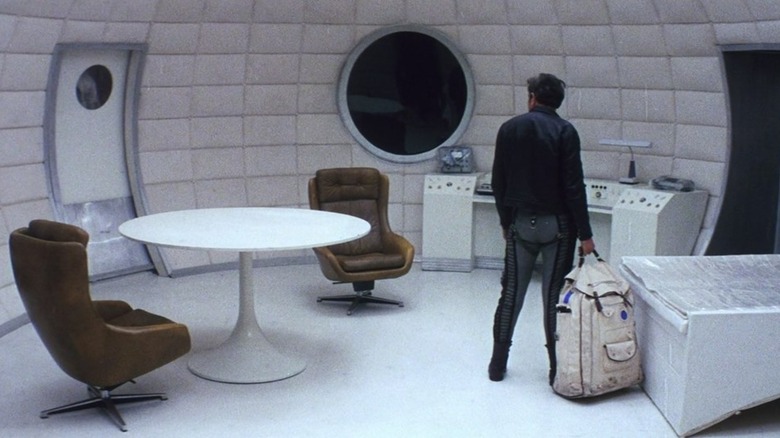
Andrei Tarkovsky's 1972 sci-fi head trip "Solaris" is not a film for the impatient. Tarkovsky was one of the masters of slow cinema, with his films usually featuring very few edits and his cameras often held at a distance from the action. Tarkovsky's highly influential sci-fi movie "Stalker," which runs a hefty 161 minutes, only has 142 shots. That's an average of almost one minute and eight seconds for every shot. "Solaris" sports a scene, shot out through the windshield of a car, which goes on for a full four minutes and 42 seconds. There are some incidents in the traffic scene, though. The film's protagonist, Kris Kelvin (Donatas Banionis), seems locked in a state of dread.
There are also prolonged sequences in "Solaris" of people walking and moving very slowly through eerie spaces, not saying anything and not discovering anything. Tarkovsky seems to want audiences to slow their breathing and enter a meditative state. Films needn't be about happenstance. Sometimes, holding a sense of unease to the point of somnambulism can force viewers into a fugue state.
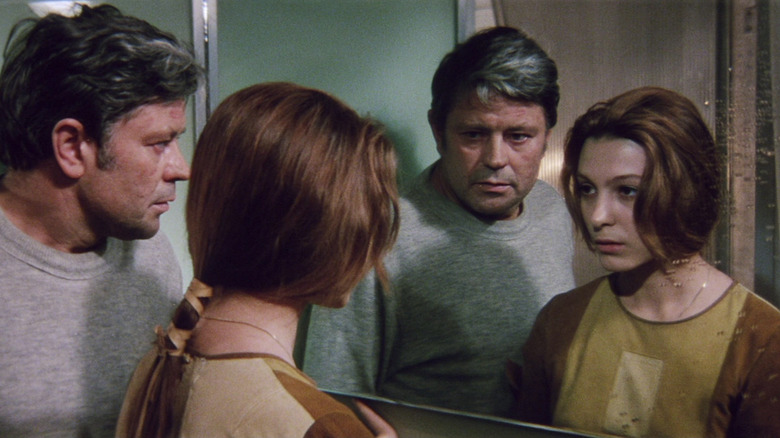
"Solaris," based on the 1961 sci-fi novel by Stanisław Lem, is about the eponymous world, a distant planet that plays host to some form of ocean-sized alien life. In time, Kris travels to a space station surrounding Solaris and finds that all attempts to communicate with said life form have produced no real results. What's more, the planet seems to be magically manifesting human beings on the station, culled from its crew's repressed memories. Thus, Kris meets a duplicate of his wife Hari (Natalya Bondarchuk), who died a decade earlier.
As documented by the British Film Institute, "Solaris" was a giant hit in its native Russia. Indeed, it wound up playing in limited-run theaters consistently for 15 years.
Despite its popularity in Russia, Stanisław Lem disliked Andrei Tarkovsky's Solaris
Mosfilm
"Solaris" the book and the film are similar in structure, yet they explore very different themes. The novel is about how the nature of alien life would be so beyond human comprehension, so, well, alien, that humans would never be able to communicate with it. This is in line with other sci-fi stories of its day like Arthur C. Clarke's novel "2001: A Space Odyssey," which posits that space is much, much larger and way less understandable than our human brains can even ponder.
Andrei Tarkovsky's movie, on the other hand, focuses more on its human characters, narrowing in on how Kris is wrestling with unresolved guilt over his wife's death. It's the alien presence and his wife's recreation that force him to confront these feelings. In a larger sense, the film posits that we humans might scrape up against cosmic forces that can access our innermost thoughts. Notably, Tarkovsky was a deeply religious man who often worked themes of the divine into his movies.
Contrary to its popularity in Russia, though, Stanisław Lem disliked Tarkovsky's film adaptation of his book, saying that he took his novel and turned it into "'Crime & Punishment' in space" (per the BFI). Not a bad idea, I'd say, but that's not what Lem intended. The BFI, however, also observed that one of Lem's speeches made its way into Tarkovsky's movie and illustrates both the book and film's points. The gist is that humans don't really want to be a part of the cosmos; we just want to extend Earth's influence. That is, we're mainly looking for mirrors of humanity, not honest to goodness "aliens." And that's fair. Real aliens certainly won't be like the ones in "Star Trek."
Solaris has become a film school staple
Mosfilm
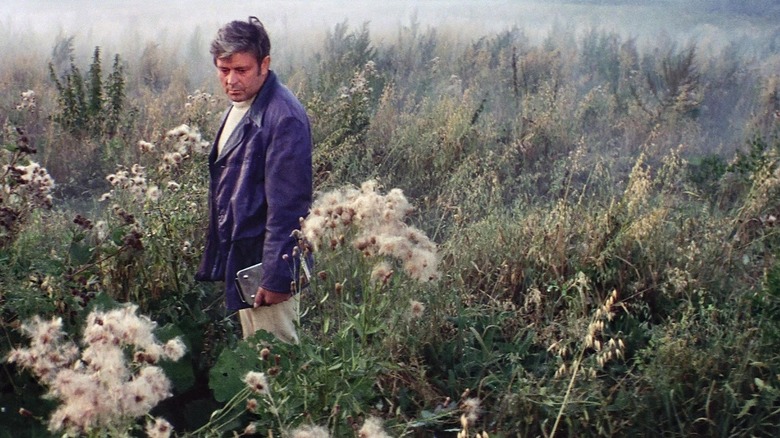
By the time "Solaris" finished its theatrical run in its homeland, it was 1987, at which point Hollywood had churned out no less than four "Star Trek" flicks, three "Star Wars" films, and two "Alien" movies. Meanwhile, in Soviet Russia, "Solaris" was the bedrock of the sci-fi genre and was championed as an antidote to the more crowd-pleasing sci-fi cinema on the other side of the Iron Curtain. Per the BFI, Soviet leaders declared "Solaris" to be the superior and less cold-hearted version of Stanley Kubrick's 1968 film adaptation of "2001: A Space Odyssey."
"Solaris" eventually became something of a staple in film schools in the U.S. At the very least, it's an absolute must-watch for students of Russian and Soviet cinema. Roger Ebert saw the movie in 1972, and while he admitted that he initially balked at its slow pace, he later added it to his Great Movies series. Ebert was ultimately tantalized by the ideas in "Solaris," asking heady questions like:
"When we love someone, who do we love? That person, or our idea of that person? Some years before virtual reality became a byword, [Andrei] Tarkovsky was exploring its implications. Although other persons no doubt exist in independent physical space, our entire relationship with them exists in our minds."
In 2002, Steven Soderbergh remade "Solaris," casting George Clooney as Kelvin and Natasha McElhone as his deceased wife. It's a slicker, more accessible version of Tarkovsky's movie, although it's still slow-moving and cerebral. It's okay, but it's not as good as Tarkovsky's version, and it definitely didn't play in theaters for 15 years. Rather, it tanked, despite counting James Cameron among its producers. As such, one would do better to seek out Tarkovsky's film on the Criterion Channel instead.







 English (US) ·