
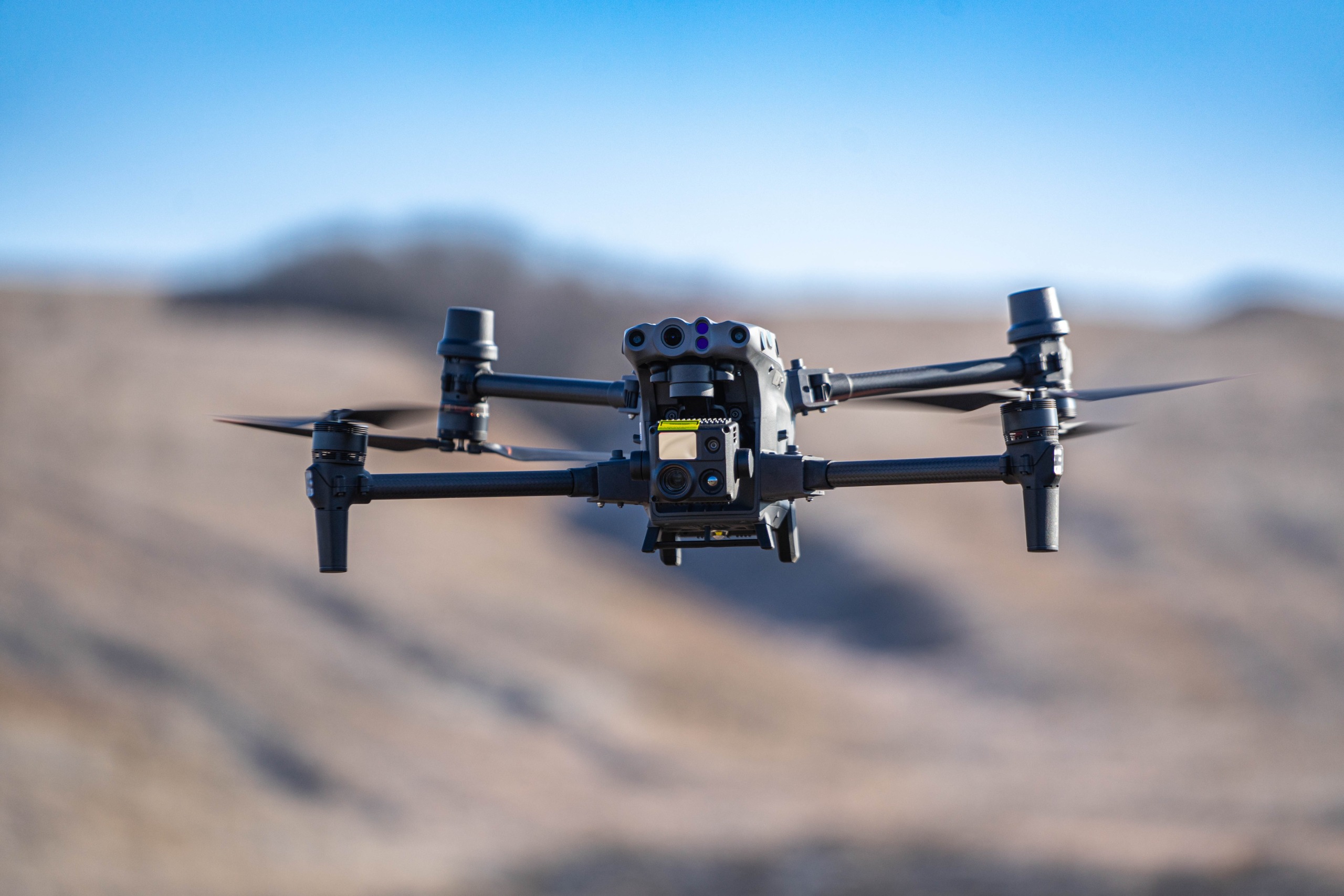
Drone technology has rapidly advanced in the last five years. They are recording sports events, helping to track the movements of wildfires, and even delivering McDonalds. But their rise has a far more sinister side.
As the war in Ukraine has demonstrated on sea, land, and in the air, their capacity as warfighting tools is evolving, with high-precision first-person view (FPV) drones being used for targeted strikes in warzones around the world.
But the drone industry relies heavily on Chinese hardware - with China's DJI commanding an 80% global market share - and with that comes the risk of supply chains being cut, costs increasing, or malicious software being secretly installed.
How drone tariffs address supply chain risk
In an attempt to address these risks, President Trump has recently introduced sweeping tariffs on drones and drone components in an attempt to bolster domestic production and reduce the risk of supply chain disruptions.
Drones over 25 kilograms or with thermal imaging capabilities now face a 100% tariff, while those smaller in size without “certain capabilities that particularly implicate national security” face a 25% tariff. The 25% tariff also applies to drone components.
But Trump - not wanting to strain relations with allies further than they already are - has applied a 15% tariff for drones and components from the European Union, Japan, Liechtenstein, Republic of Korea, Switzerland, and Taiwan. The United Kingdom has also received a much more lenient tariff of just 10%.
But the question remains on how drone manufacturers in the US will adapt to increased import costs and how the tariffs will affect manufacturing while addressing the growing demand for drones from civilian, law enforcement, and military markets.
Latronix provides compute, System-on-Module platforms, and flight-ready reference designs for drones and Unmanned Autonomous Vehicles (UAVs). I spoke to Latronix CEO Saleel Awsare to understand the challenges facing domestic component suppliers and how the tariffs will affect competition at home and abroad.
- As soon as I heard of Trump’s new tariffs on foreign-made drone parts, I immediately thought of the supply chain issues the US encountered after the tariffs imposed towards the start of 2025. How adaptable is the US drone supply chain to these new tariffs, and does the grace period provide enough time for adaptation?
The broader supply chain impact is that the market is being pushed toward more regionalized, transparent, and trusted sourcing rather than globally optimized sourcing based purely on cost. Drone manufacturers will have to look much more closely at where key components are designed, manufactured, assembled, and supported.
At Lantronix, we are well positioned because our System-on-Modules (SOMs) are dual-use platforms designed for a broad range of commercial and defense applications, helping ensure customers aren't exposed to unnecessary regulatory or supply-chain risk. Our SOMs are already production-ready embedded compute platforms, and our Drone Reference Platform is designed with NDAA and Trade Agreements Act (TAA) compliance in mind. With U.S. manufacturing options also coming online, we can give customers a path toward American-made SOM solutions without sacrificing the performance, software support, and scalability next-generation drone platforms require.
Lantronix is already positioned with compliant SOM and reference-platform solutions, but the grace period could still be challenging for customers because qualifying and designing a new compute platform into a production drone takes time, even when a compliant alternative is available today.
- What challenges and benefits do you see the US drone industry encountering as a result of these tariffs?
Challenges: The biggest short-term impact will hit the consumer and commercial drone market, where cost-sensitive products still rely heavily on foreign motors, electronic speed controllers, batteries, cameras and electronics. Tariffs could make affordable alternatives difficult to source until U.S. or allied suppliers scale. Defense suppliers should be better positioned because many already design around NDAA, Blue UAS and trusted-supply-chain requirements that are already in place.
Benefits: Longer term, the tariffs should accelerate a stronger U.S. and allied drone supply chain, with more focus on trusted sourcing, controlled bills of materials (BOMs) and domestic manufacturing. This creates an opportunity for Lantronix because our solutions already provide compliant, production-ready compute platforms with long lifecycle support and North American engineering.
- Do you see the lesser tariffs on US allies hindering or helping competition within the US drone industry, and are there key component industries (software or hardware) that will be affected to a greater extent?
The lower tariffs on U.S. allies should help the drone industry stay competitive while domestic capacity grows, giving manufacturers continued access to trusted suppliers in Taiwan, Japan, Korea, Europe and the UK.
Hardware will be affected far more than software, especially motors, batteries, ESCs, sensors and structural components where China has significant scale.
The tariffs should also accelerate investment in U.S. manufacturing and technologies like additive manufacturing. For Lantronix, this is favorable because we can provide trusted, compliant compute platforms while still leveraging established U.S. and allied semiconductor supply chains, rather than competing in the hardware categories facing the most disruption.
- What effect will the US Commerce Department's onshoring exemption have on the competition with existing domestic suppliers, particularly with reference to the reduced duty rates they will receive?
The onshoring exemption should benefit companies that were already proactive about compliance, supply-chain planning, and U.S. operations. Lantronix already had a plan in place to bring SOM production to our Plymouth, Minnesota facility, so the exemption strengthens our ability to support compliant U.S.-based drone programs. Companies with the right operational infrastructure and trusted supply chains should not be negatively impacted, and, in many cases, should be better positioned to grow and support the U.S. drone market.
- What effects will these tariffs have on the US drone industry's exports? Do you see US allies shifting purchases towards the US drone market or turning away as a result of these tariffs?
There is a potential downside internationally. Some EU and other non-U.S. customers could view U.S. localization requirements as a precedent or competitive threat, particularly if more countries begin mandating local manufacturing. It would be difficult for the industry to operate efficiently if every market required its own domestic supply chain.
Today, many international markets have less restrictive component-origin requirements than the U.S. does, but this could change as governments look to reduce dependence on Chinese or other sole-source suppliers. Longer term, we may see more emphasis on regional manufacturing, trusted allied supply chains, and diversified sourcing rather than purely global supply chains.
- Is the US drone industry better positioned to compete within the global market? Where can the US offer greater value in its drone manufacturing over the economies of scale driving drone production for DJI and China?
The US is now better positioned to compete, but historically there was not the same urgency to rebuild domestic drone manufacturing and supply chains. That is rapidly changing, although the timeline is challenging because moving and qualifying supply chains takes time.
There is also a wide range of critical components: from motors, batteries and electronics to magnets, rare-earth materials and other underlying resources. Additionally, there is a need for domestic or trusted-allied capacity to ramp up production. The US may not match DJI and China purely on cost and scale in the near term, so the greater opportunity is to compete on trusted supply chains, advanced AI and autonomy, cybersecurity, customization, and engineering support. For companies like Lantronix, that creates an opportunity to provide compliant, production-ready compute platforms with U.S.-based engineering and expanding domestic manufacturing support.

Follow TechRadar on Google News and add us as a preferred source to get our expert news, reviews, and opinion in your feeds.








 English (US) ·