
CBS
We may receive a commission on purchases made from links.
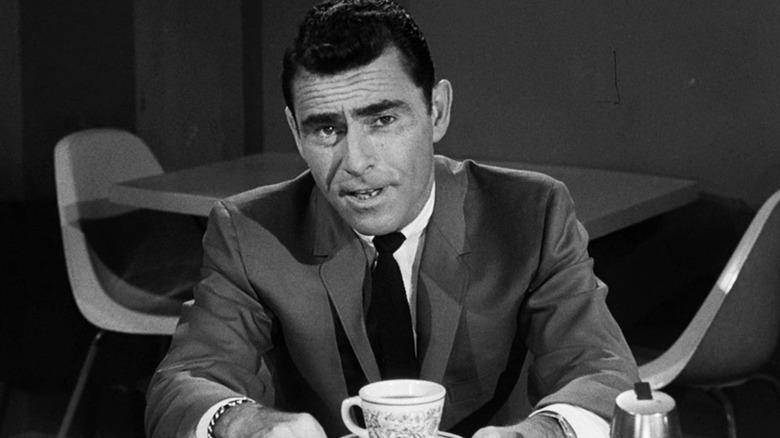
When you think of Rod Serling, you think of the suave "Twilight Zone" host, a skilled orator and an even more skilled writer responsible for perhaps the greatest anthology TV series ever made. You don't necessarily think of a frustrated pugilist. But as with so many great creatives, Serling had a polymathic element, and did indeed compete as an amateur boxer while enlisted in the United States Army.
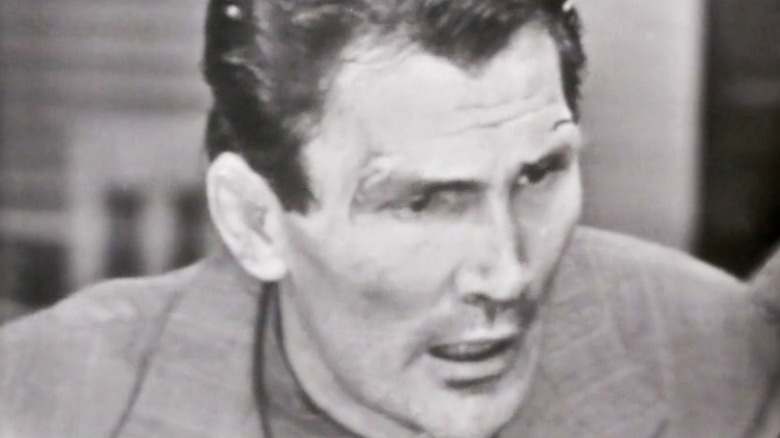
Unfortunately, as the New York Times pointed out in its Serling obituary, he had "his nose broken in his first bout and again in his last bout," after which he stepped out of the ring for the last time. But he later revisited boxing via several short stories written during his college years, and again in 1956 when he penned a teleplay for the CBS anthology series "Playhouse 90." Entitled "Requiem for a Heavyweight," it starred Jack Palance in the lead role of a boxer facing the end of his career following defeat at the hands of a younger opponent. The live broadcast became one of the show's most celebrated episodes, earning Serling an Emmy in the process. Though he contributed multiple stories to "Playhouse 90," "Requiem" was his most successful — as the many adaptations that followed prove.
"Requiem" was remade multiple times in various countries, including the United Kingdom, where a pre-James Bond Sean Connery played the washed-up boxer. Already, then, Serling had been responsible for giving two future Hollywood legends significant early roles. Six years after the original "Playhouse 90" broadcast, he'd go one better by giving the great Muhammad Ali a cameo in the big screen version of "Requiem."
Requiem for a Heavyweight was one of Rod Serling's finest pre-Twilight Zone moments
CBS
During his Army years, Rod Serling competed as a flyweight in boxing matches. According to "Serling: The Rise and Twilight of Television's Last Angry Man" author Gordon F. Sander, during his training in Georgia, the 5-foot 4-inch Serling also spent time looking for trouble in bars, picking fights just to prove his toughness. In the official Army boxing league, Serling fought in 16 fights and reached the second round of the division finals.
Following his service, Serling matriculated at Antioch College and left boxing behind. But he revisited his love for the sport via short stories before making boxing the focus of his 1956 script "Requiem for a Heavyweight." The story follows Harlan "Mountain" McClintock (Jack Palance), a boxer whose glory days are behind him. After being defeated by a younger fighter, McClintock learns he's suffering from punch drunk syndrome and is no longer able to fight. Meanwhile his manager, Maish (Keenan Wynn), bet against McClintock in his final fight in an effort to win enough cash to pay his debt to the mafia. As the aging fighter tries to find a new path in life, he finds himself pulled into the world of professional wrestling despite his aversion to pre-arranged fights.
The original "Playhouse 90" version of "Requiem" was a hit, earning widespread critical praise and earning Emmys for Serling, director Ralph Nelson, and Palance. Given its 90 minute runtime, it's also arguably one of the best boxing movies. With that kind of reception, a big screen adaptation likely seemed like a sure bet. While 1962's "Requiem for a Heavyweight" didn't enjoy the same success as its small-screen counterpart, it did debut to positive reviews and also featured a soon-to-be heavyweight champion of the world.
Muhammad Ali made a cameo in Requiem for a Heavyweight

Columbia Pictures
Muhammad Ali made his amateur boxing debut in 1954 and his professional debut in 1960. In 1964, he claimed the world heavyweight title by defeating Sonny Liston. But before that victory, he found time for a cameo in the big screen version of "Requiem for a Heavyweight."
The 1962 film was once again directed by Ralph Nelson and based on Serling's original teleplay. Anthony Quinn played the lead role of Luis "Mountain" Rivera, with Jackie Gleason as manager Maish Rennick and Mickey Rooney as Mountain's cutman, Army. In this version, Quinn's pugilist faces off against Ali (then still known as Cassius Clay) who provides the requisite beatdown to kick off Rivera's dark night of the soul.
While the film debuted to solid reviews, not everyone was convinced it had outdone the original. Per Turner Classic Movies, a contemporaneous review from Variety noted how the story of "Requiem" had "lost some of its dramatic weight in the transition from the very small screen to the very large screen." Meanwhile, Nelson wasn't thrilled with the reintroduction of several scenes cut from the original teleplay, and wasn't even a fan of Quinn's performance in the lead role, later writing in a letter to the editor published in Life magazine that he preferred Palance's take.
Otherwise, however, "Requiem" enjoyed positive reviews, holds a very respectable 89% score on Rotten Tomatoes today, and remains an underrated boxing movie everyone should see. Of course, Ali quickly became the biggest boxer in the world and mostly left acting behind (though he did appear in the 1969 Broadway musical "Buck White," and a handful of projects throughout the 1970s and 80s). Those interested in his big screen debut can watch "Requiem for a Heavyweight" on Tubi.







 English (US) ·