

Published Feb 15, 2026, 9:01 AM EST
Carly Lane is an Atlanta-based writer and critic who has been with Collider in some form or fashion since 2021. She considers herself a television nerd, diehard romance/sci-fi/fantasy reader, and nascent horror lover. Her fondness of books is only eclipsed by the towering TBR that her shelves can't possibly contain.
She is the author of A REGENCY GUIDE TO MODERN LIFE: 1800s ADVICE ON 21ST CENTURY LOVE, FRIENDS, FUN AND MORE, published through DK Books (an imprint of Penguin Random House) and currently available wherever books are sold.
Sign in to your Collider account
Editor's note: The below interview contains spoilers up to The Pitt Season 2 Episode 6.
With HBO's The Pitt finally back for Season 2, the day is still just ramping up for the doctors and nurses working in the emergency department of the fictional Pittsburgh Trauma Medical Center. The first few hours of this Fourth of July shift have been disconcertingly quiet, but that's no longer true as the second season of R. Scott Gemmill, John Wells, and Noah Wyle's medical drama hits its sixth installment, "12:00 P.M." With the ED now overwhelmed with patients being diverted from another hospital due to a mysterious "Code Black," the last thing anyone's expecting is for frequent "boarder" Louie (Ernest Harden Jr.) to flatline.
Ahead of The Pitt's return, Collider had the opportunity to speak with the show's creators and cast alike about some of Season 2's most pivotal moments over the first six episodes, including Gerran Howell, who plays Dr. Dennis Whitaker, and Isa Briones, who plays Dr. Trinity Santos. Over the course of the interview, which you can watch above or read below, the two co-stars (and onscreen roomies) discuss Whitaker's growth in confidence this season, where Santos' protective instincts with her young patient are really coming from, the impact Louie's death will have on Whitaker moving forward, and more.
COLLIDER: Gerran, one thought I had that I think a lot of people had last season was how many different bodily fluids Whitaker was going to get covered in at any point. In Season 2, he seems to have dodged the bullet there.
ISA BRIONES: Literally. He knows how to dodge now.
GERRAN HOWELL: Dodged the bullet! I can really see it coming, and I can dodge it. I mean, look, there's still undiscovered bodily fluids, and there are still episodes to go, so who knows? I'm expecting the finale to be just a bucket of everything. He knows his way around the ED a lot better now. He's grown in confidence a lot. So that stuff, he's more attuned to. But those things will never go away. It will still be in his day-to-day life. So, you'll always have to be looking out for them, I'm sure.
Gerran Howell Explains the Biggest Difference in Whitaker Between 'The Pitt' Season 1 and 2
"Now he's teaching people, so he just has to step up..."
 Image via HBO Max
There is a 10-month time jump between Seasons 1 and 2, and for a variety of reasons, Langdon has gone and taken care of himself and come back, and Dana has obviously gone and come back, and in that time span, we see how the 10 months have impacted them. Whitaker was someone who stood out to me almost immediately. He does feel like he has more confidence. He does feel like he's taking on more of a mentoring role to some of these med students. One of the scenes in particular that really stuck out is when he decides to say that they're going to adopt Robby's moment of silence, and the shot shifts to Noah [Wyle] standing over your shoulder, unbeknownst to you.
HOWELL: Nope. I didn’t even know that. He's just over my shoulder?
BRIONES: It’s very sweet.
HOWELL: That's lovely.

Related
Yeah, he’s nodding his approval, seeing that that tradition is being passed on. What other lessons do you think Whitaker has internalized from Robby that he now wants to take and incorporate into his own approach to medicine?
HOWELL: That's a great question. To find balance, I think, is the biggest thing. That is Whitaker's whole thing now. Without all the Season 1 fear and being out of his depth, now it's about navigating the balance between showing too much empathy to patients. Now he's teaching people, so he just has to step up, and Robby is held in the highest regard by Whitaker. So, he's just following his lead, and at least on the surface, appearing confident for other people's benefit now, because the pressure's on. He's a doctor. “I'm getting paid, to some extent.” He has a paycheck! Look at him go. And he has a mother. [Laughs]
BRIONES: Paycheck and a mother.
HOWELL: Paycheck and a mother! It’s all coming up well for him. It feels like there's a little bit of a passing of the torch moment. He's just trying to do the best he can now.
Isa Briones Explains the Root of Santos' Protective Instincts in 'The Pitt' Season 2
"Unfortunately, she does have a very dark view of the world because of what she's been through..."
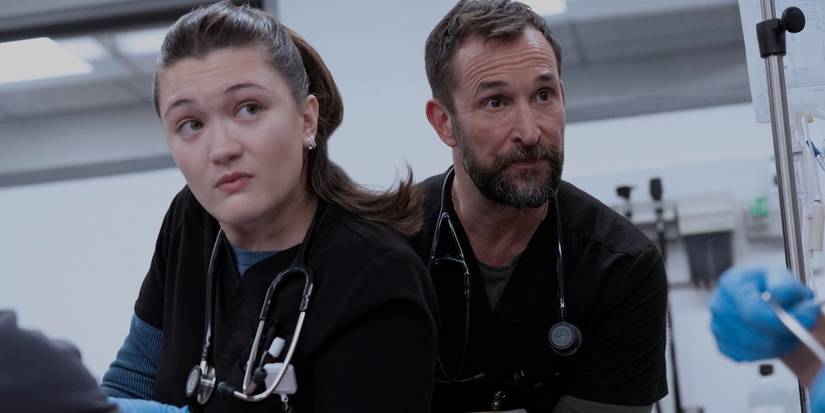 Image via HBO Max
Isa, you and I spoke last season about Santos, and the ways in which some of her behavior hasn't always sat well with viewers. This season, we see her not necessarily questioning her own instincts, but there is that moment where the young patient that she has early this season has bruises, and they don't necessarily know where they came from. [Santos'] drive to figure out what's going on feels, to me, more like she's trying to just rule out the possibility that something sinister is going on, as opposed to jumping to conclusions. Was that your read on the situation?
BRIONES: Yeah. A lot of people have said to me the kind of judgment of, like, “Oh my god, she thinks everyone's an abuser.” And I'm like, “Well, unfortunately, that is something that you really do need to look out for.” This season, she's paired with a lot of young patients, a lot of children this season, and those are the most vulnerable people, and often the people who can't stand up for themselves, and I think she very much relates to that. She has been that kid who has been taken advantage of. She's been that kid who couldn't speak up for herself. So, I think she is, of course, really primed to look out for that, but it is a thing that comes into the ER a lot, so I don't think it's crazy that she's on the lookout for it.
I do think that it does make sense because of her past, and unfortunately, she does have a very dark view of the world because of what she's been through, that, of course, she jumps to that, or she can jump to that, because she has seen some of the worst of humanity. It's not always well, and thank God that's not the case in that patient's case, but I think it helps to have all doctors who have different backgrounds and different viewpoints and experiences. That's why multiple people will work on a case, because they're seeing it from different sides. They are looking for different things, and that's one of her superpowers, is really looking out for very vulnerable people.
Talking about multiple doctors handling a case, Louie, who's obviously a beloved patient in the E.R., is one of Whitaker's patients, and he seems to have formed a very close bond with him. From Whitaker's perspective, it feels like that loss really weighs heavily on him in the sense that he feels like he should have been there if this was the moment where he was going to lose someone he has a close relationship with. Was that the way that you wanted to play it — especially in the scene with Patrick [Ball], where Whitaker and Langdon are talking about how Langdon had to step in towards the end?
HOWELL: It's interesting with Louie. He's obviously growing in confidence, like we've said, and he's now a lot more used to people potentially dying on his watch, but Louie is different because he was the first patient he saw in Season 1, Episode 1. He was his first-ever patient. He's a constant in that ED, and someone who's just as regular as the painting on the walls. Do you know what I mean? He's always there. To lose someone like that can really throw you off balance because you think, “He's going to outlive me.”
But he's an interesting person to lose because, after that happens, you get to see that Whitaker actually does kind of shut it off quite quickly, surprisingly. It’s a good example of seeing how far Whitaker has come in that way, that for better or worse, he makes a decision to shut that off, compared to Season 1 with Mr. Milton, where it haunted him for longer — at least on the surface.
BRIONES: He's learning to protect himself.







 English (US) ·