
 9 hours ago
9
9 hours ago
9
The Odyssey looks set to be the blockbuster hit of the summer, with global opening weekend grosses of $264m, critical rave reviews including five stars from the Guardian’s Peter Bradshaw, and reports of fans traversing continents to experience Christopher Nolan’s epic tale of gods and monsters in one of the few dozen screens worldwide with the capability to screen Imax in 70mm. It also has the potential to rule the box office for the coming weeks, with few other true blockbusters to be released this summer, with the exception of Spider-Man: Brand New Day (hence the cast’s humiliation ritual of a press tour). Read on for a spoiler-packed breakdown of the epic battles, narrative twists and out-of-nowhere cameos that bring richness to Nolan’s idiosyncratic vision of ancient life.
A monumental spectacle
After Oppenheimer won best picture at the 2024 Oscars, Nolan knew he had a once-in-a-lifetime chance to realize a decades-long dream of bringing Homer to the big screen. “OK, I’ve now got an opportunity to make a film I wouldn’t be able to make otherwise,” he recently told the Guardian. You can see every penny of The Odyssey’s reported $250m budget on screen. The landscapes of Ithaca are breathtakingly beautiful, and there’s a creepy pall to our hero’s journey to the underworld that Nolan achieved by shooting on the black sands of Iceland’s beaches under the hazy light of the midnight sun. (Fun fact: Nolan also used Icelandic glaciers as the backdrop for the alien planet of Interstellar.)
Nolan filmed in six countries to achieve the range of landscapes in the film, which also included Scotland, Greece, Italy and Malta, and, more controversially, Western Sahara. Controlled by Morocco, the region is often referred to as Africa’s last colony, with the UN classifying it as a non-decolonized territory. “Audiences coming to see The Odyssey deserve better,” the artist and writer Mohamed Sleiman Labat wrote in an essay for the Guardian. “Those cinematic shots sold to them as the places and moments where historical epics took place were captured at the expense of the Sahrawi people’s suffering.”
The film’s epic scenes in the Mediterranean were filmed in the ocean, with Nolan eschewing CGI in favor of real roiling seas and Odysseus and his crew aboard the only functional Viking ship in the world (the delightfully named Draken Harald Hårfagre). A replica of the boat was built for scenes shot in a colossal water tank on the Universal lot. “There were these two jet engines, like 737 engines, blowing water on us,” Damon has said. “It was definitely about as hard as you can make water work in a controlled environment.”
Technical wizardry
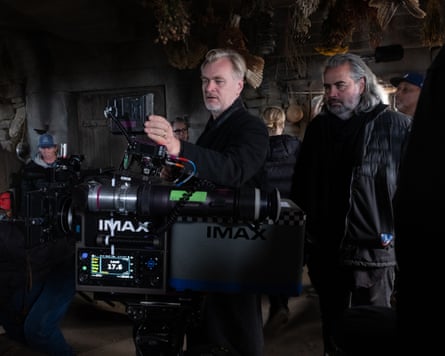
Nolan has been a champion of Imax for two decades: in 2008, The Dark Knight was the first major Hollywood film to use the cameras for its action sequences. The camera set-up has been used increasingly prominently in his films since then. Nolan used half a dozen Imax cameras to shoot the film, all enclosed in soundproof “blimp” casing to mask their loud operational whirr.
The team also worked with an LED company to create lighting rigs they called “pyrohedrons” (fire pyramids) to give the illusion that warm firelight was casting a glow over interior and night-time scenes. “I wanted the camera to see what the human eye would see,” Nolan told the New York Times.
Bringing the divine down to earth
In Homer’s epic poem, gods are “self-interested beings, whose interventions in human lives are motivated primarily by their own desires, whims, and preferences”, as classicist Emily Wilson put it in her translation. Yet Nolan’s vision of how gods, demi-gods and mortals interact is somewhat earthier than in Homer, with Zendaya’s Athena less of a fearsome divine force than a pal and a confidante to Odysseus.
Charlize Theron is always a treat (even in her ropey Netflix fare), but Nolan’s interpretation of nymph Calypso may not feel strong enough for some viewers to work as a framing device for the bulk of the film. In Homer, the nymph is a cruel enslaver who holds Odysseus captive on her island; Nolan sees the character as lonely and somewhat pitiable. It’s worth wondering what Theron would have done with a spikier version of the role – she excels as a cartoon villain.
Like classicist Emily Hauser, who recently wrote for the Guardian about Nolan’s omissions, some viewers may also miss the Homeric princess Nausicaa. While interacting with Odysseus, she sniffily pooh-poohs him as “an unpromising man” – her barbs would have added a little light relief to the picture.
Nolan’s women
When Lupita Nyong’o was announced as Helen of Troy – the face that launched a thousand ships – rightwing commentators denounced the casting choice for predictably small-minded reasons. It is ironic that the character is afforded little screen time: when Tom Holland’s Telemachus goes to visit Helen and her husband, Menelaus (Jon Bernthal) in Sparta midway through the film, the famed beauty is near mute, with a grisly scar covering the left side of her face. It’s a bold choice from Nolan, but a little odd that we never find out the cause of her injury.
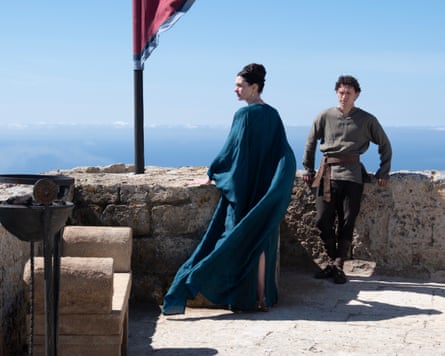
Odysseus’s loyal wife Penelope (Anne Hathaway) is a steely and cunning presence despite the suitors’ invasion of her palace. “We wanted to make sure that she did not look like she was mourning her husband,” said costume designer Ellen Mirojnick, who dressed Hathaway in the red and blue colors of Ithaca. “She was always viewed as the queen.” The actor has likened her character to a slowly simmering volcano that eventually erupts in scenes where she curses the suitors and pushes her double-crossing servant Melantho (Mia Goth) to certain death while the palace is at war.
One of the film’s most memorable scenes sees Odysseus and his men face the sirens, whose alluring song can lure sailors to their death. As their boat approaches their island, Odysseus is tethered to a mast to hear their beautiful yet terrible song while it is muffled to the audience’s ears, as if we, like Odysseus’s first mate Eurylochus (Himesh Patel), have our ears plugged with wax. The sound is “all the things you want it to be, then all the things you wish you never wished for”, says Odysseus, as Nolan powerfully leaves it to the audience’s imagination to fill in the blank.
Surprise cameos
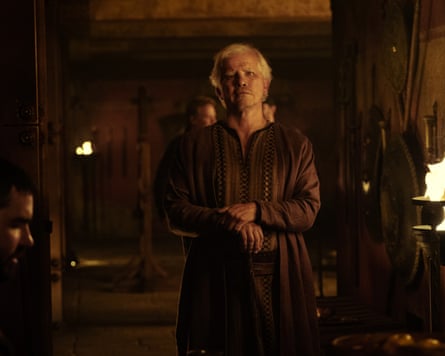
Some of the film’s most touching moments come from John Leguizamo, barely recognisable with white hair and a dirty smock in the role of Eumaeus, the nearly-blind swineherd that remains loyal to Odysseus to the very end. As Greek military leader Agamemnon, Benny Safdie strikes a fearsome presence in a smart bit of against-type casting from Nolan. Meanwhile, not all cameos were planned: a pod of dolphins who made a surprise appearance on a day of shooting ended up making the film’s final cut.
Yet perhaps most surprising of all is the casting of rapper Travis Scott as a bard storyteller who opens the movie with a story of Odysseus’s heroic exploits at Troy. As he orates, the character pounds his staff on the floor in the tempo of dactylic hexameter (which as every good classicist knows, is the original meter of Homer’s poem). “I cast him because I wanted to nod towards the idea that this story has been handed down as oral poetry, which is analogous to rap,” Nolan said in an interview with Time.
Oscar chances
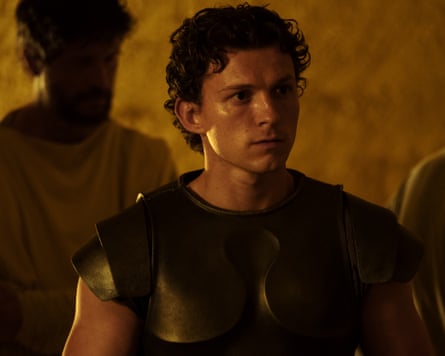
It’s likely far too early to make many accurate predictions about next year’s Oscars, given that many of the awardsiest-seeming films won’t premiere until fall film festivals. But Nolan is one of the Academy’s favorite directors, winning seven out of Oppenheimer’s 13 nominations in 2024 and a respectable three out of eight for Dunkirk a few years prior. The Odyssey seems like a lock for nominations in best picture, best director and most of the craft categories, leaving the acting categories as a toss-up.
There’s no debate about who the male lead of the film is, but there’s all to play for in the supporting categories, with Holland and Robert Pattinson eligible for supporting actor and Zendaya, Nyong’o and Theron potential competitors in the supporting actress category – and Hathaway, if Universal decides not to run her in lead. But I’d personally lean towards Leguizamo for his turn as Eumaeus, and Samantha Morton’s staggering, scene-stealing role as Circe, a witch who turns Odysseus’s men into pigs.
Being something of an outsider to the Hollywood star system hasn’t stopped Morton getting two Oscar nominations to date (for Sweet and Lowdown and In America). With the weight of Nolan’s film behind her, I’ll be gunning for her to go all the way this time.
Examining the true cost of war
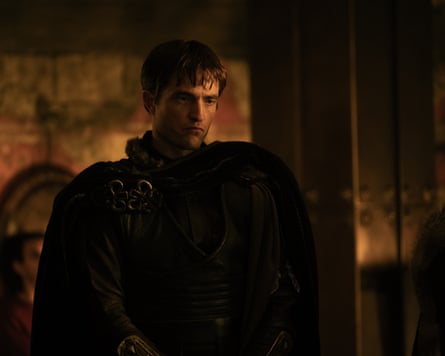
There’s a good case to be made that The Odyssey’s best sequence is its final 30 minutes, where Odysseus finally makes it back home with the help of Athena and sneaks into his Ithaca palace disguised as a beggar man. After Penelope challenges the men to string his bow – and Odysseus is the only one able to – he throws off his rags and reveals his true identity.
His face-off with the suitors isn’t the merciless slaughter that Homer described – it’s a fair fight with both sides armed – but the suitors, led by Pattinson’s slimy Antinous, are no match for the master of the house. His recapturing of Ithaca is bittersweet, interspersed with flashbacks to the “fires of anarchy and pain” that blazed through Troy as the Greeks sacked the city. There’s no glory in war for Nolan, echoing the sentiments of Dunkirk and Oppenheimer. As Odysseus puts it: “We have broken the fragile bond between men.”
There may be few true winners here, but Nolan’s cap to the story is somewhat more uplifting than Homer’s. Whereas the great poet ended The Odyssey with Odysseus planning “raids” to recoup his lost wealth, Nolan sees a rosier and less grimly mercenary future for Odysseus and Penelope. In a beautiful coast-side scene, the reunited couple embark on a journey west to honor the souls of his fallen men while Telemachus – who may be anywhere between 16 and 22 at this point; Holland certainly doesn’t seem to know – stays to rule over Ithaca.
![‘Super Troopers 3’ Is the R-Rated Release Fans Have Been Waiting For [Exclusive]](https://static0.colliderimages.com/wordpress/wp-content/uploads/2026/07/super-troopers-3-2.jpg?w=1600&h=900&fit=crop)





 English (US) ·