
 2 hours ago
21
Alongside great judgement and clever tweaks, this astonishing remake has a proper ace up its sleeve.
I have a friend who first played The Legend of Zelda: Ocarina of Time back in the day, when the game was only just released and he was home from university for Christmas. This is objectively the best of all times to play any video game: not Christmas specifically, but dropped out of the regular world and faced with a few weeks filled with nothing pressing to do whatsoever. Years later, though, my friend told me that the magic of the game didn't just come down to the playing of it, but the way that the playing of it unfolded.
Here's what he meant. He'd play all day, curtains drawn, family ignored, working through dungeons and pelting across Hyrule Field on Epona. Then in the evening he'd call his girlfriend, who was back with her own family for Christmas. She always wanted to know what he'd got up to that day. And not in East Sussex; she wanted to know what he'd got up to in Hyrule.
So as he played he took regular breaks to tell someone else about what he had encountered, and what he had discovered, and what he had yet to overcome. It is my bright delight today to be able to tell you that, around thirty years later, having just revisited the game in Nintendo's new remake, Ocarina of Time is still worth telling people about. It's still an adventure so surprising, so satisfying, so moving that I need to talk about it.
Here's the thing, though. Despite the game being a cast-iron masterpiece, this reaction was something of a surprise to me. Or rather, it was a surprise precisely because the game was a cast-iron masterpiece. In truth, a couple of weeks ago I wasn't really aching to head back to Ocarina of Time after all these years. I kind of dreaded having to slog through an echoing, once-great game and summon a thousand words of measured reverence afterwards.
Thankfully I had forgotten two things. The first is that I am an idiot, which means that I had failed to realise that any chance to replay a Zelda should be leapt at. And secondly, it turns out that I'd forgotten exactly what kind of masterpiece Ocarina of Time is. And along with that last point - and we'll get to this properly in a bit - I hadn't realised that there's a secret ingredient to this specific remake that has proved absolutely essential to its greatness, and that has nothing at all to do with the code running on the Switch 2.
Let's deal with remake duties here. This is more or less the game that people played back in 1998. The beats of the adventure, with Link travelling between different eras of Hyrule in order to defeat Ganon, remain the same. You still start in Kokiri Forest [check] and you still ride Epona over the fence at Lon Lon Ranch in one of the great heart-racing, skin-prickling moments in all of art. If you're stuck in a dungeon, you can almost always use an existing guide from the N64 game to work your way through it. The game world is still broken up into little chunks that fade out and in as you move between them. And each game still begins with that unskippably evocative intro that has Link and Epona dashing over a misty hill with the moon behind them, Zelda meets Susan Cooper.
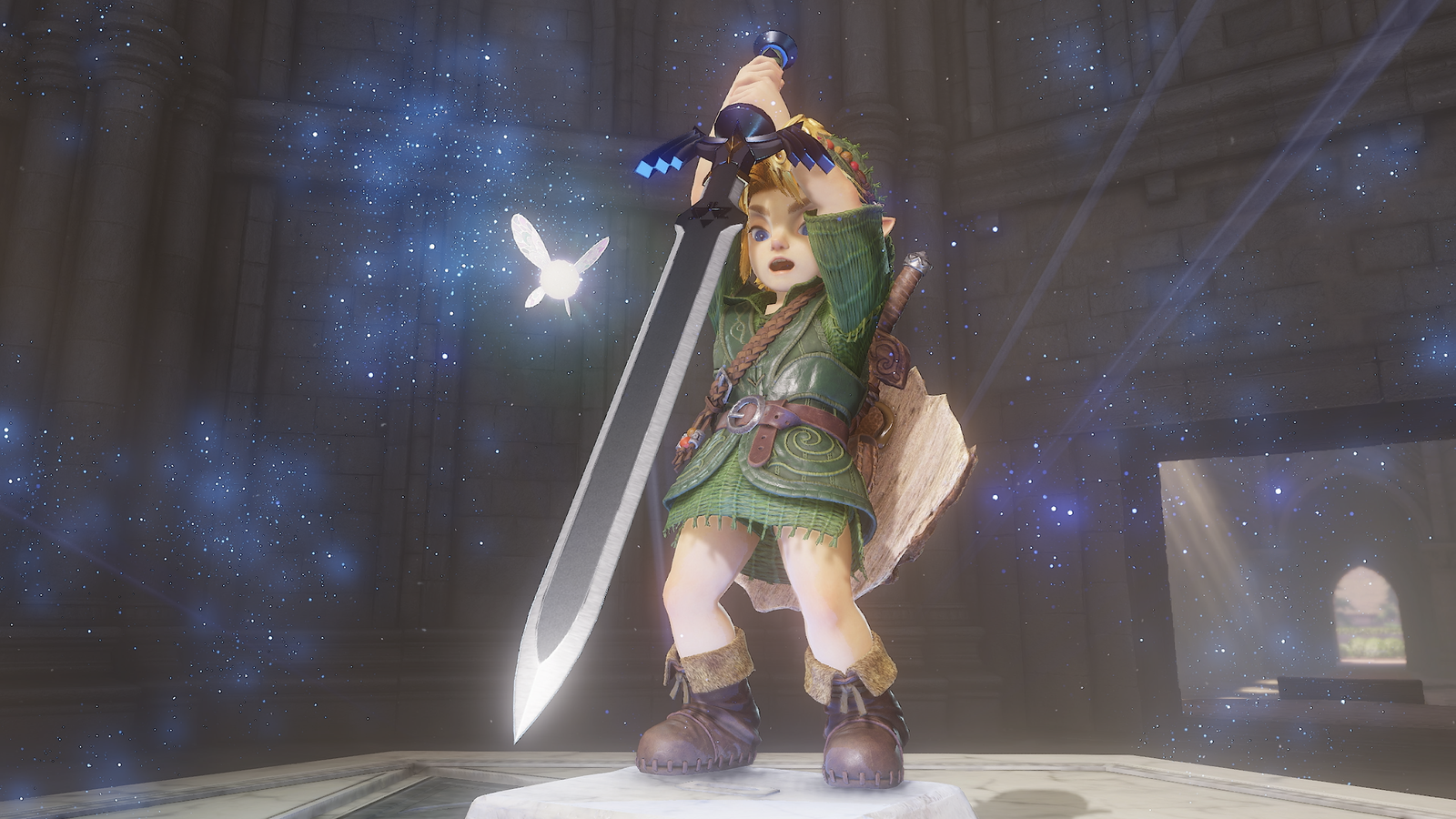
Changes though? For one thing the whole game's been updated with modern graphics, and has ditched any and all fixed cameras for a modern system of movement on one thumbstick and camera on the other. One example: Hyrule Castle Town, in my memory at least, always had a central camera and you would pivot about its streets as if you were a horse on a circus merry-go-round.
Now it's pure Frozen territory, cobbled paths racing off in every direction and you can explore them with the camera rushing behind you. The game's spaces feel less like elaborate machines that you were a mechanical part of, and more like video game spaces. Yes, from the way I've phrased that I now see that something of a trade-off has taken place here. I loved that sense you got in early 3D games that the whole thing was a clever practical trick that was forever almost about to collapse in on itself, but anyway! The new Ocarina is a game you can show kids who weren't alive in 1998 and they will feel at home more quickly.
Sometimes the graphical update is really wonderful. The route to Zora's Domain, which I barely remember in the original Ocarina, is now a lovely scramble over cliffs and arcing crags. A bold smattering of 1990s Nickelodeon colours and glossy textures, meanwhile, makes Jabu Jabu's Belly a cross between a pre-millennium rave and a modern soft play.
My favourite locations of all, however, are two of the mid-game dungeons. The Water Temple is now a drowned Art Nouveau palace that you could easily imagine Captain Nemo knocking around in. And the Forest Temple, which is my absolute favourite Zelda dungeon of all time, is a parquet-floored murder mansion that's been overtaken by trees. Dark wood-panelled corridors and weird bits of church sticking out of the foliage. It's the kind of place you'd hear a weird crime podcast about.
Trade-offs, however. My wife, a huge fan of the original game, would wander in and out as I played, and often felt the game she remembered was a little more characterful in its visuals. The moment you fight Dark Link, for example, has lost a little of its glitchy liminality, although the staging, with an old tree in the middle of a vast smoky room, is still wonderfully strange. Towards the end of the game, with the trip into Gerudo territory, you could also occasionally be forgiven for wondering if you'd stepped into one of a dozen third-person Unreal games in development at the moment. It's pleasant to look at, but it sometimes doesn't look specifically like Zelda anymore.
All that, and some strange character models that inevitably I learned to love, don't really matter very much, however. Not least because a handful of clever tweaks elsewhere mean that Ocarina now races along at an astonishing clip. And all this with a careful paring back of intrusions from Navi the fairy and the owl, who were both there in the original game to help move you along swiftly in the first place.
These tweaks are all pretty great. Link now has a jump button, which removes the original game's contextual jumps from the equation, and makes the thundering jump attack even more pleasing to pull off. Even better, in a loan from the 3DS remake of Ocarina, you can swap out usable items using a trigger mini-menu, and you can change boots and whatever you had on your head with some of the directional face buttons.
This doesn't sound like much, but it's quietly transformative in the way that the best updates are. Take the Water Temple. This is the stuff of memes in terms of difficulty and the patience required in navigating an environment that can be flooded up to three different levels. But now, as on the 3DS, you can enjoy it without having to slip into the menu every few steps to add your iron boots or remove them.
And this in turn means that a dungeon I had been really dreading turned out to be a dungeon that revealed itself via experimentation. I would change the water level and see what options I now had, think about the relationship between spaces I could reach and spaces I could not, all without needing to muddle about in menus and interrupt the flow of things. Flow is the word in fact: a simple UI and item-management tweak has given a legendary Zelda dungeon its perfect pace and sense of revelation.
Alongside tweaks like that which I noticed - oh, it's easier to equip the Hookshot - are no doubt hundreds of little things I didn't notice. I suspect there's a lot more gentle direction prompting built into places like the Water Temple, while elsewhere, in the Forest Temple, for example, I suspected that some of the backtracking had been removed. Individual item placements have been changed around perhaps, and there are generous tweaks like a wallet that holds more rupees from the off. For me at least, all of these tweaks had several things in common: they improved the game without removing or altering anything that was particularly meaningful about the original, and, also, I struggled to confidently spot them.
I did try to spot them for a while. And I measured up what I was playing against my memory, which is always wonky in the first place. Hyrule Field feels smaller now, but it's still thrilling to race across. I remember Epona entering the game sooner, or maybe I just remember the idea of a horse in a Zelda game being a huge, attention-holding deal. I thought a favourite boss involving oil paintings came much later, but again, I had just shifted it to the third act because of its original impact on me.
But this gives way over time to the most important thing about Ocarina of Time, I think, and the reason why this remake has such an emotional impact on people like me. This isn't just another Zelda with an ingenious overworld. It's a Zelda game that's even more preoccupied with time than ever before. And this is because time unfolds within the game, via a central mechanic that takes Hyrule seven years into the future, transforming Link from a child to an adult - and then allows you to go back again.
To play a game like this, a game that is about this stuff, after a period of almost thirty years away, gives your imagination and memory a kind of IMAX treatment. I realised that not only is this a game about the passage of time and the way that the world looks different when you're young to when you're a bit older - I had never really realised that adult Link goes through variations of the same dungeons that young Link went through, but now they're all just a bit harder and more consequential - it's also the kind of game that a lot of players have knowingly or unknowingly measured parts of their lives by.
This time, when I reached the first Fairy Fountain, for example, I remembered that my wife had walked down the aisle to this music - about half the registry office recognised the tune with a shiver of laughter, incidentally. Then there's the Water Temple, which has become cultural shorthand for a challenge that is really not screwing around. How many awful things had I faced in life by first conjuring the spirit of Link about to enter this place.
There's that first arrival in Hyrule Field, which is both a promise of everything that games were about to become in 1998 and that fleeting moment in childhood where the boundaries suddenly change. This game doesn't just send me back into my memories, then. It puts me back in conversation with all the people I have known who have ever loved it. I play it now and think I'm talking to my friend who played it at university, or my wife who loved it long before we met.
Was it always this good? Were the dungeons always so complex and challenging, but also so playful, so coherent? Were the bosses always driven by interesting ideas and drama and humour rather than difficulty? Was the world always so rich with minor characters who linger in the mind - the accordion player in the windmill, the gravedigger who has his own tour he'd really like you to try out? It's impossible for me to say at this point. This is Ocarina as it's always been, as timeless and intricate, but it also has a vibrancy and clarity that makes it feel like it was just created last Wednesday. If you're new to Zelda and you're coming to this game fresh, you're going to love it. Someone, somewhere, is about to play a game so special for the first time that they need to call up their friend and tell them all about it. But if you're returning to this game? Well, somehow you'll find that you're still coming to it fresh.
My dad always said that you should read Don Quixote three times in your life, and I only recently realised that he meant that the book changes because you change. So. When I got to the Deku Tree back at the start of Ocarina a few weeks ago, and I completed the dungeon and watched the impossible vision of the Deku Tree dying of weariness? I remembered that the first time I'd been here, almost thirty years ago, I couldn't help but identify with Link, freshly gifted a sword and shield, one dungeon down, ready for whatever came next. This time, I think, I was closer to identifying with the Deku Tree.
And here's the important part: this wasn't a depressing thought. It just meant that I had taken the long route to reach this point, and this astonishing game had taken the long route too. And yet we arrived at this point together, and together we were transformed. And that's really why any of this video game stuff matters.
A copy of The Legend of Zelda: Ocarina of Time was provided for this review by Nintendo.



 English (US) ·