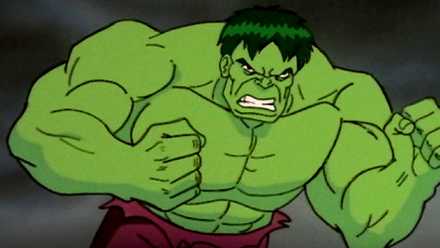
The challenge has become even more apparent in recent years as the Hulk's role within the MCU timeline has evolved significantly from his comic book counterpart. While there have been plenty of entertaining interpretations over the years, one adaptation managed to capture virtually every aspect of the character. Released in 1996, The Incredible Hulk: The Animated Series remains the gold standard for Hulk adaptations.
The Incredible Hulk Animated Series Is The Greatest Hulk Adaptation Ever
The Incredible Hulk: The Animated Series is so remarkable because it completely understands the source material. The series embraces every major element that has defined Hulk comics for decades, creating a version of the character that feels lifted directly from the page.
The Incredible Hulk perfectly balances Bruce Banner's life as a fugitive with the superhero action expected from a Marvel series. General Ross relentlessly pursues Banner, creating constant tension and reinforcing the character's sense of isolation. At the same time, viewers are treated to battles against iconic villains and appearances from numerous Marvel heroes, ensuring the series never feels overly bleak.
More importantly, The Incredible Hulk explores the psychological dimensions of the Hulk. Rather than portraying Banner's transformations as a simple superpower, it presents them as manifestations of deeper emotional struggles. The series frequently examines Banner's fears, frustrations, and internal conflicts, giving the story a level of emotional depth rarely seen in children's animation during the 1990s.
Like many entries in Marvel's celebrated 1990s animated universe, the show trusted younger audiences to engage with surprisingly mature themes. Beneath the action scenes and gamma-powered chaos was a thoughtful character study about a man constantly battling himself. That's what made it feel so authentically Hulk.
The Marvel Cinematic Universe Should Learn From The Incredible Hulk Animated Series
The MCU deserves credit for making Hulk a beloved part of the franchise, but it has often sidestepped some of the character's most compelling themes. While Mark Ruffalo's portrayal has delivered plenty of memorable moments, many of the deeper psychological elements that define Hulk comics have been largely absent.
The Incredible Hulk: The Animated Series demonstrated that these ideas can be explored while remaining accessible to younger audiences. The show never sacrificed entertainment value, yet it still tackled Bruce Banner's fractured psyche with surprising sophistication. It understood that Hulk stories work best when the monster and the man are equally important.
 Related
The Incredible Hulk animated series laid essential groundwork for the MCU’s version of Bruce Banner, which allowed it to quickly evolve him.
Perhaps most importantly, the series embraced the concept of multiple Hulk personas. Long before many casual audiences became familiar with the idea, the show explored the existence of different Hulk alters and the psychological complexity they represented. This approach reflected decades of comic book storytelling and added layers to Banner's ongoing struggle.
As the MCU continues developing Hulk's future, revisiting this animated classic would be a smart place to start. The Incredible Hulk: TAS proved that audiences can enjoy giant monster fights and thoughtful psychological storytelling at the same time. After all, the Hulk is at his best when he is both a superhero and a deeply human tragedy wrapped inside seven feet of green muscle.
Release Date
1996 - 1998-00-00
Network
UPN
Directors
Ernesto Lopez, Tom Tataranowicz, Richard Trueblood, Dick Sebast
Writers
Bob Forward, Meg McLaughlin, John Semper Jr., Douglas Sloan, Len Wein, Steve Granat, Greg Johnson
-

Lou Ferrigno
Jennifer Walters / She-Hulk (voice)
-








 English (US) ·